If you are reading this, chances are you are standing at the edge of an exciting venture. Maybe you have just bought a sleek, single-car trailer. Perhaps you are a classic car enthusiast looking to turn a passion into profit, or a startup entrepreneur ready to hit the road and deliver vehicles for a living.
Then, the reality check hits. You start looking into business expenses, and you see it: the insurance premium. Suddenly, the question “What is the 1 car hauler insurance cost?” becomes the most pressing number in your business plan.
Let’s be honest—insurance isn’t the fun part of the job. You don’t get to brag about it at car shows. But without it, you cannot legally move one inch down the highway. The cost of insuring a single-car hauler is a moving target. It depends on who you are, where you live, and how you operate.
This guide is designed to pull back the curtain. We aren’t here to give you a single magic number (because that number doesn’t exist). Instead, we are here to give you the roadmap. By the end of this article, you will understand exactly what goes into that premium and, more importantly, how to get the best rate for your specific situation.
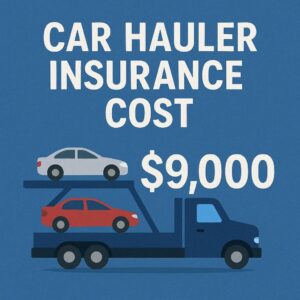
1 Car Hauler Insurance Cost
More Than Just a Trailer: Defining the “1 Car Hauler”
Before we talk about price, we need to make sure we are talking about the same thing. When we say “1 car hauler,” we usually mean a rig that consists of two main parts:
-
The Truck: The vehicle doing the pulling. This could be a heavy-duty pickup truck like a Ford F-350 or a Ram 3500. It could also be a medium-duty truck.
-
The Trailer: The equipment carrying the car. This is typically a flatbed or an enclosed trailer designed to hold a single vehicle.
Insuring this combination is not like insuring your family sedan. You aren’t just covering the metal; you are covering a business operation, a liability risk, and often, someone else’s prized possession.
The Big Question: How Much Does 1 Car Hauler Insurance Cost?
Let’s get down to brass tacks. While every quote is unique, we can talk in realistic ranges. For a legitimate, insured small business owner operating a single-car hauler, you should expect to pay somewhere between $3,000 and $8,000 per year.
However, this is a broad stroke. In reality, the cost can dip lower or skyrocket depending on the factors we are about to explore.
-
The Low End ($1,500 – $3,000/year): This usually applies to “owner-operators” with squeaky-clean driving records who are hauling non-commercially (like for their own classic cars) or who have very low mileage limits. It also applies if the truck is already covered under a personal policy and you only need “trailer interchange” or minimal coverage.
-
The Mid-Range ($3,500 – $6,000/year): This is the sweet spot for most active, part-time to full-time haulers. This assumes you are hauling other people’s cars for a fee, have good experience, and have solid safety measures in place.
-
The High End ($7,000 – $12,000+/year): This territory is for new drivers with no prior hauling experience, drivers with recent accidents or tickets, those hauling high-value exotic cars, or operators in states with notoriously high insurance minimums.
A Quick Reality Check: If you call an insurance company and they quote you $1,200 a year to haul other people’s cars full-time, be very, very careful. You are likely being under-quoted on a commercial policy, which means you might not be covered when you need it most.
Why the Price Varies So Much: The Factors That Drive Your Premium
Insurance companies aren’t just pulling numbers out of a hat. They are using complex math to determine how much of a risk you are. Here are the biggest levers that move your premium up or down.
1. Operating Radius: Are You Local or Long-Haul?
This is one of the first questions an agent will ask.
-
Local (50-100 miles): Lower risk, lower premium. You are staying close to home, familiar with the roads.
-
Regional (Up to 500 miles): Moderate risk. You might cross state lines but stay within a few states.
-
Long-Haul (National): Higher risk. More miles mean more exposure to accidents, theft, and varying weather conditions. Expect to pay significantly more.
2. The Value of the Cargo (The Cars You Haul)
This is arguably the biggest factor for your “Cargo Insurance” or “Motor Truck Cargo” coverage.
-
Hauling a $5,000 project car: Your cargo coverage will be relatively cheap.
-
Hauling a $150,000 Porsche or a one-of-a-kind classic: The insurance company is taking on a massive potential payout. Your premium will reflect that risk.
3. Your Experience and Driving Record
Insurance companies love stability.
-
Clean Record: If you have a spotless driving history for the last 5-10 years, you are rewarded with lower rates.
-
Accidents and Tickets: Speeding tickets, especially in a commercial vehicle, are red flags. At-fault accidents will significantly increase your cost.
-
Industry Experience: Have you been hauling cars for 10 years? Or are you brand new? Experience equals lower risk in the eyes of the underwriter.
4. The Type of Trailer
The equipment itself matters.
-
Open Trailer: These are lighter, have less wind resistance, and are generally cheaper to insure. They are also less appealing to thieves.
-
Enclosed Trailer: These are more expensive to replace if stolen or damaged in an accident. They also act as a “rolling billboard” for your business, which can increase liability. Insuring an enclosed trailer costs more.
5. Coverage Limits and Deductibles
Insurance is a trade-off.
-
Liability Limits: You will need to meet your state’s minimums, but most professionals carry $1 million in combined single limits. Higher limits cost more.
-
Deductibles: Choosing a higher deductible (the amount you pay out of pocket before insurance kicks in) will lower your annual premium. Just make sure you can actually afford the deductible if something happens.
6. The Value of Your Truck
Your truck is a business asset. If it gets totaled, you need to be able to replace it. Comprehensive and collision coverage on your truck itself adds to the total cost, especially if it is a brand-new, high-end pickup.
Breaking Down the Insurance Policy: What Are You Actually Buying?
You aren’t buying one thing; you are buying a package of protections. Understanding this package helps you see where your money is going.
Here is a simple breakdown of the typical coverages in a car hauler policy:
| Coverage Type | What It Does | Why It Matters |
|---|---|---|
| Primary Liability | Covers damage you cause to other people’s property or injuries you cause to others in an accident. | This is legally required in almost every state. Without it, you cannot drive. |
| Motor Truck Cargo | Covers the vehicle you are hauling if it is damaged in an accident, stolen, or damaged by fire while on your trailer. | This is the heart of your business. If you scratch a Ferrari, this pays for it. |
| Physical Damage | Covers damage to your own truck and trailer (from collision, theft, fire, vandalism). | Protects your business assets. If your truck is in the shop, you aren’t making money. |
| General Liability | Covers incidents that aren’t related to driving. For example, if a client slips and falls in your shop or if you damage their garage while loading. | Provides a safety net for the non-driving parts of your business. |
| Uninsured/Underinsured Motorist | Covers your injuries and damage if you are hit by a driver who has no insurance. | Essential protection against the many uninsured drivers on the road. |
Important Note for Readers: Never assume you are covered. If you have a personal auto policy and you start hauling cars for money, your personal insurer will likely deny any claim. You must have commercial insurance.
How to Get the Best Rate: A Step-by-Step Guide
Shopping for insurance can feel like a chore, but doing it right can save you thousands of dollars. Here is how to approach it.
Step 1: Gather Your Information
Before you call anyone, have these details ready:
-
Your driver’s license number and history.
-
The VINs for your truck and trailer.
-
The estimated annual mileage and operating radius.
-
The average value of the cars you plan to haul.
Step 2: Talk to the Right People
Don’t waste time with a generalist agent who sells health and home insurance. You need a specialist.
-
Look for agencies that advertise “Commercial Trucking Insurance” or “Auto Hauler Insurance.”
-
Get multiple quotes. Aim for at least three different quotes from reputable companies.
Step 3: Ask the Right Questions
When you get a quote, don’t just look at the price. Ask:
-
“Is this an ‘occurrence’ form or a ‘claims-made’ form for the cargo coverage?” (Occurrence is generally better).
-
“Are there any mileage restrictions?”
-
“How is the value of the cargo determined in a total loss?” (Actual Cash Value vs. Stated Value).
Step 4: Consider Joining an Association
Sometimes, the best rates come from being part of a group. Organizations like the National Independent Automobile Dealers Association (NIADA) or state-specific towing and recovery associations often have deals with insurers for their members. The membership fee can pay for itself in insurance savings.
Frequently Asked Questions (FAQ)
Q: Can I insure my single-car hauler under my regular personal auto policy if I only haul my own cars?
A: Possibly, but you need to read the fine print. Many personal policies exclude business use but may cover a personal trailer for liability. However, they almost never cover the cargo (the car on the trailer) for its full value. If you are hauling a valuable classic of your own, you may need a separate inland marine or classic car policy to cover it while in transit.
Q: Do I need a special license to drive a single-car hauler?
A: In most cases, if you are driving a heavy-duty pickup truck and trailer for personal use, a standard driver’s license is fine. However, if you cross into commercial use and your combined vehicle weight rating (GVWR) exceeds 26,000 pounds, you may need a Commercial Driver’s License (CDL). Rules vary by state, so check with your local DMV.
Q: What is the difference between “Terminal Liability” and “Trailer Interchange”?
A: This is a common point of confusion. Terminal Liability covers damage to a customer’s car that happens while it is parked at your location (e.g., someone hits it in your lot). Trailer Interchange covers damage to a trailer you are borrowing or a customer’s trailer you are towing. If you own your own trailer, you don’t need Trailer Interchange, but you do need Physical Damage coverage for your own trailer.
Q: My insurance is due tomorrow and the quote seems high. Can I just get a cheap policy online now and switch later?
A: You can, but be extremely cautious. “Cheap” in the hauling world often means “thin.” You might get a policy that excludes certain types of accidents or has very low cargo limits. If you have a claim, you might find out the hard way that you weren’t fully covered. It’s better to take the time to get it right.
Conclusion
Understanding 1 car hauler insurance cost is about understanding risk. Your premium is a reflection of your experience, the value of the cars you protect, and how far you roam. While the annual cost may seem like a significant investment, it is the very thing that protects your livelihood. By shopping smart, asking the right questions, and prioritizing safety, you can find a policy that offers both protection and peace of mind without breaking the bank.
Additional Resource
For the latest industry standards, safety regulations, and advocacy for vehicle transporters, visit the National Auto Transporters Association (NATA) website. They offer great resources for independent haulers.