The insurance industry, often perceived as traditional and paper-heavy, is undergoing a quiet but profound digital revolution. At the forefront of this change is Augmented Reality (AR)—a technology that superimposes digital information onto the real world through a smartphone, tablet, or smart glasses. For the claims process, a historically stressful and cumbersome experience, AR is not just an innovation; it’s a powerful tool for creating transparency, efficiency, and trust. This guide delves deep into the practical advantages of using augmented reality in insurance claims, offering a realistic look at how it’s setting a new standard for the entire industry.
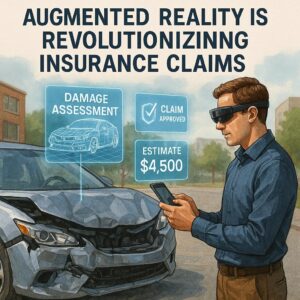
Augmented Reality is Revolutionizing Insurance Claims
Understanding Augmented Reality in the Insurance Context
Before we explore its benefits, let’s clarify what we mean by AR in insurance. Unlike Virtual Reality (VR), which creates a completely immersive digital environment, AR enhances the physical world. Imagine a claims adjuster pointing their tablet at a hail-damaged car roof. Through the screen, they see the real car, but overlaid on it are digital markers highlighting each dent, measurements automatically calculated, and a preliminary repair estimate generated in real time. That’s AR in action. It’s a bridge between the physical damage and the digital claim file, making the invisible visible and the complex simple.
The Core Advantages of Augmented Reality for Insurance Claims
The integration of AR into the claims workflow offers tangible benefits for every stakeholder: the policyholder, the adjuster, and the insurance company itself.
1. Unprecedented Speed and Efficiency in Claims Processing
The traditional claims process can be slow, often dependent on scheduling in-person inspections that may take days or weeks. AR fundamentally accelerates this timeline.
-
Immediate Virtual Inspections: Policyholders can use their smartphone app to initiate a claim and be guided through an AR-powered inspection instantly. They’re prompted to scan the damaged area, with the AR interface ensuring they capture all necessary angles and data. This eliminates the waiting period for an adjuster’s visit.
-
Streamlined Workflow for Adjusters: For adjusters, AR acts as a powerful assistant. They can conduct detailed inspections remotely or use AR on-site to automatically document measurements, identify parts, and pull up historical data or policy details hands-free. What used to be a multi-step process of notes, photos, and manual data entry becomes a single, fluid action.
Industry Expert Insight: “AR is compressing the claims lifecycle from weeks to hours in many cases. It’s the most significant lever we have for operational efficiency while simultaneously improving data quality,” says Michael Chen, a technology consultant for P&C insurers.
2. Enhanced Accuracy, Transparency, and Reduced Fraud
Human error and subjective assessment are inherent challenges in claims. AR introduces a new level of objective precision.
-
Precision Measurement and Documentation: AR apps can use LiDAR (in modern devices) or photogrammetry to create precise 3D models and measurements of damage. This eliminates guesswork in estimating repair areas or the size of a water-damaged room.
-
Immutable Digital Record: The AR session creates a rich, digital record—a video or a 3D model—that becomes part of the claim file. This provides complete transparency for all parties and creates a much stronger evidence base than static photographs.
-
Fraud Deterrence: The detailed, spatially-aware data from an AR inspection makes it harder to exaggerate claims. Inconsistent lighting, scale, or damage that doesn’t align spatially can be more easily flagged, protecting insurers and keeping premiums lower for honest customers.
3. Significant Cost Reduction and Operational Savings
The efficiencies gained directly translate to a healthier bottom line.
-
Drastically Lower Travel Costs: The ability to handle a large percentage of claims through remote AR inspections saves thousands of miles in travel, associated costs, and adjuster time.
-
Reduced Cycle Time = Lower Loss Adjustment Expense (LAE): Faster settlements mean less administrative overhead per claim. Resources can be reallocated to more complex cases that truly require expert human attention.
-
Minimized Errors and Re-inspections: Accurate first-time assessments prevent costly supplement requests from repair shops and eliminate the need for re-inspections.
Traditional vs. AR-Powered Claim Inspection
| Aspect | Traditional Inspection | AR-Powered Inspection |
|---|---|---|
| Time to Inspect | Days to schedule and complete | Minutes to hours, often immediately |
| Data Collected | 2D photos, manual notes, measurements | 3D spatial model, auto-measurements, guided video |
| Adjuster Travel | Almost always required | Often eliminated for simple/moderate claims |
| Claim File Transparency | Moderate (dependent on notes) | High (immersive, interactive record) |
| Potential for Error | Higher (subjective, manual) | Lower (objective, data-driven) |
4. Elevated Customer Experience and Satisfaction
A claim is a moment of truth for any insurer. AR turns a traditionally frustrating experience into a modern, engaging, and empowering one.
-
Convenience and Control: Policyholders can start the process on their own schedule, without waiting. This gives them a sense of control during a disruptive event.
-
Clarity and Communication: With AR, adjusters can use annotation tools to literally draw on the live video feed to explain what they’re seeing. They can place virtual markers to point out specific damage. This clear communication builds trust.
-
Faster Payouts: The direct result of a faster process is a faster settlement and repair initiation, which is the ultimate metric for customer satisfaction after a loss.
5. Empowering Field Adjusters and Remote Experts
AR doesn’t replace adjusters; it makes them more capable and extends their reach.
-
Remote Expert Collaboration: A field adjuster facing a complex case (e.g., specialized machinery damage) can live-stream their AR view to a senior adjuster or engineer at headquarters. The remote expert can see exactly what the field adjuster sees and annotate the scene in real-time to guide the inspection.
-
Hands-Free Information Access: With smart glasses, adjusters can view policy details, codes, and manuals in their field of view while keeping their hands free to inspect, improving both safety and efficiency.
Important Note for Readers: While AR is powerful, it is not a universal solution for every claim. Complex total losses, severe structural damage, or claims involving intricate liability investigations will still require thorough, in-person professional assessment. AR is best viewed as a transformative tool for high-frequency, lower-severity claims.
Implementing AR in Your Claims Process: A Realistic View
Adopting AR technology requires thoughtful planning. It involves selecting the right software platform (often integrated with existing core claims systems), ensuring robust data security and privacy for the visual data collected, and providing training for both staff and customers. The focus should be on seamless integration, not just flashy technology.
The Future is Augmented: What’s Next?
The evolution is already underway. We are moving towards:
-
AI-Powered AR: Where the AR system doesn’t just document, but automatically identifies and categorizes damage (e.g., “hail dent, size 2cm”).
-
Preventive Applications: Using AR for pre-risk inspections, where agents or customers can scan a property to identify risks and recommend mitigations before a claim ever happens.
-
Seamless Repair Integration: The 3D model from the claim could be sent directly to a repair shop’s system to prefabricate parts or plan the repair workflow.
Conclusion
Augmented reality is fundamentally reshaping the insurance claims landscape by injecting speed, accuracy, and transparency into a core process. It delivers a powerful advantage by reducing operational costs for insurers while simultaneously creating a more convenient and satisfying experience for policyholders. As the technology matures and integrates with AI, AR is poised to move from a cutting-edge tool to a standard, essential component of a modern, efficient, and customer-centric claims operation.
Frequently Asked Questions (FAQ)
Q: Is my privacy at risk if I use an AR app for a claim?
A: Reputable insurance companies use secure, encrypted platforms specifically designed for this purpose. The visual data is typically stored directly within your claim file with the same protections as your other personal information. Always ask your insurer about their data security and privacy policy for AR inspections.
Q: As a policyholder, am I required to use an AR tool for inspection?
A: In most cases, it is offered as a convenient option, not a requirement. You should always have the choice for a traditional in-person inspection. However, opting for the AR inspection will likely lead to a much faster resolution of your claim.
Q: What kind of claims are best suited for AR?
A: AR is exceptionally effective for assessing surface-level damage to vehicles (hail, scratches, dents), property claims like roof damage, water damage in rooms, and documenting personal property items for content claims. It is less suited for complex structural failures or catastrophic losses.
Q: Do I need special equipment to participate in an AR claim?
A: In almost all consumer-facing applications, the only equipment needed is a modern smartphone (iOS or Android) with a good camera. The insurance company’s app provides all the AR functionality.