For coaches, team administrators, and parents, forming or joining a travel baseball team is an exciting venture focused on skill development and competition. However, beneath the line drives and double plays lies a critical, less-glamorous component: securing the right insurance. Understanding travel baseball team insurance cost is not just about budgeting; it’s about ensuring the safety and sustainability of your program. This guide will provide a clear, realistic breakdown of what you can expect to pay and the factors that influence every dollar.
Travel Baseball Team Insurance Cost
What is Travel Baseball Team Insurance and Why is it Non-Negotiable?
Unlike recreational league play, which is often covered under a municipal or national association’s blanket policy, travel teams operate as independent entities. This independence brings greater flexibility but also sole responsibility for risk management. Travel baseball insurance is a specialized package designed to protect your players, coaches, volunteers, and the organization itself from financial losses arising from accidents, injuries, and lawsuits.
“View insurance not as an expense, but as the foundational investment in your team’s future. It’s the safety net that allows players to compete with confidence and organizers to sleep at night.” – A veteran travel ball commissioner.
Consider this scenario: a player suffers a serious arm injury during a weekend tournament, requiring surgery and extensive rehabilitation. Without proper insurance, the family’s medical costs could be catastrophic, and the team could be held liable. The right policy intervenes here, covering medical bills and protecting the team’s assets from a liability lawsuit.
The Core Components of a Standard Policy
Most comprehensive packages include three key pillars:
-
General Liability Insurance: This is your first line of defense. It covers claims of bodily injury or property damage caused by your team’s activities. Example: A foul ball hits a spectator, or a player damages a facility’s lighting system during warm-ups.
-
Accident Medical Insurance: This helps cover out-of-pocket medical expenses (like deductibles and co-pays) for injured players, up to the policy’s limits. It acts as a secondary payer after a family’s primary health insurance.
-
Directors & Officers (D&O) Liability Insurance: This protects your board members and officers from personal financial loss if they are sued for decisions made while managing the team (e.g., allegations of mismanagement of funds, wrongful suspension of a player).
Breaking Down the Cost: What Factors Influence Your Premium?
The travel baseball team insurance cost is not a one-size-fits-all number. It’s calculated based on a risk assessment by insurers. Key variables include:
-
Number of Participants: This is the primary driver. Costs are typically calculated “per player” or “per team.”
-
Age Range of Players: Teams with older, stronger players (e.g., 16U-18U) may face slightly higher rates due to the perceived increase in injury severity.
-
Coverage Limits: Higher limits mean higher premiums. A $2 million aggregate liability limit will cost more than a $1 million limit.
-
Deductible Amounts: Choosing a higher deductible for medical coverage can lower your annual premium.
-
Team History: A team with multiple past claims may pay more.
-
Geography: Costs can vary slightly by state due to local regulations and claim histories.
-
Additional Coverages: Adding items like crime insurance, equipment coverage, or non-owned auto liability will increase the cost.
Realistic Cost Estimates
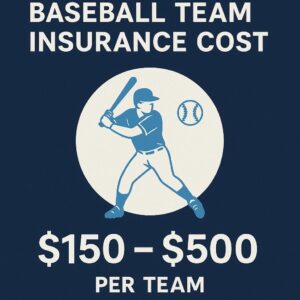
To give you a concrete starting point, here is a comparative table based on market research for a typical team of 12-15 players. These are annual estimated premium ranges.
| Coverage Type | Lower End (Basic) | Mid-Range (Common) | Higher End (Comprehensive) | What’s Included |
|---|---|---|---|---|
| General Liability | $300 – $500 | $500 – $800 | $800 – $1,200+ | Covers third-party injury/property damage. Limits usually $1M-$2M per occurrence. |
| Accident Medical | $150 – $250 | $250 – $400 | $400 – $600+ | Secondary medical coverage. Deductibles affect cost. Common limit: $25,000 per injury. |
| D&O Liability | $200 – $350 | $350 – $550 | $550 – $800+ | Protects board members. Often bundled. |
| Total Estimated Annual Cost | $650 – $1,100 | $1,100 – $1,750 | $1,750 – $2,600+ | Varies significantly based on factors listed above. |
Note: These are illustrative estimates. You must get direct quotes from reputable providers for an accurate price. Many providers offer convenient online quote tools.
Helpful List: What You Need to Get a Quote
-
Team name, location, and organizational structure (LLC, nonprofit, etc.)
-
Estimated number of players, coaches, and volunteers
-
Age range of participants
-
Expected schedule (number of events, tournaments)
-
Desired coverage limits and deductibles
Strategies to Manage and Optimize Your Insurance Costs
While insurance is essential, there are smart ways to ensure you’re not overpaying.
-
Bundle Coverages: Purchasing a packaged policy from a single insurer is almost always cheaper than buying each component separately.
-
Shop Around and Compare: Get quotes from at least three specialized sports insurance providers. Don’t just look at price; compare coverage details and exclusions.
-
Consider Affiliation: Some travel baseball associations or conferences offer group insurance plans to member teams at a discounted rate. The joining fee may be worth the insurance savings.
-
Raise Your Deductible Responsibly: Opting for a higher medical deductible (e.g., $1,000 instead of $250) can lower your premium. Ensure your families understand this is for secondary coverage.
-
Implement a Strong Risk Management Program: Insurers favor proactive teams. Create safety protocols, require background checks for all adults, maintain equipment, and document all incidents. This can prevent claims and may help your reputation with insurers over time.
A Crucial Step: The Annual Policy Review
Your insurance needs will evolve. Conduct an annual review with your agent or board before your policy renews. Ask:
-
Has our player count changed?
-
Are we traveling to more high-risk tournaments?
-
Do we own more equipment that needs separate coverage?
-
Are our coverage limits still adequate given today’s litigation environment?
Beyond the Premium: Hidden Costs and Considerations
The premium is just the beginning. To avoid surprise expenses, factor in these often-overlooked elements:
-
Tournament-Required Coverage: Some elite tournaments require specific, higher liability limits or name them as an “Additional Insured.” Fulfilling this may incur a small administrative fee per certificate ($25-$50 each).
-
Fundraising for Insurance: Many teams bake the insurance cost into their annual player fees. Others host a dedicated fundraiser. Be transparent with parents about what this fee covers.
-
The Cost of Being Uninsured or Underinsured: This is the greatest hidden cost. One major, uncovered incident could lead to thousands in legal fees, medical bills, and out-of-pocket settlements, potentially bankrupting the organization and its leaders.
Conclusion
Navigating travel baseball team insurance cost is a fundamental duty of team leadership. By understanding the components of a policy, the factors that shape its price, and the strategies to secure the right coverage, you protect more than just finances—you protect the dreams, health, and community your team represents. Invest the time to get it right, and play ball with peace of mind.
FAQ
Q: Can we just rely on the tournament’s insurance?
A: Rarely. Tournament insurance typically covers the event organizer for their liability, not your individual team’s actions. You are almost always required to carry your own team policy.
Q: Does the team insurance cover us during practice?
A: Yes, a comprehensive team policy should cover all sanctioned team activities, including practices, games, and team-related travel.
Q: What if a player doesn’t have primary health insurance?
A: The team’s accident medical policy would then act as primary coverage, but only up to its limits. It is strongly advisable to require all players to have personal health insurance as a condition of participation.
Q: Are fundraised money and team funds protected under a standard policy?
A: Not automatically. You may need to add a “Crime” or “Fidelity” endorsement to protect against theft or embezzlement of team funds.
Additional Resource
For a deeper dive into risk management and sample safety forms, visit the non-profit resource center at the National Council of Youth Sports (NCYS).