There’s nothing quite like the feeling of driving with the top down, the sun on your shoulders, and the open road ahead. It’s the dream that sells every convertible. But when the dream meets reality—specifically, the reality of your insurance renewal—you might be left with a less sunny question: do convertibles cost more to insure?
The short answer is often “yes,” but the real story is far more nuanced. The cost to insure any vehicle, convertible or not, is a complex calculation based on risk. Insurers analyze mountains of data to predict the likelihood of having to pay out a claim. With convertibles, several unique factors come into play, pushing the average premium higher than that of a similar hard-top car.
However, labeling all convertibles as “expensive to insure” is an oversimplification. A cautious driver in a safe, modestly-powered Volvo C70 will have a very different insurance profile than someone behind the wheel of a Chevrolet Corvette Z06 convertible. This guide will peel back the layers, giving you a comprehensive, realistic look at what determines your premium and, most importantly, how you can manage it.
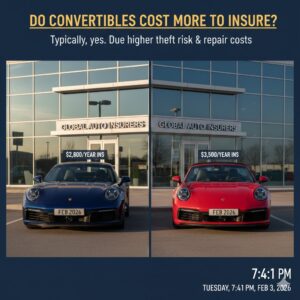
Wondering if convertibles cost more to insure?
Why Insurers View Convertibles Differently
Insurance is, at its core, a business of risk assessment. Actuaries calculate premiums based on the statistical probability of a claim. Convertibles, as a category, often trigger specific risk flags in these models. Understanding this perspective is key to understanding your quote.
The Core Factors That Drive Up Costs
Several inherent characteristics of most convertibles contribute to their higher insurance risk profile.
1. Increased Risk of Theft and Vandalism: Convertibles are often seen as attractive targets. The very feature that defines them—the soft top or retractable hardtop—is a vulnerability. A simple knife can slash a fabric roof, providing easy access for thieves. Furthermore, convertibles are frequently marketed as luxury or performance vehicles, making them and their contents more desirable to steal. Even minor vandalism to the top can lead to costly repairs.
2. Higher Repair Costs: Convertible technology is complex and expensive. Repairing or replacing a powered roof mechanism, whether soft top or hardtop, requires specialized labor and parts. A simple fender-bender that might only damage body panels on a sedan could also impact the roof mechanism in a convertible, exponentially increasing the repair bill. These higher potential costs are directly factored into collision and comprehensive coverage premiums.
3. Perceived Safety Concerns: While modern convertibles are engineered with incredible safety features like reinforced A-pillars, pop-up roll bars, and advanced airbag systems, the perception of reduced safety persists. The lack of a fixed metal roof leads to concerns about rollover protection. Insurers consider the potential for more severe injuries in certain types of accidents, which can influence the medical payments or personal injury protection portions of a premium.
4. Performance Profile: Let’s be honest—many drivers choose convertibles for the sporty, performance-oriented driving experience. Models like the Porsche 911 Cabriolet or BMW M4 Convertible are powerful machines. Insurers have clear data showing a correlation between high horsepower and a higher frequency of claims. The “sports car” association, justified or not, places many convertibles in a higher-risk category.
Comparative Insurance Risk Table: Convertible vs. Hardtop
| Risk Factor | Typical Convertible | Typical Sedan/Coupe Hardtop | Impact on Insurance Premium |
|---|---|---|---|
| Theft/Vandalism | High (vulnerable soft top, desirable image) | Moderate to Low | Increases Comprehensive Premium |
| Repair Complexity | Very High (roof mechanisms, specialized parts) | Moderate | Increases Collision Premium |
| Safety Perception | Moderate to High (rollover concerns) | Low (enclosed cabin) | Can increase Liability/Medical Premiums |
| Driver Profile | Often associated with sporty/recreational use | Associated with practical/commuter use | Can lead to a general rating surcharge |
| Vehicle Value | Often higher MSRP for comparable models | Varies | Higher value = higher cost to repair/replace |
Key Variables That Determine Your Premium
While the general risk profile exists, your individual insurance quote is personalized. These variables mean that the “convertible premium” can range from minor to significant.
Vehicle Make, Model, and Trim: This is the most significant factor. Insurers have specific data on claims for every vehicle.
-
High-Risk Example: A high-performance convertible like a Ford Mustang GT Convertible or a luxury icon like an Aston Martin Volante will command very high premiums due to power, cost, and theft rates.
-
Lower-Risk Example: A Mazda MX-5 Miata or a Mini Cooper Convertible often enjoys relatively reasonable rates. They are less powerful, extremely common (making parts cheaper), and have excellent safety records for their class.
Your Driving Record and History: This trumps almost everything. A spotless record in a Corvette will likely cost less than a driver with a recent at-fault accident in a Honda Civic. Insurers reward proven low-risk behavior.
Your Location: Where you garage your car dramatically affects your rate. Urban areas with higher traffic density, crime rates, and vandalism will lead to higher premiums. A convertible kept in a suburban garage will cost less to insure than one parked on a busy city street.
Your Age and Demographics: Statistical realities impact pricing. Younger drivers, especially males under 25, pay the highest rates due to crash statistics. As drivers mature, rates typically decrease.
Annual Mileage and Usage: Insuring a convertible you drive 3,000 miles per summer is far less risky than insuring one you commute in daily. Low annual mileage generally qualifies for a discount.
Credit-Based Insurance Score (in most states): In many regions, insurers use a credit-based insurance score as a statistically correlated factor for predicting risk. Maintaining good credit can positively affect your rate.
“Don’t assume your convertible will break the insurance bank. A responsible driver in a sensible model might be pleasantly surprised. Always get personalized quotes—the blanket assumptions are often wrong.” — Michael Anderson, Veteran Insurance Agent.
Actionable Strategies to Lower Your Convertible Insurance Costs
You don’t have to accept a sky-high premium as the cost of open-air motoring. Here are proven tactics to reduce your rates.
1. Shop Around and Compare Quotes Diligently: This cannot be overstated. Different insurers weigh convertible risk differently. Get quotes from at least three to five companies. Don’t just look at national carriers; check with regional insurers or those specializing in auto policies.
2. Leverage Every Possible Discount:
-
Bundling: Combine your auto policy with homeowners or renters insurance.
-
Safe Driver Discounts: Maintain a clean record.
-
Pay-in-Full Discount: Pay your annual premium upfront instead of monthly.
-
Anti-Theft Devices: If your car has an alarm, tracking system (like LoJack), or an immobilizer, make sure your insurer knows.
-
Defensive Driving Course: Completing an accredited course can often net you a discount.
-
Low Mileage Discount: If you drive less than the average driver, ask about this.
-
Professional/Association Discounts: Members of certain alumni groups, professional organizations, or employers may have partner discounts.
3. Optimize Your Coverage Wisely:
-
Consider a Higher Deductible: Opting for a higher deductible on your comprehensive and collision coverage (e.g., $1,000 instead of $500) can lower your premium. Just ensure you have that amount saved for an emergency.
-
Reassess Your Coverage on Older Models: If your convertible is older and has depreciated significantly, evaluate whether carrying collision/comprehensive coverage still makes financial sense. Compare the annual cost plus the deductible to the car’s actual cash value.
4. Demonstrate Low-Risk Behavior:
-
Usage-Based Programs: Consider programs like Progressive’s Snapshot or Allstate’s Drivewise. If you’re a safe, low-mileage driver, these telematics devices can prove it and earn you a substantial discount.
-
Garage Your Car: Always list your primary parking location as a private, locked garage. This significantly reduces theft and vandalism risk.
5. Choose the Right Car Before You Buy: If you’re in the market, do your insurance homework before purchasing. Call your insurer with the VINs of a few models you’re considering to get estimated rates. This can save you from an unpleasant shock later.
Helpful Pre-Purchase Checklist
Before signing on the dotted line for a convertible, ask these questions:
-
Have I obtained insurance quotes for this specific make, model, and year?
-
What is the vehicle’s safety rating from IIHS and NHTSA?
-
What is the historical cost of repairing the roof mechanism?
-
Does it have factory-installed anti-theft features?
-
Is it a model known for high theft rates (check the NICB Hot Wheels list)?
Important Note for Readers: The most common mistake convertible owners make is failing to shop their coverage annually. Loyalty is not always rewarded in insurance. An annual review of your policy and comparison of quotes is the single best habit for ensuring you’re not overpaying.
Beyond the Premium: Specialized Coverage Considerations
Owning a convertible isn’t just about the base price. Consider these coverage aspects unique to your car.
Gap Insurance: If you finance or lease a new convertible, strong gap insurance is crucial. Convertibles can depreciate quickly in their first few years. If your car is totaled, your standard insurance pays the actual cash value, which may be thousands less than your loan balance. Gap coverage pays that “gap,” protecting you from major financial loss.
OEM Parts Endorsement: After an accident, insurers often authorize the use of cheaper aftermarket or recycled parts for repairs. For a convertible’s complex parts, this can be a concern. An “OEM (Original Equipment Manufacturer) Parts” endorsement guarantees that only new, manufacturer-made parts will be used. It increases your premium but ensures repair quality.
Agreed Value Coverage (for Classics): If you own a classic or vintage convertible, standard insurance is inadequate. Classic car insurers offer “Agreed Value” coverage. You and the insurer agree on the car’s value upfront (often based on an appraisal), and that is the amount paid in a total loss, with no depreciation deduction.
Conclusion
So, do convertibles cost more to insure? Often, but not universally. The premium is a product of the vehicle’s specific risk profile combined intimately with your own as a driver. By understanding the factors insurers care about—from repair costs and theft statistics to your personal driving history and garaging situation—you can make informed decisions. The key to affordable convertible insurance lies in proactive shopping, leveraging discounts, and choosing the right vehicle for your budget. With the right approach, you can focus less on the cost of coverage and more on the joy of the drive.
Frequently Asked Questions (FAQ)
Q: Is the insurance difference between a convertible and a hardtop of the same model significant?
A: It can be. For example, insuring a BMW 4 Series Convertible will typically cost 10-20% more per year than insuring a BMW 4 Series Coupe. The exact difference depends on the model and insurer.
Q: Does a retractable hardtop (like on a Porsche 911 Targa or BMW) cost less to insure than a soft top?
A: Often, yes. Retractable hardtops are generally more resistant to vandalism and may be viewed as slightly safer, potentially lowering comprehensive coverage costs. However, their repair complexity can be even higher, which may offset some savings.
Q: I only drive my convertible in the summer. Can I suspend coverage?
A: You should never fully suspend your state-required liability insurance. However, if you store the car for months (e.g., winter), you can call your insurer to reduce coverage, typically removing collision and comprehensive while it’s in a secure garage. This can lead to significant savings.
Q: Are two-seater convertibles more expensive to insure than four-seaters?
A: Typically, yes. Two-seaters are overwhelmingly classified as sports cars, carrying that higher-risk profile. Four-seat convertibles (like an Audi A5 Cabriolet) may be rated slightly more favorably as “luxury cars.”
Additional Resources
For further research on vehicle safety ratings, which significantly impact insurance evaluations, visit the Insurance Institute for Highway Safety (IIHS) website at: https://www.iihs.org. Their detailed crash test results, including rollover strength tests for convertibles, are a valuable tool for any car buyer.