If you’ve been told you need an echocardiogram, your first questions are likely about your health—but a very close second is often about the cost. Understanding “how much does an echocardiogram cost with insurance?” can feel like deciphering a complex code. The short answer is: it varies dramatically, but with insurance, your out-of-pocket cost could range from a $30 copay to over $1,000, depending on your plan’s specifics. This comprehensive guide will walk you through every factor that influences the final bill, providing you with the knowledge and strategies to navigate the process confidently and avoid financial surprises.
How Much Does an Echocardiogram Cost with Insurance?
Understanding the Echocardiogram Procedure
Before diving into costs, it’s helpful to understand what you’re paying for. An echocardiogram (often called an “echo”) is a non-invasive, painless ultrasound test that uses sound waves to create detailed moving images of your heart. It allows doctors to assess your heart’s size, structure, and function, including how well the chambers and valves are working.
There are several types of echocardiograms, which is one reason costs can differ:
-
Transthoracic Echocardiogram (TTE): The most common type. A technician places a transducer on your chest.
-
Transesophageal Echocardiogram (TEE): A more invasive procedure where a probe is guided down your esophagus to get closer images of the heart. This is more complex and costly.
-
Stress Echocardiogram: A TTE is performed both before and immediately after you exercise on a treadmill or stationary bike, or after being given medication that stresses the heart.
-
Doppler Echocardiogram: Used to assess blood flow through the heart’s chambers and valves, often part of a standard TTE.
The Core Factors That Determine Your Final Cost with Insurance
Your out-of-pocket expense is not a single, set price. It’s the result of an equation involving multiple variables. Here are the key pieces of the puzzle.
1. Your Insurance Plan Design: Deductible, Copay, and Coinsurance
This is the most significant factor. You need to understand three core terms:
-
Deductible: The amount you pay out-of-pocket for covered services before your insurance starts to pay. If you have a $2,000 deductible, you will likely pay the full negotiated rate for the echo until you meet that amount.
-
Copay: A fixed fee (e.g., $30, $50) you pay for a covered service, like a specialist visit or a diagnostic test. Some plans have copays for imaging after a deductible is met.
-
Coinsurance: Your share of the costs after you’ve met your deductible, expressed as a percentage. For example, if your plan has 20% coinsurance, you pay 20% of the negotiated rate for the echo, and your plan pays 80%.
Example in Action:
“Two patients can have the exact same echocardiogram at the same facility but pay vastly different amounts,” explains a healthcare billing advocate. “The person with a plan that has a $500 deductible and 10% coinsurance will pay a fraction of what someone with a $5,000 deductible and 30% coinsurance will owe, even though the ‘price’ of the test is identical.”
2. The “Negotiated Rate”: The Secret Price Tag
Hospitals and clinics have a “chargemaster” price (the grossly inflated list price). However, your insurance company has a pre-negotiated discount with that provider. The negotiated rate is the actual amount your insurance company has agreed to pay. Your deductible, copay, and coinsurance are all calculated from this lower rate, not the chargemaster price.
3. Where You Have the Procedure Performed
Costs fluctuate significantly based on the setting, due to differing facility fees.
| Facility Type | Typical Cost Range (Before Insurance) | Why the Difference? |
|---|---|---|
| Independent Imaging Center | $500 – $1,500 | Lower overhead costs. Often the most cost-effective choice for a standard echo. |
| Hospital Outpatient Department | $1,000 – $3,000+ | Includes high “facility fees” to cover the hospital’s operational costs. |
| Hospital Inpatient | $2,000 – $5,000+ | Most expensive. For patients already admitted. Costs are bundled into the overall hospital stay. |
4. Your Geographic Location
Healthcare costs vary by state and even by city. Procedures in urban coastal areas (e.g., New York, San Francisco) are typically more expensive than in rural Midwestern regions.
5. The Type and Complexity of the Echocardiogram
A simple TTE will cost less than a more involved Stress Echo or a TEE, which requires sedation and specialist involvement.
A Realistic Cost Breakdown: Scenarios with Insurance
Let’s put this into practice with some hypothetical scenarios. Assume the total negotiated rate between the provider and insurance is $1,200 for a standard TTE at a hospital outpatient department.
Scenario 1: Plan with Low Deductible and Copay
-
Deductible: $250 (already met for the year)
-
Specialist Copay: $40
-
Your Estimated Cost: $40
-
You simply pay your copay at the time of the visit.
Scenario 2: Plan with High Deductible and Coinsurance
-
Deductible: $3,000 ($500 remaining to meet)
-
Coinsurance: 20%
-
Your Estimated Cost: $740
-
Calculation: You first pay the remaining $500 of your deductible. The remaining $700 of the bill ($1,200 – $500) is subject to coinsurance. You pay 20% of $700 = $140. Total out-of-pocket: $500 + $140 = $640.
Scenario 3: Deductible Not Met
-
Deductible: $1,500 ($0 met so far)
-
Coinsurance: 10%
-
Your Estimated Cost: $1,200
-
Calculation: You must pay the full negotiated rate because it is less than your deductible. This $1,200 payment will apply to your deductible for the year.
Important Note: These are estimates. Always verify benefits with your insurance company and a price estimate from the provider.
Your Action Plan: How to Estimate and Manage Your Cost
Don’t go in blind. Be your own advocate with this step-by-step plan.
1. Contact Your Insurance Provider.
Call the member services number on your insurance card. Ask these specific questions:
-
“Is a prior authorization or referral required for an echocardiogram?” (Getting this wrong can leave you with a full bill).
-
“Have I met my deductible for the year?”
-
“What is my cost-sharing responsibility (copay or coinsurance) for a diagnostic echocardiogram at an [outpatient hospital/imaging center]?”
-
“Is the provider/facility I’m considering in-network?” (This is critical—out-of-network costs can be catastrophic).
2. Contact the Healthcare Provider’s Billing Department.
Ask for a good faith estimate for the specific CPT billing codes for your procedure (e.g., 93306 for a complete TTE). Ask: “What is your negotiated rate with my insurance plan [provide plan name] for these codes?”
3. Shop Around If Possible.
If your situation is not an emergency, call different in-network facilities (imaging centers vs. hospitals) to compare their negotiated rates. The difference can be thousands.
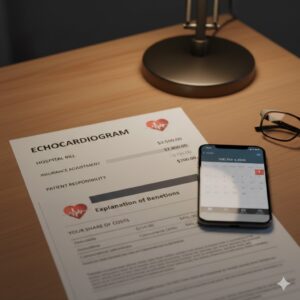
4. Understand Your Explanation of Benefits (EOB) and Bill.
-
EOB: This comes from your insurance company after the claim is processed. It is NOT a bill. It shows the service, the negotiated rate, what insurance paid, and what you owe.
-
Final Bill: This comes from the healthcare provider. Match it against your EOB. The amount you owe the provider should match the “patient responsibility” on the EOB.
5. Ask About Financial Assistance and Payment Plans.
If the cost is unaffordable, contact the provider’s billing office. Most hospitals and many large clinics have:
-
Financial aid programs based on income and family size.
-
Interest-free monthly payment plans.
-
Prompt-pay discounts for paying the estimated bill in full upfront.
Frequently Asked Questions (FAQ)
Q: Can I get an echocardiogram without insurance, and how much would it cost?
A: Yes, but you will be responsible for the full amount. The cash price for a standard echo can range from $500 to $2,500+ depending on the facility. Always ask for the self-pay or cash price, which is often lower than the chargemaster price.
Q: What happens if I go to an out-of-network provider by accident?
A: Your costs can skyrocket. You may be subject to a higher deductible and coinsurance, and the provider may “balance bill” you for the difference between their charge and what your insurance pays. Always confirm network status in advance.
Q: Does Medicare cover echocardiograms?
A: Yes, Medicare Part B covers medically necessary echocardiograms. You will typically pay 20% of the Medicare-approved amount after meeting your Part B deductible ($240 in 2024), provided the provider accepts Medicare assignment.
Q: How can I reduce my echocardiogram cost?
A: 1) Choose an independent imaging center over a hospital. 2) Ensure you get any required prior authorization. 3) Use an in-network provider. 4) Meet your deductible earlier in the year with other care if possible. 5) Ask about financial assistance.
Q: Are there any hidden costs I should watch for?
A: Be aware of separate bills from the physician who reads and interprets the echo (the cardiologist) and the facility where it was performed. This is called “component billing” and is standard practice.
Conclusion
The cost of an echocardiogram with insurance is a personalized figure, shaped by your specific plan’s deductible and coinsurance, the facility you choose, and the type of test required. By proactively contacting both your insurer and the provider for estimates, confirming network status, and understanding your Explanation of Benefits, you can transform a confusing charge into a manageable, predictable expense. Taking these steps empowers you to focus on what truly matters—your heart health.
Additional Resource:
For a deeper understanding of medical billing codes and patient rights, visit the American Medical Association’s resource on CPT Codes and the Centers for Medicare & Medicaid Services page on Your Rights Against Surprise Medical Bills.