Navigating the world of farm insurance can feel as complex as predicting the weather. For any farmer or rancher, protecting your livelihood isn’t a luxury—it’s a necessity. But when you start looking into policies, one question quickly rises to the top: how much is this going to cost me? The short answer is that there’s no single price tag. The annual premium for a farm insurance policy can range from a few thousand dollars for a small operation to well over $100,000 for large, diversified agribusinesses. The final cost is a unique calculation, a reflection of your farm’s individual fingerprint.
This guide will demystify that calculation. We’ll walk you through every factor that influences your premium, provide realistic cost ranges based on common scenarios, and give you actionable strategies to secure the best possible coverage without breaking the bank. Consider this your essential reference for making informed, confident decisions about protecting your farm.
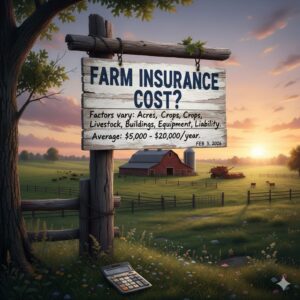
How Much Does Farm Insurance Cost?
Understanding the Variables: What Shapes Your Farm Insurance Quote?
Imagine two farms side-by-side. One is a 50-acre organic vegetable farm with a roadside stand. The other is a 5,000-acre grain operation with massive storage facilities and a fleet of equipment. Their insurance costs will be worlds apart. Your premium is built from a combination of risk factors that insurers carefully evaluate.
Core Factors That Directly Impact Your Premium
1. Location, Location, Location:
Your geographic area is a primary driver of cost. Insurers assess local risks like:
-
Weather & Natural Disasters: Is your region prone to hailstorms, tornadoes, wildfires, or flooding? Premiums in the Plains states or wildfire-prone areas will be higher.
-
Theft & Vandalism Rates: Rural crime statistics in your county play a role.
-
Proximity to Fire Departments: Distance from a hydrant or volunteer fire station can affect property coverage costs.
2. The Size and Scope of Your Operation:
-
Acres in Production: More acres typically mean higher liability and crop-related premiums.
-
Type of Farming: A dairy farm with expensive livestock and complex machinery carries different risks than a hay operation.
-
Revenue: Your farm’s annual income is a key metric insurers use to gauge the scale of potential liability and business interruption losses.
3. Your Property and Assets:
This is the backbone of your policy’s value.
-
Structures: The rebuild cost of barns, silos, milking parlors, greenhouses, and your farmhouse (if covered).
-
Equipment: The value of tractors, combines, planters, and specialized machinery.
-
Livestock: The number, type, and value of your animals (e.g., a herd of dairy cows vs. a flock of sheep).
-
Stored Crops & Feed: The value of grain in storage or harvested hay.
4. Your Coverage Selections:
This is where you have the most control. A basic policy is cheaper, but may leave gaps. You can add endorsements (or “riders”) for:
-
Equipment Breakdown: For costly repairs to machinery.
-
Cyber Liability: If you sell online and hold customer data.
-
Pollution Liability: Crucial for operations with significant fuel or chemical storage.
-
Umbrella Liability: Extra liability coverage above your base policy limits.
Breaking Down the Costs: Real-World Estimates
To make this tangible, let’s look at some hypothetical but realistic scenarios. The following table illustrates how costs can vary dramatically.
Comparative Table: Estimated Annual Farm Insurance Premiums
| Farm Profile | Key Assets | Typical Coverage | Estimated Annual Premium Range |
|---|---|---|---|
| Small Diverse Farm 50 acres, vegetables & poultry, farm stand, $150k revenue. |
Farmhouse, 1 barn, small equipment, 500 laying hens. | Property, Liability, Farm Auto, Product Liability. | $2,500 – $5,000 |
| Mid-Size Grain Farm 750 acres, corn/soybeans, grain bins, $500k revenue. |
Tractors, combine, grain drills, multiple grain storage bins. | Property, Equipment, Crop Hail/Multi-Peril, Liability. | $15,000 – $35,000 |
| Commercial Dairy 200 milking cows, parlor, bulk tank, 300 acres feed crop. |
Livestock, milking equipment, specialized machinery, manure lagoon. | Property, Livestock, Business Interruption, General Liability. | $25,000 – $60,000+ |
| Large Agribusiness 5,000+ acres, custom harvesting, seed sales, $3M+ revenue. |
Extensive equipment fleet, large storage facilities, retail space. | Comprehensive Package: Property, Liability, Auto, Workers’ Comp, Umbrella. | $75,000 – $200,000+ |
Important Note: “These figures are national estimates. Your actual quote will depend on the specific risk factors of your farm and your chosen coverage limits and deductibles. Always get multiple personalized quotes,” advises Michael Thorson, a veteran farm insurance underwriter with over 20 years of experience.
Key Components of a Farm Policy and Their Cost Weight
A farm insurance policy isn’t one monolithic product. It’s a package of coverages, each with its own cost.
1. Farm Property Insurance (15-30% of premium)
Covers buildings, equipment, and stored goods. Cost is based on replacement value.
-
Tip: Ensure you have replacement cost coverage, not actual cash value, which deducts for depreciation.
2. Farm Liability Insurance (20-35% of premium)
Protects you if someone is injured on your property or by your products. Limits often start at $1 million.
-
Tip: If you have a farm stand or agritourism (corn mazes, pumpkin patches), you must have elevated liability limits.
3. Crop Insurance (Highly Variable: 10-50%+)
Federally subsidized programs (like MPCI) have premiums based on yield history, coverage level chosen, and crop prices. A common range is $20-$40 per acre, with the farmer paying a portion and the government subsidizing the rest.
4. Farm Auto & Equipment Insurance (15-25% of premium)
Covers trucks, tractors, and combines used primarily for farm work. Premiums depend on vehicle value, usage, and driver records.
5. Livestock Insurance (Cost varies by animal value)
Can be covered under property insurance or through specific mortality policies for high-value animals.
Helpful List: 5 Actionable Ways to Lower Your Farm Insurance Costs
-
Bundle Your Policies: Place your farm, home, and auto with the same insurer for a multi-policy discount.
-
Increase Your Deductibles: Opting for a higher out-of-pocket deductible can significantly lower your annual premium.
-
Invest in Risk Management: Install security cameras, lightning rods, or modern fire suppression systems. Document these for your agent.
-
Maintain a Clean Claims History: Just like personal auto insurance, a history free of small claims is rewarded.
-
Annually Review and Update Your Policy: Don’t let your coverage become outdated. Remove sold equipment, update building values, and discuss new discounts.
The Final Calculation: Getting Your Personalized Quote
The only way to know your true cost is to engage with a specialist. Here’s how to prepare:
-
Document Everything: Create a list of assets, including make/model/year for equipment, square footage and construction of buildings, and livestock inventories.
-
Know Your Numbers: Have recent revenue figures and land acreage details ready.
-
Interview Agents: Work with an independent agent who represents multiple companies specializing in farm insurance. Ask them to explain the “why” behind their quote.
Final Recommendation: Never choose a policy on price alone. The cheapest policy is often the most expensive mistake when a loss occurs. Focus on the value—the combination of comprehensive coverage, responsive service, and a fair price.
Conclusion
The cost of farm insurance is a personalized equation, shaped by your location, assets, and specific risk profile. By understanding the core components, seeking multiple quotes from specialized agents, and proactively managing risks, you can secure the vital protection your operation needs at a sustainable cost. Investing in the right policy is ultimately an investment in the resilience and future of your farm.
Frequently Asked Questions (FAQ)
Q: What is the single biggest mistake farmers make when buying insurance?
A: Underinsuring their property, especially buildings. Using market value or tax assessment value instead of the actual cost to rebuild can leave you devastatingly undercovered after a total loss.
Q: Does farm insurance cover my farmhouse?
A: It can, but you need to specify this. Often, the farm policy covers the farmhouse, or you can bundle it with a separate homeowner’s policy from the same carrier for a discount. Be clear about what structures you want included.
Q: How does crop insurance work with my other policies?
A: Crop insurance is a separate, specific policy (often through a federal program). It does not replace your main farm package policy, which covers structures and equipment. They work in tandem to provide complete protection.
Additional Resources
For more information on federal crop insurance programs and finding a certified agent, visit the official website of the USDA Risk Management Agency (RMA): https://www.rma.usda.gov/. This is an invaluable resource for understanding coverage options, deadlines, and eligibility.