Dealing with a wart can be frustrating, and if you’re paying out of pocket, your first question is likely about the price tag. The cost of wart removal without insurance isn’t a single number—it’s a range that depends heavily on the method you choose, the type and number of warts, and who performs the procedure. This guide will walk you through every potential expense in clear, straightforward terms, helping you make an informed and financially sound decision.
We’ll explore everything from pharmacy treatments to in-office medical procedures, providing realistic price brackets so you can plan your next steps with confidence.
How Much Does Wart Removal Cost Without Insurance
Understanding Warts and Removal Fundamentals
Before diving into costs, it helps to know what you’re dealing with. Warts are caused by the human papillomavirus (HPV) and can appear anywhere on the body. Common types include plantar warts on the feet, flat warts on the face, and common warts on the hands. The removal method a healthcare professional recommends often depends on the wart’s location, size, and persistence.
“The goal of treatment is to destroy or remove the wart without creating scar tissue, which can be more troublesome than the wart itself,” explains a common dermatology principle. This balance between effectiveness and cosmesis is a key factor in the treatment options available.
Breakdown of Wart Removal Methods & Their Costs
Here, we detail the most common removal avenues, from least to most expensive.
At-Home Treatments and Over-the-Counter Kits
For a single, small common wart, many people start with an at-home approach. These are the most budget-friendly options but require consistency and may not work for stubborn or large warts.
-
Salicylic Acid Solutions & Patches: These are the first-line OTC treatment. You apply the solution or a medicated patch daily, often for several weeks, to gradually peel away the wart.
-
Cost Range: $10 to $25 per kit or bottle.
-
-
Cryotherapy Kits: These kits use a pressurized freeze agent (like dimethyl ether) instead of the liquid nitrogen used in doctors’ offices. They are generally less effective than clinical cryotherapy.
-
Cost Range: $25 to $40 per kit.
-
-
Other Remedies: Duct tape occlusion therapy or topical creams are other low-cost options, often costing just a few dollars.
Important Note: When using at-home treatments, always follow package instructions carefully to avoid damaging healthy skin. If you have diabetes, poor circulation, or a compromised immune system, consult a doctor before attempting any self-treatment.
In-Office Medical Procedures
When OTC treatments fail or warts are widespread, painful, or in sensitive areas, a visit to a healthcare provider is the best course. Below is a comparative table of common professional procedures.
In-Office Wart Removal Procedures & Cost Estimates
| Procedure | How It Works | Typical Session Cost (Per Wart) | Notes & Considerations |
|---|---|---|---|
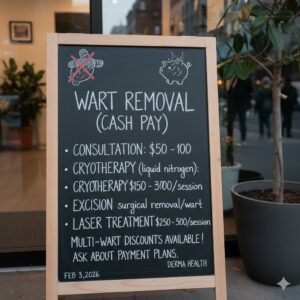
| Cryotherapy | Liquid nitrogen is applied to freeze and destroy the wart tissue. | $100 – $250 | Often requires 2-4 sessions spaced weeks apart. A very common first-line clinical treatment. |
| Electrosurgery & Curettage | The wart is burned with an electric needle and then scraped off. | $200 – $500 | Used for larger, stubborn warts. Performed under local anesthesia. May carry a higher risk of scarring. |
| Laser Treatment | A focused laser beam destroys the wart’s blood supply or vaporizes the tissue. | $250 – $600+ | Reserved for the most resistant warts. Often more expensive but can be effective when other methods fail. |
| Excisional Surgery | The wart is cut out surgically with a scalpel. | $300 – $600+ | Used for large or filiform warts. Requires local anesthesia and stitches. |
| Chemical Peels | Stronger chemicals (like cantharidin, TCA) are applied in-office to blister the wart. | $150 – $350 | Cantharidin is a common “beetle juice” treatment that causes a blister to form under the wart. |
Key Factors That Influence Your Final Cost
The prices above are estimates. Your final bill will be shaped by several variables:
-
Type of Provider: A visit to a primary care physician will generally have a lower consultation and procedure fee than a board-certified dermatologist or a podiatrist (for foot warts). Specialist fees reflect their advanced training.
-
Geographic Location: Clinical costs in major metropolitan areas (e.g., New York City, San Francisco) are consistently higher than in rural or midwest regions.
-
Number, Size, and Complexity: A single, small wart on the finger is straightforward. Multiple clustered warts, a large plantar wart mosaic, or a wart on the face or genitals requires more time, skill, and care, increasing the cost.
-
Number of Sessions: Very few warts disappear after a single professional treatment. Budget for at least 2-3 sessions for a realistic financial picture. Your provider should give you an estimate.
-
The Clinic’s Fee Structure: The total charge usually includes:
-
Consultation/Office Visit Fee: $75 – $200+
-
Procedure Fee: The cost for the specific removal technique.
-
Pathology Fee (if applicable): If the tissue is sent to a lab to confirm it’s a wart (usually for atypical growths), this can add $50 – $150.
-
Medications/Surgical Supplies: A separate line item for materials used.
-
How to Manage Costs Without Insurance
Paying out of pocket doesn’t mean you’re without options. Consider these strategies:
-
Start with a Primary Care Physician: For common warts, your family doctor or GP can often perform cryotherapy or prescribe treatments at a lower cost than a specialist.
-
Ask About Cash-Pay Discounts: Many clinics offer a reduced rate for patients paying in full at the time of service, as it saves them billing administrative costs. Always ask, “Do you offer a discount for self-pay patients?”
-
Request a Detailed Estimate: Before scheduling, ask the provider’s office for a detailed “good faith estimate” that breaks down the consultation, procedure, and any potential follow-up costs.
-
Consider Community Health Centers or Teaching Clinics: Federally Qualified Health Centers (FQHCs) and university-affiliated dermatology clinics often provide services on a sliding scale based on your income.
-
Use a Healthcare Savings Account (HSA/FSA): If you have one, wart removal is a qualified medical expense, allowing you to use pre-tax dollars.
Conclusion
The cost of wart removal without insurance can range from under $20 for an at-home kit to over $1,500 for multiple sessions of specialized laser treatment. Your specific situation—the wart’s nature and your choice of provider—will determine where you fall in that spectrum. By understanding all the options and factors at play, you can approach treatment with clear expectations and a plan that fits both your health needs and your budget.
Frequently Asked Questions (FAQ)
Q: What is the cheapest way to remove a wart without insurance?
A: For a single, small common wart, an over-the-counter salicylic acid treatment is the most affordable starting point, costing between $10 and $25.
Q: How many cryotherapy sessions will I likely need?
A: Most warts require 2 to 4 cryotherapy sessions, spaced 2 to 4 weeks apart. Stubborn warts may need more.
Q: Can I negotiate the price with my dermatologist?
A: Yes, it is often possible. Inquire about a self-pay or cash-pay discount before your appointment. Many practices have lower set rates for patients paying upfront.
Q: Is wart removal considered medically necessary?
A: It can be. If a wart is painful, interfering with function (like walking), or has an uncertain diagnosis, removal is medically necessary. Cosmetic removal (e.g., a painless wart on the face) may be viewed differently by providers and insurers.
Q: Are there any risks to cheaper, at-home methods?
A: Yes. Misapplication can damage healthy skin, cause infection, or lead to scarring. It’s crucial to follow instructions and see a doctor if the wart changes color, bleeds, or doesn’t respond to treatment.
Additional Resources
For more information on skin conditions and finding affordable healthcare options, a reliable resource is the American Academy of Dermatology’s public resource page: AAD – Warts: Overview. They also have a tool to find a board-certified dermatologist in your area.