Navigating the financial requirements to become a licensed contractor in Washington State can feel daunting. Between bonds and insurance, the costs and terms can seem like a maze. This guide cuts through the complexity. We’ll provide a clear, detailed breakdown of what you need, what you can expect to pay, and practical strategies to manage these essential costs for your business. Think of this not as an expense, but as a foundational investment in your credibility, legality, and long-term stability.
Whether you’re a new general contractor, a seasoned electrician, or a specialty tradesperson, understanding these requirements is your first critical step toward successful, compliant operation.
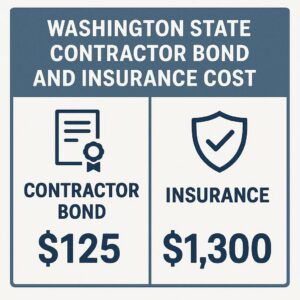
Washington State Contractor Bond and Insurance Costs
Understanding the Foundations: Bond vs. Insurance
Before diving into costs, it’s crucial to understand the fundamental difference between a surety bond and insurance. They protect different parties and function in distinct ways.
A surety bond is a three-party agreement between:
-
The Principal: You, the contractor.
-
The Obligee: The state of Washington (the Department of Labor & Industries or the Department of Licensing).
-
The Surety: The bonding company that guarantees your performance.
The bond is a guarantee to the state and the public that you will operate according to laws and regulations. If you violate the terms (e.g., fail to pay taxes, damage public property, violate licensing rules), a claim can be made against the bond. Crucially, if a claim is paid, you are legally obligated to repay the surety company in full. It is a form of credit.
Insurance is a two-party agreement between you and your insurance provider. It protects your business assets and third parties from specific risks, such as accidents, injuries, or property damage. When a covered event occurs, the insurance company pays the claim (up to your policy limits) on your behalf, and you are generally not expected to repay that amount (though your premiums may rise).
Industry Expert Quote: “Many contractors confuse bonds with insurance. A bond is your pledge of good practice to the government; it’s a safeguard for the public. Insurance is your safety net for the unforeseen accidents of the trade. Both are non-negotiable for a serious business.” – Michael Torres, Risk Consultant for Northwest Contractors.
Why Washington State Requires These Protections
The state mandates these financial tools to create a accountable construction industry. They protect consumers from substandard work and financial loss, ensure workers are compensated, and create a level playing field where all licensed contractors meet the same baseline of financial responsibility.
Breaking Down Washington State Contractor Bond Costs
The cost of your bond is not a one-size-fits-all premium. It is primarily determined by the bond amount set by the state and your personal credit score.
1. Contractor Bond (for General and Specialty Contractors)
Most contractors registered through the Washington Department of Labor & Industries (L&I) must post a $12,000 surety bond. This is the most common requirement.
How the Cost is Calculated:
You do not pay $12,000. You pay an annual premium, which is a percentage of the total bond amount. This percentage is almost entirely based on your personal credit history.
Typical Premium Cost Table for a $12,000 Bond:
| Credit Tier | Estimated Premium Rate | Approximate Annual Cost |
|---|---|---|
| Excellent (720+) | 1% – 2% | $120 – $240 |
| Good (650-719) | 2% – 4% | $240 – $480 |
| Average (600-649) | 4% – 8% | $480 – $960 |
| Below Average (Below 600) | 8% – 15%+ | $960 – $1,800+ |
Important Note: These rates are annual. Your bond must be maintained continuously to keep your license active. Some sureties may offer a 2 or 3-year term for a slightly discounted total.
2. Electrical Contractor/Traffic Control Contractor Bond
Contractors in these specialties, licensed through the Department of Labor & Industries, have a higher bond requirement: $20,000.
Typical Premium Cost Table for a $20,000 Bond:
| Credit Tier | Estimated Premium Rate | Approximate Annual Cost |
|---|---|---|
| Excellent (720+) | 1% – 2% | $200 – $400 |
| Good (650-719) | 2% – 4% | $400 – $800 |
| Average (600-649) | 4% – 8% | $800 – $1,600 |
| Below Average (Below 600) | 8% – 15%+ | $1,600 – $3,000+ |
3. Driver Training School Bond
For completeness, note that businesses like driver training schools, licensed through the Department of Licensing, have a $25,000 bond requirement, with costs scaling similarly based on credit.
Key Factors That Influence Your Bond Premium:
-
Personal Credit Score: The single biggest factor. A strong score demonstrates financial responsibility and lower risk to the surety.
-
Business Financials: For larger bonds or contractors with weaker credit, business assets, revenue, and liquidity may be reviewed.
-
Industry Experience: A long, claim-free track record can positively influence underwriting.
-
Claims History: Previous bond claims will significantly increase your premium or make bonding difficult.
Helpful List: Steps to Get Your Washington Contractor Bond
Determine Your Exact Requirement: Confirm your bond amount with L&I or DOL based on your license type.
Shop Around: Get quotes from multiple reputable surety bond agencies or providers.
Complete an Application: Provide personal, business, and financial information.
Receive Your Quote: The surety will issue a premium quote based on their underwriting.
Pay the Premium: Once approved, pay the annual premium.
File the Bond: The surety will issue the bond document; you must file it with the appropriate state agency to finalize your license.
Breaking Down Washington State Contractor Insurance Costs
Insurance costs are far more variable than bond costs, as they depend on a wider range of risk factors. We’ll break down the common types and their estimated costs.
1. Workers’ Compensation Insurance
This is mandatory in Washington if you have even one employee (including yourself, if you are a corporate officer). It is provided by the Washington State Department of Labor & Industries (L&I)—it is a state-run fund. You cannot purchase it from a private carrier.
How the Cost is Calculated:
Your premium is based on every $100 of payroll assigned to a specific risk class code. Each trade has a different code with a different base rate.
Example Risk Class Codes and 2024 Base Rates (for illustration):
-
Carpentry – Code 0510: ~$4.99 per $100 of payroll
-
Electrical Wiring – Code 0513: ~$3.65 per $100 of payroll
-
Roofing – Code 0514: ~$10.88 per $100 of payroll
-
Plumbing – Code 0517: ~$2.88 per $100 of payroll
-
Landscaping – Code 0603: ~$4.91 per $100 of payroll
Cost Example: A plumbing business with $200,000 in annual payroll would have an estimated base premium of: ($200,000 / $100) x $2.88 = $5,760 annually.
Important Notes:
-
Experience Modification Factor (“E-Mod”): After three years in business, your premium is adjusted by an experience mod—a debit (>1.0) if you have more claims than average, or a credit (<1.0) if you have fewer. This can significantly raise or lower your costs.
-
Audits: L&I conducts annual audits to reconcile estimated premiums with actual payroll. You may owe more or receive a refund.
2. General Liability Insurance
This is the cornerstone of your business protection, covering third-party bodily injury, property damage, and personal/advertising injury (like slander). While not always legally required by the state, it is universally required by clients, general contractors, and for most business licenses.
Typical Annual Cost Range: $800 to $3,500+
Most small to mid-sized contractors pay between $1,200 and $2,500 per year.
Factors That Drastically Affect Your GL Premium:
-
Type of Work: Roofing, demolition, and framing are higher risk than painting or flooring.
-
Annual Revenue: Higher revenue typically means higher potential exposure.
-
Project Size: Working on large commercial jobs vs. small residential repairs.
-
Claims History: A clean history is the best way to keep costs low.
-
Coverage Limits: Standard is $1 million per occurrence / $2 million aggregate. Higher limits cost more.
-
Deductible: Choosing a higher deductible can lower your premium.
3. Commercial Auto Insurance
Required for any vehicle owned or used by your business.
Typical Annual Cost Range: $1,200 to $3,500 per vehicle
A contractor’s pickup truck will cost significantly more to insure than a sedan due to its use and value.
4. Tool and Equipment Insurance (Inland Marine)
Covers your tools and equipment on the job site, in transit, or in storage against theft, loss, or damage. This is highly recommended.
Typical Annual Cost: Often a few hundred dollars, depending on the total value of your tools.
5. Umbrella/Excess Liability Insurance
Provides an extra layer of liability coverage above your General Liability and Auto policies. Crucial for larger contractors.
Typical Annual Cost: $500 to $1,500+ for an additional $1 million in coverage.
Comparative Table: Estimated Total Annual Insurance Costs for Different Contractor Types
| Contractor Type | Workers’ Comp* | General Liability | Commercial Auto | Estimated Total Annual Range |
|---|---|---|---|---|
| Residential Painter ($150k payroll) | ~$5,985 | $1,100 – $1,800 | $1,500 | $8,585 – $9,285 |
| Small Electrical Contractor ($250k payroll) | ~$9,125 | $1,500 – $2,500 | $1,800 | $12,425 – $13,425 |
| Roofing Contractor ($300k payroll) | ~$32,640 | $3,000 – $5,500 | $2,200 | $37,840 – $40,340 |
| Landscaping Contractor ($200k payroll) | ~$9,820 | $1,800 – $2,800 | $2,000 | $13,620 – $14,620 |
*Workers’ Comp calculation based on 2024 example rates: Painter (Code 0512: $3.99), Electrician (Code 0513: $3.65), Roofer (Code 0514: $10.88), Landscaper (Code 0603: $4.91). Includes owner/officer payroll.
Strategies to Manage and Reduce Your Total Costs
Managing your bond and insurance expenses is an ongoing part of smart business.
For Lower Bond Premiums:
-
Improve Your Personal Credit: This is the most impactful action. Pay bills on time, reduce debt, and check your credit report for errors.
-
Maintain a Clean Record: Avoid any violations that could lead to a bond claim.
-
Opt for a Multi-Year Term: If offered, a 2- or 3-year bond can lock in a rate and sometimes offer a discount.
-
Shop at Renewal: Don’t auto-renew without checking if better rates are available.
For Lower Insurance Premiums:
-
Implement a Robust Safety Program: Documented safety meetings, training, and equipment checks can prevent claims and may qualify you for discounts.
-
Shop Around Annually: The market changes. Get competing quotes every year at renewal.
-
Bundle Policies: Use the same insurer for General Liability, Auto, and other lines for a multi-policy discount.
-
Increase Deductibles: Willingly assuming more small-risk costs can lower your premium.
-
Control Your Workers’ Comp Costs: This is often the largest expense. Accurately classify employees, submit payroll reports on time, and most importantly, prevent workplace injuries. A low E-Mod is your biggest money-saver.
-
Consider a Business Owner’s Policy (BOP): For smaller contractors, a BOP bundles General Liability and Property insurance at a lower combined rate.
Critical Note for Readers: Never, ever operate without required bonding or insurance to save money. The financial consequences of a single accident, injury, or lawsuit can be catastrophic, far exceeding any premium savings. It can also lead to license suspension, fines, and business closure.
The Registration and Renewal Process: A Timeline
-
Initial Licensing: Determine your contractor classification (general or specialty) with WA L&I. Secure your required $12,000 or $20,000 bond and proof of insurance (General Liability). Submit your application, bond, and insurance certificates. Pay registration fees.
-
Ongoing Compliance: Pay your Workers’ Compensation premiums monthly/quarterly. Keep your bond active by paying the annual premium to your surety. Renew your General Liability policy annually.
-
Biennial Renewal: Your contractor registration must be renewed every two years with L&I. You must attest that your bond and insurance remain in effect. L&I and DOL actively verify this information.
Conclusion: Investing in Your Business Foundation
The costs for a Washington state contractor bond and insurance are not merely regulatory hurdles; they are essential investments in your business’s legitimacy, resilience, and growth. While the bond secures your license and public trust, insurance protects the enterprise you’re building from unforeseen risks. By understanding the factors that influence these costs—from personal credit to workplace safety—you can make informed decisions, budget effectively, and implement strategies to manage these expenses wisely. A responsible approach to bonding and insurance is the hallmark of a professional, sustainable contracting business.
Frequently Asked Questions (FAQ)
Q: Can I get a contractor license in Washington without a bond?
A: No. The surety bond is a mandatory requirement for almost all contractor registrations with the Washington Department of Labor & Industries. There is an alternative in the form of an “assigned account” held by the state, but posting a bond is the standard and far more practical method.
Q: My credit is poor. Can I still get bonded?
A: Yes, but it will be more expensive. Surety companies specializing in “bad credit” or “subprime” bonds will offer coverage at premium rates of 10-20%. Improving your credit should be a top priority to reduce this cost over time.
Q: Is General Liability insurance legally required in Washington?
A: While the state doesn’t universally mandate it for all contractors, many city and county business licenses require it. More importantly, virtually every client, property manager, and general contractor will require you to show a Certificate of Insurance (COI) before you step on a job site. In practice, it is absolutely required to operate.
Q: What happens if someone makes a claim against my bond?
A: The surety company will investigate. If the claim is valid, they will pay the claimant up to the bond’s penal sum. However, you are then legally obligated to reimburse the surety company in full, plus any legal fees. This is a key difference from insurance.
Q: How often do I need to renew my bond and insurance?
A: Your bond is typically an annual contract that must be renewed and kept continuous. Your insurance policies (General Liability, Auto) are also annual. Your contractor registration with the state is renewed biennially, and you must confirm your bond and insurance are active at that time.
Additional Resources
-
Washington State Department of Labor & Industries (L&I) – Contractor Registration: The primary source for all rules, applications, and requirements for general and specialty contractors. https://lni.wa.gov/licensing-permits/contractors/
-
Washington State Department of Licensing (DOL): For specific license types like Electrical Administrators or Driver Training Schools. https://www.dol.wa.gov/
-
Washington Small Business Development Center (SBDC): Offers free business advising, including guidance on legal and financial requirements for startups. https://wsbdc.org/