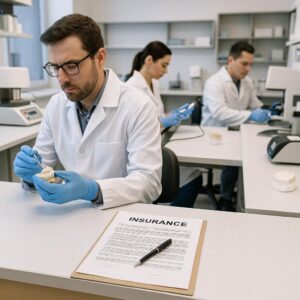
If you are a dental technician or run a dental laboratory, you know that your work is a blend of art and science. You transform raw materials into functional, life-changing prosthetics. But what happens when the unexpected occurs? A fire damages your 3D printers, a patient alleges a faulty crown caused them injury, or a key piece of equipment simply stops working.
This is where dental lab insurance becomes more than just a monthly expense—it becomes the shield that protects your business, your reputation, and your livelihood.
In this guide, we will walk you through everything you need to know about insuring your dental lab. Whether you are a solo technician working from a home office or the owner of a large, full-service laboratory, we will help you understand the risks, the coverage options, and how to build a policy that fits you like a well-crafted denture.
Why Dental Labs Need Specialized Insurance
Many small lab owners make the mistake of thinking a standard Business Owner’s Policy (BOP) or a home insurance rider is sufficient. The reality is that dental laboratories have a unique set of risks that require specialized attention.
You are dealing with expensive equipment, hazardous materials, and most critically, the health and safety of patients. A general policy might have loopholes that leave you exposed to the very claims most likely to happen in your industry.
Note: “Don’t wait for a disaster to read your policy. The fine print matters, especially when it comes to exclusions for things like mold, faulty workmanship, or virus-related claims which can be devastating to a lab.”
The Core Components of Dental Lab Insurance
A solid insurance package for a dental lab is rarely a single product. It is usually a combination of several different coverage types, tailored to your specific operations. Let’s break down the essential layers of protection.
General Liability Insurance
This is the foundation of your business insurance. It protects you from third-party claims of bodily injury or property damage that occur on your premises or as a result of your business operations.
What it typically covers:
-
A delivery driver slips on a wet floor in your lab.
-
You accidentally cause a fire while using a torch at a client’s office.
-
A sales representative trips over a box in your workspace.
However, standard General Liability has limits. It often does not cover professional mistakes (malpractice) or damage to the products you are working on for a client.
Professional Liability (Malpractice) Insurance
This is arguably the most critical coverage for a dental lab, yet it is often overlooked. General Liability covers physical incidents, but Professional Liability covers the financial loss resulting from your professional services or advice.
In the dental world, if a restoration fails, it can lead to patient discomfort, additional dental work, and even lawsuits against the dentist. And if the dentist gets sued, they will likely come after you, the lab, for contribution or indemnity.
What it typically covers:
-
Allegations of faulty workmanship leading to a failed bridge or crown.
-
Errors in design or material selection that cause harm to a patient.
-
Breach of contract claims regarding the quality of your finished product.
This coverage pays for your legal defense and any settlements or judgments, ensuring that one mistake doesn’t bankrupt your business.
Commercial Property Insurance
Your lab is filled with high-value assets: milling machines, 3D printers, furnaces, scanners, and computers. Commercial Property insurance protects these physical assets from perils like fire, theft, vandalism, and certain types of weather damage.
Key Considerations:
-
Replacement Cost vs. Actual Cash Value: Ensure your policy covers the replacement cost of your equipment, not just its depreciated value. A five-year-old scanner might only be worth a few hundred dollars on paper, but replacing it with a new one could cost tens of thousands.
-
Valuable Papers & Records: This covers the cost to recreate your digital and physical models, prescription slips, and customer records if they are destroyed.
Equipment Breakdown (Boiler & Machinery) Insurance
A standard property policy covers damage from external events like a fire. But what if your furnace just… stops working? What if a power surge fries the motherboard of your milling machine?
Equipment Breakdown coverage fills this gap. It covers the cost to repair or replace your equipment when it breaks down due to mechanical or electrical issues.
Why it’s vital for dental labs:
-
Expensive Repairs: Servicing high-tech dental equipment is specialized and costly.
-
Business Interruption: Many policies also include coverage for the income you lose while your equipment is being repaired, helping you pay bills even when you can’t produce work.
Business Interruption and Extra Expense Insurance
If a fire or other covered disaster forces you to close your doors for weeks or months, your bills—rent, loans, payroll—don’t stop. Business Interruption insurance replaces lost income during that downtime, helping your business survive a catastrophic event.
Extra Expense coverage goes a step further, paying for the additional costs of operating out of a temporary location or renting equipment to get back up and running faster.
Cyber Liability Insurance
In the modern digital lab, patient data flows through your systems. If you store digital impressions, patient names, or dentist information, you are a target for cybercriminals.
Cyber Liability insurance helps you respond to a data breach. It covers:
-
Costs to notify affected individuals.
-
Legal fees and regulatory fines.
-
Public relations efforts to restore your reputation.
-
Costs associated with ransomware attacks.
Inland Marine (Tools of the Trade) Insurance
If you are a traveling technician who works in multiple dental offices, or if you occasionally take work home, your equipment is exposed to risks outside your lab. Inland Marine coverage protects your portable equipment, tools, and laptops no matter where they are—in your car, at a client’s office, or at a conference.
Comparing Coverage: What’s Usually Included?
To make it easier to visualize, here is a comparison of what a basic policy versus a comprehensive policy might look like for a typical dental lab.
| Coverage Area | Basic/Generic Policy | Comprehensive Dental Lab Policy |
|---|---|---|
| General Liability | $1M per occurrence / $2M aggregate | $1M – $2M per occurrence / $2M – $4M aggregate |
| Professional Liability | Often Excluded | $1M per claim / $3M aggregate (Recommended) |
| Property (Equipment) | Actual Cash Value | Replacement Cost |
| Equipment Breakdown | Rarely Included | Included or Available as Endorsement |
| Cyber Liability | Excluded | Available as Endorsement |
| Business Interruption | Limited (12 months) | Extended (24+ months) |
| Valuable Papers | Excluded | Included |
As you can see, the gaps in a generic policy are significant. Paying a little more for a tailored policy can mean the difference between a quick recovery and closing your doors for good.
Factors That Influence Your Insurance Premiums
Insurance companies don’t pull numbers out of a hat. They calculate your premium based on a variety of risk factors. Understanding these can help you manage your costs.
-
Location: Labs in areas prone to natural disasters (floods, earthquakes, wildfires) or with high crime rates will typically pay more.
-
Services Offered: A lab that only does simple removables poses a different risk profile than a lab doing complex implant-borne, all-ceramic restorations. The more complex the work, the higher the professional liability risk.
-
Revenue and Payroll: Generally, the more money you make and the more employees you have, the higher your exposure and the more coverage you will need.
-
Safety Protocols: Do you have fire suppression systems? Do you follow strict infection control and material handling protocols? A safer lab is a cheaper lab to insure.
-
Claims History: A history of past claims will inevitably raise your rates. This is why it’s crucial to have the right coverage from the start—to prevent a small incident from becoming a costly claim that follows you for years.
-
Deductible Amount: Choosing a higher deductible can lower your monthly premium, but you need to ensure you have the cash on hand to pay that deductible if a claim occurs.
How to Choose the Right Insurance Provider
Finding the right insurance is about more than just price. You need a partner who understands the unique pressures of the dental industry.
Questions to Ask Potential Insurers or Agents
-
Is the policy specifically written for dental laboratories? (If they hesitate, move on).
-
Does the professional liability coverage include “products and completed operations”? (This is vital. It covers you if a restoration fails years after it was delivered).
-
How is equipment breakdown handled? (Is it included in the property policy, or is it a separate endorsement?)
-
Are my digital models and files considered “valuable papers”?
-
Does the policy cover me if I have to hire a temporary technician to complete orders after a covered loss?
-
Can the policy be bundled? (Bundling multiple coverages with one carrier often leads to discounts).
Reader’s Tip: Don’t just look for the cheapest option. Look for the best value. A slightly more expensive policy that includes Equipment Breakdown and higher Professional Liability limits is infinitely better than a cheap policy that leaves you exposed.
Special Considerations for Different Lab Setups
Your insurance needs will look different depending on how you operate.
The Home-Based Lab
Working from home presents a unique challenge. Your homeowner’s policy likely excludes business-related claims and offers little to no coverage for your expensive lab equipment.
-
The Risk: If a client or delivery person is injured in your home office, your homeowner’s policy may deny the claim. If your kiln causes a fire, you might not be covered.
-
The Solution: You need a specific in-home business policy or a BOP tailored for dental labs. This will cover your liability and equipment without mixing it with your personal home insurance.
The Full-Service Commercial Lab
With multiple employees, higher overhead, and a larger volume of complex cases, your risk profile is higher.
-
The Risk: A single lawsuit from a failed implant case could be catastrophic. Employee theft or injury adds another layer of complexity.
-
The Solution: High-limit Professional Liability, robust Workers’ Compensation, Employment Practices Liability Insurance (EPLI), and higher property limits are non-negotiable.
The Mobile Technician
If you travel between offices, your risk moves with you.
-
The Risk: Theft of equipment from your car. Damaging a dentist’s property while working on-site.
-
The Solution: Inland Marine coverage for your tools is essential. You also need to ensure your General and Professional Liability policies cover you at locations other than your primary address.
Frequently Asked Questions (FAQ)
Q: Is dental lab insurance legally required?
A: While not always a federal or state legal requirement, it is often a contractual requirement. Most dentists will require proof of insurance before they send work to your lab. Additionally, if you have employees, Workers’ Compensation insurance is legally mandated in most places.
Q: How much does dental lab insurance cost?
A: Costs vary widely. A small, home-based lab might pay between $500 and $1,500 per year for a basic policy. A larger, full-service lab with high revenues and multiple employees could pay $5,000 to $15,000+ per year for comprehensive coverage.
Q: What is the difference between “claims-made” and “occurrence” policies?
A: This is crucial for Professional Liability.
-
Occurrence: Covers incidents that happen during the policy period, no matter when the claim is filed. If a patient sues you in 2028 for a crown you made in 2024, and you had an occurrence policy in 2024, you are covered.
-
Claims-Made: Only covers claims filed while the policy is active. If you cancel your policy in 2025 and a claim is filed in 2026, you are not covered unless you purchase expensive “tail” coverage. Occurrence policies are generally preferred for their long-term security.
Q: I’m a one-person LLC. Do I still need professional liability insurance?
A: Yes. An LLC protects your personal assets from some business debts, but it does not protect the business itself from a lawsuit. A malpractice lawsuit could wipe out your business bank account and force you to sell your equipment. Professional liability insurance is your first line of defense.
Q: Does my insurance cover lost or damaged cases in the mail?
A: This depends on your policy. Some property policies may cover the materials you used, but not the value of your labor. You may need to specifically ask about coverage for goods in transit or consider using a shipping service that offers its own insurance for the declared value of the package.
Additional Resources
To help you further secure your business, we recommend checking out the following resource:
-
The National Association of Dental Laboratories (NADL): They often provide resources, best practices, and even group insurance options for their members. Visit NADL.org
Conclusion: Secure Your Future, Focus on Your Craft
Navigating the world of dental lab insurance can seem complex, but it is an essential part of running a successful and sustainable business. By understanding the different types of coverage—from General Liability to specialized Professional Liability and Equipment Breakdown—you can build a safety net that allows you to focus on what you do best: creating high-quality restorations.
Don’t view insurance as just another bill; view it as an investment in your peace of mind and the long-term resilience of your laboratory. Take the time to assess your risks, ask the right questions, and build a partnership with an insurer who understands the unique art and science of the dental lab profession.