Navigating the world of dental benefits can sometimes feel like trying to read a map in a foreign language. You pay your premium every month, flash your card at the dentist’s office, and hope for the best. But then, a term pops up on your Explanation of Benefits (EOB) that stops you cold: “Annual Maximum.”
It sounds technical and a bit intimidating. But here is the good news: once you understand what the “dental insurance annual maximum” actually is, you gain a significant advantage. You stop being a passive passenger and become the driver of your dental health finances.
In this guide, we are going to pull back the curtain on this critical aspect of your policy. We will explore how it works, why it exists, and most importantly, how you can use this knowledge to ensure you are getting the most out of your plan without any nasty surprises.
What Exactly Is a Dental Insurance Annual Maximum? (The Simple Explanation)
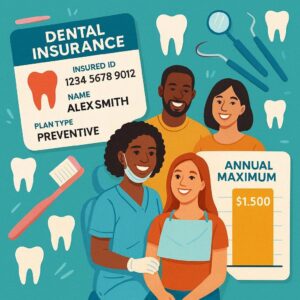
Let’s start with the basics. In the simplest terms, your dental insurance annual maximum is the total dollar amount your insurance company will pay for your dental care within a specific period—usually a calendar year (from January to December).
Think of it like a yearly budget. You pay premiums to the insurance company, and in return, they set aside a pot of money to help pay for your dental work. Once that pot is empty for the year, you are responsible for 100% of the costs until the plan resets.
It is not the total value of your care. It is the insurance company’s contribution.
A Quick Analogy: The Prepaid Phone Card
Imagine you have a prepaid phone card for international calls that has a limit of $100 for the year. Every time you make a call, the cost is deducted from that $100. You might pay a small connection fee (your co-pay), but the bulk of the call cost comes off your card’s balance. Once you hit $100, the card stops working. You can still make calls, but you have to pay for them entirely out of your own pocket. Your dental plan works in a very similar way.
Why Does an Annual Maximum Exist?
It is easy to view the annual maximum as a limitation, a barrier the insurance company puts up to avoid paying for your care. While there is some truth to that, it is more accurate to understand it as a fundamental part of how insurance spreads risk and keeps premiums affordable for everyone.
-
Predictability for the Insurer: By capping their yearly payout per person, insurance companies can accurately predict their total financial liability for the year. This allows them to calculate premiums that are stable and manageable.
-
Keeping Premiums Lower: If there were no annual maximums, insurance companies would have to charge much, much higher premiums to cover the risk of a few members needing extremely expensive, comprehensive care. The maximum acts as a safety valve, keeping the cost of entry (your premium) reasonable.
-
Focus on Preventive Care: Most plans are designed to encourage routine maintenance. By fully covering or heavily subsidizing preventive care (cleanings, exams), they hope you will avoid the major restorative work that eats into that annual maximum.
The Typical Numbers: What Does the Average Plan Look Like?
While plans vary wildly depending on your employer, your location, and the level of coverage you choose, there is an industry standard you can use as a benchmark.
-
The Standard Maximum: For decades, the most common annual maximum for employer-sponsored dental insurance has hovered around $1,500 per person, per year.
-
The Inflation Problem: Here is a critical point that many people miss: that $1,500 figure has remained largely unchanged for over 40 years. If you adjust for inflation, a $1,500 maximum today is worth a fraction of what it was in the 1980s, while the cost of dental procedures has risen significantly. This is often referred to as the “dental insurance gap.”
| Procedure | Typical Cost (Without Insurance) | % Covered by Plan (Typical) | Insurance Pays | What You Pay | Impact on $1,500 Max |
|---|---|---|---|---|---|
| Preventive (Cleaning, Exam, X-rays) | $200 – $300 | 80% – 100% | $200 | $0 – $50 | Low (Uses ~$200) |
| Basic (Simple Filling) | $150 – $350 | 70% – 80% | ~$200 | ~$50 | Moderate (Total Used ~$400) |
| Major (Crown) | $1,200 – $2,000 | 50% – 60% | ~$900 | ~$600 | High (Total Used ~$1,300) |
| Major (Root Canal) | $900 – $1,500 | 50% – 60% | ~$650 | ~$550 | High (Total Used ~$1,950) |
As you can see, it doesn’t take much to hit that maximum. One crown and a root canal can easily wipe out the entire year’s benefit.
The Three Tiers of Coverage: How They Interact with Your Maximum
To truly understand how your money is spent, you need to understand how insurance companies categorize dental procedures. Each tier applies a different “co-insurance” percentage, which deducts a different amount from your annual maximum.
1. Preventive Care (Class I)
This is the “use it or lose it” category, but in a good way. It includes routine cleanings, oral exams, and routine x-rays.
-
Typical Coverage: 80% to 100%.
-
Impact on Maximum: Because the insurance pays almost the entire bill, the full cost of the procedure is usually applied to your annual maximum. This is why using your preventive care early in the year is a smart move.
2. Basic Restorative Care (Class II)
This covers procedures that address common dental issues like cavities and minor tooth decay.
-
Typical Coverage: 70% to 80%.
-
Impact on Maximum: You will pay a co-pay or co-insurance (e.g., 20%), and the insurance pays the rest. The amount they pay comes out of your annual maximum.
3. Major Restorative Care (Class III)
These are the big-ticket items—complex procedures that require significant lab work and chair time.
-
Typical Coverage: 50% to 60%.
-
Impact on Maximum: This is where your annual maximum is most vulnerable. Since the procedures are expensive and the insurance covers only half, the dollar amount they contribute can rapidly deplete your yearly budget.
Important Note: There is often a fourth, separate category for orthodontics (braces, Invisalign). Many plans have a separate, lower lifetime maximum for orthodontics (e.g., $1,500 lifetime) that does not reset every year and is distinct from your annual maximum for restorative care. Always check your policy details.
Strategies to Maximize Your Dental Insurance Benefits
Knowing how the system works allows you to play the game wisely. Here are actionable strategies to ensure you squeeze every last drop of value from your plan.
Strategy 1: The “Use It or Lose It” Rule is Real
This is the golden rule of dental insurance. If you don’t use your $1,500 (or whatever your maximum is) by December 31st, it disappears. It does not roll over. It does not go into a savings account for you. It’s gone.
-
Schedule your cleaning: If you haven’t had your second cleaning of the year, book it now.
-
Don’t delay treatment: If your dentist mentioned a small filling back in March, don’t put it off until next year. Get it done now while you have the budget for it.
Strategy 2: Master the Art of Timing (Treatment Phasing)
This is the most powerful tool in your arsenal. If your dentist presents you with a treatment plan that totals $3,000, you have a problem because your maximum is only $1,500. The solution is treatment phasing.
-
Phase 1 (This Year): Complete the most urgent procedures. Let’s say a crown on a problematic tooth costing $1,200. Your insurance pays its 50% ($600), and you pay your 50% ($600). You have now used $600 of your $1,500 maximum. You have $900 remaining.
-
Phase 2 (Next Year): On January 1st, your annual maximum resets to a fresh $1,500. You can now tackle the next procedure, perhaps a different crown or a root canal. You have a full $1,500 budget to put toward the remaining $1,800 of treatment.
This strategy effectively allows you to use two years’ worth of benefits (a total of $3,000) to pay for a large chunk of expensive treatment.
Strategy 3: Stay In-Network
This seems obvious, but it’s worth emphasizing. In-network providers have pre-negotiated rates with your insurance company. They have agreed to a maximum fee for each procedure.
-
How it helps: If an out-of-network dentist charges $1,400 for a crown, and your insurance allows $1,200, you may be responsible for the $200 difference plus your co-insurance. This difference does not count toward your annual maximum. By staying in-network, you ensure that every dollar your insurance pays goes directly toward your procedures, not toward “excessive” provider charges.
Strategy 4: Coordinate Dual Coverage
Do you and your spouse both have dental insurance through your respective employers? If so, you may have “dual coverage.” You cannot double your maximum to $3,000, but you can use a coordination of benefits provision.
-
How it works: Your primary insurance pays up to its maximum. Then, the remaining bill can be sent to your secondary insurance. The secondary may pay some or all of the remaining balance, up to 100% of the procedure cost. This can drastically reduce your out-of-pocket expense, even if the primary’s maximum was exhausted.
What Happens When You Exceed Your Annual Maximum?
This is the moment most people dread, but understanding it removes the fear. If you hit that magic number, your insurance company’s financial responsibility for the year is over. You enter what is often called the “benefit exhaustion” phase.
-
You are now 100% responsible for all further dental costs for the remainder of the year.
-
Negotiate a payment plan: This is where a good relationship with your dentist’s office manager comes in. Many offices are willing to set up an interest-free monthly payment plan for the remaining balance.
-
Consider a dental discount plan: If you have no insurance or have exhausted your benefits, you might look into a dental discount plan. This isn’t insurance; it’s a membership program where you pay a low annual fee to get discounted rates (usually 10-60% off) on all procedures from participating providers.
-
Prioritize urgent care: If you hit your max in June, you must prioritize. Can a cosmetic whitening wait? Probably. A painful tooth? Absolutely not.
The “Use It or Lose It” Myth vs. Reality
We touched on this earlier, but it deserves its own section because it is the most common point of confusion. People often think that if they don’t “use” their insurance, they are losing money they paid for. This isn’t entirely accurate.
-
The Reality: You didn’t pay for that $1,500 directly. You paid a premium, which is your entry fee to a risk pool. The $1,500 is the maximum the pool will pay out for you. Think of it like car insurance. If you don’t get into an accident, you don’t expect your insurance company to send you a check for your premium back. You paid for the protection, not the payout.
-
The Smart Perspective: Instead of seeing it as “losing” money, see it as a prepaid service budget. By not using your preventive care, you are leaving free money on the table and potentially risking more expensive problems down the road.
Navigating Your Explanation of Benefits (EOB)
Your EOB is not a bill. It is a report card from your insurance company detailing how they processed a claim. Learning to read it is key to tracking your annual maximum.
Look for these key sections:
-
Total Billed: What the dentist charged.
-
Plan Allowed: The negotiated rate your insurance company has deemed acceptable.
-
Paid by Insurer: The amount the insurance paid to the dentist (this is deducted from your annual maximum).
-
Your Share: What you owe the dentist (deductible + co-insurance).
-
Benefit Remaining: A running tally of how much of your annual maximum is left for the year.
Keep all your EOBs in a folder. If you ever have a dispute about whether your maximum was reached, these documents are your proof.
The Future of the Dental Annual Maximum
The dental insurance landscape is slowly evolving. The antiquated $1,500 maximum is being challenged by rising dental care costs and consumer awareness.
-
Rollover Maxims: Some newer, more progressive plans now offer a “rollover” feature. If you don’t use your full maximum, a portion of it (e.g., $250) can roll over to the next year. This rewards people who maintain good oral health.
-
Higher-Tier Plans: Many employers now offer a “buy-up” option. You pay a slightly higher premium for a plan with a higher annual maximum, often $2,000, $2,500, or even $3,000.
-
Direct Primary Care Models: A small but growing trend is the emergence of dental membership plans offered directly by dentists. For a monthly or annual fee, patients get access to preventive care and discounted rates on other services, bypassing traditional insurance maximums altogether.
Conclusion
Understanding your dental insurance annual maximum transforms it from a frustrating limitation into a manageable budget. Remember that it is the yearly cap on what your insurer will pay, not a reflection of your dental needs. By scheduling preventive care, phasing major treatments across calendar years, and staying in-network, you can navigate this cap with confidence. The system works best for those who understand its rules, so use your knowledge to make your dental health both effective and affordable.
Frequently Asked Questions (FAQ)
1. What is a typical dental insurance annual maximum?
The most common annual maximum for individual dental plans is $1,500. However, plans can range from $1,000 to $2,500 or more, depending on the premium and the employer.
2. What happens if I don’t use my full annual maximum?
Generally, unused funds do not roll over. At the end of the plan year (usually December 31st), your benefit resets to the full amount for the new year, and the unused portion from the previous year is forfeited.
3. Does my deductible come out of my annual maximum?
Your deductible is a separate out-of-pocket expense you must pay before your insurance begins to pay. The amount you pay toward your deductible does not count toward your annual maximum. Only the amount the insurance pays counts toward the maximum.
4. If I have two insurance plans, do I have two annual maximums?
Yes, but they don’t combine. Your primary plan pays first up to its maximum. Your secondary plan may then pay for some of the remaining balance, up to its own maximum, but typically not more than 100% of the procedure cost.
5. Can my dentist charge me more than my insurance allows?
If you see an out-of-network dentist, they may “balance bill” you, meaning they charge you the difference between their fee and what your insurance paid. In-network providers have signed a contract preventing them from doing this.
6. Do root canals and crowns count toward the same maximum?
Yes. All covered restorative procedures (fillings, crowns, root canals, dentures) typically count toward the same annual maximum, unless they are orthodontic, which often has a separate lifetime maximum.
Additional Resource
For more detailed information on understanding dental plan fine print and comparing different types of coverage, we recommend visiting the National Association of Dental Plans (NADP) website at [www.nadp.org]. They offer consumer-friendly guides and resources to help you decipher the complexities of dental benefits.