There is a moment in every parent’s life that arrives with a mix of pride and pure financial terror: the day your teenager hands you their driver’s permit or license. You are happy for their newfound independence, but somewhere in the back of your mind, you remember what the internet says about teen driver rates.
Let’s address the elephant in the room immediately. Adding a teenager to your car insurance policy is expensive. In fact, it is one of the single biggest jumps in premium you will ever experience as a driver. But here is the good news: the “average cost” you see plastered across the internet is often a scary, one-size-fits-all number that doesn’t account for your specific situation.
This guide isn’t just about throwing a number at you. We are going to dissect exactly what goes into that rate, how you can fight back against the high costs, and how to navigate the insurance world so you aren’t overpaying for the next five to seven years.
By the time you finish reading, you will know precisely what to expect when you call your agent and exactly what questions to ask to keep your wallet safe.
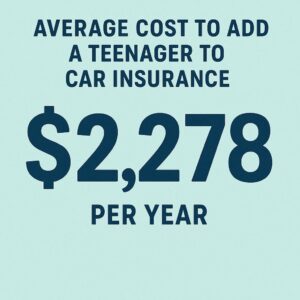
Average Cost to Add a Teenager to Car Insurance
The Hard Truth: How Much Are We Really Talking About?
When insurers look at your family policy and see a 16-year-old being added, they don’t just see your child. They see an actuarial risk. Statistically, teenagers—especially those in the first few years of driving—are involved in more accidents than any other age group. Insurance is a business of predicting risk, and unfortunately, teens are the highest risk on the road.
So, what is the damage?
On a national average, adding a teenager to a parents’ policy will roughly double your annual premium.
To put that into real dollars:
-
Average annual premium for an adult alone: Approximately $1,500 – $2,000.
-
Average annual premium for a family policy with a teen: Approximately $3,000 – $4,500.
According to recent industry data, the specific average cost to add a teenager to car insurance nationally hovers around $2,500 to $3,000 per year. However, this is a very fluid number. It depends heavily on whether the teen is a male or female, how old they are, and where you live.
Important Note: These figures are for adding the teen to an existing policy. Buying a separate policy for a teenager is almost never advisable, as it will cost significantly more—often upwards of $5,000 to $8,000 per year for minimum coverage.
Why Is It So Expensive? The Truth About Teen Drivers
To understand the cost, you have to understand the mindset of the insurance company. They aren’t pricing based on your child’s personality; they are pricing based on hard data.
The “New Driver” Factor
A 16-year-old has zero driving history. The insurance company has no data to suggest they are a safe driver. In the eyes of the underwriter, a lack of history is almost as bad as a bad history.
Distraction and Technology
We live in an age of smartphones. Data shows that the leading cause of accidents for teens is distracted driving. Insurers know this, and they price the policy expecting that your teen might look at their phone while driving, even if you’ve told them a thousand times not to.
The Passenger Multiplier
The risk doesn’t just increase when a teen drives; it increases exponentially when they have friends in the car. A car full of teenagers is statistically a recipe for disaster due to peer pressure and distraction. This is why many states have graduated licensing laws restricting passengers for the first year.
Gender Matters: The Male vs. Female Gap
If you have a son, unfortunately, you are going to pay more. If you have a daughter, you will still see a spike, but it will be slightly less painful.
-
Male Teenagers: Statistically, young male drivers are involved in more fatal accidents and more risky driving behaviors than their female counterparts. Because of this, the average cost to add a male teenager to a policy is roughly 10% to 20% higher than adding a female.
-
Female Teenagers: While rates are lower than males, they are still high. However, the gap tends to widen as the teen gets older. An 18-year-old male driver will see a much steeper rate than an 18-year-old female driver.
The Age Progression: 16 vs. 17 vs. 18 vs. 19
The age at which you add your child makes a significant difference. You might think that waiting until they are 18 would save you money, and you would be partially right. But the savings aren’t as dramatic as you might hope.
-
Age 16: The peak of the cost curve. This is the most expensive time to insure a driver because they are brand new and have the least amount of experience.
-
Age 17: Rates drop slightly (usually around 5-10%) simply because they have survived one year of driving. They now have a year of “proven” experience.
-
Age 18: The “adult” threshold. While 18-year-olds are still considered high-risk, the rate drops more significantly here—often 15-20% lower than at age 16. This is because they are legally adults, and the statistical risk pool improves slightly.
-
Age 19: Rates continue to decline gradually.
-
Age 21+: Once your child turns 21 and maintains a clean record, they will usually fall off the “young driver” classification and rates will normalize significantly.
State-by-State Cost Comparison (Table)
Where you park the car matters just as much as who is driving it. If you live in a state with high population density, high accident rates, or high cost of repairs, you will pay more.
Below is a realistic look at how the average annual cost to add a teen varies across the U.S. (These are estimated averages for adding a 16-year-old to a full-coverage policy).
| State | Average Annual Increase (Male) | Average Annual Increase (Female) | Why the Variance? |
|---|---|---|---|
| California | $2,900 | $2,500 | High population density and strict insurance regulations limit pricing flexibility, but accident rates in urban areas keep costs high. |
| Texas | $3,100 | $2,700 | Large urban sprawl (Houston, Dallas) with high rates of uninsured motorists drives up premiums for everyone, including teens. |
| Florida | $3,800 | $3,300 | Florida leads the nation in high-risk auto insurance due to high litigation rates, severe weather, and a high percentage of elderly drivers mixed with tourists. |
| New York | $3,500 | $3,000 | High cost of living, dense traffic, and expensive medical coverage (PIP) make adding a teen here very costly. |
| Ohio | $1,900 | $1,700 | Generally considered a “low-cost” state for insurance due to moderate population density and fewer catastrophic weather events. |
| Illinois | $2,400 | $2,100 | Chicago metro area rates are high, but downstate rates are lower, averaging out to a moderate increase. |
| Pennsylvania | $2,600 | $2,300 | Varied terrain and a mix of urban and rural driving environments. |
| North Carolina | $1,800 | $1,600 | State regulations keep rates relatively lower than the national average, making it one of the more affordable states to add a teen. |
| Michigan | $4,000+ | $3,500+ | Historically the most expensive state for auto insurance due to unlimited lifetime medical benefits (though recent reforms are slowly changing this). |
| Arizona | $2,200 | $1,900 | Growing population and high rates of heat-related vehicle issues, but generally moderate premiums. |
Note: These figures are estimates. Your actual rate will depend on your specific zip code, credit score (where allowed), and the type of car driven.
It’s Not Just the Driver: The “Car Factor”
You might think you are just insuring the teenager. In reality, you are insuring the teenager inside a specific vehicle. This is a critical detail that many parents overlook.
The “Worst Car” Rule
Insurance companies often use a principle called “driver assignment.” They will assign your high-risk teen to the highest-risk vehicle on your policy. If you have a brand new sports car and an old minivan, and you tell the insurer your teen drives the minivan, the insurer may still price based on the sports car if it is available to them.
How the Car Choice Affects the Rate
-
The Safe Choice (Best for Rates): An older (but safe) mid-size sedan or SUV with good crash test ratings, stability control, and a 4-cylinder engine. Think Honda CR-V, Subaru Outback, Toyota Camry. These vehicles are cheap to repair and unlikely to be used for street racing.
-
The Risky Choice (Worst for Rates): High-horsepower vehicles, two-door coupes, and convertibles. If your teen drives a Mustang, a Charger, or even a smaller two-door Civic Coupe (compared to a four-door Civic Sedan), expect a surcharge on top of the teen surcharge.
Strategies to Lower the Cost (The Discount Guide)
Okay, enough with the scary numbers. Let’s talk about how you get that bill down. Insurance companies are required to offer certain discounts, but they rarely advertise them loudly. You have to ask.
The “Good Student” Discount
This is the biggest and most common discount.
-
Requirement: Your teen must be a full-time student and maintain a “B” average or above (usually a 3.0 GPA).
-
Savings: Typically 5% to 25% off the teen portion of the premium.
-
Pro Tip: You will need to provide a report card or a transcript to your insurer annually to keep this discount active.
Driver Training and Defensive Driving Courses
Most states require a driver’s ed course to get a license, but a voluntary defensive driving course after they are licensed can yield additional savings.
-
Savings: Usually a flat discount (around 5-10%) for completing an approved course.
The “Away at School” Discount
This is a lifesaver for parents of college students.
-
The Rule: If your teen goes to college more than 100 miles away from home and does not take a car with them, you can usually get a significant discount.
-
Savings: Up to 50% off the teen’s portion of the premium during the school year, because the insurer considers them a “part-time” driver.
Telematics (Usage-Based Insurance)
This is the modern way to save. Programs like Progressive’s Snapshot, State Farm’s Drive Safe & Save, or Allstate’s Drivewise involve plugging a device into the car or using a smartphone app to monitor driving habits.
-
How it works: It tracks hard braking, speeding, rapid acceleration, and the time of day the car is driven (late-night driving is penalized).
-
Savings: Good drivers can save 10% to 30%. However, be warned: bad habits can raise your rate or disqualify you from the discount.
Bundle and Multi-Policy Discounts
If you have homeowners or renters insurance, make sure you bundle it with your auto insurance. The multi-policy discount often applies to the entire premium, including the teen’s portion.
The “Named Driver” Exclusion: A Word of Caution
Sometimes, parents look at the cost and ask the agent, “What if we just don’t put them on the policy? They can drive my car once in a while.”
Do not do this.
If a teenager lives with you and has access to your vehicles, they must be listed on the policy, or at least rated on the policy. If they are in an accident and are not listed, the insurance company has every right to:
-
Deny the claim entirely.
-
Pay the claim but then retroactively add the teen to your policy and bill you for two years of back premiums.
-
Drop you as a customer (non-renewal).
The “Excluded Driver” Option
There is a legal way to remove them: the Named Driver Exclusion. If your teen has their own car and their own insurance, or if you strictly forbid them from driving and sign a form saying so, you can exclude them.
-
The Risk: If you exclude them and they do drive your car and get into an accident, the coverage is void. You pay for everything out of pocket. This is only advisable in very specific family situations.
The Financial Timeline: When Does It End?
The financial burden of a teen driver isn’t permanent. Here is the typical timeline of how the costs phase out:
-
Ages 16-18: Maximum rates. You are paying the highest possible premium.
-
Age 18-21: Gradual decline. The rate drops every 6 to 12 months as they gain experience and reach legal adulthood.
-
Age 21-25: Significant drop. By 21, if they have a clean record, they are no longer in the “high-risk” pool.
-
Age 25+: The “good driver” rate. At this point, they should be rated similarly to any other experienced adult.
Once your child graduates college, gets a full-time job, and moves out, it is time for them to get their own policy. This is a good thing—it removes them entirely from your rating calculation.
When to Keep Them and When to Kick Them Off
Deciding when your child should get their own policy is a balancing act.
-
Keep them on your policy as long as they live with you. It is almost always cheaper to have them as an additional driver on your multi-car policy than for them to buy a single policy.
-
Once they move out, they need their own insurance. However, if they move out but still use your address for mail and voting, keep them on your policy. Insurance is tied to the garaging address. If the car is parked at their apartment, the policy should reflect that.
Conclusion
Adding a teenager to your car insurance is an unavoidable rite of passage that comes with a significant financial adjustment. While the average cost to add a teenager to car insurance nationally lands between $2,500 and $3,000 annually, this number is not set in stone. By understanding the factors that drive the cost—like the choice of vehicle, the importance of good grades, and the strategic use of telematics—you can take control of the situation. The key is to be proactive, ask your insurer about every possible discount, and encourage safe driving habits from day one. This phase is expensive, but with the right strategy, it doesn’t have to break the bank.
Frequently Asked Questions (FAQ)
1. Is it cheaper to add a teen to my insurance or get them their own policy?
It is almost always significantly cheaper to add them to your existing policy. A separate policy for a teen is considered a “high-risk” policy and can cost two to three times more than adding them as an additional driver on your family policy.
2. Does my teen need their own car to be insured?
No. They can be listed as a driver on your policy even if they don’t own a vehicle. They will be covered when driving any of the family cars listed on the policy (and usually, they have limited coverage when driving a non-owned car).
3. Will my rates go down if my teen only has a permit?
Yes. Most insurance companies have a different rating class for “permit” drivers versus fully licensed drivers. While you should notify your insurer as soon as they get their permit to ensure coverage during practice driving, the rate increase usually doesn’t hit in full until they pass the road test and obtain their full license.
4. What happens if my teen gets a ticket?
If your teen gets a moving violation, it will likely cause your rates to increase at the next renewal. For a first minor infraction, some insurers offer “accident forgiveness” or ticket forgiveness, but this varies by company. Major violations (like speeding 20+ over the limit or reckless driving) can cause massive rate hikes or even policy non-renewal.
5. Do I need to insure my teen if they don’t live with me full-time (e.g., divorced parents)?
Generally, the teen should be listed on the policy of the parent whose home they primarily reside in and where the car is primarily garaged. If custody is split 50/50, the insurer may require the teen to be listed on both policies, or they may designate one primary policy. Always disclose the situation to avoid coverage gaps.