Living in the Magic City is an experience like no other. From the vibrant nightlife of South Beach to the cultural rhythm of Little Havana, Miami is a place of energy and constant motion. But if you own a vehicle here, you know that navigating the roads of Miami-Dade County comes with its own unique set of challenges—and a price tag that often shocks newcomers.
If you’ve been asking yourself, “What is the average car insurance cost in Miami for 2026?”, you’ve come to the right place. Whether you’re a longtime resident, a new transplant from another state, or just looking to shop for a better rate, understanding the nuances of Miami’s insurance market is the first step to saving money.
In this guide, we’ll break down exactly what you can expect to pay in 2026, why rates are so specific to our city, and—most importantly—how you can find the best coverage without breaking the bank.
Let’s dive in.
The 2026 Landscape: What Drivers in Miami Can Expect
Before we get into the nitty-gritty of numbers, it’s important to set the stage for 2026. The auto insurance industry doesn’t exist in a vacuum; it’s heavily influenced by the world around it. As we move through the mid-2020s, several key factors are converging to shape the rates you’ll see on your quotes.
First, vehicle technology continues to advance. Cars are packed with more sensors, cameras, and expensive electronic components than ever before. While this makes driving safer, it also means that even a minor fender bender in a Miami parking lot can result in a repair bill that is thousands of dollars higher than it was a decade ago. Insurers have to account for these higher claim costs.
Second, the weather in South Florida remains a constant factor. We know hurricane season all too well. While comprehensive coverage (which covers weather damage) is separate from collision, the overall risk profile of insuring a car in a coastal, storm-prone area keeps baseline premiums elevated.
Finally, the trend of distracted driving continues to be a national concern, and Miami’s dense, fast-paced traffic is a prime environment for accidents. Insurers use massive amounts of data to predict risk, and the driving habits observed in 2024 and 2025 will directly influence the rates we see in 2026.
Average Car Insurance Cost Miami for 2026
So, let’s get to the heart of the matter. What are you actually going to pay?
It is crucial to understand that “average” is a slippery term. Your neighbor might pay a completely different rate than you do, even if you drive the same car. However, based on current market trends, inflation adjustments, and the specific risk factors of Miami-Dade County, we can project realistic figures for 2026.
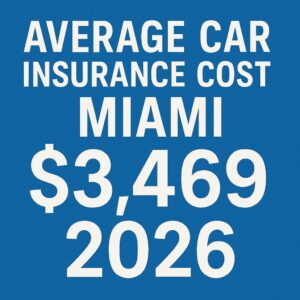
For a standard policy with full coverage (which includes liability, collision, and comprehensive), the average driver in Miami can expect to pay somewhere between $2,800 and $3,500 per year.
To make this easier to digest, let’s look at it on a monthly basis.
| Coverage Type | Estimated Monthly Cost (2026) | Estimated Annual Cost (2026) |
|---|---|---|
| State Minimum Liability Only | $90 – $130 | $1,080 – $1,560 |
| Standard Full Coverage | $235 – $290 | $2,820 – $3,480 |
| Full Coverage (Sports Car/New Model) | $350 – $500+ | $4,200 – $6,000+ |
A Quick Note: These figures are estimates. They represent a general range for a driver with a good driving record. If you have recent accidents or tickets on your record, you will likely find yourself on the higher end of these scales—or even above them.
Miami vs. The Rest of Florida (and the USA)
To truly understand the cost, you have to look at the context. Florida is consistently ranked as one of the most expensive states in the nation for car insurance, and Miami is the most expensive major city in that state.
Why? Because insurance rates are ultimately about risk and cost.
While the average annual premium in the United States hovers around $1,500 to $1,800 for full coverage, Florida’s statewide average is already significantly higher, often topping $2,500. Miami sits at the peak of that curve. Compared to a city like Tallahassee or Jacksonville, Miami drivers frequently pay 30% to 50% more. This is the reality of living in a major metropolitan hub with unique legal and environmental challenges.
Why Is Car Insurance So Expensive in Miami?
If you’re new to the area, your jaw might have dropped at those numbers. It’s a fair reaction. The cost of car insurance in Miami isn’t just a random number pulled from thin air. It’s the result of a perfect storm of specific factors. Let’s break down the main culprits.
1. The High Rate of Uninsured Motorists
This is arguably the biggest factor. Florida has one of the highest rates of uninsured drivers in the country, with some estimates suggesting that over 20% of drivers on the road have no insurance at all. When you are involved in an accident with an uninsured driver, your own insurance policy has to cover the damages. This risk is priced into everyone’s premium. Essentially, responsible drivers pay higher rates to protect themselves from the irresponsible ones.
2. Florida’s No-Fault Insurance Laws
Florida is a “no-fault” state. This means that after an accident, you turn first to your own insurance policy (specifically, Personal Injury Protection, or PIP) to cover your medical bills, regardless of who caused the crash. While designed to speed up payments, this system is also prone to fraud. Unscrupulous medical clinics and legal actors have historically exploited this system, leading to inflated costs that trickle down to every policyholder in the form of higher premiums.
3. Dense Population and Heavy Traffic
Miami is a densely populated city with a constant influx of tourists and seasonal residents. More cars on the road—especially driven by people unfamiliar with the area—simply means more accidents. Insurers look at the accident frequency in a specific zip code. In Miami, those frequencies are high, and premiums reflect that increased likelihood of a claim.
4. Theft and Fraud Concerns
Unfortunately, vehicle theft and insurance fraud are persistent issues in South Florida. Whether it’s organized crime rings targeting specific vehicles or staged accident scams, these illegal activities cost the insurance industry billions each year. They recoup those losses by raising premiums for everyone in the affected areas.
5. Cost of Repairs and Lawsuits
As mentioned earlier, modern cars are expensive to fix. Beyond that, Florida is known for being a litigious state when it comes to auto accidents. The frequency of lawsuits related to car accidents drives up the costs for insurance companies, which are then passed on to you, the consumer.
Breaking Down the Types of Coverage
When you look at a car insurance policy, it’s not just one price for one thing. It’s a package of different protections. Understanding these parts can help you make smart decisions about where to save money and where to spend a little more for peace of mind.
Here’s what you’ll typically see on your declaration page:
-
Bodily Injury Liability (BIL): This pays for injuries you cause to other people in an accident. Florida law does not technically require this, but if you have any assets to protect (like a home or savings), you absolutely need it. Driving without it is a massive financial risk.
-
Property Damage Liability (PDL): This pays for damage you cause to someone else’s property, usually their vehicle. This is required by Florida law.
-
Personal Injury Protection (PIP): This is the “no-fault” coverage required by Florida. It covers your medical expenses (and those of your passengers) up to a certain limit, regardless of fault, no matter who caused the accident.
-
Collision: This pays for damage to your own car resulting from a collision with another car or object, regardless of fault.
-
Comprehensive: This pays for damage to your car from things other than a collision—like theft, vandalism, hurricane damage, flooding, or hitting a deer.
-
Uninsured/Underinsured Motorist (UM/UIM): This is a critical coverage in Miami. It protects you if you are hit by a driver who has no insurance or not enough insurance to cover your injuries.
How to Save on Your Miami Car Insurance in 2026
Paying high rates isn’t inevitable. While you can’t change the city you live in, you can change how insurers view you as an individual. Here are proven strategies to lower your premium in 2026.
Shop Around and Compare Quotes
This is the single most effective thing you can do. Insurance companies use different formulas to calculate risk. One company might favor drivers with long commutes, while another might penalize them. Get quotes from at least three to five different insurers. Don’t just go with the first name you recognize.
Leverage Discounts
Insurance companies offer a wide variety of discounts. You just have to ask for them.
-
Multi-Policy Discount: Bundling your auto insurance with your renters or homeowners insurance is one of the easiest ways to save.
-
Multi-Car Discount: Insuring more than one vehicle on the same policy usually gets you a discount.
-
Safe Driver Discount: Maintaining a clean driving record for several years is rewarded.
-
Defensive Driving Course: Completing an approved defensive driving course can sometimes net you a discount, especially for drivers over 55.
-
Good Student Discount: If you have a young driver on the policy who maintains a B average or better, you can often save significantly.
-
Telematics/Usage-Based Insurance: Many insurers now offer programs where they track your driving habits (mileage, hard braking, time of day you drive) via an app or a device in your car. Safe driving can lead to substantial savings.
Raise Your Deductibles
Your deductible is the amount you pay out of pocket before your insurance kicks in. If you raise your collision and comprehensive deductibles from $500 to $1,000, your premium will drop. Just make sure you have that $1,000 set aside in an emergency fund in case you need it.
Check Your Credit Score
In most states, including Florida, insurers use your credit-based insurance score to help determine your rate. Statistically, people with good credit file fewer claims. Maintaining a healthy credit score can positively impact your insurance costs.
Drive a “Cheaper” Car
Before you buy your next vehicle, check the insurance rates. A sports car or a luxury SUV with high theft rates will cost a fortune to insure compared to a sensible sedan or a minivan with top safety ratings.
The Future of Insurance: Telematics and AI
As we look toward 2026, technology is playing an increasingly large role in how we buy and use car insurance. We’re moving away from the one-size-fits-all model.
Telematics, or usage-based insurance (UBI), is becoming mainstream. Instead of just looking at your age and zip code, insurers can look at how you actually drive. Do you slam on the brakes? Do you speed? Do you drive 50 miles a day or 5 miles a day? Programs like Progressive’s Snapshot, State Farm’s Drive Safe & Save, and Allstate’s Drivewise use this technology.
For a safe driver in Miami, this could be a game-changer. It allows you to prove that despite the city’s high-risk reputation, you are a low-risk individual, potentially earning you a rate that beats the city average.
Furthermore, Artificial Intelligence (AI) is streamlining the claims process and helping insurers detect fraud more efficiently. While this doesn’t directly lower your premium overnight, it helps keep the overall system healthier and can prevent the massive fraud-driven spikes we’ve seen in the past.
Conclusion
As we look ahead to 2026, one thing is certain: car insurance will remain a significant expense for Miami drivers. The unique combination of Florida’s legal landscape, the high rate of uninsured motorists, and the dense, bustling traffic of Miami-Dade County ensures that premiums will stay well above the national average. While the projected cost of $2,800 to $3,500 per year for full coverage may seem daunting, knowledge is your best tool. By understanding the factors that drive these costs and actively managing your own insurability—through safe driving, smart policy choices, and diligent comparison shopping—you can navigate the market with confidence and find the protection you need at the fairest price possible.
Frequently Asked Questions (FAQ)
Q: Is car insurance more expensive in Miami than in the rest of Florida?
A: Yes, generally speaking. Miami-Dade County consistently has some of the highest average premiums in the state due to its dense population, higher rates of accidents and theft, and a significant number of uninsured drivers.
Q: What is the minimum car insurance required by law in Florida?
A: Florida law requires drivers to carry $10,000 of Personal Injury Protection (PIP) and $10,000 of Property Damage Liability (PDL) . Bodily Injury Liability is not technically required but is highly recommended to protect your assets.
Q: Does my credit score affect my car insurance rate in Miami?
A: Yes, in most cases. Florida insurers are permitted to use a credit-based insurance score to help determine your premium. Maintaining good credit can help you secure a lower rate.
Q: How can I lower my car insurance bill before 2026?
A: The best ways are to shop around for quotes from multiple companies, ask about available discounts (especially for bundling policies), consider raising your deductible, and enroll in a usage-based insurance program to prove you are a safe driver.
Q: Why is my insurance quote so high even though I have a clean record?
A: Your personal driving record is just one factor. Insurers also look at your zip code, the make and model of your car, your age, your credit history, and the overall claim statistics for your area. In Miami, the citywide statistics can push premiums up for everyone.
Additional Resource
For official information on Florida insurance laws, consumer rights, and assistance, you can visit the Florida Office of Insurance Regulation (OIR) website. They provide valuable resources for understanding your policy and filing complaints if necessary.
Click here to visit the Florida Office of Insurance Regulation Website