If you own a boat in the Lone Star State, you already know that Texas is a boater’s paradise. From the expansive Gulf Coast and the Houston Ship Channel to the serene lakes of the Hill Country like Lake Travis and Canyon Lake, there’s no shortage of water to explore. However, with great boating opportunities comes great responsibility—and the need for solid insurance.
As we look ahead to 2026, many boat owners are asking the same question: “How much is this going to cost me?” Whether you own a small fishing skiff or a luxury yacht, understanding the Average Cost of Boat Insurance in Texas 2026 is the first step to protecting your investment.
In this guide, we will dive deep into current market trends, pricing factors, and money-saving tips to ensure you are well-informed before your next voyage.
Why Boat Insurance Matters in Texas
Before we talk numbers, it is important to understand why boat insurance is not just an optional expense. While Texas law does not require insurance for all watercraft like it does for cars, most marinas and lenders do.
-
Marina Requirements: If you plan to keep your boat at a marina, they will almost certainly require you to carry liability insurance.
-
Lender Requirements: If you financed your boat, the bank will require comprehensive coverage to protect their asset.
-
Accidents Happen: Collisions with other boats, running aground, or even theft are real risks on Texas waterways.
Average Cost of Boat Insurance in Texas 2026
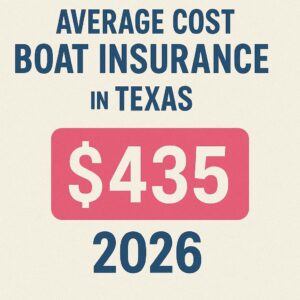
So, what is the bottom line? Based on current market analysis and projected trends for 2026, Texas boaters can expect to pay between $300 and $800 per year for a standard policy on a mid-range vessel.
However, this is a broad average. To give you a clearer picture, we have broken down the estimated costs based on boat type and value.
Boat Insurance Premium Estimates for 2026
| Boat Type | Average Insured Value | Estimated Annual Premium |
|---|---|---|
| Small Fishing Boat (Jon Boat, Skiff) | $5,000 – $15,000 | $200 – $350 |
| Bowrider / Runabout (18-22 ft) | $20,000 – $40,000 | $350 – $550 |
| Pontoon Boat | $25,000 – $50,000 | $400 – $600 |
| Wakeboard / Ski Boat | $50,000 – $80,000 | $500 – $800 |
| Cruiser / Yacht (30ft+) | $100,000+ | $900 – $2,500+ |
| Personal Watercraft (Jet Ski) | $8,000 – $15,000 | $150 – $400 |
Note: These are estimates for 2026 based on a boater with a clean record in Central or Coastal Texas. Actual rates may vary based on specific circumstances.
Key Factors Influencing Your Insurance Rate
Insurance companies look at a variety of risk factors when calculating your premium. Understanding these can help you see why your neighbor pays a different rate than you do.
1. The Value and Type of Your Boat
This is the biggest factor. A high-speed cigarette boat designed for speed is riskier to insure than a slow-moving pontoon designed for leisurely cruising. Similarly, the higher the value, the more it costs to replace.
2. Where You Boat in Texas
Location is crucial. Boating primarily on calm inland lakes like Lake Conroe or Lake Lewisville usually results in lower rates than navigating the coastal waters near Galveston or South Padre Island. Saltwater environments and offshore navigation introduce higher risks, such as sinking and greater liability.
3. Your Boating Experience
Insurance companies love experienced boaters. If you have completed a boating safety course (like those offered by the U.S. Coast Guard Auxiliary), you are statistically less likely to file a claim. Be sure to mention this to your agent.
4. Storage Solutions
Where you keep your boat when it is not in use matters significantly.
-
Dry Storage: Stored on a trailer in your driveway or a yard.
-
Marina Docking: Kept in a slip in the water (higher risk of storm damage).
-
Lift or Covered Slip: The best of both worlds; protected from sun and waves but still on the water.
5. Horsepower and Speed
High-horsepower engines mean higher speeds and greater risk. If your boat has a massive engine, expect your premium to reflect that.
Understanding Your Coverage Options
To understand the cost, you must understand what you are buying. A standard boat insurance policy in Texas typically includes several components.
Liability Coverage
This is the foundation of your policy. It pays for injuries you cause to others and damage you cause to their property. If you accidentally run into a dock or another boat, liability coverage kicks in. Experts recommend carrying at least $300,000 to $500,000 in liability coverage for 2026, given the rising cost of medical care and repairs.
Comprehensive & Collision
-
Collision: Pays to repair your boat if you hit an object (like a submerged log) or another vessel.
-
Comprehensive: Covers non-collision incidents like theft, vandalism, fire, or hail damage.
Uninsured Boater Coverage
Sadly, not everyone on the water has insurance. If an uninsured boater hits you, this coverage pays for your damages and medical bills. This is highly recommended for Texas waterways.
Medical Payments
This covers medical expenses for you and your passengers if injured on the boat, regardless of who is at fault. It is a relatively inexpensive addition that provides peace of mind.
Towing and Assistance
Running out of gas or suffering a mechanical failure in the middle of a lake is inconvenient. This add-on covers the cost of towing you back to the ramp or marina.
Important Note: Read your policy carefully regarding “winterizing” or “lay-up” periods. Some policies only cover you during the boating season (typically April to October in Texas) unless you pay extra for year-round coverage.
Regional Risks: Coastal vs. Inland Texas
When calculating the Average Cost of Boat Insurance in Texas 2026, underwriters will heavily weigh your operating area.
Inland Texas (Lakes and Rivers)
Boaters on lakes like Possum Kingdom, Cedar Creek, or the Rio Grande generally enjoy lower rates. The risks here are primarily collisions, theft, and occasional severe storms. The water is calm, and the navigation is generally straightforward.
Coastal Texas (Gulf of Mexico)
If you boat near Corpus Christi, Port Aransas, or Freeport, your rates will be higher. Coastal insurance must account for:
-
Hurricane and Windstorm Risk: This is a major factor. After a heavy storm season, reinsurance costs go up, which trickles down to boat owners.
-
Saltwater Corrosion: Constant exposure to saltwater increases maintenance costs and the likelihood of equipment failure.
-
Navigation Limits: Your policy may restrict how far out to sea you can go (e.g., within 25 miles of the coast).
How to Save on Boat Insurance in 2026
Nobody wants to overpay. Here are some realistic and effective ways to lower your premium without sacrificing coverage.
Bundle Your Policies
If you already have home and auto insurance with a company, ask about adding your boat. Most major insurers offer a multi-policy discount that can save you 10% to 20%.
Increase Your Deductible
Just like with a car or home, choosing a higher deductible (the amount you pay out of pocket before insurance kicks in) will lower your annual premium. Just make sure you can afford the deductible if something happens.
Take a Safety Course
We mentioned it earlier, but it is worth repeating. Completing a NASBLA-approved boating safety course is one of the easiest ways to prove you are a responsible owner and earn a discount.
Install Safety Features
Equipping your boat with a GPS tracking system, a ship-to-shore radio, fire extinguishers, and theft deterrents can lead to lower rates.
Pay Annually
Insurance companies often charge administrative fees for monthly payment plans. If you can afford to pay the full premium upfront, you will usually save money compared to paying month-to-month.
The Future of Boating Insurance in Texas
As we move through 2026, the insurance landscape is shifting. With climate change leading to more unpredictable weather patterns, insurers are becoming more cautious. Additionally, the rising cost of boat parts and labor (due to supply chain stabilization but higher labor costs) means that repair claims are more expensive than ever.
This means that while the market remains competitive, the Average Cost of Boat Insurance in Texas 2026 is experiencing a slight upward trend compared to 2024-2025. Shopping around and maintaining a clean history is more important than ever.
List of Documents You’ll Need for a Quote
To get an accurate quote, have the following information ready:
-
HIN (Hull Identification Number): Similar to a car’s VIN.
-
Purchase Price/Current Value: Proof of what you paid or a recent appraisal.
-
Engine Details: Horsepower, fuel type, and number of engines.
-
Safety Equipment: List of installed gear (fire suppression, GPS, etc.).
-
Boating History: Years of experience and any safety course certificates.
Conclusion
Boating in Texas offers a fantastic lifestyle, and protecting that lifestyle with the right insurance is a smart move. While the average cost typically falls between $300 and $800 annually for most boaters, the exact figure depends on your unique situation—from the size of your motor to the salinity of your favorite fishing spot. By understanding the risks and shopping wisely, you can find a policy that fits your budget and lets you enjoy the water with peace of mind in 2026.
Frequently Asked Questions (FAQ)
1. Is boat insurance legally required in Texas?
No, Texas state law does not mandate insurance for most watercraft. However, if you have a loan on the boat, your lender will require it. Additionally, almost all marinas require proof of insurance before you can dock there.
2. Does my homeowners insurance cover my boat?
It might, but only to a very limited extent. Homeowners policies usually cover very small boats (like canoes or small dinghies) with low value, and only for specific perils like theft. They do not cover liability on the water or damage from sinking. A standalone boat policy is almost always necessary.
3. What is the best month to buy boat insurance?
You can buy insurance anytime, but if you are looking for the best rate on a new policy, consider purchasing in the late winter or early spring (January-March). This is before the peak boating season, and some insurers offer incentives to get your business early.
4. Does boat insurance cover mechanical breakdown?
Generally, no. Standard boat insurance covers sudden and accidental damage (like hitting a rock), but not mechanical failure due to wear and tear, such as a engine blowing a gasket. For that, you would need a separate mechanical breakdown warranty or service contract.
5. How is the value of my boat determined for a claim?
It depends on the policy.
-
Agreed Value: You and the insurer agree on the boat’s worth when you buy the policy. If it is totaled, you get that amount (minus deductible).
-
Actual Cash Value: The insurer pays the current market value, factoring in depreciation. This is usually cheaper to buy but can result in a lower payout for an older boat.
Additional Resource
For official boating safety courses and regulations in Texas, visit the official Texas Parks & Wildlife Department website: Texas Parks & Wildlife – Boating. Completing a course here can help lower your insurance premium.