You come home to find a leak has ruined your kitchen floor. Or a storm has torn off several shingles from your roof. Your first instinct might be to grab your phone and file a claim immediately. After all, you have paid your premiums on time for years. That is what insurance is for, right?
Not so fast.
Filing a homeowners insurance claim is one of those decisions that seems simple on the surface but gets complicated very quickly. A claim can save you from financial disaster. However, it can also lead to higher premiums or even a policy cancellation.
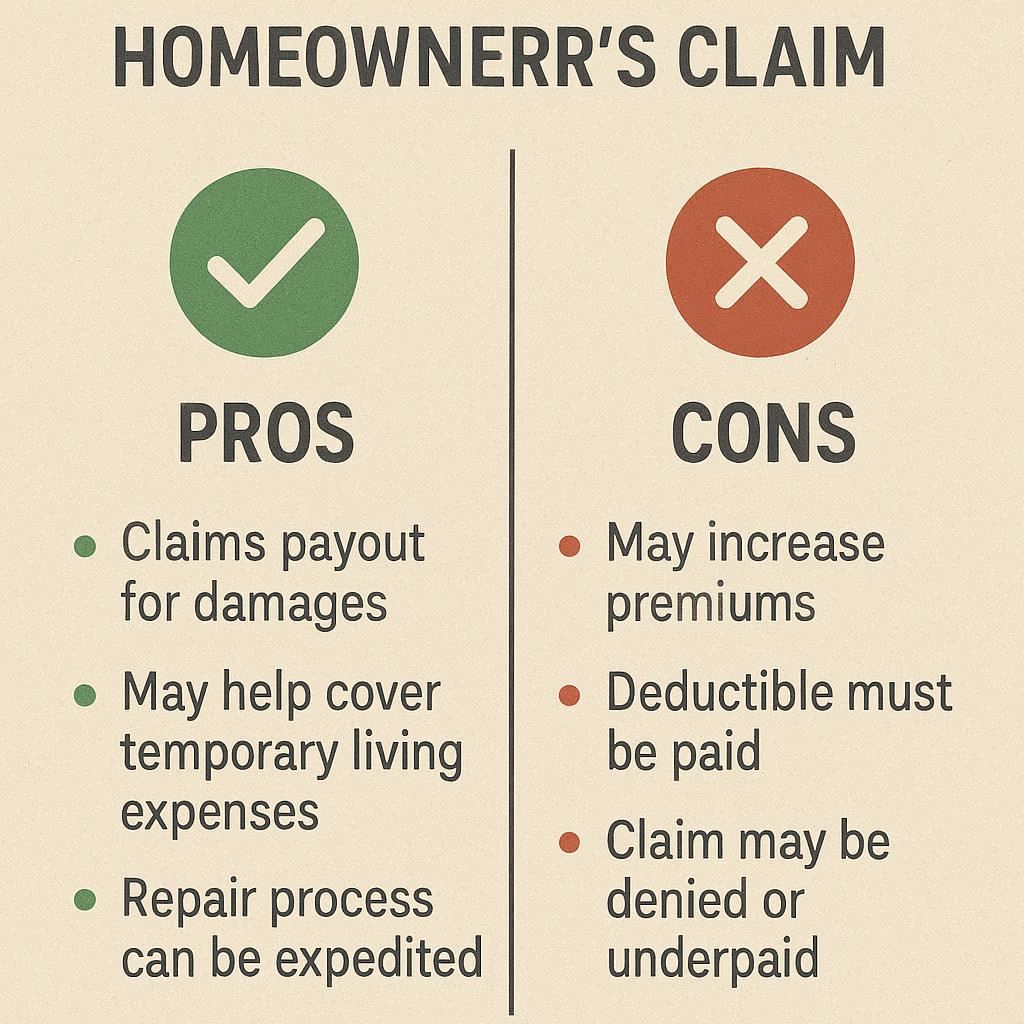
This guide walks you through every advantage and disadvantage. You will learn when to file, when to pay out of pocket, and how to protect your wallet and your coverage for the long term.
Understanding the Basics: How Homeowners Claims Work
Before exploring the pros and cons, it helps to know what happens behind the scenes. When you file a claim, you are asking your insurance company to pay for damage to your home or belongings. You will pay a deductible first. Then the insurer covers the remaining cost, up to your policy limits.
But here is the part many homeowners miss. Every claim you file goes into a central database called the Comprehensive Loss Underwriting Exchange (CLUE). Insurance companies check this database whenever you apply for a new policy or renew an existing one. So a small claim today could affect your rates for five to seven years.
That is why you need to think carefully. Let us look at the real benefits first.
The Pros: Why Filing a Claim Makes Sense
Filing a claim is not always a bad move. In some situations, it is the smartest financial decision you can make. Here are the genuine advantages.
Financial Protection Against Major Losses
The most obvious pro is also the most important. Homeowners insurance exists to protect you from bills you cannot pay on your own. Imagine a fire destroys half your house. The repair costs could easily exceed $100,000. Most people do not have that kind of cash sitting in a savings account.
In this scenario, filing a claim is not just helpful. It is necessary. Your insurance steps in to cover the massive expense after your deductible. Without it, you might face bankruptcy or lose your home entirely.
Coverage for Additional Living Expenses
Your home is more than four walls. It is where you sleep, cook, and live. If a covered disaster makes your home uninhabitable, your policy’s Additional Living Expenses (ALE) coverage starts working.
This means your insurer pays for:
- A hotel or rental home
- Restaurant meals
- Laundry services
- Storage units for your belongings
- Extra transportation costs
These expenses add up fast. A month in an extended-stay hotel could cost $3,000 or more. Your insurance handles this while you figure out your next steps. That is a significant pro that many homeowners overlook.
Peace of Mind During a Crisis
Let us be honest about the emotional side of this decision. When a tree crashes through your living room or a pipe bursts in the middle of the night, you are already stressed. You do not need the added pressure of finding thousands of dollars immediately.
Filing a claim allows you to focus on your family’s safety and well-being. You hire professionals to fix the damage. You stay in a comfortable place. The insurance company handles the money side. That peace of mind has real value, even if you cannot put a dollar amount on it.
Access to Vetted Contractors
Many insurance companies maintain networks of approved contractors. These professionals meet specific licensing, insurance, and quality standards. When you file a claim, you can access these pre-screened experts.
This protects you from scam artists who show up after disasters. You also avoid the headache of calling ten different roofers or plumbers to get quotes. The insurance company helps coordinate the repairs. For homeowners who do not have a trusted contractor already, this is a major advantage.
The Cons: The Hidden Costs of Filing a Claim
Now for the uncomfortable truth. Filing a claim can backfire in ways that surprise even experienced homeowners. These cons might make you think twice before picking up the phone.
Premium Increases That Last for Years
This is the number one reason people hesitate to file a claim. And they are right to worry. Insurance companies see a claim as evidence that you are more likely to file another one in the future. Even if the damage was completely out of your control.
Your rates might go up at your next renewal. The increase depends on several factors:
- The type of claim (water damage often causes bigger increases than wind damage)
- The amount the insurer paid out
- Your claims history before this incident
- The laws in your state
Some homeowners see their premiums jump by 20% to 40% after a single claim. And that higher rate can stick around for three to seven years.
The Risk of Non-Renewal or Cancellation
Here is a worse outcome than higher premiums. Your insurance company might decide not to renew your policy at all. This happens more often than people realize.
Insurance companies track how many claims you file and how much they pay out. If you file two small claims within a few years, you look like a high-risk customer. The company might send you a non-renewal notice when your policy term ends.
Then you have to find a new insurer. But other companies will see your claims history in the CLUE database. Many will quote you very high rates. Some will refuse to cover you entirely. You might end up with a state-run insurer of last resort, which costs significantly more and offers less coverage.
The Deductible Reality Check
Your deductible is the amount you pay before insurance kicks in. Many homeowners carry deductibles of 1,000,2,500, or even more. Some policies have percentage deductibles for certain perils like wind or hail. That percentage might be 1% or 2% of your home’s insured value.
Let us do the math. Your home is insured for 300,000.Yourwindandhaildeductibleis26,000 before insurance pays a single dollar.
If the damage estimate comes back at 7,000,yourinsurancewouldonlypay1,000. Is filing a claim worth it for a $1,000 payout? Probably not. But many homeowners do not realize their effective deductible is that high until after they file.
Small Claims Are Often a Net Loss
This point connects directly to the deductible issue. Homeowners sometimes file claims for damage that costs only slightly more than their deductible. They think they are coming out ahead. But they forget about the long-term cost of higher premiums.
Consider this realistic example:
| Scenario | Cost | Insurance Payout | Long-Term Cost (Higher Premiums) | Net Result |
|---|---|---|---|---|
| Small roof repair | $2,500 | 1,500(after1,000 deductible) | $2,400 over 3 years | You lose $900 |
| Medium water damage | $8,000 | 7,000(after1,000 deductible) | $2,400 over 3 years | You gain $4,600 |
| Large fire damage | $75,000 | 74,000(after1,000 deductible) | $3,000 over 5 years | You gain $71,000 |
As you can see, small claims can actually cost you money once you factor in premium increases. Medium and large claims still make financial sense. But you need to know which category your damage falls into before filing.
The Time and Effort Involved
Filing a claim is not a five-minute process. You will need to:
- Document all damage with photos and videos
- Fill out detailed forms from your insurer
- Meet with an adjuster who inspects your home
- Get repair estimates from contractors
- Negotiate if the adjuster’s estimate seems too low
- Wait for checks to arrive in the mail
- Manage the repair process yourself
For a major disaster, this effort is worth it. For a minor issue, you might spend twenty hours of your life to recover a few hundred dollars. That is not a good trade for most people.
When to File a Claim: A Practical Decision Framework
Knowing the pros and cons is one thing. Applying them to your real-life situation is another. Use this simple decision framework to guide your choice.
The 1.5x Rule of Thumb
Many insurance agents suggest a simple rule. Only file a claim if the repair cost exceeds your deductible by at least 50%. In other words, if the damage will cost 1.5 times your deductible or more.
So with a 1,000deductible,youwouldonlyfilefordamagesabove1,500. With a 2,500deductible,youwouldonlyfilefordamagesabove3,750.
This rule gives you a buffer. It ensures you actually come out ahead after accounting for your time and potential premium increases.
The Frequency Factor
Your recent claims history changes the math completely. Ask yourself these questions:
- Have you filed any other claims in the past three years?
- If yes, what type and how much did the insurer pay?
- Has your insurer already sent you a warning letter about your claims history?
If you have filed two claims in the last three years, think very carefully before filing a third. Some companies will non-renew after three claims regardless of the dollar amount. You might be better off paying for the current damage yourself to protect your long-term insurability.
The Type of Damage Matters
Not all claims are created equal in the eyes of insurance companies. Some types of damage carry more weight than others.
Claims that often lead to higher rates:
- Water damage (especially from plumbing leaks)
- Theft
- Multiple wind or hail claims
Claims that may not increase rates as much:
- Major fires (one large claim is better than several small ones)
- Damage from falling trees (if the tree was healthy and fell due to wind)
- Vandalism
- Liability claims (these are handled differently)
This does not mean you should never file a water damage claim. It means you should be extra cautious before filing one for a smaller amount.
Real Scenarios: Applying the Pros and Cons
Let us walk through five common situations. Each one shows how the pros and cons play out in real life.
Scenario 1: A Leaky Toilet Damages Your Bathroom
You notice water staining on your bathroom ceiling. A plumber finds a slow leak from the upstairs toilet. The repair costs 2,800.Yourdeductibleis1,000.
- Insurance payout: $1,800
- Likely premium increase: 300to500 per year for 3-5 years
- Total potential cost of filing: 900to2,500
In this case, filing puts you at risk of breaking even or losing money. The better move is to pay the $2,800 yourself. Keep your claims record clean for a larger future event.
Scenario 2: A Kitchen Fire Causes Extensive Damage
A grease fire spreads to your cabinets and ceiling. Total damage is 45,000.Yourdeductibleis1,000. Additional living expenses will add another $8,000 while repairs happen.
- Insurance payout: $52,000 (including ALE)
- Likely premium increase: $500 per year for 5 years
- Total potential cost of filing: $2,500
- Net benefit of filing: $49,500
This is a clear file situation. You cannot afford $45,000 out of pocket. The premium increase is minor compared to the payout.
Scenario 3: Hail Damage to a 10-Year-Old Roof
A hailstorm damages your roof. A roofer says replacement will cost 12,000.Yourroofisolder,sotheinsurerwilllikelyapplydepreciation.Youractualcashvaluepayoutaftera1,000 deductible might be only $6,000.
- Insurance payout: Approximately $6,000
- Likely premium increase: $600 per year for 3-5 years
- Total potential cost of filing: 1,800to3,000
- Net benefit of filing: 3,000to4,200
This one depends on your financial situation. You come out ahead by filing, but not by as much as you think. Some homeowners might still choose to pay for the roof themselves to avoid having a claim on their record. But mathematically, filing makes sense here.
Scenario 4: A Tree Falls on Your Fence
A storm causes a healthy tree to fall, damaging a 40-foot section of your wood fence. Repair cost is 1,800.Yourdeductibleis1,000.
- Insurance payout: $800
- Likely premium increase: $300 per year for 3 years
- Total potential cost of filing: $900
- Net benefit of filing: You lose $100
Do not file this claim. You will pay more in increased premiums than you receive from the insurer. Pay the $1,800 yourself and move on.
Scenario 5: Your Home Is Burglarized
Thieves steal 7,000worthofelectronics,jewelry,andcash.Yourdeductibleis1,000. Your policy has a sublimit for jewelry (often $1,500) and excludes cash entirely.
- Actual covered loss: $5,000 (after deductible and jewelry limit)
- Likely premium increase: $400 per year for 5 years
- Total potential cost of filing: $2,000
- Net benefit of filing: $3,000
This is a file situation if the stolen items were valuable. But note the sublimit issue. Many homeowners are shocked to learn their policy only pays $1,500 for jewelry. Always read your policy carefully before filing a theft claim.
How Insurance Companies View Your Claims History
Understanding the insurer’s perspective helps you make better decisions. Insurance companies use data to predict future risk. They have learned that past claims are one of the strongest predictors of future claims.
The CLUE Database Explained
Every time you file a claim, your insurance company reports it to LexisNexis. That information goes into the CLUE (Comprehensive Loss Underwriting Exchange) database. CLUE reports include:
- The date of each claim
- The type of claim (water, wind, fire, theft, liability)
- The amount the insurer paid
- Whether the claim is still open or closed
When you apply for insurance with a new company, they pull your CLUE report. They can see every claim you have filed in the past five to seven years. They cannot see claims older than that in most states.
Here is an important note. Even inquiries where you decided not to file can sometimes appear on your CLUE report. If you call your agent and they open a claim number, that counts. Never call your insurer to “ask about filing” unless you are sure you want to proceed.
How Insurers Calculate Your Risk Score
Insurance companies use a proprietary algorithm to score each homeowner. The exact formula varies by company. But most include these factors:
- Number of claims in the past 3-5 years
- Total dollars paid out on those claims
- Time since your last claim
- Type of claims (water claims are weighted heavily)
- Your credit-based insurance score (in most states)
One claim in five years might not change your score much. Two claims in three years will definitely raise your risk score. Three claims in three years makes you very expensive to insure.
The Concept of “Claims-Free” Discounts
Many insurers offer a discount for homeowners who go three or five years without filing a claim. This discount is often 10% to 20% off your base premium.
When you file a claim, you lose this discount immediately. That is part of the premium increase we discussed earlier. But here is something many guides miss. The discount comes back after you go another three to five years without a claim. So the financial pain from filing is not permanent. It just lasts several years.
Special Situations That Change the Analysis
Some situations do not fit the normal pros and cons framework. Here are a few special cases where the rules change.
When Your Mortgage Lender Requires Repairs
If you have a mortgage, your lender has a financial interest in your home. After certain types of damage, your lender might require you to make repairs to protect their investment. This is especially true for damage that affects the home’s structural integrity or habitability.
In this case, you might need to file a claim because you cannot afford the repairs on your own. Your lender does not care about your future premiums. They care about their collateral. Filing becomes necessary even if the math is not ideal.
When Local Laws Require Upgrades
Building codes change over time. If your home was built twenty years ago, it might not meet current codes. When you repair damage, you might be required to bring parts of your home up to modern standards. This can add significant cost.
Most homeowners policies include “ordinance or law” coverage. This pays for the extra cost of bringing your home up to code after a covered loss. But this coverage often has a sublimit, like 10% or 25% of your dwelling coverage.
If a required upgrade will cost 15,000butyourordinancecoverageonlypays10,000, you have a problem. Filing a claim helps with the 10,000.Butyoustillneedtofind5,000 yourself.
When You Have an Umbrella Policy
An umbrella policy provides additional liability coverage above your homeowners policy. It does not cover damage to your home itself. But umbrella insurers look at your claims history on your underlying policies.
If you file a questionable homeowners claim, your umbrella insurer might non-renew you as well. This puts all your liability protection at risk. If you have significant assets to protect, be extra cautious about filing small claims.
When You Are Planning to Sell Your Home
Are you planning to list your home for sale in the next year or two? A recent claim on your record could complicate the sale.
Buyers will ask about past damage. You will have to disclose it. Some buyers might walk away. Others might negotiate a lower price. And the buyer’s insurance company will run a CLUE report on the property address. If they see a recent water or fire claim, they might charge higher premiums or refuse coverage.
This does not mean you should never file a claim before selling. A major loss still needs to be fixed. But a borderline claim might be worth paying yourself to keep the home’s claims history clean for the next owner.
A Step-by-Step Guide to Making the Right Decision
You have read the pros, the cons, and the scenarios. Now it is time to make your own decision. Follow these steps.
Step 1: Get Multiple Repair Estimates
Do not rely on one opinion. Call at least two or three reputable contractors. Get written estimates that break down labor, materials, and any necessary permits.
Why does this matter? Contractors vary in their pricing. One might quote 3,000whileanotherquotes5,000 for the same work. The lower estimate might change your decision about filing.
Step 2: Read Your Policy Declarations Page
Your declarations page (the first few pages of your policy) contains key numbers:
- Your deductible amount
- Any percentage deductibles for wind or hail
- Sublimits for specific categories like jewelry, electronics, or water backup
- Your coverage limits for dwelling, personal property, and ALE
Write these numbers down. Compare them to your repair estimates. If the damage is close to your deductible, do not file.
Step 3: Check Your Recent Claims History
If you have been with the same insurer for years, call your agent and ask. “How many claims have I filed in the past five years?” Also ask if your policy has any “claims-free” discount currently applied.
If you have filed two claims in three years, think very carefully about filing a third. If you have filed zero claims in five years, you have more room to file one small to medium claim.
Step 4: Calculate the Estimated Net Benefit
Use this simple formula:
(Repair cost – Deductible) – (Estimated premium increase × Years increase lasts) = Net benefit
You do not need exact numbers. A rough estimate is fine. If the net benefit is negative or close to zero, pay out of pocket. If the net benefit is clearly positive (more than 2,000to3,000), filing makes sense.
Step 5: Consider Non-Financial Factors
Money is not the only factor. Ask yourself:
- Can I afford to pay the repair cost today without using emergency savings?
- Will delaying repairs cause more damage (like mold from a water leak)?
- Is my family’s safety or comfort at risk?
- Do I have the time and energy to manage the repair process myself?
If you answer yes to the first two questions and no to the last two, paying out of pocket is attractive. If you cannot afford the repairs or delaying will cause more damage, filing is the right choice.
Alternatives to Filing a Claim
You have options between filing a claim and doing nothing. Here are three alternatives to consider.
Paying Out of Pocket
This is the simplest alternative. You hire a contractor and pay them directly. The work gets done. Your insurance company never knows. Your premiums stay the same. Your claims record stays clean.
The downside is obvious. You need to have the cash available. For repairs under 5,000,thisisoftenthebestpath.Forrepairsover10,000, most homeowners cannot afford it.
Using a Home Warranty or Service Plan
Some homeowners confuse home warranties with homeowners insurance. They are different. A home warranty covers the repair or replacement of appliances and systems due to normal wear and tear. It does not cover damage from sudden events like fires or storms.
If your water heater fails because it is old, a home warranty might help. If your water heater explodes and floods your basement, your homeowners policy covers the damage but the warranty does not.
Before filing an insurance claim, check if you have a home warranty or any service contracts. They might cover part of the repair without touching your insurance record.
Negotiating a Discount With Your Contractor
Contractors know that insurance claims are a hassle for everyone. Some will offer a cash discount if you pay them directly without involving insurance.
Ask your contractor: “If I pay you directly in cash or by check, can you give me a better price?” You might save 10% to 20% compared to the insurance-approved rate. This could bring a borderline repair cost below your deductible threshold.
Common Mistakes Homeowners Make With Claims
Learn from others’ errors. These are the most frequent and costly mistakes people make when deciding whether to file a claim.
Mistake 1: Filing for Every Little Thing
Some homeowners file claims for everything. A broken window. A few missing shingles. A small patch of water damage. They think, “I pay for insurance, so I should use it.”
This is a terrible strategy. Each small claim chips away at your standing with your insurer. Eventually, you will have a major loss, and your insurer may non-renew you because of your history of small claims. Save your claims for losses you truly cannot afford.
Mistake 2: Waiting Too Long to File
The opposite mistake is waiting so long that you hurt your claim. Most policies require you to report damage “promptly” or “within a reasonable time.” If you wait months to file, the insurer might argue that the damage worsened because of your delay.
If you have a genuine major loss, file as soon as you have secured the property and documented the damage. Do not wait to see if you can afford it. The clock is ticking.
Mistake 3: Not Documenting Damage Thoroughly
This mistake does not affect the decision to file. It affects how much you get paid after you file. But it is still worth mentioning here.
Before you move or throw anything away, take photos and videos of everything. Open cabinets and drawers. Get close-ups of water lines on walls. Film yourself walking through each room. This documentation is gold when negotiating with an adjuster.
Mistake 4: Assuming Your Agent Is on Your Side
Your insurance agent wants to keep your business. They also want to keep their relationship with the insurance company. When you call to ask about filing a claim, remember that the agent works on commission.
Some agents will discourage you from filing small claims because they know it leads to non-renewals and unhappy customers. Others will encourage filing because it means more work for them. The only person with your best interests at heart is you.
Get the information you need from your agent. But make the final decision yourself based on the facts of your situation.
Mistake 5: Forgetting About Your Deductible in the Moment
In the stress of a damaged home, it is easy to focus on the total repair cost. You hear “8,000″andthink,”Ineedinsurance.”Youforgetthatyour2,500 deductible means you are paying the first $2,500 yourself.
Always subtract your deductible from the repair cost in your head before deciding. The number that remains is what the insurer might pay. Decide if that number is worth the long-term consequences.
How Different States Affect the Pros and Cons
Your location changes the analysis significantly. Some states have laws that protect homeowners from premium increases after certain claims.
States With Claim Protection Laws
Several states limit how much insurers can raise rates after a claim. California, for example, has strict rules about using claims history to set premiums. Insurers cannot raise your rates simply because you filed one claim that was caused by weather or an act of God.
Other states with some protections include:
- Florida (for weather-related claims, though this is changing)
- New York
- Texas (limited protections)
- Washington
If you live in one of these states, the con of premium increases is smaller. You can be more willing to file legitimate claims.
States With Frequent Natural Disasters
If you live in Florida, Louisiana, Texas, or California, you face an additional consideration. Your insurer might be looking for any excuse to drop policyholders. These states have seen insurers leave the market entirely due to high claim costs.
In these states, the risk of non-renewal after a claim is higher than average. You might want to set a higher threshold for filing. Instead of the 1.5x deductible rule, consider a 2x or 2.5x rule.
States With Low Average Premiums
In states like Idaho, Utah, or Wisconsin, homeowners insurance is relatively cheap. A premium increase of 300peryearfeelssignificantbecauseyourbasepremiummightonlybe1,200.
In high-cost states like Florida or New York, a $300 increase might be a drop in the bucket. The relative size of the increase matters more than the absolute dollar amount.
Long-Term Strategies to Minimize Future Claims
The best way to avoid the pros and cons dilemma is to prevent claims from happening in the first place. These maintenance steps reduce your risk of a claim.
Preventive Maintenance That Pays Off
- Clean your gutters twice a year to prevent ice dams and water back-up
- Replace your washing machine hoses every five years with steel-braided ones
- Install a water leak detection system that automatically shuts off your main valve
- Trim trees that overhang your roof to prevent limb damage
- Check your roof annually for loose or missing shingles
- Keep your driveway and walkways in good repair to prevent trip-and-fall liability claims
These tasks take a few hours each year. They can save you from a $10,000 water damage claim that would haunt your insurance record for five years.
Choosing a Higher Deductible
This sounds counterintuitive. A higher deductible means you pay more out of pocket when you have a claim. But it also means you will file fewer claims.
Consider this comparison:
| Deductible | Annual Premium | 5-Year Premium Cost | Claims You Will File | Total Out-of-Pocket |
|---|---|---|---|---|
| $1,000 | $1,500 | $7,500 | Likely 1 small claim | $8,500 |
| $2,500 | $1,200 | $6,000 | Likely 0 small claims | $6,000 |
| $5,000 | $1,000 | $5,000 | Likely 0 small claims | $5,000 |
The higher deductible saves you money in two ways. Lower annual premiums mean you keep more cash in your pocket. And you avoid filing the small claims that would raise your rates.
This strategy works best for homeowners who have an emergency fund to cover the higher deductible. If you cannot afford a $5,000 unexpected expense, stick with a lower deductible.
Bundling Policies for Forgiveness Programs
Many large insurers offer “accident forgiveness” or “claim forgiveness” programs. These programs mean your first claim (or first claim after a certain number of years) does not increase your premiums.
You often get this benefit automatically if you bundle your home and auto insurance with the same company. Ask your agent if your policy includes claim forgiveness. If it does, you can file a small claim without worrying about the premium increase con.
But read the fine print. Some forgiveness programs only apply after you have been claim-free for five or more years. Others only apply to claims under a certain dollar amount.
The Emotional Side of the Decision
Let us take a step back from the numbers. Making this decision while your home is damaged is hard. You feel vulnerable. You might be living in a hotel or sleeping in a damaged bedroom. The stress makes it difficult to think clearly.
Here is some honest advice. Give yourself permission to file a claim for your peace of mind, even if the math is borderline. Your mental health matters. If you are losing sleep over how to pay for repairs, file the claim. That is what insurance is for.
But also give yourself permission not to file. If you have the money and the damage is manageable, paying out of pocket lets you control the repair process. You choose the contractor. You set the timeline. You do not have to justify anything to an adjuster.
There is no universally right answer. The right answer depends on your financial situation, your risk tolerance, and your emotional bandwidth.
Conclusion
Filing a homeowners insurance claim offers real protection against financial disaster, especially for major losses like fires or large storms. Your policy also covers additional living expenses and connects you with vetted contractors. However, filing a claim can increase your premiums for years, put your policy at risk of non-renewal, and turn into a net financial loss for smaller damages. Before filing, always get repair estimates, know your deductible, check your recent claims history, and follow the 1.5x rule to ensure the payout truly benefits you.
Frequently Asked Questions (FAQ)
1. How much will my homeowners insurance go up after one claim?
There is no fixed amount. Increases vary by insurer, state, claim type, and your claims history. A single small claim might raise your premium by 10% to 40%. A single large claim could raise it by 20% to 50%. The increase typically lasts three to five years.
2. How long does a claim stay on my record?
Most insurers look back five to seven years on your CLUE report. Some states limit this to five years. After that period, the claim no longer affects your rates or eligibility.
3. Should I file a claim for a small water leak?
Probably not. Water damage claims are viewed negatively by insurers. If the repair cost is less than 1.5 times your deductible, pay out of pocket. You will likely save money in the long run by avoiding premium increases.
4. Can my insurance company cancel my policy for filing a claim?
They cannot cancel your policy mid-term solely for filing one claim. But they can choose not to renew your policy when it expires. Two or three small claims within a few years significantly increase your risk of non-renewal.
5. What if I start a claim and then change my mind?
You can withdraw a claim before the insurer pays out. However, the claim may still appear on your CLUE report as a $0 claim. Some insurers treat this less harshly than a paid claim. Others count it the same. Ask your agent before filing if you are unsure.
6. Does filing a claim affect my auto insurance?
Usually not. Home and auto claims are separate in your CLUE report. However, if you bundle both policies with the same company, they might consider your home claims when setting your auto rates. This varies by insurer.
7. What is better: a high deductible or low deductible?
A high deductible (2,500or5,000) works best if you have an emergency fund and want to avoid filing small claims. A low deductible (500or1,000) works best if you cannot afford a large out-of-pocket expense and are willing to pay higher premiums for that protection.
8. Can I file a claim for damage that happened months ago?
You can try, but the insurer may deny the claim for late reporting. Most policies require you to report damage “promptly.” File as soon as you discover damage. The longer you wait, the harder it becomes to prove the damage happened during your policy period.
9. Does a denied claim still affect my insurance?
Yes. Even a denied claim appears on your CLUE report. Insurers see that you reported damage, even if they ultimately paid nothing. The denial might have less impact than a paid claim, but it is still on your record.
10. How can I check my CLUE report for free?
You can request one free copy of your CLUE report from LexisNexis every 12 months. Visit their website or call 1-866-312-8076. Review the report for errors. If you find incorrect claims, you can dispute them.
Additional Resource
For an official, unbiased guide to understanding your homeowners policy and filing claims, visit the National Association of Insurance Commissioners (NAIC) Consumer Education Page.
Click here to access the NAIC Homeowner’s Insurance Resource Guide
This government-affiliated resource explains your rights as a policyholder, how to file complaints, and what to do if your claim is unfairly denied. It is a trustworthy supplement to the practical advice in this article.