Deciding to restore your smile with All-on-4 dental implants is a life-changing decision. It’s about more than just aesthetics; it’s about regaining the ability to eat your favorite foods, speaking clearly, and boosting your confidence. However, for most people, the conversation inevitably turns to one major question: How am I going to pay for this?
If you’ve started researching, you’ve likely encountered the term “all on 4 dental implants insurance” and found a confusing mix of hope and disappointment. The truth about insurance coverage for this advanced procedure is nuanced. It’s rarely a simple “yes” or “no.”
This guide is designed to be your trusted companion through this financial maze. We will explore the realistic landscape of dental insurance, uncover alternative funding paths, and provide you with the knowledge to make an informed decision without the usual sales pitch or false promises. Let’s dive into the details and build a strategy that works for your unique situation.
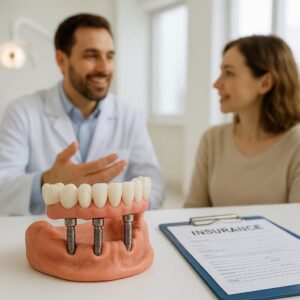
All-on-4 Dental Implants Insurance
Understanding the All-on-4 Procedure and Its Costs
Before we can tackle insurance, we need to understand exactly what we’re paying for. The All-on-4 technique is a sophisticated dental restoration procedure. Unlike traditional dentures that rest on your gums, or individual implants for each missing tooth, the All-on-4 concept uses just four strategically placed dental implants per arch (upper or lower) to support a full set of permanent, fixed teeth.
Why Is the Cost So Significant?
The price tag for an All-on-4 procedure typically ranges from $20,000 to $40,000 per arch, and sometimes more depending on your location and the materials used. This isn’t just a mark-up; it reflects the complexity of the service.
-
Surgical Expertise: The procedure requires a team, often including a prosthodontist, an oral surgeon, and a lab technician.
-
Technology: It relies on advanced 3D imaging and computer-guided surgery for precision.
-
Materials: The final prosthetic teeth (the bridge) are made from high-grade materials like zirconia or acrylic, designed to withstand biting forces.
-
Laboratory Fees: A significant portion of your fee goes to a master ceramist who crafts your final teeth.
Understanding this breakdown is the first step. It helps you see why a standard dental insurance plan, designed for fillings and cleanings, might struggle to cover a procedure of this magnitude.
The Hard Truth About Standard Dental Insurance and All-on-4
Let’s address the elephant in the room. If you have a typical PPO dental insurance plan through your employer or purchased on the marketplace, it is highly unlikely to cover the majority of your All-on-4 procedure.
Important Note: Most traditional dental insurance plans operate with an annual maximum benefit, usually between $1,000 and $2,000 per year. This is the total amount the insurance company will pay for your care over 12 months.
When your procedure costs $30,000, a $1,500 benefit, while helpful, only covers about 5% of the total. This is the primary reason people often feel that their insurance is useless for major restorative work.
Common Policy Limitations
To be realistic, here’s what you’ll typically find in the fine print of a standard plan regarding All-on-4:
-
Annual Maximums: As mentioned, these hard caps are the biggest barrier.
-
Missing Tooth Clauses: Many plans will not cover a tooth that was missing before the policy was active. Since All-on-4 is for patients who are already missing teeth or are about to have them extracted, this clause can nullify coverage.
-
Classification as “Major” Restorative: While implants themselves are sometimes covered, they fall under the “Major” category, which often has the lowest coverage percentage (often 50% after your deductible). However, the $1,500 max still applies.
-
Exclusion of the Prosthesis: Some plans might offer a small allowance towards the implant fixtures but explicitly exclude the cost of the teeth (the bridge/crowns) that attach to them, deeming them “cosmetic.”
Decoding Coverage: What Parts Might Be Covered?
While a standard plan won’t write a big check for the whole procedure, it’s a mistake to ignore your insurance completely. A savvy approach involves looking at the individual components. You might be able to use your benefits for specific parts of the treatment plan.
Think of the All-on-4 process in phases. Here’s how insurance might interact with each phase:
| Phase of Treatment | Typical Insurance Classification | Realistic Coverage Scenario |
|---|---|---|
| Consultation & Diagnostics | Diagnostic / Preventive | Often covered at 80-100% after a small deductible. This includes X-rays, 3D scans (CBCT), and the initial exam. |
| Extractions | Basic Restorative | Usually covered at 70-80%. If you need multiple teeth removed, this can be a good way to utilize your annual benefits. |
| The Implants (Fixtures) | Major Restorative | Coverage is possible but limited. Your plan might pay 50% of the allowed amount, up to the $1,500 max. |
| Temporary Prosthesis | Major / sometimes excluded | Highly variable. Some plans may contribute to an “interim” appliance. Others see it as part of the final, non-covered restoration. |
| Final Prosthesis (Teeth) | Prosthodontics / often excluded | This is the hardest part to get covered. Many insurers view this as an elective or cosmetic component. |
Strategy: Ask your provider’s insurance coordinator to perform a “predetermination of benefits.” They will send a detailed treatment plan to your insurance company, which will respond with a written estimate of what they will pay. This gives you a clear picture before you commit financially.
Beyond PPO: Exploring Specialized Insurance and Riders
If you know you need major dental work in the near future, you might have the option to shop for better coverage. This requires careful planning, as most plans have waiting periods.
High-Limit or Major Dental Plans
Some insurance companies offer “premier” or “high-limit” plans. These are not typical employer-based plans but are often available for individual purchase. They may feature:
-
Higher annual maximums ($2,500 – $5,000).
-
Shorter waiting periods for major care.
-
Better coverage percentages for implants (sometimes up to 50%).
While a $5,000 maximum is still far from the total cost, it is substantially more helpful than a $1,500 limit.
Dental Insurance Riders
Think of a “rider” like an add-on feature for an insurance policy, similar to how you might add roadside assistance to your car insurance. Some insurance carriers now offer implant riders.
For an additional premium, this rider provides a specific, separate benefit for implant procedures. It might have its own dedicated annual maximum (e.g., an extra $2,000 just for implants) or cover a specific percentage of the implant cost without tapping into your primary plan’s maximum.
This is one of the most promising developments in “all on 4 dental implants insurance,” but it is not yet widely available. You’ll need to ask insurance brokers specifically about plans offering these riders.
Medical Insurance: An Overlooked Opportunity
Most people stop at dental insurance, but your medical insurance might play a role in your All-on-4 journey. This is a crucial avenue to explore because medical plans often have significantly higher annual maximums (in the tens or hundreds of thousands of dollars).
When Medical Insurance Might Apply
Medical insurance is designed to treat disease, injury, and functional impairment. If your dental condition overlaps with these categories, you might have a case for medical coverage.
-
Trauma: If you lost your teeth due to an accident or facial trauma, the reconstructive surgery (including implants) could be billed to your medical insurance.
-
Medical Necessity: This is a tougher but viable route. You and your surgeon need to document a true medical necessity. Examples include:
-
Severe weight loss or malnutrition due to the inability to chew.
-
Sleep apnea that could be alleviated by a mandibular advancement device (though this is different from All-on-4).
-
Pre-prosthetic surgery required to remove diseased tissue or bone cysts before implants can be placed.
-
How to Pursue Medical Coverage
This is not a DIY project. You need your surgeon’s office to be on board.
-
The Letter of Medical Necessity: Your doctor must write a compelling letter detailing why the procedure is not just for cosmetic improvement but is essential for your overall health and function.
-
Correct Coding: The billing department must use specific medical (CPT) codes, not dental (CDT) codes, when submitting the claim. For example, bone grafting might be coded as a reconstructive procedure following a pathology.
-
Coordination of Benefits: In some cases, you might be able to use both insurances. Medical might cover the surgical phase (extractions, bone grafts, implant placement), while dental covers the prosthetic phase (the teeth).
The success rate for medical insurance coverage is highly variable and depends on your specific policy, your diagnosis, and the skill of the provider’s billing team. It is always worth a thorough investigation.
Discount Plans and Alternative Financing
If traditional insurance falls short, and for most people it will, you are not out of options. There are established, legitimate ways to make All-on-4 affordable.
Dental Savings Plans (Discount Plans)
These are not insurance. They are membership programs. You pay an annual fee to join a network, and in return, you receive 20% to 60% off services from participating providers.
-
How they work with All-on-4: If your chosen implant specialist is part of a discount plan network (like Careington or Aetna Dental Access), you could save thousands of dollars on the total procedure cost.
-
Pros: No waiting periods, no annual maximums, no exclusions for pre-existing conditions. You use the discount on the entire bill.
-
Cons: You are still paying the discounted fee out-of-pocket. The discount doesn’t apply if your doctor isn’t in the network.
In-House Membership Plans
Many modern dental practices are moving away from insurance entanglements and offering their own internal savings plans. For a monthly or annual fee, you become a “member” of the practice and receive discounted rates on all treatments, including major ones like All-on-4.
These plans are transparent and can significantly reduce the financial burden, especially for patients without any insurance.
Third-Party Financing (Healthcare Credit Cards)
This is the most common way patients fund their All-on-4 procedures. Companies like CareCredit and LendingClub specialize in healthcare financing.
-
How it works: You apply for a line of credit specifically for medical/dental expenses.
-
Promotional Offers: The biggest draw is the promotional financing. You’ll often see offers like “No interest if paid in full within 12, 18, or 24 months.”
-
Critical Note: Pay close attention to the terms. If you do not pay the full amount by the end of the promotional period, interest is often charged retroactively from the original purchase date at a high rate (typically 26.99% or more). Use these cards responsibly and have a solid repayment plan.
A Real-World Look at an Insurance & Payment Strategy
Let’s create a realistic scenario to see how these pieces can fit together. Meet “Sarah.” She needs an All-on-4 procedure on her lower arch, quoted at $28,000.
-
Phase 1: Predetermination. Sarah’s dental office submits a claim to her standard dental insurance (annual max: $1,500). The insurance confirms they will pay $800 towards the extractions and $700 towards the implant fixtures, totaling her $1,500 max. This leaves $26,500.
-
Phase 2: Medical Billing. Sarah’s surgeon documents that she has significant bone loss caused by an infection (a pathology) and requires a bone graft. They bill her medical insurance for the grafting procedure. Medical pays $2,000 after her deductible. Remaining balance: $24,500.
-
Phase 3: Discounts. Sarah signs up for her dentist’s in-house membership plan for $150/year. This gives her a 10% discount on the remaining balance of the final prosthesis. 10% off $24,500 is a savings of $2,450. New balance: $22,050.
-
Phase 4: Financing. Sarah uses a CareCredit card with a 24-month, no-interest promotion to pay the final $22,050. She divides this by 24 and sets up an automatic payment of $918.75 per month to ensure it’s paid off before the interest kicks in.
In this realistic scenario, Sarah combined insurance benefits, discount plans, and structured financing to create a manageable pathway. It required effort and coordination, but it demonstrates that paying for All-on-4 is possible without a miracle.
Questions to Ask Your Dental Provider
Your dental team is your best resource. A great office will have a dedicated financial coordinator who deals with these questions daily. Here’s a checklist of questions to ask during your consultation:
-
“Based on my specific insurance plan, can you perform a predetermination of benefits?”
-
“Do you have experience billing medical insurance for the surgical aspects of this procedure?”
-
“Are you a participating provider with any dental discount plans?”
-
“Do you offer an in-house membership or savings plan for uninsured procedures?”
-
“What third-party financing companies do you work with?”
-
“Can you provide a detailed, line-item breakdown of the entire quote so I understand what each part costs?”
-
“Is there any aspect of the treatment that we could phase over 12-24 months to better utilize my annual insurance benefits?”
Additional Resources
Navigating the financial side of dental care can feel overwhelming, but you don’t have to do it alone. For independent, unbiased information on managing healthcare costs and understanding patient rights, the Consumer Guide to Dentistry is an excellent resource. You can find articles on financing, insurance terms, and questions to ask your dentist.
[Link to Consumer Guide to Dentistry]
Frequently Asked Questions (FAQ)
Q: Can I get dental insurance that covers All-on-4 implants?
A: It is rare to find a plan that covers the entire procedure. However, you can look for plans with high annual maximums ($5,000+) and check if they offer an “implant rider” for additional coverage. Standard plans will only cover a small fraction of the cost.
Q: Will Medicare pay for All-on-4 dental implants?
A: Original Medicare (Part A and B) does not cover routine dental care or dental procedures like implants. However, if you are enrolled in a Medicare Advantage (Part C) plan, some of these private plans are beginning to offer limited dental benefits, which might include implants. You must check your specific plan’s details.
Q: What is the most cost-effective way to pay for All-on-4?
A: For most people, a combination of methods works best. This typically involves utilizing any existing insurance benefits, applying for a healthcare credit card (like CareCredit) with a 0% interest promotion, and choosing a provider who offers a discount plan or in-house membership.
Q: Is it worth appealing if my insurance denies coverage?
A: Absolutely. Insurance denials are common, but they are not always final. Work with your provider to gather more documentation, write a strong appeal letter emphasizing medical necessity, and resubmit. Many denials are overturned on appeal.
Q: Can I use my FSA or HSA to pay for All-on-4?
A: Yes! Both Flexible Spending Accounts (FSA) and Health Savings Accounts (HSA) allow you to use pre-tax dollars for qualified medical and dental expenses. All-on-4 implants are considered a qualified expense. This can save you 20-30% on the total cost, effectively giving you a built-in discount.
Conclusion
Finding coverage for All-on-4 dental implants requires a shift in mindset. Instead of looking for a single insurance policy to pay for everything, the key is to build a strategic financial plan. By understanding your current policy’s limits, exploring the potential of your medical insurance, leveraging discount plans, and utilizing financing options, you can create a realistic pathway to afford your new smile. It’s about being an informed consumer, asking the right questions, and working closely with a dental team committed to helping you navigate the process with honesty and transparency. Your journey to a restored smile is a marathon, not a sprint, and with the right financial roadmap, the finish line is well within reach.