If you are reading this, you are probably asking a very important question: Are there any locations where you cannot get health insurance?
It is a fair question. We often assume that in the modern world, essential services like healthcare coverage are universal. But the reality is a bit more complicated. Geography plays a massive role in the type of health insurance you can access, the cost you pay, and the specific plans available to you.
The short answer is no, you cannot technically be left without any option for coverage in the United States. However, there are specific locations where obtaining affordable, comprehensive health insurance becomes extremely difficult, or where your options are so limited that it feels like you cannot get insurance.
In this guide, we will explore the geographic nuances of health insurance. We will look at the gaps in the system, the “dead zones” for coverage, and most importantly, what you can do if you find yourself in one of these challenging locations.
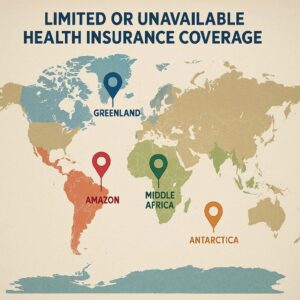
Are There Any Locations Where You Cannot Get Health Insurance
The Geography of Coverage: How Location Defines Your Options
Before we dive into the “where,” we need to understand the “why.” Health insurance in the United States is not a single federal system. It is a patchwork of state regulations, private companies, and federal programs. Where you live dictates everything.
The Role of State Lines
Unlike countries with nationalized healthcare, the U.S. relies on a state-by-state approach. Insurance companies are regulated at the state level. An insurance carrier like Blue Cross Blue Shield may operate in 50 states, but the plans they offer in Texas are completely different from the plans they offer in New York.
This means you cannot simply buy a plan from a neighboring state if you live in a rural area with few options. Your zip code is the key that unlocks—or locks—your insurance marketplace.
The Impact of the Affordable Care Act (ACA)
The Affordable Care Act (ACA) created the Health Insurance Marketplace. It was designed to ensure that every American had access to a plan, regardless of pre-existing conditions. However, the ACA allowed states to decide whether they would run their own marketplace or let the federal government run it. It also allowed states to decide on Medicaid expansion.
This is where the geographic disparities began to widen significantly. As of the current enrollment period, states that expanded Medicaid have far lower uninsured rates than those that did not. This creates a scenario where two people with identical income levels could have vastly different access to insurance based solely on which side of a state line they live on.
Location #1: States That Did Not Expand Medicaid
This is the most significant “gap” in the American health insurance landscape. When the ACA was enacted, the goal was to cover everyone up to 138% of the Federal Poverty Level (FPL) through Medicaid. However, a Supreme Court ruling in 2012 made Medicaid expansion optional for states.
If you live in a state that did not expand Medicaid, you may find yourself in what experts call the “coverage gap.”
What is the Coverage Gap?
Imagine you are an adult without dependent children. You earn too much money to qualify for traditional Medicaid in your state (which often has very strict limits), but you do not earn enough to qualify for subsidies (premium tax credits) in the ACA marketplace.
In this situation, you are trapped. You cannot get Medicaid because your state refused to expand it. You cannot get subsidized private insurance because the law assumes you would be on Medicaid.
List of States with Coverage Gaps (as of current data):
While this list changes slowly, the following states have historically not expanded Medicaid, creating potential gaps for residents:
-
Texas
-
Florida
-
Georgia
-
South Carolina
-
Tennessee
-
Alabama
-
Mississippi
-
Louisiana (expanded, but check updates)
-
North Carolina (recently expanded, but implementation varies)
-
Wisconsin (partial expansion)
-
Wyoming
-
South Dakota (recently expanded)
-
Kansas (recently expanded)
Important Note for Readers: Medicaid expansion status is fluid. States like North Carolina and South Dakota have recently expanded, but the administrative rollout takes time. If you live in a non-expansion state, you are not necessarily “uninsurable,” but you may have to navigate a much narrower path to coverage.
How to Navigate a Non-Expansion State
If you live in one of these areas, your options usually come down to three things:
-
Increasing your income: If you can project your annual income to be above 100% of the FPL (roughly $15,000 for a single person), you qualify for marketplace subsidies.
-
Employer-based insurance: Getting a job that offers group health insurance bypasses the Medicaid gap issue entirely.
-
Moving: As drastic as it sounds, many individuals and families relocate to neighboring states to access affordable healthcare coverage.
Location #2: Rural “Desert” Counties
Even if you live in a state with a robust marketplace and expanded Medicaid, you might still struggle to find a plan. This is due to carrier participation.
In insurance terms, a “desert” is an area where only one—or zero—insurance carriers are offering plans on the marketplace.
The Rural Carrier Problem
Insurance companies are for-profit businesses. They look at the population density of an area to decide if they want to sell plans there. In remote rural counties, the population is too small to create a large enough “risk pool.” If there aren’t enough healthy people paying premiums to balance out the sick people filing claims, the insurer loses money.
Over the last decade, many major insurers have pulled out of rural counties in states like Alaska, Arizona, Missouri, and Oklahoma.
The Consequences of Limited Carriers
When only one carrier is available:
-
No competition: Premiums tend to be higher because the carrier has a monopoly.
-
No choice: You have to take whatever plan they offer, even if the network is narrow.
-
Network gaps: Even if you have insurance, the closest “in-network” hospital might be 100 miles away.
| Carrier Availability | What It Means for You |
|---|---|
| 3+ Carriers | Ideal. Competition keeps prices down. You have options to fit your budget and medical needs. |
| 2 Carriers | Moderate. You have some choice, but premiums may be higher than average. Networks might be limited. |
| 1 Carrier | Difficult. You have a monopoly. Premiums are likely high. You take what is offered or pay the penalty (if applicable). |
| 0 Carriers | Critical. This is rare. Usually, the federal government steps in with a “Federally-facilitated Marketplace” plan, but it often involves a narrow network. |
Quote from a rural health advocate: “We see it all the time. A family moves to a beautiful, remote area for the lifestyle, only to find out their nearest in-network provider is a three-hour drive away. They have insurance, but they don’t have access to care.”
Location #3: U.S. Territories
This is a unique and often overlooked category. If you live in a U.S. territory—such as Puerto Rico, Guam, the U.S. Virgin Islands, American Samoa, or the Northern Mariana Islands—the rules are different.
While the ACA extended to territories, the funding structure is not the same as for states.
The Disparity in Funding
Residents of territories cannot access the same marketplace subsidies (Premium Tax Credits) that residents of the 50 states can. Instead, territories receive a fixed block grant from the federal government. When that money runs out, the subsidies stop.
Furthermore, Medicaid in territories has a statutory cap. In the 50 states, Medicaid is an “entitlement”—if you qualify, the federal government pays its share. In territories, there is a strict limit on how much federal Medicaid funding is available.
The Result
-
Puerto Rico: For years, residents faced a massive coverage gap similar to the non-expansion states on the mainland, but with even less federal funding.
-
Limited Carriers: Many territories have very few private insurance options, often dominated by one local insurer.
Location #4: Short-Term Rental or Nomadic Lifestyles
Your location isn’t just about your permanent address. It’s also about where you are when you need coverage.
Standard health insurance plans (ACA plans, employer plans) are built on the concept of a “service area.” You are expected to live and seek non-emergency care within that network.
The Nomad Problem
If you are a digital nomad, a full-time RVer, or someone who splits their time between two states, you face a unique challenge: Residency versus Coverage.
You can only buy health insurance in the state where you legally reside. If you are an RVer who uses South Dakota as your domicile (a popular choice for full-time travelers), you buy insurance in South Dakota. However, if you are spending the winter in Florida and break your leg, you rely on “emergency” coverage.
The Catch: While emergency care is covered anywhere in the U.S., follow-up care is not. If you need physical therapy or a specialist follow-up in Florida, a South Dakota-based plan will likely deny coverage or charge out-of-network rates.
How to Handle This
-
Nationwide PPOs: These are the holy grail for nomads. These plans (usually offered by large employers or Blue Cross Blue Shield) have networks that span the country. However, they are rarely available on the individual marketplace; they are usually employer-based.
-
Multi-state plans: The ACA attempted to create multi-state plans, but they are not truly national. They usually have a “home” state network.
-
Travel Insurance: For short-term gaps, travel medical insurance can cover emergencies, but it is not a replacement for comprehensive health insurance.
Location #5: Outside the United States
If you live abroad, you generally cannot use a standard U.S. health insurance plan. Medicare does not cover you outside the country (with very rare exceptions). Medicaid stops at the border. ACA marketplace plans do not provide coverage in foreign countries.
The Expat Dilemma
If you are an American living in another country, you fall into a regulatory gap. You are technically required to have health insurance under the ACA (though the individual mandate penalty was reduced to $0 federally, though some states have their own mandates).
But you cannot buy a plan that covers you in your new home country through the U.S. marketplace.
The Solution
-
Local Insurance: You buy insurance in the country where you live. Many countries require this for residency visas.
-
International Health Insurance: Companies like Cigna Global or Aetna International offer plans designed for expats. These are private plans that are not regulated by the ACA but provide global coverage (excluding the U.S. often, or including it at a higher cost).
Location #6: Incarceration and Institutions
While not a “location” in the traditional geographic sense, being in a specific institutional setting removes your ability to purchase private health insurance.
If you are incarcerated in a prison or jail, you are generally not eligible for Marketplace subsidies or Medicaid (though some states are beginning to explore pre-enrollment for release). Care is provided by the correctional facility.
Similarly, if you are in a long-term care institution, you may be on Medicaid, but you cannot purchase a private ACA plan to cover that care, as ACA plans are not designed for long-term custodial care.
What About Discrimination? (Religion, Gender, Age)
We should address a common fear: Are there locations where you cannot get insurance because of who you are?
The ACA made it illegal for insurers to deny coverage based on pre-existing conditions, gender, or health status. No matter where you live in the United States, a private insurer cannot deny you a plan during Open Enrollment because you are a woman, because you have cancer, or because of your age (though they can charge older adults more—up to 3 times more than younger adults).
However, there are exemptions based on religion. Some states allow “health care sharing ministries” (HCSMs) to operate as an alternative to insurance. These are not insurance. If you live in a state with a high number of HCSMs, you may be tempted to join one, but these organizations are legally allowed to deny sharing costs for pre-existing conditions, mental health, or certain “lifestyle” choices. They are a controversial option that leaves many people underinsured.
How to Check Coverage in Your Specific Location
You don’t have to guess whether your location has good options. Here is a step-by-step guide to finding out exactly what is available to you.
Step 1: Visit Healthcare.gov (or Your State Marketplace)
Enter your zip code. Do not just look at the price. Click on the plans and look for:
-
The “Plan Name”: Does it say “Local” or “Regional”?
-
The Network: Look for “PPO” (Preferred Provider Organization) versus “EPO” (Exclusive Provider Organization) versus “HMO” (Health Maintenance Organization). HMOs and EPOs typically have the strictest geographic limitations.
Step 2: Check Provider Directories
Before you buy a plan, search for your local hospital and your primary care doctor in the plan’s directory. If the only hospital in your county is not listed as “in-network,” you have a location-based problem.
Step 3: Contact the State Insurance Department
Every state has a Department of Insurance. If you suspect you are in a “desert” (only one carrier available), call them. They often have consumer assistance programs that can help you understand if you qualify for special programs like the Basic Health Program (available in states like Minnesota and New York) or state-specific subsidies.
A Comparative Table: Urban vs. Rural vs. Territorial Coverage
To illustrate how dramatically location changes the insurance landscape, here is a comparison of three hypothetical individuals.
| Factor | Urban Area (e.g., Dallas, TX) | Rural Area (e.g., West Texas) | U.S. Territory (e.g., Puerto Rico) |
|---|---|---|---|
| Number of Carriers | 5-8 | 1-2 | 1 (local government plan) |
| Average Premium | Moderate (Competitive) | High (Monopoly pricing) | Low, but with high out-of-pocket caps |
| Subsidies | Full ACA Subsidies available | Full ACA Subsidies available | Block grants; limited subsidy availability |
| Medicaid | Expansion state? (Yes/No) | Often Non-expansion | Capped funding; waiting lists |
| Provider Access | Multiple hospitals within 10 miles | 1 critical access hospital 50 miles away | Limited specialists; many travel to US mainland |
The Future of Geographic Coverage Gaps
The landscape is not static. Several trends are emerging that may change where you can and cannot get health insurance.
Telehealth Expansion
The pandemic accelerated telehealth. For those in rural deserts, this is a lifeline. However, regulations are changing. While telehealth is now widely accepted, restrictions on cross-state telehealth (seeing a doctor in another state) are tightening again. If you live on a state border, you used to be able to see a doctor across the line easily; now, licensure laws are making that harder.
The “Family Glitch” Fix
A recent administrative fix to the ACA addressed the “family glitch.” Previously, if your employer offered affordable coverage for you, your family could not get subsidies on the marketplace, even if the family coverage was unaffordable. This fix helps families in high-cost areas access better plans.
State-Based Public Options
Some states are creating their own public health insurance options to compete with private insurers in rural areas.
-
Washington State: Created “Cascade Care,” a public option available in every county.
-
Colorado: Launched the “Colorado Option,” which mandates that insurers reduce premiums and offer standardized plans in areas that previously had only one carrier.
If you live in a state that is actively trying to solve the rural desert problem, your experience will be vastly different from someone in a state that relies solely on the federal marketplace.
Practical Solutions: What to Do If You Are in a “Bad” Location
Let’s assume you have determined that your location is problematic. You live in a non-expansion state, or you live in a county with one terrible insurance plan. What are your actionable steps?
1. Leverage the “Special Enrollment Period” (SEP)
If you are moving to a location with bad insurance, you have a SEP. If you are moving from a bad location to a good one, you can change plans. Use moving as an opportunity to upgrade your coverage.
2. Look for Federally Qualified Health Centers (FQHCs)
Even if you cannot get insurance, you are not without care. FQHCs (often called Community Health Centers) exist in nearly every county in the U.S. They offer sliding scale fees based on your income. If you are in a coverage gap (too poor for subsidies, too rich for Medicaid), these centers are your safety net.
3. Consider Direct Primary Care (DPC)
This is a growing model where you pay a doctor a flat monthly fee (usually $50–$100) for primary care services. It is not insurance—it does not cover hospitals or specialists—but it gives you a doctor. You can pair this with a “catastrophic” insurance plan (if you qualify) to cover emergencies.
4. Strategic Employment
If the individual marketplace in your area is a disaster, the group market (employer insurance) is often better. Larger employers in rural areas often negotiate better rates with insurers because they have a larger group of employees. Working for a local hospital system, the county government, or a large agricultural company can often be the only way to get a decent PPO plan in a rural desert.
Important Notes for Specific Demographics
Your location interacts with your personal status. Here are a few specific scenarios to consider.
For Students
If you go to college out of state, your location matters. If you stay on your parent’s plan, ensure the network covers your college town. If the network doesn’t, you may need to buy a student health plan offered by the university. These are often location-specific and only valid near the campus.
For Retirees (Under 65)
If you retire early and do not yet qualify for Medicare, location is everything. The ACA marketplace is your main option. If you live in a rural area with high premiums and low subsidies, this can decimate a retirement budget. Some retirees choose to move to states with robust marketplaces (like California, Colorado, or New York) specifically for better health insurance options before Medicare kicks in.
For Native Americans
If you are a Native American or Alaska Native, you have unique protections. You can enroll in Marketplace plans any time of the year (a special SEP), and you can access Indian Health Services (IHS). IHS provides care based on location, usually on or near reservations. If you live in an urban area away from your tribe, accessing IHS can be difficult, making marketplace insurance more critical.
Conclusion
So, are there any locations where you cannot get health insurance?
Technically, no. You cannot be in a location in the United States where no insurance product exists for purchase. However, there are numerous locations—specifically non-expansion Medicaid states, rural counties with monopolistic carriers, and U.S. territories—where obtaining meaningful, affordable, and accessible health insurance is extraordinarily difficult.
Geography is destiny in American healthcare. Your zip code often determines whether you pay $200 a month for a gold PPO plan or $500 a month for a bronze HMO plan with no local doctors. The good news is that awareness is power. By understanding the “where” and the “why,” you can make strategic decisions about where to live, where to work, and how to navigate the complex system to ensure you and your family are protected.
Frequently Asked Questions (FAQ)
1. Can I buy health insurance from a different state if my state has bad options?
No. Health insurance is regulated by the state where you live. You must have a primary residence address in the state where you purchase an ACA marketplace plan. You cannot cross the border to buy a plan unless you legally move.
2. What if I am homeless or have no fixed address? Can I get insurance?
Yes. You do not need a permanent home to apply for Medicaid or Marketplace coverage. You can use a mailing address (like a shelter, a PO box, or a trusted friend’s address) to receive correspondence. Eligibility is based on income, not housing status.
3. Is it true that some counties have no insurance companies at all?
It is rare, but it happens. In these cases, the federal government usually intervenes to ensure that a “Federally-facilitated Marketplace” plan is available. However, these plans are often very limited, and many residents in these counties end up relying on catastrophic coverage or remain uninsured.
4. Does moving to a different state guarantee I will get better insurance?
Not automatically. You must move to a state that has expanded Medicaid and has a competitive marketplace. Moving to a state like Texas or Florida (non-expansion) may not solve your problem if your income is low. Research the state’s Medicaid status and carrier availability before relocating.
5. What is the difference between “not having insurance” and “not having access to care”?
This is a crucial distinction. You may have an insurance card in your wallet (so technically, you have insurance), but if no doctors in your area accept that plan, you do not have access to care. This is a common problem in rural areas with narrow-network plans. Always verify the provider network before enrolling.
Additional Resources
For further reading and personalized assistance, please explore these official resources:
-
Healthcare.gov: The official federal marketplace. Use the “See Plans & Prices” tool to enter your zip code and see what is available in your specific county.
-
State Insurance Departments: Find your state’s Department of Insurance website. They often publish annual “Carrier Participation” maps showing which counties have 1, 2, or 3+ carriers.
-
Rural Health Information Hub: An excellent resource for understanding the unique challenges of healthcare in rural America. They offer guides on telehealth and rural hospital networks.
-
Kaiser Family Foundation (KFF): A non-profit organization that provides unbiased data on Medicaid expansion status by state, uninsured rates by county, and marketplace competition.