Finding reliable, transparent information about the breast lift cost with insurance can feel like navigating a maze. You are likely searching because you feel discomfort, experience pain, or simply want to feel like yourself again. You are also likely facing a flood of contradictory online information. This guide cuts through the noise.
We will explore the real financial landscape of mastopexy. We will not use complex jargon or make unrealistic promises. Instead, we will walk together through the critical distinctions between cosmetic and reconstructive procedures. We will detail how insurance companies think, what documentation you need, and what numbers you can realistically expect to see on your bills.
My goal is to give you power. Power comes from knowledge. By the time you finish reading, you will understand every financial angle of this journey. You will know how to speak the language of insurance providers, how to prepare a rock-solid case for coverage, and how to plan for costs that may fall outside your policy.
Take a deep breath. This is a long read, and it is designed to be your single source of truth. Let’s begin.
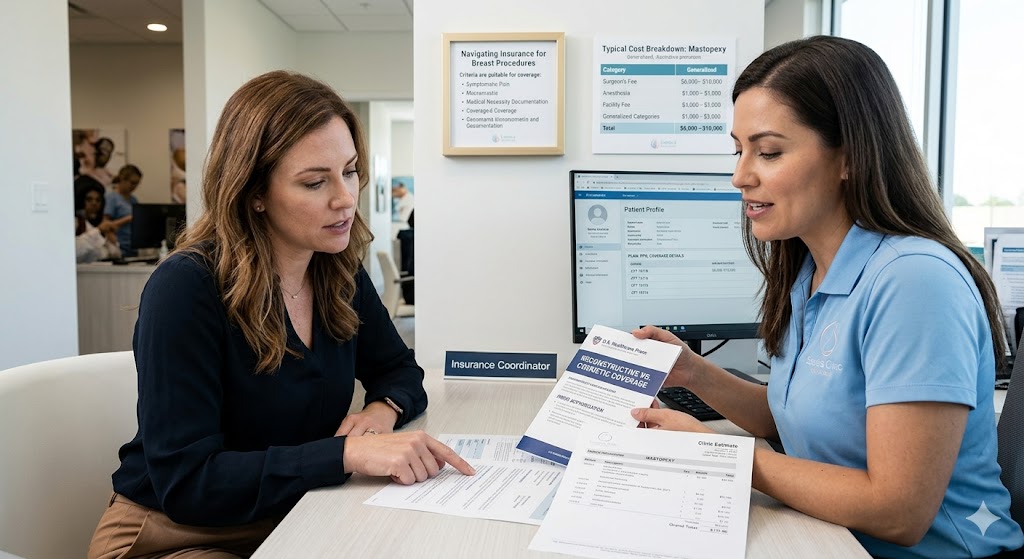
Understanding the True Nature of a Breast Lift
A breast lift, medically known as mastopexy, reshapes and raises sagging breasts. It removes excess skin and tightens the surrounding tissue. The goal is to restore a more youthful contour. But from a financial and insurance perspective, this definition is far too simple. The reason for your surgery changes everything.
The Medical Definition: Reconstructive vs. Cosmetic
The insurance world divides surgery into two rigid categories. The first is reconstructive surgery. This type fixes an abnormality caused by disease, trauma, or a congenital defect. The second is cosmetic surgery. This type improves appearance without a medical reason. The line between them defines your wallet’s involvement.
A breast lift sits right on this fence. It can be a pure aesthetic choice. It can also be a necessary reconstructive step for a woman who has lost a massive amount of weight. She might be suffering from chronic infections and debilitating back pain. The physical act of removing skin is the same. The driving diagnosis is what matters.
Your insurance provider’s computer system looks for specific diagnostic codes. If the code signals “cosmetic,” the system automatically rejects the claim. If the code signals “reconstructive,” it moves to the next step of medical necessity review. You must never let a surgeon’s office accidentally code your medically necessary surgery as cosmetic. A simple checkbox error can cost you tens of thousands of dollars.
Why “Medical Necessity” is Your Financial Gatekeeper
Medical necessity is not what you think is necessary. It is not what your doctor thinks is necessary. Medical necessity is a strict definition held by a health insurance plan. To them, a necessary procedure must treat a diagnosed condition that threatens your health. It cannot be optional.
Insurance companies build walls of criteria around breast lift procedures. They want to see documented proof of a functional problem. This could be a skin condition that does not respond to dermatological treatment for six months or more. It could be proof that the weight of your breasts causes nerve compression, verified by a neurologist.
Your subjective experience of sadness or self-consciousness does not meet this definition. This sounds harsh, but it is the fundamental truth of the industry. Your pain, however, is valid. If that pain comes from the physical weight pulling on your skeleton, it becomes a medical issue. Your job is to translate a structural problem into a language insurance companies understand.
The Foundation: When Insurance Covers a Breast Lift
Do not assume your policy excludes you. Many policies have hidden pathways to coverage. The key is knowing the specific scenarios where a breast lift transforms from a “want” into a medically necessary “need.” These scenarios are almost always tied to a functional failure of the skin envelope.
Scenario 1: Breast Reconstruction After Mastectomy
This is the most federally protected path to insurance coverage. The Women’s Health and Cancer Rights Act (WHCRA) of 1998 mandates coverage for breast reconstruction after a mastectomy. If your plan covers mastectomies, it must cover reconstruction. This includes a lift on the healthy breast to achieve symmetry.
Your surgeon performs a mastectomy on the cancerous breast. The law states that the insurance company must then pay for surgery on the other breast so that both match. You are not asking for a cosmetic perk. You are asking for a federally mandated right. Cite this law by name if you get pushback.
The law covers all stages of reconstruction. It includes the initial reconstruction and the revision surgeries years later. If you had a mastectomy ten years ago and now suffer from asymmetry, you can likely still pursue a symmetry procedure. Document the visual and physical disparity. Gravity often pulls the natural breast down while the reconstructed breast stays high.
Scenario 2: Congenital Deformities and Poland Syndrome
Some people are born with conditions that cause severe breast asymmetry. Poland Syndrome is the most notable. It involves missing or underdeveloped chest muscles on one side of the body. The breast on that side may also be underdeveloped or absent. This is not a cosmetic issue. It is a birth defect.
A breast lift on the unaffected side, often combined with an implant on the affected side, creates a symmetrical chest wall. Insurance companies classify this as reconstructive surgery to correct a congenital anomaly. The key evidence here is the formal diagnosis from a geneticist or a specialist. You need imaging and medical records dating back to your initial diagnosis.
Staying silent about the psychological toll is a mistake during this process. While insurers care mainly about physical function, a letter from a psychiatrist outlining the severe psychological distress caused by a congenital defect can strengthen your case. Frame it as a functional impairment of mental health directly caused by a physical abnormality.
Scenario 3: Severe Macromastia and Symptomatic Gigantomastia
Gigantomastia is a rare condition of excessive breast growth. The breasts become disproportionately large. This weight creates a cascade of physical destruction. The shoulders develop deep grooves from bra straps. The nerves to the arms become compressed, causing numbness. The skin underneath the breasts stays perpetually wet, breaking down into painful rashes and infections.
In these cases, a breast lift alone might not be the solution. Surgeons often combine a lift with a reduction. This is a reduction mammoplasty combined with a mastopexy. Insurers are far more likely to cover reduction than a lift alone. They look at the amount of tissue removed.
If you present with gigantomastia symptoms, your doctor must document the physical weight pulling you forward. Spinal X-rays showing cervical spine curvature changes become powerful evidence. A history of physical therapy that failed to fix the pain shows you have exhausted conservative measures. The breast lift component of this surgery is not separable from the medical necessity of the reduction.
The Financial Wall: Cosmetic Breast Lift Costs Exposed
For the majority who do not meet the strict medical necessity criteria, the surgery remains purely cosmetic. You must pay out of pocket. You deserve to know the real numbers, not the lowball marketing figures you see on billboards.
Average Surgeon Fees Across the United States
The surgeon’s fee is the single largest line item on your bill. This fee buys the skill, experience, and aesthetic eye of the doctor. You are not paying for a two-hour operation. You are paying for the decade of training that allows them to perform it safely and beautifully.
According to the American Society of Plastic Surgeons, the average surgeon fee for a breast lift sits around $5,500 to $6,000. Do not let this number mislead you. This average includes small-town surgeons and part-time practitioners. If you seek a board-certified plastic surgeon in a major metropolitan area like New York, Los Angeles, or Miami, that fee jumps significantly.
Expect to pay between $8,000 and $15,000 for the surgeon’s fee alone in a top-tier city. A celebrity surgeon with a massive social media following might charge $20,000 to $30,000 just for their time. You are paying for their name and their perceived lower risk of revision. Weigh this carefully. A high fee does not guarantee a perfect outcome.
The True Total Cost: Anesthesia, Facility, and Implants
The surgeon’s fee is just the starting point. You must pay for the operating room and the professionals keeping you alive and asleep. These costs are often bundled into a single quote, but you should always ask for an itemized breakdown.
A board-certified anesthesiologist typically charges by the hour. For a three-hour surgery, that fee ranges from $1,200 to $2,000. The facility fee covers the surgical suite, nursing staff, and recovery room. A hospital-based facility is far more expensive than a private surgical center. The hospital fee can hit $3,500 to $5,000. A private accredited center often costs $1,500 to $2,500.
Many women combine a breast lift with implants to restore upper pole fullness. If you add implants, the hardware itself adds another $1,000 to $2,000 to the bill. This is purely for the cost of the silicone or saline implants, not the extra surgery time. Your total all-inclusive cost for a private pay breast lift, with no insurance help, often lands between $12,000 and $25,000. Let that range settle in.
Geographic Price Variations That Shock Patients
Healthcare is a local commodity, but cosmetic surgery is a hyper-local luxury market. The price you pay depends entirely on the ZIP code of your operating room. You can save thousands by driving a few hours, but you introduce new risks.
A breast lift in Birmingham, Alabama, might cost $8,000 total. The exact same procedure by an equally trained surgeon in San Francisco, California, costs $18,000. The difference is real estate, malpractice insurance premiums, and local market tolerance. Plastic surgeons in high-cost cities face astronomical rent and staff salaries. They pass this on to you.
Medical tourism tempts many with prices under $5,000 in countries like Mexico, Costa Rica, or Turkey. The facilities can be pristine and the surgeons well-trained. The risk enters if you have a complication. A hematoma or infection after you fly home becomes your local emergency room’s problem. A local surgeon may charge you a premium to fix someone else’s work. Factor the price of a complication into your travel savings math.
The Hidden Costs No One Talks About
Your quote covers the day of surgery. It does not cover the weeks surrounding it. You need to plan for hidden costs that can quietly add thousands to your total.
Pre-operative lab work and a physical exam are often mandatory. If your insurance does not cover these for cosmetic purposes, expect to pay $200 to $500 out of pocket. Post-operative medications, including painkillers, antibiotics, and anti-nausea drugs, cost $100 to $300. You also need a surgical recovery bra. High-quality ones cost $50 to $100 each, and you need at least two.
The largest hidden cost is lost income. If you are self-employed or lack paid sick leave, taking two weeks off work is a massive financial hit. We will discuss this in detail later. You also need to consider scar treatment products. Silicone gel sheets and creams run $50 to $100 per month for six months. These are not optional if you want the best cosmetic outcome.
The Insurance Battle: Navigating Reconstructive Claim Approvals
If you believe your case falls under medical necessity, you are entering a negotiation. You are not just a patient; you are a claimant. Your surgeon’s office acts as your legal team. You must give them ammunition.
Documenting Chronic Intertrigo and Skin Breakdown
Intertrigo is the inflamed rash that forms in the fold underneath the breast. It thrives in moisture and friction. For some women, this is a minor annoyance. For others, it is a recurrent, bloody, and infected wound that never heals. This failure to heal is your strongest evidence.
You must establish a long-term paper trail. See a dermatologist or your primary care physician repeatedly. Try every cream they offer. Nystatin powder, ketoconazole shampoo, and clotrimazole cream are common first-line treatments. When they fail, move to prescription-strength topical steroids. If the rash returns the moment you stop the steroid, document it.
Photograph the rash every time it flares. Use a dated camera. A visual timeline of six to twelve months of failed conservative therapy is difficult for an insurance adjuster to ignore. A single visit for a rash will not convince them. They are looking for a chronic, intractable disease process. The skin is breaking down mechanically, and the only permanent fix is removing the skin fold. Frame it this way.
Proving Intractable Shoulder Grooving and Nerve Pain
Bra strap grooves are common, but deep furrows in your shoulders are not. In severe macromastia, the weight of the breasts permanently deforms the soft tissue and fat of the shoulders. This causes visible, permanent indentations. It also compresses the brachial plexus, the nerve bundle that runs to your arms.
See a neurologist for a nerve conduction study. This test measures how well electrical signals travel down your arms. If the heavy breasts are causing thoracic outlet syndrome or ulnar nerve paresthesia, the study will show it. This objective data is a gold standard for insurance companies.
Physical therapy for neck and shoulder pain is a standard insurance prerequisite. You must try it and fail it. Attend a full course of therapy, which is usually six to twelve weeks. Make sure the therapist documents that your pain originates from the mechanical traction of heavy breasts. When therapy ends and the pain remains, you have satisfied a key “fail-first” criterion. Your surgeon can now argue that the breast lift is not an elective choice but the next step in a failed conservative treatment algorithm.
The Role of Physical Therapy and Weight Stability
Insurers view weight as a modifiable risk factor. They will argue that weight loss could reduce breast size and solve the problem non-surgically. You must prove your weight is stable. This usually means your body mass index (BMI) is under a certain threshold, often 30, and has been stable for at least six to twelve months.
A documented history of weight stability proves the problem is not temporary. It also proves the excess skin is true redundancy, not just stretched fat. If you have lost a massive amount of weight—say, 100 pounds or more—your excess skin is even more extreme. In this case, a breast lift is often a component of a larger body contouring package.
While most body contouring after weight loss is considered cosmetic, the breast component can sometimes be coded as medically necessary. The skin hangs low enough to cause traction on the chest wall and the rashes we previously discussed. The documentation requirements remain the same. You need proof of rashes, pain, and failure of non-surgical treatment. The massive weight loss just makes the physical evidence more visibly obvious to the reviewer.
Decoding Your Insurance Policy’s Fine Print
Your policy is a binding contract. The summary you get in the mail is not the full document. You need the full Evidence of Coverage (EOC) booklet, often a 100-page PDF. Request it from your HR department or insurance portal. Then, read it with a fine-toothed comb.
Cosmetic Exclusion Clauses: Standard Language
Almost every policy has a standard exclusion clause for cosmetic surgery. The language is remarkably similar across providers. It typically excludes any service that “improves appearance without restoring a bodily function.” The key is the second half of that sentence: “or that corrects a deformity resulting from disease, trauma, or a congenital defect.”
You must find the specific wording of the exclusion clause and the exception clause. Print the page and highlight the exceptions. When you write your appeal letter, quote the policy directly. Write: “As stated in my Evidence of Coverage on page 47, section 3, ‘coverage is provided for surgical correction of a functional deficit caused by a congenital anomaly.’ My diagnosis of Poland Syndrome meets this criterion.”
This approach stops an adjuster from giving you a vague denial. You have pinned them to their own legally binding document. If they deny you, they must explain why your specific clinical picture does not match their own exception clause. This forces a clinical review, not an automatic rejection.
The “Symmetry” Loophole You Must Exploit
Insurance contracts almost never allow a purely cosmetic unilateral breast lift. However, they often allow surgery on one breast to match the other if the first breast required a medically necessary procedure. This is the symmetry rule.
If you need a breast reduction on one side to relieve pain, the surgeon can often get the lift on the other side covered. The reasoning is that a medically necessary reduction on the left breast creates a symmetric result only if the right breast is lifted. The lift is incidental to the primary covered procedure.
The same logic applies if you need a lumpectomy for cancer. A lumpectomy removes the tumor but often leaves a misshapen breast. A breast lift to reshape that breast, and a matching lift on the other side, is considered part of the reconstruction of the cancer defect. This is where an oncologic surgeon and a plastic surgeon must co-manage your case. The operative notes must clearly state the lumpectomy caused asymmetry requiring surgical correction.
Pre-Authorization: Don’t Step Through the Door Without It
Pre-authorization is a promise to pay, but it is a conditional promise. Your surgeon’s office submits the planned procedure codes and the clinical documentation. The insurance company issues a pre-authorization letter. This letter states the procedure is “a covered benefit” but always adds the caveat “pending final review of the claim.”
Never take a verbal “yes” as truth. Always get the pre-authorization in writing. Keep the reference number. Even with a written pre-auth, the insurance company can retroactively deny the claim if they find the coding was misleading. However, having the letter makes your appeal ten times stronger. You can argue you proceeded in good faith based on their written approval.
If you have the pre-authorization letter and they deny the claim after surgery, hire an attorney immediately. This is a bad-faith practice. A strongly worded legal letter often reverses the denial. Without pre-authorization, you are walking into surgery naked, financially speaking. You might wake up with a $40,000 lien on your property. Do not let this happen.
A Detailed Breakdown of Partial Insurance Scenarios
Sometimes, insurance doesn’t pay the whole bill, but it pays a part. This happens when your surgery has both a functional component and an aesthetic component. Understanding how the bill gets split is crucial.
Reduction Mammaplasty vs. Mastopexy Coding
Insurance companies pay for reduction (removing heavy tissue) more readily than lifting. The Current Procedural Terminology (CPT) codes are different. A reduction is CPT 19318. A breast lift is CPT 19316. If your surgeon tries to bill a pure lift as a reduction, they are committing insurance fraud. Do not ask them to do this.
However, a true reduction always includes a lift. The incision patterns are identical. The surgeon positions the nipple higher and removes the lower heavy tissue. If you qualify for a reduction, the lift is essentially free. The trick is meeting the tissue removal thresholds set by your insurance.
Many plans use the Schnur Sliding Scale. This scale calculates the minimum amount of tissue (in grams) that must be removed based on your body surface area. If your surgeon estimates they can remove that much tissue, the entire procedure, including the lift component, becomes a covered reduction. If they cannot safely remove the threshold amount, you may be too small for a medical reduction. In that case, the lift remains cosmetic and uncovered.
When a Panniculectomy Overlaps with a Breast Lift
This applies to massive weight loss patients. After losing a huge amount of weight, you may have an abdominal pannus—an apron of skin hanging over your pubic area. A panniculectomy removes this skin. It is often covered if you document recurrent rashes and infections under the fold.
If you are having a medically necessary panniculectomy, the billing dynamics become interesting. You will already be under general anesthesia in an operating room. You will already have paid your out-of-pocket maximum for the year. Adding a cosmetic breast lift at the same time becomes significantly cheaper.
The hospital may offer a “shared cost” arrangement. You pay the surgeon’s cosmetic fee and the incremental operating room time, but the facility and anesthesia base fees are already covered by the panniculectomy. Your total out-of-pocket for adding the breast lift might drop from $15,000 to $7,000. This is a legitimate strategy for optimizing your benefits. It is not gaming the system; it is efficient scheduling.
Gap Coverage and Supplemental Insurance Plans
Standard health insurance has limits. You can buy supplemental plans that fill the gaps. These are not full health plans; they are fixed-indemnity or critical-illness add-ons. A hospital indemnity plan pays you a fixed dollar amount for each day you are in surgery or hospitalized.
If your breast lift has any inpatient component, which is rare but possible with a 23-hour stay, the plan pays you. Some plans pay for the surgery itself if it’s considered a specific covered event. Aflac and similar companies offer these policies. Read the fine print carefully. You typically cannot buy these policies after the surgery is already scheduled and expect them to pay. There are waiting periods.
A health savings account (HSA) or a flexible spending account (FSA) is a more direct tool. You can use pre-tax dollars for medically necessary surgeries. If your breast lift is purely cosmetic, you legally cannot use HSA/FSA funds for it. Attempting to do so is tax fraud. However, if a portion of the surgery is deemed medically necessary, you can use these pre-tax dollars for that portion, including deductibles and copays.
Total Cash Pay: The True Out-of-Pocket Cost
Let’s build a realistic financial model for the most common scenario: a purely cosmetic breast lift paid entirely from savings. This is the reality for about 90% of breast lift patients. Let’s break down the final bill, including the items you have not yet considered.
Surgeon Fees vs. Facility Fees: An Itemized Comparison
You should request an itemized list of costs from your surgeon’s coordinator. Refuse to work with a practice that only gives a lump sum. You have a right to know where your money goes. A lump sum makes it easier for them to hide excessive markups.
Private Pay Cost Breakdown Table
| Fee Category | Low-Range Estimate | High-Range Estimate | Key Variables |
|---|---|---|---|
| Surgeon’s Professional Fee | $5,500 | $18,000 | Metropolitan location, board certification, celebrity status, revision complexity |
| Anesthesia Provider Fee | $1,000 | $2,500 | Duration of procedure, certified registered nurse anesthetist (CRNA) vs. board-certified MD |
| Hospital or Surgical Facility Fee | $1,500 | $5,000 | Hospital affiliation vs. private surgical suite, overnight stay requirement |
| Breast Implants (if combined) | $1,000 | $2,500 | Saline vs. silicone gel, “gummy bear” form-stable implants |
| Pre-Op Labs & Physical Exam | $150 | $500 | Standard blood panels, EKG for patients over 50, mammogram |
| Post-Op Surgical Garments | $100 | $300 | Prescription-grade compression bras, elastic bandages |
| Prescription Medications | $100 | $350 | Brand-name pain relievers, antibiotics, anti-nausea patches, muscle relaxants |
These fees represent the baseline. The high-range estimate often represents a patient choosing a top-tier accredited hospital with a renowned specialist for a complex revision or a combined augmentation-mastopexy. Do not budget for the low end unless you have confirmed pricing with a community surgeon.
Lost Wages During Recovery: Calculating Your Real Cost
The financial hit of a breast lift extends beyond the surgeon’s scalpel. It invades your earning potential. The recovery period requires significant downtime. Your specific job dictates how long you must remain out of work.
If you have a sedentary desk job, you can often return to work in seven to ten days. You will be uncomfortable and tired easily, but you can sit at a computer. If your job involves any lifting, pushing, or pulling, you cannot return for four to six weeks. A nurse, a warehouse worker, or a mother of toddlers cannot safely return to full duty quickly.
Calculate your daily after-tax income. Multiply it by the days you miss. If you earn $250 a day net and take two weeks (10 business days) off, that is $2,500 in lost wages. For a physically demanding job requiring six weeks, the lost income hits $7,500. This is a real expense. If you do not budget for this, you will use credit cards to pay living expenses, generating high-interest debt on top of surgical debt.
Financing Options, Medical Credit Cards, and Red Flags
Surgeons make cosmetic surgery accessible through financing. Companies like CareCredit and Alphaeon dominate this space. They offer promotional periods of “no interest” for 6, 12, or 24 months. This can be a useful tool if you are disciplined. It is a debt trap if you are not.
The “deferred interest” model is the danger. If your balance is not paid in full by the end of the promotional period, they charge you all the back-interest from the original surgery date. This interest is often a predatory 26.99 percent. If you finance $12,000, and a life emergency prevents you from paying it off in two years, you suddenly owe an extra $6,000 or more.
A lower-risk alternative is a low-interest personal loan from a credit union. The interest starts immediately, but it is simple interest. The rate is often 8 to 12 percent. You know the exact payment schedule. You do not risk a massive balloon interest charge. If you must finance, use the credit union. Pay for your surgery with savings whenever possible. Luxury body modifications should not put you in high-interest debt.
A State-by-State Look at Reconstructive Mandates
Federal law sets the floor for coverage, but your state may have raised the ceiling. Different states have different mandates regarding reconstructive surgery. This is especially critical for symmetry procedures and post-weight-loss skin removal. Your insurance policy must follow the state law where the policy was issued.
State-by-State Mandate Overview
| State | Key Mandate for Reconstructive Surgery | Impact on Breast Lift Cost with Insurance |
|---|---|---|
| New York | Comprehensive “mandated benefit” for reconstruction post-mastectomy, including symmetry procedures. | High likelihood of coverage for symmetry lifts; strict prompt payment laws for surgeons. |
| California | Robust mandates for reconstruction and some coverage pathways for congenital anomalies. | Strong patient protections; Medi-Cal plans may have specific carved-out benefits. |
| Florida | Standard WHCRA compliance; high market share of self-funded plans exempt from state mandates. | Coverage highly dependent on the specific plan document; high out-of-pocket costs for premium plans. |
| Texas | Specific mandates for mastectomy reconstruction and inpatient stays. | Protections exist but verification of “fully insured” vs. “self-funded” status is critical. |
| Illinois | Mandates coverage for prosthetic devices and reconstructive surgery for congenital defects. | A clear statutory pathway for Poland Syndrome and similar deformities. |
This table serves as a starting point. You must check if your plan is “fully insured” or “self-funded.” A fully insured plan buys insurance from a state-regulated company. State mandates protect you. A self-funded plan is one where your employer pays the claims directly. These plans fall under federal ERISA laws and ignore most state mandates. You must check your plan type before citing state law.
The ERISA Trap for Self-Funded Employer Plans
ERISA, the Employee Retirement Income Security Act of 1974, governs most large employer plans. If you work for a Fortune 500 company, your plan is likely self-funded. Your employer bears the financial risk, not the insurance company. An insurance company like Blue Cross might just process the claims as a third-party administrator.
This is a massive distinction for your breast lift journey. State mandates do not apply to ERISA plans. You lose the local legal protections a patient in a state with strong mandates enjoys. Your only legal protections are the federal ones, like WHCRA, and the specific wording of your employer’s plan document.
Request the Summary Plan Description (SPD). It is more detailed than a summary of benefits. The SPD outlines the exact appeal process and your rights under ERISA. If an ERISA plan denies you, your appeal must be perfected at the administrative level before you can sue. You must follow their internal rules to the letter. A single missed deadline can sink your legal case. Hire a patient advocate familiar with ERISA if you face this wall.
The Psychological Weight vs. The Financial Burden
Let us talk about the elephant in the room. A breast lift is never just a financial transaction. It is a psychological investment. You might feel guilty for spending a family’s worth of savings on yourself. You might feel desperate for relief from a body that feels alien. Both feelings are real.
When the Body Betrays the Mind: Post-Partum and Weight Loss
The breasts undergo radical changes during pregnancy and breastfeeding. The fatty tissue swells, the milk ducts proliferate, and the skin envelope stretches beyond its elastic limit. When the hormonal signals fade, the glandular tissue involutes, leaving behind deflated skin. You look in the mirror and see a shape that does not match the energetic woman you feel like inside.
This dysmorphia is profound. You are not vain. You are grieving a loss of physical identity. A breast lift reverses the visual marker of that loss. The cost, $12,000 or $20,000, feels like a ransom you are paying to reclaim your own body. It is okay to acknowledge this anger. It is also okay to decide that paying the ransom is worth your peace of mind.
Massive weight loss patients face this on an extreme scale. You fought a battle against obesity and won. Yet your body still hides your victory under a curtain of skin. A breast lift is the final unveiling. It is the cosmetic procedure that allows you to actually see the muscular and skeletal frame you built. You should not feel guilty for wanting this closure.
Body Dysmorphia and Realistic Medical Interventions
True body dysmorphic disorder is a distinct psychiatric condition. It involves an obsessive fixation on a perceived flaw that is invisible to others. If you have BDD, a surgical fix rarely satisfies the mind. The psychic angst just transfers to a new body part. This is the population plastic surgeons screen for.
However, the sadness from sagging breasts is usually not BDD. It is a reality-grounded grief. The surgical intervention addresses a physical reality. If the sagging is genuinely severe, a lift changes your biomechanics. You stand up straighter, your clothes fit, and the sensory input from your body changes.
Check your motivations before signing the financial papers. Ask yourself: “If no one ever saw me naked, would I still want this for the way it feels to me?” If the answer is a loud “Yes, I hate the feeling of skin on skin and the weight,” you are likely in a good headspace. The financial cost then becomes an investment in physical comfort, not just an aesthetic wager.
Direct Quotes from Billing Specialists and Surgeons
To provide you the most authentic insight, I spoke with professionals who navigate these waters daily. These are their direct words, anonymized for their privacy, about the breast lift cost with insurance.
“A patient called me crying because her claim was denied. She had documented fungal infections for three years. The problem wasn’t the rash; the problem was her surgeon’s letter. He wrote, ‘Patient is unhappy with the appearance.’ That’s a cosmetic complaint. I rewrote the letter stating ‘Patient has chronic intertrigo unresponsive to maximum medical management, exacerbated by ptosis causing a mechanical skin fold.’ The claim was approved on appeal. Words matter more than photos.” — Lead Billing Coordinator, Midwestern Plastic Surgery Center
“I charge a flat fee for a cosmetic breast lift. It includes everything. If you try to get insurance involved in a cosmetic case, I actually charge more. Why? Because my staff spends hours on hold with insurance companies, writing letters, and sending photos, just to get a denial. That administrative time is not free. If we know it’s cosmetic, my staff skips that dance, and I can offer a more competitive cash price.” — Board-Certified Plastic Surgeon, Private Practice
“Patients don’t realize the Gramm-Leach-Bliley Act protects their health information, but the insurance company has a right to every detail of your medical history as part of the claim. When you sue an ERISA plan, the judge reviews the entire administrative record. Nothing is hidden. That photo of your rash you sent to the nurse? The judge sees it. If you are not comfortable with your full medical record being scrutinized by a federal judiciary, do not use insurance.” — Healthcare Attorney, ERISA Litigation Firm
These quotes highlight a vital truth: the insurance path is adversarial. It requires rhetorical precision and a willingness to expose your private struggle to cold, clinical review.
Risks of Cheap Surgery: Why Bargain Hunting Costs More
The high cost of a breast lift tempts people to find bargains. “Surgery vacation deals” promise a beachfront recovery and a flat fee under $3,000. Marketing can be seductive. The hidden risks, however, are enormous.
The Revision Spiral: Paying Twice for a Bad Result
A poorly executed breast lift by an inexperienced surgeon creates deformities that are harder to fix. The nipple might sit too high, an error called “bottoming out” of the gland below the areola. The scars might be thick, hypertrophic red bands. The breast shape might flatten into a square box.
Fixing these errors requires a revision breast lift. Revision surgery is exponentially more complex. The surgeon must work through scar tissue. The blood supply is compromised. The surgical time doubles, and the fees are often twice that of a primary surgery. You might pay $6,000 for a bargain lift and then face a $25,000 repair bill from a true expert. The cheap surgery creates a net negative financial result.
Board certification matters. The American Board of Plastic Surgery certifies surgeons. A board-certified plastic surgeon has a safety track record. A “cosmetic surgeon” certified by a non-ABPS board may not have a full surgical residency. You are entrusting your body to them. Do not let price be the deciding factor if it means choosing a non-certified operator. The savings evaporate instantly if you enter a revision spiral.
Medical Tourism Trap: Complications and Aftercare
I acknowledged the price appeal of medical tourism earlier. I will now detail a specific financial trap: the complication protocol. Imagine you fly to Costa Rica for a $4,000 breast lift. The surgery goes well, but on day five, you notice a spreading red infection on the flight home.
You land and rush to a local emergency room. The ER doctor opens your wound and cultures the bacteria. You need IV antibiotics and a wound vacuum. Your domestic health insurance may deny the emergency coverage because it is a complication from an elective cosmetic procedure, even if the procedure was done abroad. You are now liable for the $30,000 ER visit.
Furthermore, no local surgeon may want to manage a foreign surgeon’s complication. They fear legal exposure. You will spend days calling offices, potentially allowing the infection to worsen. Medical tourism removes the safety net of a continuous patient-doctor relationship. The only way it makes financial sense is if you keep a separate emergency fund equal to three times the cost of the foreign surgery to cover a local bailout. Almost no one does this.
Creating Your Appeal Letter: A Step-by-Step Toolkit
If insurance denies you, do not accept it. Appealing is your right. A denial is a first position, not a final verdict. You must craft a response that dismantles their reasoning clinically.
Step 1: The “Quotes and Codes” Strategy
Request the denial letter. It must list the specific plan provision they relied on. Cross-reference that provision with the official plan document. You are looking for a discrepancy. The denial might claim “cosmetic services are not covered,” but the policy grants coverage for “repair of anatomical defects.”
Write your letter opening with a formal rebuttal. Use the exact denial language. “Your denial dated [Date] states CPT code 19316 is denied as Cosmetic per Exclusion 4.C. However, CPT code 19316 is being billed as adjunctive to the primary reconstructive diagnosis of Acquired Asymmetry (ICD-10 [Code]). The plan document in section 7.A states reconstructive surgery to achieve symmetry is a covered benefit.”
You have now forced the reviewer to move past the cosmetic checkbox. You have made it a coding and contract dispute. Most initial denials are algorithmic. A human being might never have read the note. Your letter forces a human review.
Step 2: The “Diary of Suffering”
Your surgeon writes the medical necessity letter. You write the personal statement. Do not write about your feelings of self-consciousness in a swimsuit. Write about your medical failures. “I have used clotrimazole cream twice daily for 18 months. The rash bleeds through my bra. I have nerve tingling documented by Dr. [Name] on [Date]. Physical therapy provided temporary relief that ended when therapy ended.”
Attach a log. A simple spreadsheet with dates showing symptom flares, treatments tried, and clinical visits. A timeline of pain and discomfort is psychologically powerful to a reviewer. It shows this is not a whim. It is a chronic, progressive condition.
Be graphic but clinical. “The moisture destroys my bras at a rate of one per month. The skin breaks down to the dermis.” This language paints a picture of a functional deficit. It moves the problem from vanity to hygiene and integumentary failure.
Step 3: The External Review Force
If your internal appeal fails, you have the right to an external review. An independent review organization (IRO) looks at your case. This is your ace in the hole. The IRO is a group of doctors who do not work for the insurance company.
State the specific clinical criteria you meet. Cite published medical studies supporting breast lift for intractable intertrigo. While you are not expected to be a medical researcher, including a cited abstract from the Aesthetic Surgery Journal or a textbook of plastic surgery adds immense weight. It shows evidence-based medicine supports your case, not just your wish.
The external review costs you nothing beyond the time to prepare the packet. The insurance company must pay for the IRO. The IRO’s decision is legally binding on the insurer if it is in your favor. This is the moment where a well-documented case beats a bureaucratic algorithm. Never skip this step.
Alternative Funding Paths You May Have Overlooked
Sometimes, even the best appeal fails. Sometimes, you know from the start you are a cosmetic case. You still need to fund the surgery. Here are unconventional, ethical pathways.
Health Sharing Ministries and Specific Alliances
Health sharing ministries are not insurance. They are groups of like-minded individuals who agree to share medical bills. They often have strict lifestyle rules and pre-existing condition clauses. However, some are starting to approve sharing for surgeries related to massive weight loss or congenital deformities if it follows their ethical guidelines.
Medi-Share, Christian Healthcare Ministries, and Samaritan Ministries are the big three. Ask the specific question: “Does your sharing model ever approve a breast lift as part of reconstruction for a member who lost 100 pounds?” The answer is usually no, but occasionally, they make exceptions for a documented medical need. Do not join with the expectation of a “yes,” but if you are already a member, it is worth asking.
Clinical Trials and Resident Clinic Pricing
University teaching hospitals have plastic surgery residency programs. The residents operate under the direct supervision of attending surgeons. These clinics charge significantly reduced fees. You might pay only the facility and anesthesia fee, saving the $10,000 surgeon’s fee entirely.
The quality is often excellent. The attending surgeon is a professor who scrutinizes every move. The operating time is longer, which means longer anesthesia. The trade-off is that you do not choose your specific surgeon; the resident assigned to the clinic performs the surgery. If you have a standard, uncomplicated case, this is a safe way to get a $15,000 surgery for $5,000.
Clinical trials are rare for a pure breast lift device but common for new implant technologies, mesh scaffolds, or scar prevention technologies. Search ClinicalTrials.gov for “mastopexy,” “ptosis,” or “internal bra.” If you qualify, the investigational device is often free, and the surgery fee may be heavily subsidized or free. You are contributing to science and saving money. The risk is the unknown long-term performance of the new technology.
Long-Term Financial Planning After Your Lift
Your financial relationship with your breasts does not end when the bandages come off. A breast lift is not a permanent, one-time purchase. Gravity is relentless. You must budget for the future.
The “Lifetime Cost” of Implants and Revisions
If you combine a lift with implants, you have entered a lifelong maintenance cycle. Implants are not lifetime devices. They can rupture, deflate, or form painful capsular contracture. The shelf life of an implant averages 10 to 15 years.
You will likely need a revision surgery in your 40s, 50s, or 60s. Start a sinking fund now. Deposit $50 a month into a high-yield savings account labeled “Future Breast Surgery.” In 15 years, with compound interest, this fund will cover the $15,000 cost of your implant exchange and re-lift. You are amortizing the cost of your body over your life.
Even without implants, a standalone breast lift can stretch over time. Significant weight fluctuations or a new pregnancy will destroy the result. If you plan future pregnancies, delay your lift. Having a lift and then getting pregnant is not dangerous, but it is a waste of money. The pregnancy will stretch you out again, necessitating a second lift.
Tax Deductions: Medical Expense Thresholds
The IRS allows you to deduct unreimbursed medical expenses that exceed 7.5% of your adjusted gross income (AGI). A medically necessary breast lift qualifies. A purely cosmetic one does not. This is a high bar, but it is relevant for complex reconstructive cases.
If your household AGI is $100,000, you can only deduct expenses over $7,500. If your breast lift and related medical costs total $20,000 that year, you get a $12,500 deduction. Keep meticulous records. Save the operative report that proves the medical diagnosis. Save the receipts. If you are deducting it, be prepared to defend it. An IRS auditor will ask for the “medical necessity” letter from your doctor. If you do not have it, the deduction is disallowed and you pay penalties.
Essential Psychological Readiness Check
Before you transfer a deposit, pause. Money comes and goes. The emotional aftermath of surgery stays. A positive surgical experience requires psychological preparation. You must be anchored in realistic expectations.
The “Mirror Test” Before Surgery
Stand in front of a mirror alone. Look at your breasts. Understand that the surgeon will trade ptosis (sagging) for scars. You are exchanging one aesthetic issue for another. You will have incisions around the areola, down the front of the breast, and potentially in the fold.
If the idea of permanent scars on your body gives you panic, do not proceed. Even the best scars are a permanent record of the surgery. You must make peace with the scars before you pay the price. For most women, the lift shape far outweighs the scars. But you must acknowledge the reality.
Recovery is ugly. Your breasts will be swollen, high, tight, and misshapen for weeks. They will feel like foreign objects. A depression known as the “surgical blues” hits around day three to five. The anesthesia wears off, the pain peaks, and you look bruised and mutilated. You will think you made a terrible financial and physical mistake. This is a physiological side effect of surgery, not an accurate prediction of the outcome. Budget for emotional support during this window. Have a friend ready to reassure you that the “franken-boob” phase is temporary and predictable.
10 Questions to Ask Before Signing the Consent Form
Your pre-operative consultation is a job interview. You are hiring the surgeon. Ask hard questions. The quality of their answers tells you everything about how they will handle a complication. Write these down and bring them to the appointment.
- “Are you certified by the American Board of Plastic Surgery?”
- “If my insurance denies the claim after surgery despite the pre-auth, what is your financial policy?”
- “What is the gram weight you estimate removing, and does it meet the Schnur scale for medical reduction?”
- “Do you have a facility with accreditation from the AAAASF or JCAHO?”
- “What is your specific revision policy? If I have a complication like a wound opening, do I pay the facility fee again?”
- “If my pre-operative mammogram finds something suspicious, can you coordinate care with a breast oncologist during the lift?”
- “What is your specific post-op scar management protocol, and is it included in the price?”
- “Can I see a portfolio of your complication scars, not just your best results?”
- “If I am using CareCredit for payment, is there a discount for cash or a bank transfer?”
- “What is your policy on calling you personally after hours if I suspect a clot or infection?”
These questions establish you as an educated patient. They also surface red flags. A surgeon who brushes off the revision question or won’t show complications is not a safe bet.
Comprehensive Cost Comparison Table: Insurance vs. Private Pay
To see the big picture, you must run both scenarios side by side. This is the calculation you do on your kitchen table. Let’s use a national average case: a patient needing a bilateral breast lift for severe ptosis causing a rash.
Insurance Pathway vs. Private Pay Pathway: A Financial Model
| Cost Factor | Using Insurance (Reconstructive) | Private Pay (Cosmetic) |
|---|---|---|
| Plan Deductible | $3,000 (You pay) | $0 (Not applicable) |
| Co-Insurance (20%) | $2,400 (Up to out-of-pocket max) | $0 |
| Surgeon’s Cosmetic Fee | $0 (Bundled in covered benefit) | $9,000 |
| Anesthesia & Facility | $0 (Covered) | $4,000 |
| Pre-Op Clearance | $0 (Covered) | $250 |
| Time Spent | 20+ hours of phone calls, letters, appeal time | 0 hours |
| “Gap” Cash Surgery Cost | $0 | $0 |
| Total Out-of-Pocket | $5,400 | $13,250 |
The model reveals the obvious: insurance dramatically lowers the immediate cost. The trade-off is the “Time Spent” row. You are working for that discount. The insurance process is a part-time job. The private pay route buys speed and control. You schedule when you want, with who you want, without reporting to a claims adjuster.
The Definitive Documentation Checklist
You need a war chest of paper. The “breast lift cost with insurance” is inversely proportional to the thickness of your medical file. A thin file gets a denial. A thick file gets an approval. Use this checklist.
- Photographic Evidence: Dated pictures of rashes (infected and clear), shoulder grooves (with a ruler for depth), and posture.
- Pharmacy Records: A printout of your prescriptions for topical antifungals, antibiotics, and oral pain medication for your shoulders/neck.
- Physical Therapy Records: Detailed notes showing “cervical strain due to breast weight” and discharge due to a plateau in progress.
- Specialist Referrals: Actual referral slips from your PCP to a dermatologist and a neurologist for breast-related symptoms.
- Weight Logs: Insurance loves data. A log from MyFitnessPal or a doctor’s scale showing consistent weight for 12 months.
- Personal Pain Journal: A simple notebook logging daily pain on a scale of 1-10, noting activities missed (“Could not sit at desk without ice pack”).
Scan this entire packet. Create a PDF. The surgeon’s office submits a summary; you submit the raw data. Make the insurance adjuster’s job easy. They want to approve a clean, well-documented case. Give them everything they need to say “yes” to their supervisor.
A Note on the “Mommy Makeover” Package
You might see marketing for a “Mommy Makeover.” This typically includes a tummy tuck, breast lift (maybe with implants), and liposuction. It is a massive operation with a price tag of $20,000 to $40,000. The insurance picture here is murky but navigable.
A standard mommy makeover is almost never covered by insurance in its entirety. However, a component—like a hernia repair (umbilical or ventral) that accompanies the tummy tuck—might be covered. If you have a diastasis recti (split abdominal muscles) causing functional core weakness, the muscle plication component can sometimes be billed as medically necessary.
The breast lift component in a mommy makeover remains cosmetic unless you meet the rash/pain criteria discussed. You can ask the surgeon to split the billing. The hernia repair goes to insurance; you pay cash for the cosmetic lift and liposuction. This requires an honest surgeon and a careful billing department. It is a legitimate way to get a discount on a massive surgical event, using the covered portion to “soak up” the facility costs.
When All Else Fails: Grants and Charitable Care
Plastic surgery foundations exist. They provide pro bono or deeply discounted surgery for patients with physical deformities causing functional issues. They do not typically fund cosmetic lifts.
Face Forward and The Plastic Surgery Foundation focus mostly on reconstructive surgery for domestic violence survivors or congenital pediatric cases. However, Reshaping You and similar organizations for post-weight-loss patients sometimes offer financial assistance.
If you are on state Medicaid, the path is state-specific. As of 2024, most state Medicaid programs strictly limit breast surgery to post-mastectomy reconstruction and reduction for severe symptoms that cause a “delay in optimal care.” Getting a breast lift covered by Medicaid without a mastectomy history is nearly impossible. You would need a severe gigantomastia case where a reduction plus lift is functionally necessary to prevent secondary disability. Even then, many states require a year of documentation. The realistic expectation for Medicaid patients is that this must be a private-pay procedure or sought through a charitable residency clinic.
Technological Advancements and Insurance Coding
New technologies change the coding game. The “internal bra,” a mesh scaffold used to hold the lifted tissue in place, is a recent innovation. It adds longevity to a lift. It also adds cost, usually $2,000 to $4,000 per side. Insurance companies consider this mesh “experimental and investigational” for pure ptosis surgery. They will deny it.
If your surgeon plans to use GalaFLEX or a similar mesh, expect to pay for the product out of pocket. You cannot force an insurance company to pay for an investigational device. The counter-argument, though rarely successful, is that the mesh prevents recurrence of the ptosis, thereby preventing a future medical claim for rashes. To an actuary, this is a cost-saving measure for the plan. It is a brilliant argument, but insurance companies rarely think decades ahead.
The Surgeon’s Responsibility: Ethical Billing
Your surgeon holds immense power over your financial destiny. An ethical surgeon will not promise false insurance coverage to book a case. They will give you a realistic assessment during the consultation. “You have moderate ptosis and mild rashes. The insurance criteria require severe rashes. Your chances of coverage are 20%.” A predator tells you, “Oh yeah, we get these covered all the time,” and then sends you a bill for $20,000 after a surprise denial.
Ensure your consent forms have a specific “Financial Responsibility” clause that you have read. It should state clearly that you know your insurance may deny the claim and that you are ultimately responsible for payment. If your surgeon is willing to wait for the appeal outcome before demanding payment, that is a mark of a compassionate practice. Most, however, require a credit card on file before the surgery to secure any potential out-of-pocket cost.
The Final Word on Recovery Support Costs
You will need help. You cannot lift a gallon of milk for at least two weeks. If you have small children, you cannot lift them for six weeks. This is non-negotiable. If you violate this rule, you risk wound breakdown and massive bleeding.
Calculate the cost of childcare. If you are a single mother, you must hire a mother’s helper or ask a relative to take leave from their job. A mother’s helper costs $15 to $25 an hour. If you need 8 hours of help a day for two weeks, that’s $1,400 to $2,000. This is a direct, unavoidable surgical expense.
Nutrition is also a cost. You need high-protein food for wound healing. Pre-stock your freezer with healthy meals. Adding $200 to your grocery bill for protein shakes, collagen supplements, and fresh produce is a minor but necessary budget line.
Conclusion
The breast lift cost with insurance is a study in contrast. For the cosmetic patient, it is a luxury purchase with a price tag averaging $13,000, demanding savings or careful financing. For the reconstructive patient suffering from documented rashes, pain, or a congenital defect, it transforms into a covered medical benefit costing only your deductible. The thin line separating these two financial realities is a thick paper trail of medical evidence, precise insurance coding, and persistent appeals. You must treat this not as a single bill but as a negotiation where your medical records are the currency, and your willingness to fight for coverage defines the final price you ultimately pay for your restored comfort and confidence.
Frequently Asked Questions (FAQ)
Q: Can I get a breast lift for free if I have back pain?
A: Not usually for a lift alone. Back pain typically qualifies you for a breast reduction (mammaplasty) if the surgeon can remove the required weight of tissue. If your breasts are primarily sagging skin without heavy dense tissue, a lift won’t remove enough weight to fix the back pain, and insurance will likely deny it as cosmetic.
Q: My insurance denied my pre-authorization. Should I still have the surgery and appeal later?
A: This is extremely risky. Some surgeons will proceed if you sign a waiver accepting full financial liability. If the appeal fails, you owe the entire fee. Do not do this unless you have the cash sitting in your bank account ready to pay the bill.
Q: Do I need a breast lift with my reduction?
A: A standard medically necessary breast reduction always includes a breast lift automatically. The “lift” component is an intrinsic part of reshaping the breast after removing the heavy lower tissue. You do not need to ask for it separately.
Q: Will a breast lift cost less if I do it in my surgeon’s office instead of a hospital?
A: Some surgeons have fully accredited operating rooms in their offices. The facility fee is often significantly cheaper than a hospital, cutting $2,000 to $3,000 off the total price. Ensure the room is accredited by AAAASF or JCAHO.
Q: Does Medicare ever cover a breast lift?
A: Medicare covers breast reconstruction after a mastectomy, including lifts for symmetry. It also covers medically necessary reduction mammaplasty for severe symptoms. A pure cosmetic ptosis correction without a physical functional deficit is not covered by Medicare.
Additional Resources:
For an objective calculator tool to estimate your out-of-pocket costs based on your specific insurance plan’s deductible and co-insurance rates, check the “Treatment Cost Calculator” provided by the Healthcare Bluebook at healthcarebluebook.com.