Owning a Cirrus SR22, with its advanced avionics and renowned safety features, is a dream for many pilots. However, one of the first and most important questions a potential owner asks is: “What will it cost to insure?” The answer isn’t a simple figure on a sticker. The annual premium for a Cirrus SR22 is a personalized calculation, typically landing somewhere between 1.5% and 10% of your aircraft’s total insured value. This comprehensive guide will demystify the factors that determine your cost, show you real-world examples, and provide actionable strategies to secure the best possible rate for your high-performance aircraft.
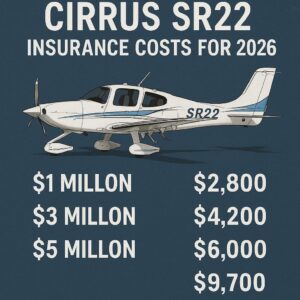
Cirrus SR22 Insurance Costs for 2026
What Determines Your Cirrus SR22 Insurance Premium?
Think of your insurance quote as a custom-tailored suit, not an off-the-rack product. Underwriters meticulously assess your unique risk profile by examining two primary categories: you, the pilot, and your specific aircraft. The final premium is a direct reflection of this calculated risk.
The Pilot Factor: Your Flying Resume is Key
Your logbook tells the most critical story to an insurance company. A pilot’s qualifications are the single largest variable in determining cost. Insurers examine several key metrics:
-
Total Flight Hours and Recency: More hours generally indicate more experience, which underwriters favor. Just as important is recent flight time; being “current” demonstrates ongoing proficiency.
-
Time in Make/Model (Cirrus SR22): Having 500 hours in a Cessna 172 is valuable, but it doesn’t fully translate to a Cirrus. Underwriters need to see significant experience in the specific make and model you want to insure—often 25-50 hours or more is a key threshold. For a qualified pilot, this is often defined as having at least a private license, instrument rating, 750 total hours, and 50 hours in the SR22.
-
Ratings and Training: An Instrument Rating (IFR) is one of the best investments for lowering your premium, as it proves you can handle complex weather situations. Furthermore, completing Cirrus-specific transition training (like the Embark program) and annual recurrent simulator training can save you 5-10% or more on your annual premium.
-
Safety and Claims History: A clean slate with no accidents, incidents, or FAA violations is your golden ticket. A prior claim can raise your premiums by 10-25% for several years.
The Aircraft Factor: Value, Model, and Use
Once underwriters review your experience, they turn to the machine itself. Not all SR22s are viewed equally.
-
Hull Value (Agreed Value): This is the cornerstone of your hull premium. The SR22’s value can range from $300,000 to over $800,000, with the turbocharged SR22T models often at the higher end. Your premium is calculated as a percentage of this agreed-upon value.
-
Model and Specifications: A turbocharged SR22T will generally cost more to insure than a normally aspirated model due to its higher performance and complexity. Newer models with the latest safety features (like the Perspective+ or Perspective Touch avionics suites) may also be viewed more favorably.
-
Intended Use: How you plan to fly makes a big difference. Private, pleasure use is the least expensive category. Using the aircraft for business, commercial operations, or flight instruction increases the risk exposure and will raise your premium.
-
Storage and Location: A hangared aircraft almost always costs 10-15% less to insure than one kept on a tie-down, as it’s protected from weather, vandalism, and other ground risks. The geographic region where you base the aircraft also affects rates.
Market Conditions: The Bigger Picture
Your personal risk profile is evaluated within the broader aviation insurance market, which cycles between “soft” and “hard” conditions. In recent years, the market has faced challenges, with claims-free general aviation operations seeing premium increases. However, for 2026, rates for piston aircraft like the SR22 are showing signs of stabilization or even slight decreases.
Market Conditions Impact
| Market Phase | Characteristics | Impact on SR22 Premiums |
|---|---|---|
| Soft Market | Many insurers competing, low claim frequency. | Lower premiums, easier underwriting, more flexibility. |
| Hard Market | Fewer insurers, higher losses, stricter underwriting. | Higher premiums, tighter requirements, less coverage flexibility. |
Breaking Down the Coverage: Hull vs. Liability
Your SR22 insurance policy is built on two essential pillars of protection. Understanding each is crucial to knowing what you’re paying for.
Hull Coverage: Protecting Your Aircraft
Hull coverage is for physical damage to your Cirrus. It’s based on an agreed value—a specific dollar amount you and the insurer set for the aircraft’s worth.
-
What it covers: Damage from accidents (ground or in-flight), theft, vandalism, fire, and natural disasters like hail or hangar collapse.
-
Cost Basis: For piston aircraft like the SR22, hull coverage typically costs between 1% and 1.5% of the agreed hull value. However, this percentage can be much higher for pilots with less experience.
-
The Deductive: You can often lower your hull premium by opting for a higher deductible, meaning you pay more out-of-pocket in the event of a claim.
Liability Coverage: Protecting Your Assets and Future
While hull coverage protects your plane, liability coverage protects you from financial ruin. It covers bodily injury and property damage you might cause to others while operating your aircraft.
-
Standard Limits: The most common structure is $1,000,000 per occurrence with a sub-limit of $100,000 per passenger. This means if you have four passengers, up to $400,000 of your $1M total could be used for passenger injuries.
-
“Smooth” Liability: For broader protection, highly qualified pilots can often obtain $1,000,000 smooth liability, which has no per-passenger sub-limit. This is highly recommended if you regularly fly with passengers other than immediate family.
-
Cost: Liability-only policies for an SR22 can range from $500-$650 per year for a qualified pilot to $900-$1,142 for a less-qualified pilot.
Pro Tip: Industry experts often note that “liability coverage is arguably more important than hull coverage. It protects your entire financial life” from devastating lawsuits. Never sacrifice adequate liability limits to save a small amount on your premium.
Cirrus SR22 Insurance Cost: Real-World Scenarios
To move from theory to practice, let’s look at how these factors combine to create real premiums. The following table illustrates the dramatic impact pilot qualifications have on the final cost for the same high-value aircraft.
Cirrus SR22T Insurance Cost Comparison (Based on $900,000 Hull Value)
| Pilot Profile | Hull Coverage | Liability Coverage | Total Annual Premium | Premium as % of Hull Value |
|---|---|---|---|---|
| Private & Instrument Rated | $900,000 Agreed Value | $1,000,000 Per Occurrence | $7,400 | 0.82% |
| Private Pilot (No Instrument Rating) | $900,000 Agreed Value | $1M Occurrence / $250k Passenger | $15,500 | 1.72% |
| Student Pilot | $900,000 Agreed Value | $1M Occurrence / $250k Passenger | $22,000 | 2.44% |
This clear progression shows why underwriters emphasize training and ratings. An instrument rating alone can cut the premium for a high-value SR22T by more than half in this example.
Broader industry data confirms these trends. For a qualified pilot (Private & IFR, 750+ total hours, 50+ in SR22) seeking a policy with $1M liability and $245,000 in hull coverage, the average annual premium ranges from $2,624 to $3,153. For a pilot lacking an instrument rating and with less than 50 hours in type, that range jumps to $4,000 to $5,500 per year for the same coverage.
How to Get the Best Rate on Your SR22 Insurance
You have significant control over your insurance costs. Here are proven strategies to secure the best possible rate:
-
Invest in Training: This is the most effective step. Complete your Instrument Rating and the official Cirrus Transition Training (Embark). Commit to annual recurrent training with a Cirrus-standardized instructor or in an approved simulator program.
-
Build (and Log) Time in Type: Before you buy, try to rent or train in an SR22 to build those crucial first 25-50 hours. Document every flight meticulously in your logbook.
-
Choose the Right Storage: Hangar your aircraft. The premium reduction and added protection for your valuable asset are well worth the cost.
-
Maintain a Clean Record: Fly safely and in compliance with all regulations. Avoid filing small claims that could be paid out-of-pocket, as a claim-free history is a major advantage at renewal time.
-
Shop the Market Annually with a Specialist: Insurance markets change. Work with an independent aviation insurance broker who specializes in general aviation and has access to all major underwriters (like AIG, Global Aerospace, Old Republic, etc.). They can shop your policy across multiple companies to find the best combination of price and coverage. A broker like BWI has reported saving clients over $1,000 annually simply by re-shopping their SR22 policy.
Special Considerations for Cirrus Aircraft
-
The CAPS Parachute System: The Cirrus Airframe Parachute System (CAPS) is a significant safety asset. While it has saved lives, insurers also consider the substantial cost of repacking the system (required every 10 years) and the total loss that typically follows its deployment.
-
Technology and Repair Costs: The SR22’s composite airframe and advanced glass cockpit avionics require specialized technicians and parts, which can drive up repair costs—a factor insurers consider in their pricing.
Conclusion
Securing insurance for your Cirrus SR22 is a detailed process where the final cost is a direct reflection of your personal flying proficiency and the specifics of your aircraft. By understanding the critical factors—from your instrument rating and Cirrus-specific training to your aircraft’s hull value and storage—you can proactively manage your risk profile. Ultimately, partnering with an experienced aviation insurance specialist is the most reliable way to navigate this complex market, ensuring you get comprehensive protection that fits both your aircraft’s capabilities and your budget, allowing you to fly with true peace of mind.
Frequently Asked Questions (FAQ)
What is the single most important thing I can do to lower my SR22 insurance cost?
Obtain your Instrument Rating (IFR) and complete official Cirrus-specific transition training. These two actions demonstrate a high level of proficiency and commitment to safety, which insurers reward with significantly lower premiums.
Can I get insurance as a low-time pilot or student buying an SR22?
Yes, but it will be considerably more expensive. Insurers view this as a high-risk scenario. You can expect to pay between 2% and 3% of the hull value annually, and you will likely face stricter requirements like mandated training with a designated instructor. It’s often advisable to build more time in a simpler aircraft first.
How does the Cirrus Vision Jet (SF50) insurance cost compare to the SR22?
Insurance for the Vision Jet is in a different category altogether—light jet insurance. While the SR22 is a high-performance piston, the SF50 is a turbine aircraft. Annual premiums for light jets typically start around $15,000 and can exceed $30,000, driven by much higher hull values (often $3M+) and the complexity of jet operations.
Are there any discounts available for SR22 insurance?
Yes, common discounts include those for hangaring your aircraft, completing annual recurrent training, bundling multiple aircraft under one policy, and having a long-term claim-free history. Some brokers may also offer discounts for paying your annual premium in full.
What happens if I need to make a claim?
Contact your insurance broker or company immediately. They will guide you through the process, which includes documenting the damage, obtaining repair estimates from approved facilities (often with expertise in composite materials for Cirrus aircraft), and managing the payout. Remember that making a claim can affect your premiums at renewal.
Additional Resource:
For the latest information on aircraft insurance market trends and insights that can affect your SR22 policy, visit the Aircraft Owners and Pilots Association (AOPA) Insurance Services page: AOPA Insurance. AOPA is a trusted authority for general aviation pilots and provides valuable resources for aircraft owners.