We’ve all been there. You’re sitting in the dentist’s chair, the hygienist has just finished scraping, and then it happens. The dentist walks in, takes a look at your X-rays, and says those dreaded words: “It looks like you need a crown.”
Your heart sinks. Not because of the procedure, but because you immediately start wondering, “Is my insurance going to cover this? How much is this going to cost me out of pocket?”
Navigating the world of traditional dental insurance can feel like trying to solve a Rubik’s Cube blindfolded. Between annual maximums that haven’t increased since the 1970s, waiting periods for major work, and networks that seem to exclude the one dentist you actually trust, it’s no wonder people are frustrated.
Enter a new player in the dental game: concierge dental insurance.
But what exactly is it? Is it insurance? Is it a membership? And more importantly, is it worth your hard-earned money?
In this guide, we’re going to strip away the jargon and look at concierge dental care realistically. We’ll explore how it differs from traditional plans, who it’s best for, and whether it might be the stress-free solution you’ve been searching for.
Concierge Dental Insurance
What Exactly Is Concierge Dental Insurance? (And Why It’s Not Really “Insurance”)
Let’s start with a reality check. The term “concierge dental insurance” is a bit of a misnomer. In the strictest sense, it’s not insurance at all.
Traditional dental insurance is a risk-pooling model. You pay a premium, and the insurance company pays the dentist a negotiated rate for your care, up to a certain limit. It’s a third-party payer system.
Concierge dental “insurance” is actually a direct membership model. It’s a financial agreement set up directly between you and the dental practice.
Think of it more like a gym membership or a wholesale club (like Costco) for your teeth. You pay a monthly or annual fee, and in return, you get access to a menu of dental services, often at significantly discounted rates.
Here is the core difference in a nutshell:
-
Traditional Insurance: You pay an insurer. They pay the dentist. You hope the dentist is “in-network.”
-
Concierge/In-House Membership: You pay the dentist directly. They give you a discount because you are a member.
Why Do People Call It “Concierge”?
The word “concierge” is borrowed from the hospitality industry. Just as a hotel concierge helps you skip the line for a restaurant reservation or gets you tickets to a sold-out show, a concierge dental practice aims to provide a higher level of access and personalized service.
In this model, the “insurance” part (the paperwork, the claims, the negotiations) is stripped away. What’s left is a direct relationship with your dental provider.
How Does a Concierge Dental Plan Work?
If you walk into a practice that offers this model, here is exactly how the process usually works:
-
You Sign Up: You fill out a simple form at the dentist’s office or on their website. You agree to their terms and pay a fee. This fee can be paid monthly, but it is most commonly paid annually.
-
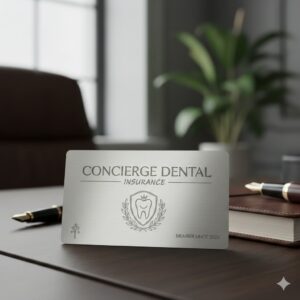
You Get a “Member Card”: You are now an “active member” of that dental practice. You’ll likely get a card that shows your status and membership number.
-
You Schedule Your Preventive Care: As a member, your routine preventive care—usually cleanings, exams, and X-rays—is either fully covered or included at a deeply discounted rate. You pay nothing additional for these services during your visit.
-
You Pay “Member Rates” for Work: If the dentist finds a cavity, you don’t file an insurance claim. Instead, the front desk will pull out the practice’s “membership fee schedule.” You will pay the pre-negotiated, discounted rate for that filling right then and there.
-
You Save on Major Procedures: The same discount applies to crowns, bridges, implants, and even orthodontics. You pay the member price, which is often significantly lower than what a non-member would pay, and sometimes lower than what an insurance company would negotiate.
Important Note: Because this is a direct agreement, you are responsible for the entire cost of your treatment at the time of service. There is no insurance company to send a check to the dentist later.
Concierge Dental Insurance vs. Traditional PPO Insurance: A Head-to-Head Comparison
To really see the difference, let’s put them side-by-side. Imagine you need two fillings and a crown this year.
| Feature | Traditional Dental PPO Insurance | Concierge Dental Membership |
|---|---|---|
| How It Works | Pay monthly premiums to an insurance company. | Pay a monthly or annual fee directly to the dentist. |
| Network Restrictions | Must see an “in-network” dentist to get the best rate. If you go out-of-network, you pay more. | Only valid at the specific practice you joined. It does not transfer to other dentists. |
| Preventive Care | Usually covered 100% (exam, cleaning, X-rays) after a small deductible or waiting period. | Usually covered 100% (included in the membership fee). |
| Cost for Fillings (2) | Insurance pays a portion (e.g., 80%). You pay the remaining 20% (co-pay) plus any deductible. | You pay a fixed, discounted “member rate” directly to the dentist. |
| Cost for a Crown | Insurance pays a portion (e.g., 50%). You pay the other 50%. Subject to annual maximum. | You pay a fixed, discounted “member rate.” |
| Annual Maximum | The Biggest Downside. Most plans cap out at $1,000 to $1,500 per year. If your crown costs $1,200 and your max is $1,000, you pay the difference. | No Maximum. There is no cap on what the dentist will cover. You get the discounted rate regardless of how much work you need. |
| Waiting Periods | Common. You may wait 6-12 months for major work like crowns. | No Waiting Periods. You are eligible for discounts on day one. |
| Paperwork | Claims, pre-determinations, EOBs (Explanation of Benefits). Lots of back-and-forth. | None. The agreement is between you and the dentist. No claims are filed. |
The Pros: Why Patients Are Switching to Concierge Plans
This model is growing in popularity for a reason. Here’s what patients love about it.
1. Radical Transparency and Simplicity
There is a certain peace of mind that comes from knowing exactly what something costs. With concierge dentistry, the guesswork is gone. The practice has a simple, one-page price list for members. You know that a filling is $X and a crown is $Y. There’s no waiting for an Explanation of Benefits (EOB) to arrive in the mail weeks later, hoping the insurance company paid their share. You know the price before the doctor even starts.
2. No More Annual Maximum Games
This is arguably the biggest financial advantage. Traditional insurance has an annual maximum—the total amount the insurance company will pay in a year. If you need a root canal and a crown, you can blow through that $1,500 max in one visit.
Concierge plans don’t have this. If you need $5,000 worth of work, you pay the discounted member rate for all of it. The discount applies to the entire bill, not just the first $1,500.
3. No Waiting Periods
Life happens. Maybe you chipped a tooth on a piece of popcorn, or a sudden toothache has you in agony. If you just signed up for traditional insurance, you’re often told to wait six months to a year before they’ll help pay for that crown. A concierge plan is immediate. You can sign up today and schedule your appointment for next week.
4. Access to Your Preferred Dentist
Have you ever had to switch dentists because your employer changed insurance providers, and your old dentist was no longer “in-network”? It’s a frustrating experience. With a concierge plan, the dentist is the provider. As long as you stay a member, you can keep seeing the same doctor. It fosters a long-term relationship, which is better for your continuity of care.
5. Covers the “Extras” That Insurance Doesn’t
Many traditional plans have strict limits. They might cover a basic cleaning but not a deep cleaning (scaling and root planing) for gum disease. They might cover silver fillings but not tooth-colored composite ones. Concierge plans often apply the same discount to everything the practice offers, including cosmetic treatments like whitening or veneers, which are almost never covered by insurance.
The Cons: What You Need to Watch Out For
Being realistic means looking at the downsides, too. This model isn’t perfect for everyone.
1. It’s Not Portable
This is the biggest limitation. Your membership is tied to that one specific dental office. If you move across town and the commute is too far, you lose your membership. If you have a falling out with the dentist, you lose it. If the practice closes, you lose it. You are locked into that single provider.
2. It Doesn’t Cover Catastrophic Events (Major Oral Surgery)
Remember, this is a discount plan, not a true insurance risk-pool. If you are in a serious accident and need complex reconstructive jaw surgery or treatment for oral cancer in a hospital setting, your in-house dental membership won’t help. Those procedures fall under major medical insurance (health insurance). Traditional dental insurance might offer a small amount of coverage for this, but a concierge plan offers none.
3. You Pay the Full Bill Upfront
While the rates are discounted, you are responsible for the entire amount at the time of service. For a big case like multiple implants, this could be thousands of dollars due at once. Some practices offer payment plans through third-party financing (like CareCredit), but it’s not the same as having an insurance company foot a portion of the bill over time.
4. You Might Overpay If You Have Zero Dental Needs
Let’s do the math. If you pay $400 for an annual membership, and you only go for your two cleanings, you paid $400. If your dentist charges $150 per cleaning for non-members, you just paid $400 for services that would have cost $300 without the plan. You effectively paid $100 extra for the “privilege” of being a member. The financial benefit of the plan only kicks in when you need restorative work.
Is a Concierge Dental Plan Right for You?
Given the pros and cons, who is this actually for? Let’s break it down by patient profile.
You Might Be a Good Candidate If:
-
You have a high-maintenance smile. You have multiple crowns, a history of cavities, or are prone to gum issues. You know you’re going to need work done, and the discounts will quickly outweigh the membership fee.
-
You value a specific dentist. You’ve found “the one”—a dentist you trust implicitly. You’re willing to pay a membership to ensure you can always see them without network interference.
-
You hate paperwork and bureaucracy. You’d rather pay a clear price and be done with it than fight with an insurance company over claims and codes.
-
You are a small business owner, freelancer, or retiree. You don’t have employer-sponsored insurance, and you’re looking for a simpler, often more affordable, alternative to the individual insurance market.
You Might Be Better Off with Traditional Insurance If:
-
You have a large family. Most concierge plans charge a per-person fee. A family of four could be looking at over $1,500 in annual membership fees. A group PPO plan through an employer might be cheaper for preventive care only.
-
You have pristine teeth. If you rarely get cavities and just need your six-month cleanings, you are better off simply paying the cash price for those visits. You’ll save money by not buying a membership.
-
You move frequently or travel extensively. Because the plan is tied to one location, it offers no value if you are not in that city.
-
You are worried about a major medical event. If you want a safety net for catastrophic dental injuries that might involve hospitalization, you need major medical insurance or a robust traditional dental policy.
How to Find and Evaluate a Concierge Dental Practice
If you think this model sounds appealing, here’s how to find a practice and what to ask before you sign up.
Where to Look
You won’t usually find these plans on an insurance exchange. You need to look directly at dental practice websites. Search for terms like:
-
“Dental savings plan near me”
-
“In-house membership plan [Your City]”
-
“No insurance dental plan”
-
“Direct dental care”
-
“Concierge dentist [Your City]”
5 Questions to Ask Before Signing Up
Don’t just sign up blindly. Treat it like a contract, because it is. Call the front desk and ask these specific questions:
-
“What is the exact breakdown of the membership fee, and what preventive care is included?” Confirm how many cleanings and X-rays are covered per year. Are fluoride treatments or night guards included?
-
“Can I see a complete fee schedule for members?” Ask for a list. They should be able to show you the price for basic fillings, root canals, crowns, and extractions. Compare these prices to what you might pay with your current insurance.
-
“Is there a discount for periodontal (gum) treatments?” If you have gum disease, your cleanings are more complex (and expensive). Make sure the plan covers “perio maintenance” or scaling and root planing at the discounted rate.
-
“What happens if I need a specialist?” If you need a root canal, the general dentist might refer you to an endodontist. Does your membership give you any discount at that specialist’s office? (Usually, the answer is no, but it’s vital to know).
-
“Can I cancel and get a refund?” Understand the cancellation policy. If you pay for the full year upfront but have to move in three months, can you get a prorated refund?
The Financial Reality: Crunching the Numbers
Let’s look at a realistic scenario to see the potential savings.
Meet Sarah.
-
Dental Needs: 2 cleanings, 1 exam, 1 set of X-rays (preventive). 2 composite fillings. 1 crown.
-
Local Dentist Cash Prices: Cleaning/Exam ($150 each), X-rays ($100), Composite Filling ($200 each), Crown ($1,200).
Scenario A: No Insurance / No Plan
Sarah pays: (Cleaning/Exam: $150 x 2) + X-rays: $100 + Fillings: $200 x 2 + Crown: $1,200
Total Cost: $2,000
Scenario B: Concierge Membership
-
Membership Fee: $350/year (includes all preventive care for free).
-
Member Rate for Fillings: $140 each ($280 total).
-
Member Rate for Crown: $840.
Total Cost: $350 (fee) + $280 + $840 = $1,470
Total Savings vs. Cash: $530
Scenario C: Typical PPO Insurance
-
Annual Premiums: $350/year
-
Deductible: $50
-
Plan covers 100% preventive after deductible.
-
Plan covers 80% of fillings, 50% of crowns.
-
Annual Maximum: $1,500
Cost Breakdown:
-
Premiums: $350 (paid whether you use it or not)
-
Deductible: $50 (applies to fillings/crown)
-
Fillings: $400 total. Insurance pays 80% of $400 = $320. You pay $80.
-
Crown: $1,200 total. Insurance pays 50% of $1,200 = $600. You pay $600.
-
Total Out-of-Pocket (Premiums + Deductible + Co-pays): $350 + $50 + $80 + $600 = $1,080
In this example, Sarah pays $1,080 with PPO insurance and $1,470 with the concierge plan. The PPO is cheaper in this specific instance. However, if her crown had cost $1,500 and pushed her over the $1,500 annual max, the math would flip.
The Takeaway: The value of a concierge plan increases with the amount of work you need, while the value of traditional insurance is capped by its low annual maximums.
The Future of Dentistry: Is This the New Normal?
The rise of concierge and in-house membership plans is a direct response to consumer frustration. For decades, dental insurance has remained largely stagnant. The $1,500 annual maximum of today has the same purchasing power as about $300 did in the 1970s, yet the cost of dentistry has risen with inflation and technology.
Dentists are also frustrated. They spend hours of staff time dealing with insurance companies, fighting to get claims paid for the treatments their patients actually need. By switching to a concierge model, they cut out the middleman, reduce administrative overhead, and can often set prices that are fairer for the patient while still profitable for the practice.
It’s unlikely that concierge plans will replace traditional insurance entirely, especially for large employer groups. However, they are becoming a powerful and popular alternative for individuals, families, and those who want a simpler, more direct relationship with their dentist.
Conclusion
Concierge dental insurance—more accurately called an in-house membership plan—offers a compelling alternative to the traditional insurance maze. It replaces confusing paperwork, restrictive networks, and low annual maximums with simplicity, transparency, and direct access to your chosen dentist. While it’s not portable and requires you to pay for care upfront, the discounted rates and lack of waiting periods can lead to significant savings, especially if you require substantial dental work. For anyone tired of the bureaucracy and eager to take control of their dental health, it’s an option worth exploring.
Frequently Asked Questions (FAQ)
1. Is concierge dental insurance the same as dental discount plans?
They are very similar, but not always the same. A concierge plan is typically run by a single dental practice for its own patients. A dental discount plan (like Careington or Aetna Dental Access) is a large network plan where you pay a fee to access discounts at many different participating dentists. The concierge model is more personal and localized.
2. Can I use my HSA or FSA to pay for a concierge dental membership?
In most cases, yes. Because the membership covers qualified medical/dental expenses (cleanings, fillings, etc.), you can typically use your Health Savings Account (HSA) or Flexible Spending Account (FSA) funds to pay for the membership fee. Always check with your HSA/FSA administrator to be sure.
3. What happens if my concierge dentist recommends a treatment I can’t afford right now?
This is a common concern. While you don’t have an insurance company to fall back on, many concierge practices are very understanding. They often offer financing options through third-party companies like CareCredit or LendingClub, which allow you to pay for large treatments in monthly installments, sometimes with zero interest if paid within a promotional period.
4. If I have a concierge plan, do I still need dental insurance?
You don’t need traditional dental insurance, but you must maintain your medical health insurance. As mentioned, a concierge plan only covers services performed in that dental office. It does not cover oral surgery in a hospital, treatment for oral cancer, or accidents covered by your medical plan.
5. Are children included in family concierge plans?
Yes, most practices offer individual and family tiers. A family plan will cover the adults and any dependent children living in the household. The fee is usually higher than an individual plan but offers a discount compared to paying for several individual memberships.