For businesses that rely on complex supply chains, a single disruption can ripple into significant financial loss. While you may trust your carriers to have their own cargo insurance, what happens if their policy lapses, is invalid, or has insufficient limits? This exposure is where contingent cargo insurance becomes critical. Yet, the first question on every logistics manager’s or business owner’s mind is: what does contingent cargo insurance cost?
Unlike standard policies with fixed formulas, the cost of contingent cargo insurance is nuanced, reflecting the unique vulnerabilities of your operations. This comprehensive guide will demystify the pricing landscape. We’ll explore the key factors insurers evaluate, provide realistic cost indicators, and offer practical strategies to manage your premium effectively. By the end, you’ll have a clear, actionable understanding of how to balance robust protection with a sensible budget.
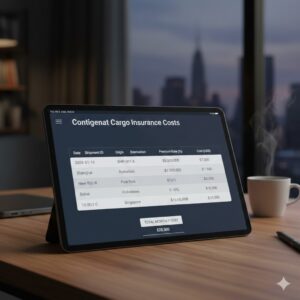
Contingent Cargo Insurance Cost
What is Contingent Cargo Insurance? A Quick Recap
Before diving into costs, let’s firmly establish what we’re discussing. Contingent cargo insurance (also known as contingent liability or gap insurance) is not primary insurance for your goods. Instead, it acts as a vital safety net.
In simple terms: It protects you (the shipper or freight forwarder) in the event that the carrier’s primary insurance fails to cover a loss during shipment. This failure could be due to the carrier having no insurance, a policy exclusion applying (e.g., theft of unattended vehicle, water damage), the carrier being bankrupt, or their limits being too low to cover the full value of your cargo.
“Contingent insurance isn’t about distrusting your partners; it’s about responsibly managing the uncontrollable variables in a multi-party logistics chain.” — Industry Risk Advisor
Key Takeaway: You are not insuring the cargo itself first; you are insuring the risk that other parties’ insurance proves inadequate. This fundamental difference shapes the cost structure.
The Core Factors That Determine Your Contingent Cargo Insurance Cost
Your premium isn’t a random number. It’s a calculated assessment of risk. Insurers weigh several interconnected factors to arrive at your quote. Understanding these gives you power to influence the final cost.
1. Your Industry and Cargo Type (The Biggest Driver)
The nature of what you ship is paramount. Insurers categorize cargo based on susceptibility to damage, theft, and spoilage.
-
High-Risk / High-Value Cargo: Electronics, pharmaceuticals, fine art, luxury goods, high-fashion apparel, high-end machinery. These items are attractive to thieves and prone to damage. This leads to the highest premiums.
-
Medium-Risk Cargo: Automotive parts, general manufactured goods, non-perishable foodstuffs, building materials. Standard rates typically apply.
-
Low-Risk Cargo: Bulk commodities like grain, ore, or low-value raw materials like scrap paper. These attract the lowest premiums.
2. Annual Shipping Volume and Value
How much do you ship, and what is its total value? This is usually expressed as Total Annual Freight Value. A company shipping $50 million worth of electronics will have a different risk profile (and cost) than one shipping $5 million worth of plastic components. Higher values mean greater potential loss for the insurer.
3. Geographic Scope and Routes
Where your goods travel significantly impacts risk assessment.
-
Domestic vs. International: International shipments, especially to regions with higher port congestion, political instability, or elevated theft rates, will increase cost.
-
Specific Routes: A lane known for cargo theft (e.g., certain highway corridors, specific ports) will be penalized. Shipping through “safe” territories can reduce cost.
-
Mode of Transport: Air, ocean, truck, and rail each have different risk profiles. Multimodal shipments add complexity.
4. Your Carrier Vetting and Management Process
This is a factor within your control. Insurers look favorably upon shippers who rigorously vet their carriers. Can you demonstrate that you:
-
Verify carrier insurance certificates before tendering loads?
-
Check for policy expiration dates and adequate limits?
-
Use reputable, asset-based carriers versus non-asset-based brokers?
-
Have a formal carrier qualification program?
A strong process shows you’re a proactive partner in risk mitigation, which can lead to better rates.
5. Claims History
Your past loss history with contingent claims (or even primary cargo claims) is a direct indicator of future risk. Frequent claims, regardless of fault, signal a higher-risk operation. A clean history is your best bargaining chip.
6. Policy Limits and Deductibles
-
Limit of Liability: The maximum the policy will pay per shipment or in aggregate. Choosing a higher limit increases your premium. You must select a limit that matches your highest potential loss.
-
Deductible (or Excess): The amount you pay out-of-pocket on a claim before insurance kicks in. Opting for a higher deductible can significantly lower your annual premium. It’s a classic risk-retention trade-off.
7. Coverage Scope and Endorsements
A basic “fall of the carrier’s insurance” policy is cheaper than a broad-form policy that also covers:
-
Non-Conveyance: Carrier picks up goods but fails to ship them.
-
Theft of an Unattended Vehicle: A common exclusion in primary truckers’ policies.
-
Mysterious Disappearance.
Each added layer of protection increases cost.
Contingent Cargo Insurance Cost: Realistic Price Indicators
It’s crucial to state: there is no standard “per-shipment” or percentage rate published online. Costs are highly individualized. However, we can provide a framework based on industry norms.
The most common pricing model is a rate applied to your Total Annual Freight Value.
Cost Influence Factors
| Factor | Lower Cost Scenario | Higher Cost Scenario |
|---|---|---|
| Cargo Type | Low-risk bulk commodities (lumber, grain) | High-value electronics or pharmaceuticals |
| Routes | Domestic, low-crime corridors | International, high-theft areas, war zones |
| Carrier Vetting | Formal program, top-tier carriers only | Ad-hoc, minimal verification |
| Claims History | Zero claims in past 3-5 years | Multiple claims in past 2 years |
| Deductible | High deductible (e.g., $5,000 per claim) | Low deductible (e.g., $500 per claim) |
| Coverage | Basic contingent coverage | Broad-form “all risks” contingent coverage |
Sample Cost Calculation Scenario
Let’s assume a manufacturer of industrial machinery parts (medium-risk cargo) with:
-
Total Annual Freight Value: $10,000,000
-
Routes: Primarily domestic US and Canada via truck.
-
Carrier Vetting: Strong, documented process.
-
Claims History: Clean.
A likely premium could range from 0.075% to 0.15% of the freight value.
-
Low End: $10,000,000 x 0.00075 = $7,500 annual premium
-
High End: $10,000,000 x 0.0015 = $15,000 annual premium
For a high-risk shipper (e.g., consumer electronics) with the same freight value but international lanes, the rate could be 0.2% to 0.5% or more, leading to a premium of $20,000 to $50,000+.
Important Note for Readers: These are illustrative examples only. Your actual quote will vary. Always obtain multiple quotes from specialist marine cargo insurers or brokers.
How to Reduce Your Contingent Cargo Insurance Cost: Actionable Strategies
You can actively manage your premium by becoming a more attractive risk to insurers.
1. Build and Document a Rigorous Carrier Compliance Program.
This is your number one tool. Create a checklist for every carrier:
-
Certificate of Insurance (COI) verification for auto liability and cargo.
-
Confirmation of “per shipment” limits that meet your needs.
-
Check for endorsements like “unattained vehicle” exclusion.
-
Validate policy expiration dates monthly.
-
Use third-party monitoring services for automation.
2. Optimize Your Deductible.
Analyze your cash flow and risk tolerance. Can you comfortably absorb a $2,500 loss per incident? If so, choosing that over a $250 deductible will substantially lower your annual premium. The savings often outweigh the potential out-of-pocket cost over time.
3. Consolidate and Leverage Your Shipping Data.
Provide insurers with clean, accurate data: exact lanes, modes, values, and commodity descriptions. Inconsistency or guesswork forces insurers to price conservatively (higher). A professional shipment management system report is ideal.
4. Bundle with Other Insurance Policies.
If you have other lines of insurance (e.g., property, general liability, marine cargo), placing your contingent coverage with the same carrier or through a single broker can sometimes secure a package discount.
5. Proactively Manage Claims.
Even if a claim is filed under the contingent policy, work swiftly to gather all documentation (BOL, invoices, carrier insurance details, damage photos). Efficient claim resolution reduces administrative costs for the insurer, fostering a better long-term relationship.
6. Regularly Review and Re-market Your Coverage.
Don’t auto-renew without review. The market changes. Every 2-3 years, work with your broker to test the market. Your improved loss history or operations may qualify you for better rates.
FAQ: Your Questions on Cost, Answered
Q: Is contingent cargo insurance a flat fee or a percentage?
A: Almost always a percentage (rate) of your total annual freight value, billed as an annual premium. Some micro-specific policies for very small shippers may have a flat fee.
Q: Can I get pay-as-you-go contingent insurance?
A: While not as common as annual policies, some insurers and digital platforms offer transactional or monthly “on-demand” coverage, which can be cost-effective for low-volume or irregular shippers.
Q: How does the cost compare to primary cargo insurance?
A: Contingent insurance is typically less expensive than primary insurance because it responds secondarily. You’re only paying for the gap risk, not the primary transit risk. A primary policy might cost 0.1%-0.3% of value, while contingent might be 0.07%-0.2%, but this is a generalism and depends entirely on the factors above.
Q: Will my premium go up after a claim?
A: Likely, yes. As with most insurance, a claims history is a primary rating factor. Multiple claims can lead to significant premium increases or even non-renewal.
Q: What’s the minimum freight value to need this insurance?
A: There’s no official minimum. The decision is based on risk tolerance. If the financial impact of a single total loss where the carrier’s insurance fails would be catastrophic to your business, you need the coverage, regardless of annual volume.
Conclusion
Understanding contingent cargo insurance cost requires moving beyond looking for a simple rate sheet. It’s a dynamic calculation based on your cargo’s risk profile, your operational diligence, and your chosen financial parameters like deductibles. By investing in robust carrier vetting, strategically selecting policy terms, and partnering with a knowledgeable broker, you can secure essential supply chain protection at a optimized, realistic cost. This coverage isn’t an expense; it’s an investment in operational resilience.
Additional Resource:
For a deeper dive into building a carrier compliance program, the Transportation Intermediaries Association (TIA) offers valuable templates and guidelines. You can explore their resources here: https://www.tianet.org/ (Note: This is an external industry association resource).