Have you ever dreamed of being your own boss? Of building a business that provides financial freedom and a legacy for your family? For many entrepreneurs, the world of franchising offers a proven path to make that dream a reality. And if you’re looking at the insurance space, you’ve almost certainly come across the name Brightway.
Brightway Insurance is a powerhouse in the Property & Casualty (P&C) insurance industry. They’ve built a massive network by offering a unique model: you don’t have to be the insurance expert from day one. Instead, you focus on sales and building relationships, while they handle the back-end paperwork.
But before you get swept away by the vision, you need to look at the numbers. The most common question we hear is, “How much does a Brightway Insurance franchise actually cost?”
It’s a fair question, and the answer isn’t always a single, simple number. The total investment can vary based on your location, your background, and the specific path you take. In this guide, we’re going to pull back the curtain. We’ll provide a realistic, honest breakdown of the Brightway Insurance franchise cost, the ongoing fees, what you get for your money, and how to evaluate if this investment is right for you.
We’ll keep it friendly, keep it real, and give you all the tools you need to make an informed decision.
Cost of a Brightway Insurance Franchise
The Brightway Difference: Why You’re Not Just Buying a Job
Before we dive into the dollars and cents, it’s important to understand what makes Brightway unique. This context is crucial because it explains why the cost structure is what it is.
In a traditional independent insurance agency, you are responsible for everything. You have to secure carrier appointments (which can take years), negotiate commissions, manage the accounting, handle customer service, and, oh yeah, sell insurance. It’s a lot.
Brightway flips this model on its head. They act as the Master Agency or the “Home Office.” Here’s how it works for you, the franchise owner (often called a Franchisee or a “Partner”):
-
You Focus on Sales: Your primary job is to build a team, market your agency, and sell policies. You are the face of the business in your community.
-
They Handle the “Back Office”: The Brightway Home Office has already done the hard work. They have secured appointments with over 30 top-rated insurance carriers (like Progressive, Foremost, and Safeco). They handle policy processing, underwriting support, customer service calls, and commission accounting.
This is often called the “Brightway Difference.” You are buying into a system where the operational heavy lifting is done for you, freeing you up to do what you do best: build relationships and sell.
This model directly impacts the Brightway Insurance franchise cost and its ongoing fees, which we’ll explore in detail.
Breaking Down the Brightway Insurance Franchise Cost
Alright, let’s get down to business. When you’re looking at the initial investment for a Brightway franchise, it’s helpful to think of it in two parts: the upfront costs you pay to join the system, and the initial capital you’ll need to get your doors open and stay afloat while you build momentum.
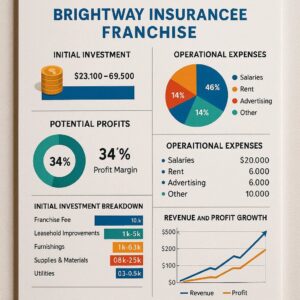
Based on the Brightway Franchise Disclosure Document (FDD), the estimated initial investment range for a new franchise is typically between $110,000 and $220,000. This is a wide range, so let’s break down what’s actually in that number.
Here is a representative table outlining the estimated expenditures. Please note: These are estimates based on historical data and current FDDs. Actual costs can vary based on location, real estate, and local market conditions.
| Expenditure Type | Estimated Amount | Notes |
|---|---|---|
| Initial Franchise Fee | $45,000 – $60,000 | This is a one-time fee paid upon signing the franchise agreement. |
| Leasehold Improvements | $5,000 – $35,000 | Costs to build out or modify your rented office space. Highly variable. |
| Furniture, Fixtures & Equipment | $10,000 – $25,000 | Desks, chairs, computers, phones, and general office setup. |
| Technology & Software | $3,000 – $8,000 | Initial setup fees for Brightway’s proprietary systems and licensing. |
| Business Licenses & Permits | $500 – $2,000 | State and local fees required to operate legally. |
| Professional Fees (Legal/Accounting) | $2,000 – $5,000 | Costs for your own advisors to review contracts and set up your business entity. |
| Marketing & Branding (Initial) | $5,000 – $15,000 | Local launch marketing, grand opening event, initial promotional materials. |
| Insurance (E&O and General Liability) | $3,000 – $8,000 | Prepaid premiums for required professional liability insurance. |
| Additional Funds (3-6 months) | $30,000 – $60,000 | Crucial. Working capital to cover personal living expenses and business costs until commissions start flowing. |
| TOTAL ESTIMATED INVESTMENT | $103,500 – $218,000 | This aligns with the official ranges in the FDD. |
The Initial Franchise Fee
This is the price of admission. The franchise fee grants you the license to operate a Brightway franchise in a specific territory. It covers the initial training, the right to use their brand, and access to their systems and carrier network. Think of it as your tuition to the Brightway University of Insurance Sales.
The “Hidden” Cost: Working Capital
One of the most important numbers in that table is the last one: Additional Funds. This is not “extra” money; it’s essential fuel for your engine. In the insurance business, commissions are “earned” when a policy is sold, but they are often not paid for 30 to 60 days.
You need enough cash in the bank to cover your rent, your staff’s salary, and your own living expenses during this ramp-up period. Underestimating this is one of the biggest mistakes new business owners make. Brightway is realistic about this, which is why they include a healthy range for working capital in their estimates.
The Ongoing Costs of Owning a Brightway Franchise
Paying the initial Brightway Insurance franchise cost is just the beginning. Like any franchise, there are ongoing fees for the continuous support and infrastructure you receive. Understanding these is critical to projecting your future profitability.
Brightway’s ongoing fee structure is a bit different from a traditional royalty. It’s often described as a “split” of the commissions.
The Commission Split Explained
Instead of you keeping 100% of your commission and then writing a check for a percentage of your revenue (a typical royalty), Brightway operates on a split model. The Home Office, because it provides the carrier appointments and handles all the service work, takes a share of the total commission.
Here’s a simplified way to look at it:
-
Total Commission from Carrier: 100%
-
Brightway Home Office Share: A predetermined percentage (varies by state, product, and contract but is clearly outlined in your agreement).
-
Your Share (Franchisee’s Commission): The remaining percentage.
This model aligns incentives. The Home Office only gets paid when you sell policies. Their job is to support you so you sell more, because that’s how they make their money, too.
Production Royalty vs. Service Fee
You might hear terms like “Production Royalty” and “Service Fee.” In essence, they are part of this same split structure.
-
The Service Fee: This is the portion of the commission that stays with the Home Office to pay for the massive support infrastructure—the call center, the accounting team, the underwriting support, and the technology platform.
-
Your Commission: The portion that flows to you, the Franchisee.
There is also a small National Advertising Fund contribution. This is a modest percentage (often around 1-2% of your commission) that goes toward national brand-building campaigns that benefit the entire Brightway system.
Technology and System Fees
A small monthly fee usually covers your access to Brightway’s proprietary agency management system and quoting tools. These are the digital tools you’ll use every day to run your business, so this fee is essentially your subscription to their industry-leading tech stack.
Is It Worth the Investment? The Profit Potential
Now for the million-dollar question: Can you make money? The Brightway Insurance franchise cost is a significant investment. The return on that investment depends almost entirely on you.
The beauty of the Brightway model is that you are building an asset. Your agency’s value is based on its “book of business”—the total commissions generated by the policies you’ve sold, year after year. Insurance is a “sticky” business. People tend to keep their home and auto policies with the same agency for a long time if they are happy.
This creates a powerful compounding effect.
-
Year 1: You’re building. You’re selling, but you’re also learning. Profits might be reinvested, or you might just be covering your costs.
-
Year 3: You have a base of clients. Many of them are renewing their policies. You’re getting paid on those renewals (often at the same commission split) while also writing new business. Your income becomes more stable.
-
Year 5 and Beyond: Your renewal book is substantial. This provides a reliable, recurring income stream. Your focus shifts to writing new business on top of this solid foundation, which is highly profitable.
“In the insurance franchise world, you eat what you kill in the first year, but by year three, you’re eating from a garden you planted. The renewals are your harvest.” – A quote from a multi-unit Brightway franchisee.
Franchisees who are successful in this model are typically driven, sales-minded individuals who are good at building and leading teams. They follow the system, utilize the Home Office support, and are persistent in their local marketing efforts.
How to Become a Brightway Franchisee: A Step-by-Step Guide
If you’ve weighed the Brightway Insurance franchise cost against the potential and you’re interested in learning more, here’s what the journey typically looks like.
-
Initial Inquiry: You fill out a form on the Brightway franchise website. You’ll likely have an initial, informal phone call with a member of their franchise development team to discuss your background and goals. This is a two-way conversation—you’re seeing if you’re a fit for them, and they’re seeing if you’re a fit for the system.
-
The FDD Review: If the initial conversations go well, you’ll be given access to the Franchise Disclosure Document (FDD). This is the legal document that contains all the details about the Brightway Insurance franchise cost, fees, litigation history, and other franchisee obligations.
-
The Discovery Day: This is a big one. You’ll be invited to the Home Office in Jacksonville, Florida, to meet the leadership team, ask tough questions, and get a feel for the company culture.
-
Franchise Agreement & Financing: If everything feels right, you’ll review the final Franchise Agreement with your attorney. You’ll also finalize your funding, whether it’s from savings, a bank loan (SBA loans are common for franchises), or other sources.
-
Training and Launch: Once you’re signed, you’ll go through an intensive training program to learn the Brightway systems, sales processes, and operational tools. Then, the real work begins: finding an office, hiring your team, and opening your doors.
Important Notes for Prospective Franchisees
-
Realistic Expectations: This is not a passive investment. It requires hard work, dedication, and a sales mindset. You are buying a job that you can eventually build into a business.
-
The Power of the System: The real value of the Brightway Insurance franchise cost is the system. Trust it. Franchisees who try to “go it alone” or ignore the proven methods often struggle. Those who embrace the system tend to thrive.
-
Territory Matters: Your territory is your sandbox. Understand its demographics, competition, and growth potential. A dense, growing suburb will have a different trajectory than a rural, stagnant area.
-
Talk to Existing Franchisees: The FDD contains a list of current and former franchisees. Call them. Ask them about their experience with the cost, the support, and the reality of the day-to-day business. This is the most valuable research you can do.
Conclusion
Deciding to invest in a franchise is a life-changing decision. The Brightway Insurance franchise cost, ranging roughly from $110,000 to $220,000, is a serious investment in a proven system. You’re not just paying for a name; you’re paying for access to top-tier carriers, a powerful back-office support team, and a business model designed to build long-term, recurring revenue. By focusing on sales while leveraging their infrastructure, you have the opportunity to build a valuable asset that generates income for years to come.
Frequently Asked Questions (FAQ)
Q1: What is the total initial investment for a Brightway franchise?
A: The estimated total initial investment ranges from approximately $110,000 to $220,000. This includes the franchise fee, office setup, technology, and—most importantly—sufficient working capital for the first few months.
Q2: Does the Brightway Insurance franchise cost include the office space?
A: No, the estimate includes costs to improve a leased space (leasehold improvements) and furnish it, but it does not include the long-term cost of the lease itself. Rent is a separate ongoing business expense.
Q3: Are there ongoing royalty fees?
A: Brightway operates on a commission split model rather than a traditional royalty. The Home Office takes a predetermined share of the total commission from policies to cover its services, and the remainder is paid to you, the franchisee.
Q4: Do I need experience in the insurance industry to buy a Brightway franchise?
A: No, you do not. One of the biggest selling points of the Brightway model is that the Home Office handles the complex insurance operations. They are looking for entrepreneurs with a sales and leadership background who can follow their proven system.
Q5: Can I get financing for the Brightway franchise cost?
A: Yes. Many franchisees use SBA (Small Business Administration) loans to fund their investment. Brightway is a well-established brand, which often makes them more attractive to lenders. You can also use personal savings, home equity, or partnerships.
Additional Resource
For the most authoritative and up-to-date information, you should always refer to the official source.