Let’s be honest for a second. You’re probably here because you felt it. That little twinge when you drink something cold. Or maybe you saw a dark spot in the mirror. Now, the anxiety isn’t just about the tooth—it’s about the bill. If you are one of the millions of Americans without dental insurance, the thought of visiting the dentist can feel like planning to buy a used car. You know you need it, but you have no idea what the final price tag will look like.
I’ve been there. Sitting in the parking lot, googling “cost of a dental filling without insurance” on my phone, trying to muster up the courage to walk in. The lack of transparency in healthcare pricing is frustrating, to say the least.
The good news? You don’t have to walk into that appointment blind. This guide is designed to pull back the curtain on dental pricing. We’ll break down exactly what you should expect to pay, why prices vary so wildly, and most importantly, how to get the care you need without wiping out your savings.
Consider this your roadmap to a healthy smile, even when your insurance card is just a distant memory.
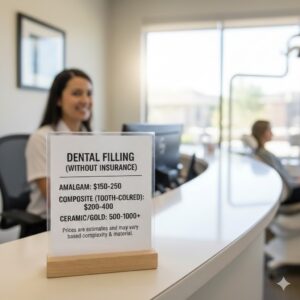
Cost of a Dental Filling Without Insurance
The Short Answer: How Much Are We Talking?
If you need a quick ballpark figure to calm your nerves, here is the honest breakdown of what you can expect to pay for a dental filling without insurance in the United States.
| Filling Material | Average Cost Per Tooth (Without Insurance) |
|---|---|
| Amalgam (Silver/ Metal) | $150 – $350 |
| Composite (Tooth-Colored) | $200 – $600 |
| Gold (Inlay/Onlay) | $900 – $4,500 |
| Porcelain/Ceramic (Inlay/Onlay) | $800 – $3,000 |
Important Note: These are national averages. Depending on where you live, these numbers could be significantly higher (like in New York City or San Francisco) or lower (in rural areas in the Midwest).
But a number on a screen doesn’t really help you budget, does it? To understand the final cost, we need to look at the items on the invoice.
Decoding the Bill: What Are You Actually Paying For?
When a dentist gives you a quote for a filling, it isn’t just the price of the “spackle” they put in your tooth. It’s a bundle of different services and overheads. Understanding this line-by-line helps you see where your money is going.
1. The Examination
Before a dentist even touches a drill, they need to see what’s going on. This usually involves:
-
Comprehensive Exam: Checking the health of your teeth and gums.
-
Diagnostic Imaging: X-rays are essential to see decay between teeth or below the gum line. A single “bite-wing” X-ray can cost $25-$50, and you usually need a set of four.
2. Anesthesia
Nobody wants to feel the drill. The numbing agent (lidocaine, etc.) and the skill of the dentist administering it come at a cost. This is often bundled into the “operative” fee, but it’s a distinct part of the service.
3. The Procedure (Operatory Fee)
This is the main event. It covers the dentist’s time, their expertise, the use of the chair, the sterilization of equipment, and the actual placement of the filling material.
4. The Material
As you’ll see below, not all filling material is created equal. Gold costs more than silver, which costs more than plastic resin. The price of the material itself is passed on to you.
5. The Polish and Finishing
Once the filling is in, the dentist needs to shape it so it fits your bite perfectly. This ensures you don’t crack the filling when you chew and that it feels smooth against your tongue.
The Price is Right? Factors That Influence Cost
You might call three different dental offices on the same street and get three completely different quotes for the exact same cavity. Why? Because dental pricing is a complex cocktail of economics, science, and geography.
1. Location, Location, Location
This is the biggest factor. A dentist practicing on Park Avenue in Manhattan has a rent bill that is 5-10 times higher than a dentist in a suburb of Ohio. That overhead has to be covered. Similarly, states with higher costs of living generally have higher dental fees.
2. The Dentist’s Expertise and Reputation
A fresh graduate just starting out will often charge less to attract patients and build a clientele. A seasoned professional with 20 years of experience, specialized training in cosmetic dentistry, and a long waiting list can—and will—charge a premium for their time and skill.
3. The Complexity of the Cavity
Not all cavities are created equal. Dentists classify cavities by how many surfaces of the tooth are affected.
-
Simple (1 surface): A small pit on the top of a molar.
-
Moderate (2 surfaces): Decay that has spread to the side of the tooth.
-
Complex (3+ surfaces): A large cavity that requires significant structural work.
A “simple” filling might cost the base price, but a “complex” filling will add a surcharge—sometimes 50% to 100% more—because it takes more time, more skill, and more material.
Amalgam vs. Composite vs. Gold: The Material Showdown
Choosing a filling isn’t just about cost; it’s about longevity, appearance, and oral health. Here is your guide to making that decision when you’re paying out of pocket.
Amalgam (Silver Fillings)
-
The Cost: The cheapest option ($150 – $350).
-
The Pros: Incredibly strong and durable. They can last 10-15 years or more. They are also less technique-sensitive, meaning they are faster and easier for a dentist to place.
-
The Cons: They are silver and noticeable when you laugh or yawn. They expand and contract with hot and cold, which can sometimes cause teeth to crack over time. They also contain a small amount of mercury (a fact that makes some patients nervous, though the ADA deems them safe).
-
Best for: Molars (back teeth) where strength is key and appearance doesn’t matter.
Composite (Tooth-Colored or “White” Fillings)
-
The Cost: The standard modern option ($200 – $600).
-
The Pros: They look natural. The dentist can shade-match them to your exact tooth color, making them virtually invisible. They also bond chemically to the tooth, which can actually support the remaining tooth structure and prevent breakage.
-
The Cons: They are less durable than amalgam and may need to be replaced sooner (5-10 years). The procedure takes longer because the dentist has to apply the material in thin layers and cure it with a special light.
-
Best for: Front teeth or any tooth where you care about aesthetics.
Gold Fillings (Inlays and Onlays)
-
The Cost: The premium option ($900 – $4,500).
-
The Pros: Incredibly durable. A gold filling can last 20-30 years. It fits perfectly and doesn’t wear down the opposing tooth.
-
The Cons: It requires at least two dental visits. The first to take an impression, and the second to cement the custom-made filling in place. It is expensive and, well, gold.
-
Best for: Patients looking for the absolute longest-lasting solution, regardless of cost.
Porcelain/Ceramic (Inlays and Onlays)
-
The Cost: The cosmetic premium option ($800 – $3,000).
-
The Pros: Looks very natural and is stain-resistant. It’s a good middle-ground between the strength of gold and the look of composite.
-
The Cons: Similar to gold, it usually requires two visits. It can be brittle and may wear down opposing teeth if not polished perfectly.
-
Best for: Patients who want a metal-free, highly aesthetic, and durable restoration.
The Hidden Costs: What Happens If You Wait?
It is so tempting to just… ignore it. To chew on the other side. To hope the pain goes away. I understand the impulse. But from a purely financial standpoint, delaying treatment for a cavity is the most expensive thing you can do.
Think of a cavity like a rust spot on your car. If you ignore a small rust bubble, eventually it will spread, creating a hole in the metal. If you ignore a cavity, here is the financial trajectory:
-
The Small Cavity (Filling): Cost: $200. *Treatment: A 30-minute appointment.*
-
The Medium Cavity (Root Canal): The decay reaches the nerve. Now you need a root canal to remove the infected nerve.
-
Cost of Root Canal: $800 – $1,500 (depending on the tooth).
-
The Problem: After a root canal, the tooth is dead and brittle. It now needs protection.
-
-
The Protection (Crown): To prevent the dead tooth from shattering, you need a crown.
-
Cost of Crown: $1,000 – $3,000.
-
-
The Worst Case (Extraction + Implant): Maybe you can’t afford the root canal and crown, so you pull the tooth. But now you have a gap, which leads to bone loss and shifting teeth. To fix it properly:
-
Cost of Extraction: $150 – $300.
-
Cost of Dental Implant + Crown: $3,000 – $6,000.
-
The Cost of Waiting:
-
Small Cavity: $200
-
Full Neglect (Implant): $4,500+
The Takeaway: Addressing a small problem now is almost always a fraction of the cost of fixing a big problem later.
10 Practical Strategies to Afford Dental Fillings Without Insurance
Okay, so you know the costs. You know you need to act. But where do you get the money? Here are realistic, actionable ways to pay for that filling.
1. The Power of the “Cash Discount”
Many dentists operate in a weird world of insurance bureaucracy. When they bill an insurance company, they have to hire staff to file claims and they wait weeks to get paid. When you pay with cash (or a credit card) at the time of service, you save them that hassle.
Action Step: When you call to book an appointment, be honest. Say, “I don’t have insurance and will be paying out of pocket. Do you offer a cash discount for self-paying patients?” You can often save 5-15% just by asking.
2. Join a Dental Savings Plan
This is not insurance. Think of it as a Costco membership for dentistry. You pay a yearly fee (usually $80-$200) to join a specific network. In return, you get access to discounted rates from participating dentists.
-
How it works: You pay the membership fee. You show your card at the dentist. They give you a pre-negotiated discount (often 20-50% off their regular fees).
-
Pros: No waiting periods, no deductibles, no annual maximums. It kicks in immediately.
-
Cons: You have to choose a dentist in that specific network.
3. Dental Schools: Supervised, Safe, and Cheap
This is the best kept secret in affordable dentistry. Dental schools need students to practice on real patients to graduate. Every step of your procedure is overseen by a licensed, experienced instructor.
-
The Cost: Usually 50-70% less than a private practice.
-
The Catch: Appointments take much longer (sometimes 2-3 hours for a filling) because the student is learning and being checked. You need patience and flexibility.
4. Federally Qualified Health Centers (FQHCs)
These are community health centers that receive federal funding to provide care on a sliding fee scale based on your income. They are located in underserved areas and are designed to help people exactly in your situation.
Action Step: Go to the HRSA (Health Resources and Services Administration) website and use their “Find a Health Center” tool to see if there is one near you.
5. CareCredit or Third-Party Financing
This is a healthcare-specific credit card. It allows you to pay for your dental work over time.
-
How it works: You apply for the card at the dentist’s office or online. If approved, you can use it to pay for treatment. Many plans offer “deferred interest” promotions like “No interest if paid in full in 6 or 12 months.”
-
Warning: Read the fine print! If you don’t pay the full amount by the deadline, they will charge you all the deferred interest retroactively, often at a very high rate (26%+).
6. Negotiate a Payment Plan
Dentists are business owners. Sometimes, they would rather get paid $2,000 over six months than get paid $0 because you went somewhere else.
-
Be polite: “I’d really like to get this work done here because I trust you, but the cost is a bit overwhelming right now. Is there any possibility of setting up an in-house payment plan to split the cost over a few months?”
7. Shop Around and Get a Second Opinion
For major work (like a root canal or a crown), it is wise to get a second opinion. Prices for the exact same procedure can vary wildly. One dentist might recommend a crown, while another might offer a large filling. A second opinion gives you both price leverage and peace of mind.
8. Consider a Dental Tourism
For major, expensive work, traveling abroad can be a viable option. Countries like Mexico, Costa Rica, Thailand, and Hungary are popular for dental tourism.
-
The Math: A $3,000 crown in the US might cost $800 in Mexico. Even with a flight and a hotel, you can save money.
-
The Risk: Follow-up care is difficult. If something goes wrong with the crown in a month, you have to fly back. Do your research on the clinic and the dentist’s credentials.
9. Health Savings Account (HSA) or Flexible Spending Account (FSA)
If you have a high-deductible health insurance plan, you might have an HSA. Or, if your employer offers it, you might have an FSA. These accounts let you set aside pre-tax dollars for medical expenses, including dental work. This doesn’t lower the bill, but it lowers the real cost by saving you on taxes.
10. Don’t Be Afraid to Ask for a Breakdown
If a dentist quotes you $500 for a filling, you can ask, “Can you provide an itemized estimate so I can see exactly what I’m paying for?” This shows the dentist you are an informed consumer and helps you identify if there are any optional “extras” you can skip.
Comparison Table: Private Practice vs. Dental School vs. Clinic
To help you visualize your options, here is a quick comparison.
| Feature | Private Practice | Dental School Clinic | Community Health Center (FQHC) |
|---|---|---|---|
| Cost for Filling | $200 – $600 | $50 – $150 | Sliding scale (based on income) |
| Provider | Licensed Dentist | Dental Student | Licensed Dentist |
| Supervision | Self-directed | Strict supervision by faculty | Self-directed |
| Appointment Time | 30-60 minutes | 2-4 hours | 45-60 minutes |
| Technology | State-of-the-art | Good, but may be slightly older | Varies |
| Best For | Convenience & Speed | Budget & Flexibility | Low-income households |
The Procedure: What to Expect During Your Visit
Knowing what happens during a filling can reduce anxiety. Here is a step-by-step walkthrough of a standard composite (white) filling.
-
Numb You Up: The dentist will apply a topical gel to your gums to numb the surface. Then, they will inject a local anesthetic (like Novocaine). You’ll feel a pinch or sting, but it fades quickly.
-
Isolate the Tooth: They may place a small rubber dam or cotton rolls around the tooth to keep it dry from saliva.
-
Remove the Decay: Using a high-speed handpiece (drill) or laser, the dentist will remove the decayed portion of the tooth.
-
Prepare the Space: They will shape the remaining tooth to ensure the filling stays in place.
-
Apply the Filling: The dentist will apply an etching gel, then a bonding agent, and finally the composite resin in layers. They will use a special blue light to harden each layer instantly.
-
Shape and Polish: Once the filling is in, the dentist will use fine burs and polishing strips to shape the filling to match your tooth’s natural contours and bite. They will have you bite down on carbon paper to check for “high spots.”
-
Aftercare: You’ll leave with a numb mouth for a few hours. Avoid hot beverages and chewing on that side until the numbness wears off to prevent accidentally biting your cheek or tongue.
Frequently Asked Questions (FAQ)
Q: Is it safe to go to a dental school for a filling?
A: Yes, it is very safe. All work is checked at multiple stages by licensed, experienced faculty dentists. The trade-off is time, not safety.
Q: Can I negotiate the price of a filling?
A: It’s not like a flea market, but you can certainly inquire about discounts. Asking for a cash discount or inquiring about a payment plan is perfectly acceptable and common.
Q: What is the absolute cheapest way to get a filling?
A: Typically, a dental school clinic or a Federally Qualified Health Center (FQHC) will offer the lowest rates for a composite filling.
Q: Does it hurt to get a filling?
A: The injection of the numbing medicine can sting for a few seconds. Once you are numb, you should not feel any pain, only pressure and vibration. If you feel pain during the procedure, raise your hand immediately so the dentist can give you more anesthetic.
Q: How long do white fillings last?
A: With good oral hygiene, a composite filling typically lasts between 5 and 10 years before it may need to be replaced or repaired.
Q: Can I just leave a cavity if it doesn’t hurt?
A: You can, but it will grow. Cavities don’t heal on their own. As explained in the “hidden costs” section, leaving it will almost certainly lead to a more expensive and invasive procedure later.
Conclusion
Facing a dental filling without insurance is a stressful financial experience, but it is a manageable one. The “cost of a dental filling without insurance” isn’t a fixed number—it’s a range that you have significant power to influence. By understanding the pricing structure, exploring alternative providers like dental schools, and being an informed consumer who isn’t afraid to ask for a discount or a payment plan, you can protect your smile and your wallet. Your health is an investment, and with the right knowledge, you can make that investment wisely.
Additional Resource
To find a low-cost health center near you, visit the HRSA (Health Resources and Services Administration) website: Find a Health Center