Getting pulled over is stressful. When the officer asks for your proof of financial responsibility, and you can’t provide it, that stress multiplies. The immediate thought is, “How much is this ticket going to be?” The truth is, the fine on the citation is just the beginning. The total cost of driving without insurance is a complex web of immediate penalties, long-term financial burdens, and legal headaches.
This guide will walk you through every potential expense and consequence, providing a realistic and comprehensive look at what you truly face. Our goal is not to scare you, but to inform you, helping you make better decisions and navigate the situation if you’ve already received a ticket.
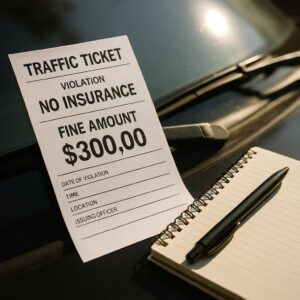
Cost of a No Insurance Ticket
Understanding the “No Insurance” Violation
Before we talk numbers, it’s crucial to understand what you’re being cited for. In every U.S. state, drivers are legally required to carry a minimum amount of auto liability insurance. This insurance doesn’t protect your car; it protects others by covering costs if you are at fault in an accident.
A “no insurance ticket” means you were unable to provide valid proof of this mandatory insurance during a traffic stop or, in some cases, after an accident. It’s often called “Failure to Provide Proof of Financial Responsibility.”
The Immediate Costs: Fines and Court Fees
The price tag on the ticket itself varies dramatically. It is not set by the federal government but by individual states, counties, and even courts. This means the cost in rural Texas will be different from the cost in Los Angeles.
State-by-State Base Fine Comparison
The table below provides a general range of the base fines for a first-time no insurance violation. Remember, these are starting points before additional penalties are added.
| State | Typical Base Fine Range (First Offense) | Additional Common Penalties |
|---|---|---|
| California | $100 – $200 | Driver Responsibility Fee, License Suspension |
| Texas | $175 – $350 | State Surcharge of up to $250/year for 3 years |
| Florida | $150 – $500 | License & Registration Suspension until proof provided |
| New York | $150 – $1,500 | $750 civil penalty, License Revocation |
| Illinois | $500 – $1,000 | Mandatory SR-22 filing, License Suspension |
| Ohio | $100 – $500 | License Suspension, Reinstatement Fee |
| Pennsylvania | $300 + | Vehicle Registration Suspension for 3 months |
Important Note: “These base fines are almost never the total amount you pay. Courts add numerous mandatory fees, surcharges, and penalties that can easily double or triple the bottom line,” explains a former traffic court clerk. “You might see a $200 fine on paper, but your total bill could be $600.”
The “Hidden” Court and Surcharge Fees
These are the add-ons that inflate your cost. You may see line items for:
-
Court Costs: Administrative fees for processing your case.
-
Penalty Assessments: State-mandated add-ons to fund various programs (e.g., DNA identification, emergency medical services).
-
Conviction Surcharges: Flat fees added on top of the fine.
-
Service Fees: If you pay online or by payment plan.
Example Breakdown: A $250 base fine could become:
-
Base Fine: $250
-
State Penalty Assessment: $100
-
Court Security Fee: $40
-
Conviction Surcharge: $75
-
Total Due to Court: $465
The Long-Term Financial Hammer: Insurance Rate Increases
This is where the real financial devastation occurs. A no-insurance conviction signals to insurance companies that you are a very high-risk driver.
What to Expect from Your Premiums
-
Rate Hikes: You can expect your annual premium to increase by 50% to 150% on average. For someone paying $1,200 a year, that’s an extra $600 to $1,800 per year.
-
Duration: This “high-risk” surcharge typically lasts for three to five years from the conviction date.
-
Total Long-Term Cost: Using a conservative example of a $800 annual increase over 5 years, you will pay an additional $4,000 just in higher premiums.
The Mandatory SR-22 Certificate
Many states require you to file an SR-22 form (or its equivalent, like an FR-44 in Florida or Virginia) to reinstate your license.
-
What it is: A certificate from your insurance company proving you now carry the state-mandated minimum coverage. It is not insurance itself.
-
The Cost: Insurance companies charge a one-time filing fee (usually $15-$50). The real cost is that needing an SR-22 places you in a high-risk insurance pool, guaranteeing those drastic premium increases mentioned above.
-
Duration: You are usually required to maintain the SR-22 for three years without any lapses in coverage.
Administrative Penalties: More Than Just Money
The financial pain is coupled with severe restrictions on your driving privileges.
-
License Suspension: Immediate suspension of your driver’s license is common. You cannot drive legally until you fulfill all requirements.
-
Vehicle Registration Suspension/Impoundment: Your car’s registration may be suspended, or the vehicle itself may be impounded on the spot.
-
Reinstatement Fees: After your suspension period, you must pay a fee to get your license and registration back in good standing. These fees range from $50 to $400.
The Catastrophic Cost: If You Cause an Accident
All previous costs pale in comparison to the liability of causing an accident while uninsured.
-
You are personally responsible for all property damage and medical bills for other parties.
-
You will face lawsuits that can lead to wage garnishment, liens on your property, and financial ruin.
-
You may face criminal charges for aggravated offenses.
What to Do If You Receive a Ticket
-
Don’t Ignore It. This will lead to a warrant for your arrest and permanent license revocation.
-
Verify Your Actual Insurance Status. Sometimes it’s an administrative error (a missed payment, outdated card). Contact your insurer immediately.
-
Go to Court (Consider Legal Help). Appear on your court date. If you obtained valid insurance after the ticket, bring proof. A judge may reduce the fine. For serious cases or accidents, consulting a traffic attorney is highly advisable.
-
Fulfill All Requirements. Pay fines, file the SR-22 if required, and pay reinstatement fees. Get everything in writing.
Conclusion
The cost of a no insurance ticket extends far beyond the fine printed on the citation. It is a multi-layered financial penalty starting with hundreds in court costs, escalating to thousands in insurance premium hikes over years, and compounded by license suspensions and reinstatement fees. The only way to avoid this severe and lasting financial burden is to maintain continuous, valid auto insurance coverage.
FAQ: No Insurance Tickets
Q: Can I get a no insurance ticket dismissed if I show proof later?
A: It depends on the court and your record. If you had valid insurance at the time of the stop but simply didn’t have the card, bringing proof to court often results in dismissal (sometimes with a small administrative fee). If you were truly uninsured, dismissal is unlikely.
Q: How long does a no insurance ticket stay on my record?
A: The conviction typically stays on your driving record for 3-5 years, affecting your insurance rates. It may appear on background checks.
Q: Is driving without insurance a misdemeanor?
A: In most states, it is considered a traffic misdemeanor for a first offense. Repeat offenses or cases involving an accident can escalate to more serious misdemeanors or even felonies.
Q: Can I just pay the ticket online and not go to court?
A: You can often pay online, but this is an admission of guilt. It will result in a conviction on your record, triggering all the associated penalties (license suspension, SR-22 requirements). It is usually better to appear in court.
Additional Resources
For the most accurate and state-specific information, always refer to your state’s Department of Motor Vehicles (DMV) or equivalent website. They provide official details on:
-
Required minimum insurance limits.
-
Exact fine and penalty schedules.
-
Reinstatement procedures and fees.
-
SR-22 filing requirements.
Consider using online insurance comparison tools to get quotes if you are now shopping for high-risk insurance. Being informed is your first step toward mitigating the long-term costs of a no-insurance violation.