Getting pulled over and hearing the words, “May I see your proof of insurance?” can send a chill down anyone’s spine. If you can’t produce that little card or digital document, you’re facing more than just an awkward conversation. In Texas, driving without valid auto insurance is a serious violation with a price tag that extends far beyond the initial fine. It’s a financial domino effect that can impact your life for years.
This guide will walk you through every layer of expense and complication that comes with a Texas no-insurance citation. We’ll move past the basic fine to explore the hidden court costs, the brutal state surcharges, the skyrocketing insurance premiums, and the legal ramifications you might not see coming. Our goal is to give you a clear, honest, and complete picture so you can navigate this situation effectively.
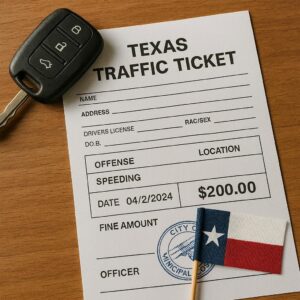
Cost of a No Insurance Ticket in Texas
Understanding the Law: Texas Financial Responsibility Law
Texas operates under a “fault” system and mandates that all drivers be financially responsible for any accidents they cause. The primary way to meet this requirement is through liability auto insurance. The minimum legal limits in Texas are often called 30/60/25:
-
$30,000 for bodily injury per person.
-
$60,000 for bodily injury per accident.
-
$25,000 for property damage per accident.
When an officer asks for proof, they are verifying you have an active policy that meets these minimums at the time of the stop. It’s not enough to have paid a bill; the policy must be in force. “I thought I was covered” or “It must have lapsed” are not valid defenses in the eyes of the law.
A Key Distinction: There is a difference between “Failure to Present Proof of Financial Responsibility” (you have it but didn’t have it with you) and “Operating a Vehicle Without Financial Responsibility” (you did not have valid insurance at all). The former is typically dismissed with a small fee if you provide proof to the court; the latter is the costly violation we are focusing on here.
The Immediate Financial Hit: Fines and Court Costs
Let’s start with the bill you get first. The base fine for a no-insurance conviction in Texas is set by statute, but it’s not a single, fixed amount everywhere.
Base Fine Range: The fine can range from $175 to $350 for a first offense. However, judges have some discretion within this range, and the final amount can be influenced by your driving record, the circumstances of the stop, and the specific county or court where you are ticketed.
The Real “Ticket Price”: Court Costs and Fees. This is where the initial cost balloons. Courts add mandatory administrative fees to every citation. When you receive a “total amount due” on your ticket, it includes these fees. It’s not uncommon for the total upfront payment to reach $350 to $600 or more, even for a first-time offense.
| Cost Component | Estimated Range | Notes |
|---|---|---|
| Statutory Fine | $175 – $350 | Judge’s discretion; higher for repeat offenses. |
| Court Costs & Fees | $100 – $250+ | Mandatory fees that vary significantly by county. |
| Total Immediate Out-of-Pocket | $275 – $600+ | The amount you must pay to settle the citation. |
What About “No Insurance” in an Accident?
The stakes are dramatically higher if you are caught without insurance and are involved in an accident. On top of the citation, you become personally liable for all damages and injuries you caused. This can lead to lawsuits, wage garnishment, and financial ruin. The ticket will be the least of your worries.
The Hidden Long-Term Cost: Texas Driver Responsibility Surcharge
This is arguably the most punishing and least understood part of a no-insurance conviction in Texas. The Driver Responsibility Program (DRP) imposes annual surcharges on your driver’s license for certain convictions.
For a No-Insurance Conviction: The DRP surcharge is $250 per year, for three consecutive years.
That’s an extra $750 paid to the state, on top of your fine and court costs. Failure to pay these surcharges results in an automatic driver’s license suspension.
Important Note: The Texas Legislature has passed bills to repeal the DRP, but as of our latest update, the program is still active and collecting surcharges for existing citations. New citations may be assessed under the new rules, but anyone with an outstanding surcharge balance is still obligated to pay. Always verify the current status with the Texas Department of Public Safety (DPS).
The Biggest Financial Burden: Skyrocketing Insurance Premiums
Here is the cost that truly keeps on giving. A no-insurance conviction signals to insurance companies that you are a high-risk driver. When you go to buy the legally required insurance (which you must do to reinstate a suspended license), you’ll face dramatically higher rates.
What to Expect:
-
Rate Increases: You can expect your annual premium to increase by 80% to 150%, or even more.
-
Duration: This “high-risk” label can stay on your record and affect your rates for three to five years.
-
SR-22 Requirement: The state may require you to file an SR-22 certificate (often called “high-risk insurance”) for two years. This is not insurance itself but a form your insurance company files with the state to prove you have coverage. Merely needing an SR-22 can double your premiums, and not all companies offer it.
Let’s visualize the three-year financial impact of a single ticket, assuming a driver with a previously clean record.
| Year | Immediate Costs | DRP Surcharge | Estimated Annual Premium Increase | Annual Total | Cumulative Total |
|---|---|---|---|---|---|
| 1 | $450 (Fine/Fees) | $250 | +$800 (on $1,000 premium) | $2,500 | $2,500 |
| 2 | — | $250 | +$800 | $1,050 | $3,550 |
| 3 | — | $250 | +$800 | $1,050 | $4,600 |
| *Table Notes: Example assumes a $450 initial ticket, a $250 annual surcharge, and an 80% premium increase on a base rate of $1,000/year. Actual totals will vary.* |
Legal and Administrative Consequences
The financial pain is accompanied by legal and logistical hurdles:
-
License Suspension: Your driver’s license will be suspended if you fail to pay your fines, fail to pay your DRP surcharges, or fail to file an SR-22 if required.
-
Vehicle Impoundment: During a traffic stop, an officer has the authority to impound your vehicle if you cannot provide proof of insurance.
-
Reinstatement Fees: To get a suspended license back, you must pay a $100 Reinstatement Fee to the Texas DPS, plus any other outstanding fines or fees.
What to Do If You Get a No-Insurance Ticket in Texas
Don’t panic and don’t ignore it. Ignoring a ticket leads to a warrant for your arrest and guaranteed license suspension. Follow these steps:
-
Don’t Drive Uninsured Again. Get a valid insurance policy immediately.
-
Appear or Respond by the Date on Your Ticket. This is non-negotiable.
-
Explore Your Options: You can:
-
Plead Guilty or No Contest and Pay the Fine. This results in a conviction on your record, triggering all the costs above.
-
Fight the Ticket (Plead Not Guilty). Request a court hearing. If you genuinely had valid insurance but didn’t have proof, bring your policy documents or a letter from your insurer showing coverage was active on the date of the stop.
-
Seek Dismissal with Proof (Compliance Dismissal). In some cases, if you obtain valid insurance after the ticket but before your court date, and show proof to the prosecutor or judge, they may offer a dismissal for a small administrative fee. This is not guaranteed.
-
Request Deferred Disposition (Probation). Some courts may offer this. You pay a fine and court costs, are on probation for a set period (e.g., 90 days), and if you don’t get another ticket and show proof of continuous insurance, the charge is dismissed. This avoids a conviction and the DRP surcharge.
-
-
Consider Hiring a Traffic Attorney. For a few hundred dollars, an attorney can often negotiate a better outcome, such as a reduction to a non-moving violation (like “Defective Equipment”) that doesn’t trigger an insurance surcharge or the DRP. Their knowledge of local court procedures is invaluable.
Preventive Measures: Avoid the Nightmare
The best strategy is to never be in this situation.
-
Set up auto-pay for your insurance premium.
-
Store digital proof of insurance on your phone (the Texas DPS accepts electronic versions).
-
Keep a physical card in your glove compartment as a backup.
-
Review renewal notices carefully and update your payment method if needed.
-
If money is tight, shop for cheaper minimum coverage before your policy lapses. Even minimal coverage is infinitely better than none.
Conclusion
The cost of a no-insurance ticket in Texas is a multi-layered financial crisis, beginning with hefty fines and court fees, extending into years of mandatory state surcharges, and culminating in severely inflated insurance premiums that can total thousands of dollars. Beyond the money, it risks license suspension and legal hassles. The most effective solution is to maintain continuous coverage, but if ticketed, addressing it promptly—often with legal help—is crucial to mitigating the long-term damage.
Frequently Asked Questions (FAQ)
Q: Can I just show my insurance card to the court to make the ticket go away?
A: If you had valid insurance at the time of the stop but simply failed to provide proof, then yes, presenting that proof (often called “proof of compliance”) to the court clerk usually results in a dismissal with a small administrative fee (usually under $20). If you did not have insurance at the time, showing a new policy later may help you seek a dismissal, but it’s not automatic.
Q: How long does a no-insurance ticket stay on my driving record in Texas?
A: The conviction typically remains on your Texas Department of Public Safety (DPS) driving record for three years. However, insurance companies may look back 3-5 years when calculating your rates.
Q: Is driving without insurance a criminal offense in Texas?
A: It is generally a class C misdemeanor (the same category as most traffic tickets), which is a criminal offense but does not carry jail time for a first offense. However, it can escalate if there are aggravating factors or repeat offenses.
Q: What happens if I just don’t pay the ticket or the surcharges?
A: This is the worst course of action. The court will issue a warrant for your arrest for failure to appear, and the Texas DPS will automatically suspend your driver’s license until all fines, fees, and surcharges are paid in full, plus an additional $100 reinstatement fee.
Q: I can’t afford insurance. Are there any legal options for me in Texas?
A: Texas does allow for alternative forms of financial responsibility, such as a surety bond or a cash deposit with the state comptroller, but these are often more costly and complex than standard liability insurance. The most practical step is to shop for the absolute minimum 30/60/25 coverage, as some providers specialize in lower-cost policies.
Additional Resources
-
Official Texas DPS Page on Financial Responsibility: https://www.dps.texas.gov/section/driver-license/financial-responsibility – The official source for law and reinstatement requirements.
-
Texas Department of Insurance (TDI): https://www.tdi.texas.gov/ – Provides consumer help and information on auto insurance shopping and complaints.
-
Texas Courts Online: Search for your specific county’s court website for information on paying tickets, court dates, and deferred disposition policies.