Let’s be honest for a second: that little twinge you feel when you bite down on something sweet? Or the sharp pinch when you drink an ice-cold glass of water? Yeah, we’ve all been there. It’s probably a cavity. And if you’re like a large chunk of America right now, your first thought isn’t “I need to see a dentist.” It’s “I can’t afford to see a dentist.”
You are not alone in this. Millions of adults in the U.S. navigate the dental world without insurance every single day. The anxiety isn’t just about the drill; it’s about the bill that comes after it.
But here is the good news: Fixing a cavity without insurance doesn’t have to mean emptying your savings account. It doesn’t mean you have to live in pain, and it definitely doesn’t mean you have to settle for unsafe or shady practices.
In this guide, we are going to strip away the mystery. We’ll look at the real numbers—what you can actually expect to pay out-of-pocket for a cavity filling. We’ll explore every single option available to you, from discount plans to community clinics. By the time you finish reading, you’ll have a clear, realistic roadmap to getting your smile healthy again without the financial dread.
Let’s dive in and tackle this toothache together.
Cost of Fixing a Cavity with No Insurance
Why Does Dental Care Feel So Expensive?
Before we look at price tags, it helps to understand why a simple filling can feel like a car payment. This isn’t about justifying costs, but about understanding where your money goes. This knowledge will also help you spot a good deal versus a deal that might be too good to be true.
When you pay for a filling, you aren’t just paying for 20 minutes of work and a glob of composite resin. You are paying for:
-
The Expertise: Four years of dental school, plus often additional years of specialization. You’re paying for the precision required to work on a living surface that is smaller than your thumbnail.
-
The Overhead: Dental offices are small medical facilities. They pay for rent, utilities, malpractice insurance, and a team of trained staff (hygienists, assistants, front desk).
-
The Equipment: That chair you sit in costs thousands. The x-ray machine, the sterilizers (autoclaves) that keep you safe, and the intraoral cameras all cost serious money to buy and maintain.
-
Materials: High-quality composite resins (the tooth-colored material) and anesthetics aren’t cheap. They are medical-grade supplies.
Understanding this helps you see why a $50 filling found on a sketchy street corner might be tempting, but it’s also a red flag. You want safe, sterile, and lasting care.
Cavity Cost No Insurance: The Real Numbers (A Realistic Breakdown)
Okay, let’s get to the heart of it. What are we actually talking about here?
If you walk into a private dental office, explain you have no insurance, and need a filling, here is the general range you can expect. Please remember that prices vary wildly based on where you live. A filling in Manhattan, New York, will cost more than a filling in rural Kansas.
The Cost of the Exam and X-Rays
You can’t fix a cavity until you know exactly where it is and how deep it goes. This means your first visit will usually involve an exam and X-rays.
-
Comprehensive Exam: This is the dentist looking in your mouth, checking your gums, and assessing your overall oral health.
-
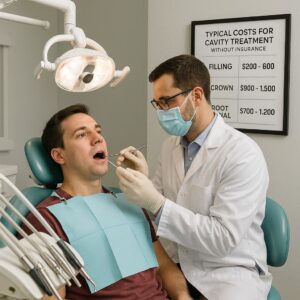
Typical Cost (No Insurance): $50 – $150
-
-
X-Rays (Bitewings): These are the small X-rays that show the crowns of your teeth and reveal cavities between them.
-
Typical Cost (No Insurance): $50 – $150 for a set of 4.
-
Total Diagnostic Cost: Expect to spend roughly $100 to $300 just to get the diagnosis.
The Cost of the Filling Itself
Now, for the main event. The cost depends on two things: the material used and the size of the cavity (how many surfaces of the tooth are affected).
Most people today get tooth-colored composite fillings. They look natural and bond directly to the tooth.
| Filling Size (by surfaces) | What It Means | Average Cost Per Tooth (No Insurance) |
|---|---|---|
| 1 Surface | A small cavity on the chewing surface or a smooth side. | $150 – $300 |
| 2 Surface | A cavity that spans between two surfaces, like between the teeth. | $200 – $450 |
| 3 Surface | A larger cavity affecting multiple areas of the tooth. | $300 – $600+ |
| 5+ Surfaces | A very large filling that is almost a crown. (A crown may be recommended instead). | $600 – $1,000+ |
A Note on Amalgam (Silver) Fillings:
These are less common now, but they are usually cheaper.
-
Cost: Roughly 25-30% less than composite. However, many patients prefer composite for cosmetic reasons, and some dentists have moved away from amalgam entirely.
The Grand Total Scenario
Let’s put this together in a real-life example.
Scenario: You have a two-surface cavity on a lower molar.
-
Exam: $75
-
X-Rays: $75
-
2-Surface Filling: $350
-
Total Out-of-Pocket: $500
-
Yes, that’s a significant chunk of change. But remember, this is the “sticker price” at a standard private practice. In the next sections, we’ll show you how to pay less than this.
Why You Shouldn’t Wait: The “Pay Now or Pay WAY More” Principle
It is incredibly tempting to ignore a cavity. You might think, “It doesn’t hurt that bad, I’ll just chew on the other side for a while.”
This is the most expensive decision you can make.
Think of a cavity like a small rust spot on a car. If you sand it down and paint it right away, it costs a little time and money. If you leave it, the rust spreads. It eats through the metal. Suddenly, you aren’t just painting; you’re replacing entire panels.
Here is the progression of cost if you wait:
-
The Small Cavity (Filling): Cost: ~$200-$400. The dentist removes the decay and fills the hole. Easy.
-
The Medium Cavity (Root Canal Therapy): If the decay reaches the nerve of the tooth (the pulp), the tooth is in big trouble. You will feel pain. To save it, you need a root canal. The dentist removes the infected nerve, cleans the canal, and seals it.
-
Root Canal Cost (No Insurance): $700 – $1,500 (depending on the tooth—front teeth are cheaper, molars are more complex).
-
-
The Result (Crown): After a root canal, the tooth becomes brittle and needs a crown (a cap) to protect it from breaking.
-
Crown Cost (No Insurance): $1,000 – $2,500.
-
-
The Worst Case (Extraction & Replacement): If you can’t afford the root canal and crown, or if you waited so long the tooth can’t be saved, it has to be pulled.
-
Extraction Cost (No Insurance): $150 – $300 for a simple pull.
-
But then you have a missing tooth. This can cause other teeth to shift. To replace it, you’re looking at a dental implant (often $3,000 – $6,000) or a bridge ($2,000 – $5,000).
-
The Takeaway: A $500 cavity today can easily turn into a $5,000 dental emergency tomorrow. Addressing it now isn’t an expense; it’s an investment in avoiding a much larger financial hit later.
7 Proven Strategies to Afford Cavity Treatment with No Insurance
Okay, you know the risks and the potential costs. Now, let’s get practical. How do you actually pay for this if your wallet is thin and your benefits are non-existent?
1. The Dental Discount Plan (The “Secret Middle Ground”)
This is often the best-kept secret in dentistry. A dental discount plan is not insurance. It’s a membership club.
-
How it works: You pay a low annual fee (usually between $80 and $200). In return, you get access to a network of dentists who have agreed to give members a discounted rate (typically 10% to 60% off).
-
Pros: There are no waiting periods, no annual maximums, and no forms to fill out. You just show your card, and you get the discount immediately. It’s perfect for predictable work like fillings.
-
Cons: You are still paying out-of-pocket; you’re just paying a reduced rate.
-
Real-World Example: If your filling is $350, a discount plan might bring it down to $240. You’ve already saved the cost of the membership in one visit.
2. Dental Schools: Supervised by Experts, Priced for Students
If you live near a university with a dental school, this is your golden ticket.
-
How it works: Dental students need real patients to complete their training. They perform procedures under the close, watchful eye of experienced, licensed professors.
-
Pros: The cost is often 50-70% less than a private practice. The supervision is incredibly thorough. Sometimes they even have “emergency clinics” for same-day needs.
-
Cons: Appointments take much longer (sometimes 2-3 hours instead of 45 minutes) because the work is being checked at every step. You are a teaching tool, which requires patience.
-
How to find one: Google “dental schools near me” or visit the American Dental Association’s website for a list of accredited programs.
3. Federally Qualified Health Centers (FQHCs) / Community Clinics
These are community-based health centers that provide care on a sliding fee scale based on your income.
-
How it works: You go to the clinic, provide proof of income, and they calculate a discounted rate for you.
-
Pros: They are designed for people exactly in your situation. They won’t turn you away for inability to pay. They offer comprehensive care, not just emergency extractions.
-
Cons: They can be very busy, and wait times for non-emergency appointments might be long. Availability varies by location.
-
How to find one: Use the search tool on the HRSA (Health Resources and Services Administration) website to find a funded health center near you.
4. In-House Membership Plans (Ask Your Dentist!)
Many private dentists are realizing that insurance is a headache for everyone. As a result, they are creating their own “in-house” savings plans.
-
How it works: You pay the dentist’s office a flat monthly or annual fee (e.g., $300/year).
-
What you get: This usually covers preventive care (2 cleanings, exams, X-rays) for the year, and then gives you a significant discount (often 15-20%) on any other work like fillings.
-
Pros: It’s simple, local, and builds a relationship with your dentist.
-
Cons: You’re locked into that specific office.
-
How to find one: Call local dental offices and simply ask, “Do you offer an in-house discount plan or membership plan for patients without insurance?” You might be surprised how many say yes.
5. Negotiate a Cash Discount
Dentists, like any business owner, hate dealing with the administrative headache of insurance claims. When you pay with cash (or a debit card) at the time of service, you save them time and money.
-
The Approach: Be polite and upfront. Before you agree to the treatment plan, say something like, “I don’t have insurance and will be paying for this myself today. Is there a cash discount available?”
-
What to expect: Many offices will knock off 5-10% just for this. It never hurts to ask.
6. Third-Party Financing (CareCredit)
For larger treatment plans (like if you need multiple fillings), financing can spread the cost out over time.
-
How it works: CareCredit is a healthcare credit card. You apply for it, and if approved, you can use it to pay for your dental work.
-
Pros: They often offer “promotional financing” like “No interest if paid in full in 6 or 12 months.” If you can pay it off in that time, you pay zero interest.
-
Cons: If you don’t pay it off in the promotional period, you get hit with deferred interest—meaning they charge you interest on the original amount from the original date. This can be very expensive. Read the fine print carefully.
7. Dental Tourism (Proceed with Caution)
This involves traveling to another country (like Mexico, Costa Rica, or Thailand) for dental work, where prices are significantly lower.
-
Pros: The cost savings can be dramatic. A $1,500 crown in the U.S. might cost $400 in Mexico.
-
Cons: This is the highest-risk option. Follow-up care is impossible if something goes wrong when you get home. Quality and sterilization standards can vary. If you have a complication, you’re stuck.
-
Our Advice: If you live near the border and know a reputable, well-reviewed clinic, it can be a viable option. For a single filling? It’s probably not worth the travel costs and hassle compared to a local discount plan.
Important Note: Whichever option you choose, always check the dentist’s credentials and read recent Google or Yelp reviews. Your safety is paramount.
What If You Can’t Afford It Right Now? (Immediate Relief)
Sometimes, even with discounts, the money just isn’t there this week. If you are in pain while you save up, here’s how to manage.
Temporary Measures (To be used only until you see a dentist)
-
Over-the-Counter Pain Relief: Ibuprofen (Advil) is generally better for dental pain because it reduces inflammation at the source, unlike Tylenol which just blocks the pain signal.
-
Salt Water Rinses: Mix a teaspoon of salt in a glass of warm water. Swish vigorously for 30 seconds. This helps draw out some fluid from the gums and can reduce inflammation and cleanse the area.
-
Clove Oil: This is an old remedy that actually works. Clove oil contains eugenol, a natural anesthetic. Soak a tiny piece of cotton ball in clove oil, blot it, and hold it against the tooth for 10-15 seconds. Do not swallow it. It’s potent stuff.
-
Temporary Filling Material: You can buy “temporary tooth filling material” at most drugstores (like Dentek Temparin). It looks like little sticky pellets. You soften them in warm water and press them into the cavity. This seals the hole from food and air, providing relief. This is a band-aid, not a fix.
What to AVOID:
-
Aspirin on the Gums: Do not put aspirin directly on your gum tissue. It can cause a painful chemical burn.
-
Ignoring Spreading Infection: If you develop swelling in your face, a fever, or difficulty swallowing or breathing, this is a serious infection. You cannot wait. Go to an emergency room immediately.
FAQs: Your Burning Questions Answered
Q: Is it cheaper to pull a tooth than to get a filling?
A: In the short term, yes. An extraction is usually less expensive than a filling. However, in the long term, it is almost always more expensive. Once a tooth is pulled, you will eventually need to replace it (with an implant or bridge) to prevent your other teeth from shifting and causing bite problems, jaw pain, and further decay. Keeping your natural tooth with a filling is the best financial decision for your future self.
Q: Can I go to the ER for a cavity?
A: You can, but they likely won’t fix it. Emergency rooms are for medical emergencies, not dental procedures. If you have a severe infection, facial swelling, or a dental abscess that requires antibiotics, they can help with that. But they will not perform a filling. They will likely give you medication for the pain and infection and send you to a dentist anyway.
Q: How long can I leave a cavity untreated?
A: It varies, but cavities don’t heal on their own. They only grow. A small cavity can reach the nerve in as little as 3-6 months, depending on your diet and oral hygiene. The “wait and see” approach always results in more damage and a higher bill.
Q: What is the absolute cheapest way to get a cavity filled?
A: The cheapest safe way is usually a dental school or a Federally Qualified Health Center (FQHC). These options are designed to provide quality care at a low cost to the community.
Conclusion
Facing a cavity without insurance is stressful, but it is a solvable problem. You are not trapped. The key is to be proactive. Ignoring the issue is the one surefire way to turn a manageable expense into a financial crisis.
To summarize, your action plan is simple:
-
Get a Diagnosis: Find a low-cost clinic or dental school for an exam and X-rays to know exactly what you’re dealing with.
-
Explore Your Options: Call around. Ask about cash discounts, in-house plans, or look into a dental discount plan. Compare the costs.
-
Act Now: Treat the cavity while it’s small. Remember, a $300 filling today prevents a $3,000 crown tomorrow.
Your smile—and your bank account—will thank you.
Additional Resource
For more detailed information on finding low-cost care in your community, the National Institute of Dental and Craniofacial Research provides an excellent resource page. You can find it here: NIDCR Finding Low-Cost Dental Care