If you are a small business owner in the Golden State, you know that California is a world of its own. From the bustling streets of Los Angeles to the tech hubs of Silicon Valley and the agricultural heartlands of the Central Valley, the risks of doing business here are as diverse as the landscape itself.
One of the first questions we hear from entrepreneurs is, “How much is this going to cost me?”
You are looking for numbers. You want a straight answer on general liability insurance cost California. But here is the thing: giving you a single flat rate would be misleading. It is like asking, “How much is a house in California?” It depends on the location, the size, and the risks.
Let’s pull back the curtain. We are going to look at the real data, the factors that move the needle on your premium, and—most importantly—how to make sure you are paying for protection, not just paying because you think you have to.
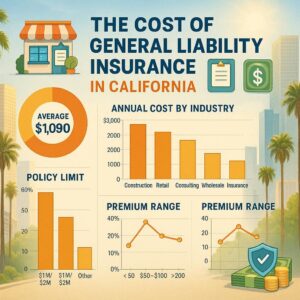
Cost of General Liability Insurance in California
The Million-Dollar Question: What is the Average Cost?
Let’s get straight to the point. For most small businesses in California, general liability insurance usually costs between $35 and $65 per month. This typically translates to an annual premium ranging from $420 to $780 per year.
However, if you work in a higher-risk industry (like construction or event planning), you might see quotes starting around $100 per month.
To make this easier to visualize, here is a breakdown based on common California business types:
| Business Type | Average Monthly Cost | Average Annual Cost | Why? |
|---|---|---|---|
| Freelance Graphic Designer (Remote) | $27 | $324 | Low risk. Minimal client interaction on-site. |
| Real Estate Agent | $45 | $540 | Moderate risk. Driving to properties, client meetings. |
| Landscaper / Gardener | $89 | $1,068 | High risk. Use of equipment, potential for property damage. |
| Food Truck Owner | $110 | $1,320 | Very High risk. Slip-and-falls, food-related illness claims. |
| General Contractor | $125 | $1,500 | Extremely High risk. Construction defects, third-party injury. |
A Quick Note: These are average ranges. I have seen a small consulting firm pay $350 a year, and a boutique in San Francisco pay over $1,200. The variance is huge, and we are about to dive into why.
Why California is Different (And Why Your Rates Might Be Higher)
If you are comparing notes with a business owner in Ohio, do not be surprised if your quote comes back higher. California presents a unique set of challenges that insurers have to account for.
1. The Litigation Landscape
California is known for being a more litigious state. The density of the population means more interactions, and more interactions mean more chances for accidents. Furthermore, the legal environment here can lead to higher settlement amounts. Insurance companies are in the business of risk prediction. If they predict a higher chance of a lawsuit or a higher payout, your premium reflects that.
2. The Weather Factor
Wildfires, earthquakes, and droughts aren’t just news headlines; they are business risks. While a standard general liability policy does not cover fire damage to your own building (you need property insurance for that), it covers you if you are held liable for causing someone else’s loss. If you are a contractor using equipment during fire season, the risk calculus changes.
3. The Cost of Living
Everything costs more in California. If a client slips and falls in your office and needs medical care, the medical bills in San Jose are going to be higher than in rural Kansas. Insurers have to factor in these higher regional costs when setting your rates.
The Secret Ingredients: What Actually Determines Your Price?
Insurance companies are not pulling numbers out of a hat. They use a specific formula. Understanding this formula puts the power back in your hands. Here is what they are looking at when you hit “Get a Quote.”
1. Your Industry Classification (The Class Code)
This is the single biggest factor. Insurers use codes to classify your risk level.
-
Low Risk: Accountants, writers, consultants (low bodily injury risk).
-
Medium Risk: Retail stores, real estate, small cafes.
-
High Risk: Roofers, electricians, manufacturers.
If you are a roofer, you will pay significantly more than a copywriter. It is simply a matter of probability.
2. Your Annual Revenue
This makes intuitive sense. If you are a small contractor making $200,000 a year, the largest job you can take is limited. If you are a massive construction firm making $10 million a year, you are handling huge projects with massive exposure. Generally, the higher your revenue, the higher your premium. Insurers see revenue as a proxy for the size and scope of your operations.
3. Your Location (The Zip Code)
We touched on this earlier, but it is worth repeating. A business in downtown Los Angeles will usually pay a different rate than a similar business in a quiet suburb of Sacramento. Urban density often equals higher risk.
4. Your Business Experience
How long have you been in business? A startup is statistically more likely to face claims than a company that has been running smoothly for a decade. Insurers love stability. If you are a new business, you might pay a slight “newness” premium for the first year or two.
5. The Coverage Limits You Choose
This is where you have direct control. A policy is usually written with two numbers, like $1 million/$2 million.
-
The first number is the per-occurrence limit (the most the insurer will pay for a single incident).
-
The second number is the general aggregate (the most they will pay for all incidents during the policy year).
If you opt for higher limits (like $2 million/$4 million), your cost will go up. For most small businesses, $1 million/$2 million is the standard, but we always recommend discussing this with a trusted advisor to make sure it is enough for your specific assets.
Real Quotes: What People Are Actually Paying
To give you a boots-on-the-ground perspective, let’s look at a few scenarios based on real quotes gathered from California business owners this year.
Scenario A: The Solopreneur
-
Business: Marketing Consultant in San Diego.
-
Structure: LLC, works from home, meets clients at coffee shops.
-
Revenue: $85,000/year.
-
The Quote: $395 per year.
-
Why so low? No physical storefront, low risk of third-party injury, professional services focus.
Scenario B: The Main Street Retailer
-
Business: Women’s Clothing Boutique in Santa Barbara.
-
Structure: LLC, 500 sq ft retail space, 1 part-time employee.
-
Revenue: $250,000/year.
-
The Quote: $675 per year.
-
Why? The storefront creates a premises liability risk (slip/trip/fall). The public foot traffic increases the odds of a claim.
Scenario C: The Tradesperson
-
Business: Licensed Plumber in Fresno.
-
Structure: S-Corp, 2 employees, owns a truck and tools.
-
Revenue: $450,000/year.
-
The Quote: $1,850 per year.
-
Why? Working on client property comes with “completed operations” hazard. If a pipe bursts after a job, the liability falls on the plumber. This is a high-risk classification.
Beyond the Price Tag: What Does This Insurance Actually Do?
Before you decide if the cost is worth it, you need to understand the product. General liability insurance is your shield. It typically covers three main things:
-
Bodily Injury to a Third Party: If a client trips over your bag and breaks their wrist, this policy pays for their medical bills and your legal fees if they sue.
-
Property Damage to a Third Party: If you are a painter and you spill red paint on a client’s brand new white carpet, your policy helps pay to replace it.
-
Personal and Advertising Injury: This is a big one. If you are sued for slander, libel, or copyright infringement in your marketing materials, this part of the policy helps cover your defense.
How to Lower Your Premium (Without Cutting Corners)
Nobody wants to overpay. Here are four legitimate ways to lower your general liability insurance cost in California while maintaining strong protection.
Bundle Your Policies (The “Business Owner’s Policy”)
This is the easiest way to save. Most insurers offer a Business Owner’s Policy (BOP) .
-
What it is: A BOP bundles General Liability with Commercial Property Insurance.
-
The Savings: By bundling, you usually save 10% to 20% compared to buying them separately. If you own or lease equipment, inventory, or office space, this is a no-brainer.
Increase Your Deductible (Self-Insured Retention)
Just like with your car or health insurance, if you agree to pay more out-of-pocket before the insurance kicks in (the deductible), your monthly premium goes down.
-
The Trade-off: Make sure you have the cash flow to cover that deductible if a claim happens tomorrow. It is a bet on your own safety.
Shop Around (But Don’t Chase the Lowest Price)
We are fortunate to live in a competitive market. There are national carriers like Hiscox, The Hartford, and State Farm, as well as regional players that specialize in California.
-
The Strategy: Get quotes from at least three different providers. However, do not just look at the price. Look at the reputation. Read reviews about how they handle claims. A cheap policy that doesn’t pay out is just an expensive piece of paper.
Join a Professional Organization
Many trade associations and chambers of commerce have group rates negotiated with insurers. If you are a member of a professional group, check their member benefits page. You might find a discounted rate available exclusively to you.
The “Contractor” Factor: A Special Note for California Builders
If you are in the construction industry, listen up. California has strict laws regarding contractors and insurance. You likely need more than just a standard policy.
You will almost certainly need to add General Liability “Wrap-Up” Insurance or specific endorsements to cover:
-
XCU Hazards: This stands for Explosion, Collapse, and Underground damage. Many standard policies exclude these, but they are critical for excavation and building work.
-
Railroad Protective Liability: If you are working anywhere near railroad tracks (common in many California cities), you need this specific coverage.
Do not just buy the cheapest policy if you are in construction. Make sure it is tailored to the unique hazards of the trade. It could save your entire business.
The Application Process: What to Have Ready
When you sit down to get a quote, having your ducks in a row makes the process faster and more accurate. Here is a quick checklist:
-
Business Formation Documents: (LLC or Corp papers).
-
Estimated Annual Revenue: Be realistic.
-
Payroll Estimates: Including what you pay yourself and any employees.
-
Number of Employees: Both full-time and part-time.
-
A Description of Your Work: Be specific. “Landscaping” is different from “Tree Removal.”
-
Contract Requirements: If you are hired by a large company, they may require you to have specific limits. Bring a copy of the contract section that discusses insurance.
Common Misconceptions (Debunked)
Let’s clear up a few things that often confuse business owners.
-
“I work from home, so my homeowner’s insurance covers me.”
-
Reality: It does not. Homeowner’s policies specifically exclude business-related liability. If a client slips on your driveway during a meeting, your home insurance will likely deny the claim.
-
-
“I need insurance because I’m an LLC.”
-
Reality: An LLC is a legal structure that protects your personal assets from business debts. However, it does not set aside money to pay for a lawsuit. Liability insurance protects the business assets.
-
-
“I only need it if I have employees.”
-
Reality: You need it if you interact with the public. Even solo consultants can be sued for giving bad advice that costs a client money (that falls under “professional liability,” which is different, but the principle remains).
-
Conclusion
Finding the right general liability insurance cost in California is a balancing act. It is about matching your specific risk profile with the right coverage at a fair price. While the average falls between $40 and $70 a month, your specific situation will tell the real story. Remember to look beyond the monthly payment and consider the value of the protection you are buying. A lawsuit from a simple accident can easily cost tens of thousands of dollars—far more than a decade’s worth of insurance premiums.
Protect your dream. It is worth the investment.
Frequently Asked Questions (FAQ)
1. Is general liability insurance legally required in California?
For most businesses, it is not a state law requirement to operate. However, if you lease commercial space, your landlord will almost certainly require it in the lease agreement. Additionally, if you hire employees, you are legally required to carry Workers’ Compensation insurance, but that is separate from General Liability.
2. Does general liability cover professional mistakes (like missing a deadline)?
No. That would fall under Professional Liability Insurance (also known as Errors and Omissions or E&O). General Liability covers physical injury or physical property damage. Professional Liability covers financial loss caused by your service or advice.
3. Can I pay monthly, or do I have to pay for the whole year?
Most insurers offer flexibility. You can usually pay the full annual premium upfront (which sometimes saves you a small administrative fee) or opt for monthly installments.
4. How quickly does coverage start?
Often instantly. Once you complete the application and make the first payment, many insurers will email you a certificate of insurance immediately. This is perfect if a client is asking for proof of coverage before a project starts tomorrow.
5. What is a Certificate of Insurance (COI)?
It is a one-page document summarizing your policy: your name, coverage limits, policy dates, and types of coverage. In California, it is common for clients to ask for a COI before you start working to prove you are insured.