If you run a home care agency, you already know the drill. You wake up thinking about your clients, your caregivers, and the schedules. You worry about retention, training, and keeping the office lights on.
But there is one question that lingers in the back of every agency owner’s mind: How much is this insurance actually going to cost me?
The short answer is that there is no single price tag. A small non-medical agency in a suburban town pays vastly different rates than a large home health agency operating in a major city.
The good news? Insurance costs are not random. They follow logic. Once you understand the mechanics behind the pricing, you can budget accurately, avoid overpaying, and—most importantly—make sure you aren’t underinsured.
This guide is designed to give you a realistic, line-by-line breakdown of exactly what “home care agency insurance cost” looks like in the current market.
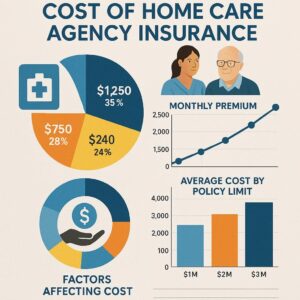
Cost of Home Care Agency Insurance
Why Insurance Feels So Expensive Right Now
Before we look at the numbers, we need to address the elephant in the room. If you have been in business for a few years, you might have noticed your premiums creeping up. You aren’t imagining it.
The home care industry is currently in a “hard market.” This is insurance jargon for a period where it is more expensive to buy coverage. This happens for several reasons:
-
Nuclear Verdicts: Lawsuits against businesses (including care agencies) are resulting in much higher settlement amounts than a decade ago.
-
Caregiver Shortages: When agencies are short-staffed, existing caregivers work overtime. Fatigued employees are more likely to make mistakes or have accidents.
-
Regulatory Changes: Shifts in employee classification laws (1099 vs. W-2) have created new liability angles that insurers are wary of.
Understanding this context is important. If your premium increased by 10-20% this year, your insurance company isn’t necessarily trying to punish you. They are reacting to the broader financial reality of paying out claims.
The Baseline: What Does “Average” Actually Mean?
When searching for “home care agency insurance cost,” you will see various figures thrown around. Some websites claim you can get fully covered for $500 a year. That is unrealistic for a legitimate, operating agency.
Let’s look at realistic ranges based on agency size.
| Agency Size (Annual Payroll) | Typical Annual Premium Range | Common Coverage Type |
|---|---|---|
| Startup / No payroll yet | $800 – $1,500 | General Liability only (risky) |
| Small ($50k – $150k payroll) | $2,500 – $4,500 | BOP + Professional Liability |
| Medium ($150k – $500k payroll) | $5,000 – $12,000 | BOP + Professional + Cyber |
| Large ($500k+ payroll) | $15,000 – $50,000+ | Package policy + Umbrella |
Important Note: These figures are estimates for agencies with a clean loss history. If you have had a claim in the last three years, expect these numbers to be higher.
Deconstructing the Policy: What You Are Actually Paying For
You don’t buy “one” insurance policy. You buy a collection of protections bundled together. To understand the total cost, you have to look at each ingredient.
1. General Liability Insurance
This is the foundation. It covers third-party bodily injury and property damage. If a client slips on a wet floor while your caregiver is present, this responds.
-
Cost: $500 – $1,200 per year for $1M/$2M limits.
-
Reality Check: This is relatively cheap. It is not the main driver of high premiums.
2. Professional Liability (Errors & Omissions)
This is arguably the most important coverage for a care agency. It covers you if a client (or their family) alleges that you failed to perform your professional duties correctly.
-
Example: A client falls and breaks a hip. The family claims the caregiver failed to follow the care plan regarding mobility assistance.
-
Cost: $1,500 – $4,000+ per year. This scales heavily based on whether you provide “skilled” nursing or just “non-medical” companion care.
3. Workers’ Compensation
This is mandatory in almost every state if you have employees. It covers medical bills and lost wages if a caregiver gets hurt on the job.
-
Example: A caregiver throws out their back transferring a client from bed to wheelchair.
-
Cost: This is usually the most expensive line item. It is calculated per $100 of payroll.
-
Non-Medical/Companion Care: $1.50 – $2.50 per $100 of payroll.
-
Home Health (Skilled Nursing/PT): $2.50 – $4.50+ per $100 of payroll.
-
-
Scenario: If you have $300k in payroll at a rate of $2.00, your Workers’ Comp premium is roughly $6,000.
4. Business Owners Policy (BOP)
This bundles General Liability and Property Insurance (for your office equipment). It is usually cheaper than buying them separately.
-
Cost: $1,200 – $2,500.
5. Cyber Liability
Home care agencies hold sensitive data: medical records, social security numbers, addresses, and credit card info. If your laptop is stolen or your email is hacked, you are liable.
-
Cost: $500 – $1,500 per year. This is becoming non-negotiable.
6. Umbrella/Excess Liability
If a claim exceeds the limits of your General Liability or Auto policy, the Umbrella kicks in.
-
Cost: $500 – $1,500 per $1M in additional coverage.
The “Hidden” Factors That Drive Your Price
You might look at the list above and think, “Okay, I can afford that.” But then you get a quote that is 30% higher than your friend across town. Why?
Insurers do not just look at your payroll. They perform “psychometric” profiling. They are trying to determine if you are a risky business owner.
The Client Risk Profile
Who are you caring for?
-
Low Risk: Independent seniors needing companionship and meal prep.
-
Medium Risk: Clients with mobility issues, using walkers or canes.
-
High Risk: Clients with dementia, Alzheimer’s, or bed-bound individuals requiring heavy lifting.
If your agency specializes in Alzheimer’s care, your rates will be higher. It is not discrimination; it is math. The probability of a claim is statistically higher.
The Employment Model
This is a major point of contention in the industry right now.
-
W-2 Employees: Higher payroll = higher Workers’ Comp premium. However, insurers like this. It is clean, legal, and predictable.
-
1099 Contractors: You aren’t paying payroll tax or Workers’ Comp through payroll, so your insurance seems cheaper. However, many carriers are now excluding coverage for 1099 workers or charging significantly higher General Liability rates because they know the state might reclassify those workers later, creating a retroactive premium issue.
Reader Note: If you are currently operating with 1099 caregivers and have not explicitly discussed this with your insurance agent, you may currently be uninsured. Most standard policies assume employees are W-2. Verify this today.
Cost vs. Value: The Danger of Shopping on Price Alone
There is a common trap in the home care industry. An agency gets a renewal quote for $8,000. A new carrier comes along and offers a shiny quote for $4,500. The agency switches immediately.
Six months later, a claim occurs. The agency then discovers the cheap policy had a “Prior Acts” exclusion, meaning it doesn’t cover incidents that occurred before the policy started. Or, it has a sub-limit for abuse and molestation that leaves the agency exposed.
Low cost is often achieved by narrowing the coverage window. You aren’t buying the same product for less money; you are buying a smaller, weaker product.
Red Flags in “Cheap” Policies:
-
Aggregate Deductibles: Instead of paying a deductible per claim, you pay a percentage of the total premium. This can get very expensive.
-
Lack of Abuse & Molestation Coverage: Some basic policies exclude this entirely. If a caregiver is accused of mistreatment, you have zero coverage.
-
No Non-Owned Auto: Does your policy cover a caregiver using their personal car to pick up groceries for a client? If not, you are exposed.
A Realistic Budgeting Strategy
How should you budget for insurance as you scale your agency?
Year 1: The Startup Phase
-
Goal: Meet minimum requirements to get contracts.
-
Strategy: Buy a BOP with Professional Liability included. Take the highest defensible deductible.
-
Budget: $1,500 – $2,500.
Year 2-3: The Growth Phase
-
Goal: Protect the assets you have built.
-
Strategy: Add Cyber Liability. Increase your General Liability limits from $1M to $2M.
-
Budget: $3,500 – $6,000.
Year 4+: The Mature Agency
-
Goal: Catastrophic protection.
-
Strategy: Add an Umbrella policy. Consider “Employment Practices Liability Insurance” (EPLI) to cover wrongful termination or discrimination lawsuits from employees.
-
Budget: $8,000 – $15,000+.
How to Lower Your Premium (Legitimately)
You don’t need to lie to your insurer to save money. There are legitimate, ethical ways to reduce your home care agency insurance cost.
1. Implement a Formal Training Program
Insurance companies love documentation. If you can prove that every caregiver undergoes a 4-hour orientation on fall prevention and proper transfer techniques, you become a lower risk.
-
Savings: Up to 10% on Professional Liability.
2. Use a Payroll Company
If you run payroll manually, there is a higher chance of misclassifying employees or making errors. Using a reputable payroll service (ADP, Gusto, Paychex) provides a paper trail.
-
Savings: Reduces audit risk and premium adjustments at the end of the year.
3. Review Your Class Codes
Sometimes agents accidentally classify you in a higher-risk class than necessary. If you are strictly non-medical, ensure you are not coded as “Home Health.”
-
Savings: Significant reduction in Workers’ Comp rates.
4. Increase Your Deductible
Raising your General Liability deductible from $500 to $2,500 can reduce your premium noticeably.
-
Trade-off: Only do this if you have the cash reserves to cover the smaller claims yourself.
Comparative Table: Insurance Needs by Agency Type
Not all home care is created equal. Here is how the cost structure shifts based on what you actually do.
| Agency Specialty | Primary Risk | Priority Coverage | Estimated Cost Index |
|---|---|---|---|
| Companion Care (Non-Medical) | Slips, trips, falls; Auto accidents | General Liability, Non-Owned Auto | 1.0x (Baseline) |
| Personal Care (ADLs) | Bodily injury during transfers; Back injuries to staff | Workers’ Comp, Professional Liability | 1.4x – 1.8x |
| Skilled Nursing (RN/LPN) | Medication errors; Professional negligence | Professional Liability (High Limits) | 1.8x – 2.2x |
| Pediatric Care | Allegations of abuse; Transportation | Abuse & Molestation, Auto | 2.0x – 2.5x |
| Staffing Agency (Travel Nurses) | Hospital credentialing requirements; Cyber | Cyber, Excess Liability | 1.5x – 2.0x |
The Application: Why Honesty Pays
When you apply for insurance, you fill out a form called the ACORD application. This is where most business owners make a critical error.
The Mistake: Answering “No” to the question: “Do you have any reason to believe a claim will be made against you?”
It sounds like a trick question. But if a client’s family was angry last week, and you have a gut feeling they are going to sue, you must disclose this.
If you fail to disclose it and the lawsuit arrives next month, the insurance company will likely deny the claim based on “known circumstances.” You will have paid a premium for nothing.
Conclusion (In Three Lines)
Insurance is not a utility bill you grudgingly pay; it is the structural integrity of your business. The true cost of coverage is determined by your risk profile, payroll size, and specialty. By investing in safety protocols and honest applications, you transform insurance from an expense into your agency’s strongest safety net.
Frequently Asked Questions
Q: Can I get home care agency insurance if I have a past claim?
A: Yes. You will likely be placed in the “non-admitted” market (surplus lines). The coverage is the same, but the premium is higher, and the carrier is not backed by the state guaranty fund. Expect rates to be 25-50% higher for 3-5 years post-claim.
Q: Do I need insurance if I am a solo caregiver with no employees?
A: Yes. You need General Liability and Professional Liability. If you are a sole proprietor, you are not covered under anyone else’s policy. Your client’s insurance covers their property, not your mistakes.
Q: How often should I shop around for insurance?
A: Annually. However, loyalty sometimes matters. If your current carrier has paid a large claim for you, it is often better to stay with them, as other carriers may see you as a “moving violation” and charge more.
Q: Does insurance cover me if I operate in multiple states?
A: It depends. Some policies are restricted to a specific territory. If you send a caregiver across state lines, you must notify your insurer. Workers’ Comp is regulated state-by-state.
Q: What is the most overlooked coverage for home care agencies?
A: Non-Owned Auto Liability. This covers the agency when a caregiver uses their personal vehicle for work-related errands (driving a client to the doctor, picking up prescriptions). Your personal auto insurance excludes business use.
Additional Resource
For current information on state-specific workers’ compensation regulations and rate filings, visit the International Risk Management Institute (IRMI) .
Click here to access IRMI’s Workers’ Comp Industry Spotlights