So, you’ve got your eyes on the prize. Whether it’s the legendary lineage of the Mk IV, the tuner-friendly nature of the Mk III, or the modern German-engineered precision of the Mk V, buying a Toyota Supra is a dream for any car enthusiast. But before you let the turbo spool in your imagination, there is a critical financial aspect that every owner needs to face: insurance.
Let’s be real for a second. The Supra isn’t your average commuter sedan. It’s a high-performance sports car. And in the eyes of an insurance company, that translates to higher risk. But how much higher? The answer isn’t a simple number. It’s a moving target influenced by everything from your age to the specific generation of Supra you’re looking to buy.
In this guide, we’re going to strip away the jargon and give you a realistic, honest look at what you can expect to pay. We’ll cover the differences between generations, how your personal profile affects the premium, and most importantly, how you can save money without sacrificing the coverage you need.
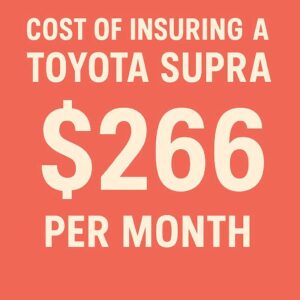
Cost of Insuring a Toyota Supra
Why Is Supra Insurance So Expensive? (The Honest Truth)
Before we dive into the numbers, it’s important to understand why you’re paying a premium. Insurance companies don’t just pull numbers out of a hat. They rely on complex data and actuarial tables. For a car like the Supra, several red flags pop up immediately.
-
Performance Capabilities: This is the big one. The Supra is fast. The Mk V makes 382 horsepower stock. That kind of power means higher speeds, and higher speeds mean more severe (and expensive) accidents.
-
Repair Costs: Modern Supras, especially the Mk V, are packed with expensive technology. Headlights alone can cost thousands to replace. For the older generations, parts are becoming scarce and valuable, which also drives up repair costs for agreed-value policies.
-
Theft Rates: Sports cars are magnets for thieves. The Supra, particularly the sought-after Mk IV, is a high-theft vehicle. Insurers factor this risk into your premium.
-
Demographic of Drivers: Statistically, sports cars are often driven by younger drivers, who are already in a higher-risk category. Even if you’re a responsible 40-year-old, you’re grouped into a pool with other Supra drivers, some of whom may have a heavier foot.
A Look at Insurance Costs by Supra Generation
One of the biggest mistakes people make is thinking all Supras cost the same to insure. They couldn’t be more different. Let’s break it down by generation. Note: The figures below are estimated annual averages for a driver with a clean record, full coverage, and good credit. Your actual cost will vary.
| Generation | Model Years | Average Annual Premium (Est.) | Key Insurance Factors |
|---|---|---|---|
| Mk V (A90/A91) | 2020 – Present | $2,400 – $3,600 | High vehicle value, expensive parts, modern safety tech (which can lower some costs), financed vehicles require full coverage. |
| Mk IV (A80) | 1993 – 2002 | $1,800 – $4,000+ | Collector status, skyrocketing market value, scarcity of parts, high theft risk, often insured with specialty/agreed-value policies. |
| Mk III (A70) | 1986 – 1992 | $1,200 – $2,200 | Lower market value than Mk IV, often a project car, may qualify for classic car insurance with mileage limits. |
| Mk II (A60) | 1982 – 1986 | $1,000 – $1,800 | True classic status, often not a daily driver, best suited for specialty insurers. |
The Modern Legend: Toyota Supra Mk V (A90/A91)
The current Supra is a technological marvel. Co-developed with BMW, it combines Toyota spirit with German engineering. Insuring a new car is always more expensive because of its value. If you have a loan or a lease on your 2023 Supra 3.0 Premium, your lender will require you to carry full coverage with low deductibles.
For a 30-year-old driver with a clean record, you might be looking at around $2,500 to $3,000 a year. However, if you’re in your early 20s, that number could easily spike to over $5,000 annually. The good news? The Mk V comes with a suite of driver-assistance features like automatic emergency braking and lane departure warning. Many insurance companies offer discounts for these safety features, which can help take the edge off.
Important Note: Because the Mk V is financed through banks, you will be required to carry comprehensive and collision coverage. Dropping to liability-only is not an option until the car is paid off.
The Icon: Toyota Supra Mk IV (A80)
Ah, the star of The Fast and the Furious. The Mk IV is a legend, and its insurance situation is unique. A standard insurance company will insure a 1995 Supra Turbo, but they will likely only pay its “actual cash value.” The problem? The actual cash value according to their book might be $25,000, but the market value for a clean, low-mileage Turbo is easily double or triple that.
If you own a Mk IV, you absolutely need to look into Agreed Value Insurance through specialty providers like Grundy, Hagerty, or Heacock. With an agreed value policy, you and the insurer decide what the car is worth (say, $80,000). You pay a premium based on that number, and if the car is totaled, they write you a check for $80,000—no depreciation haggling.
The cost for this can be surprisingly reasonable, often between $1,800 and $2,500 per year, provided you have a clean driving record and can store the car in a secure garage.
The Classic: Toyota Supra Mk III (A70) and Mk II (A60)
These generations are now firmly in “classic car” territory. Unless you are using one as a daily driver, you should also look at specialty insurers for these models. They are often cheaper to insure than a new Honda Civic, provided you agree to mileage restrictions (usually 2,500 to 5,000 miles per year).
For a Mk III or Mk II, you might pay as little as $1,000 to $1,500 per year for an agreed value policy. This is the sweet spot for enthusiasts who want to enjoy their classic without breaking the bank on insurance.
How Your Personal Profile Affects Your Premium
The car is only half the equation. The other half is you. Insurers are obsessed with risk, and your personal details are the ultimate risk calculator.
1. Age and Experience
This is the single biggest factor. Insurance is a bet, and young drivers are statistically more likely to crash.
-
Driver under 25: Expect to pay a heavy premium, often $4,000+ annually for a Mk V.
-
Driver 25-35: Rates start to stabilize. You are still considered “high risk” by some metrics, but you’ll see significant drops compared to your early 20s.
-
Driver 35-55: The golden zone. Insurers love this demographic. You will get the best rates here.
-
Driver 65+: Rates may creep up slightly, but you can still get excellent deals, especially on classic models.
2. Driving Record
This one is simple: the cleaner your record, the lower your rate.
-
Clean Record: Best possible rates.
-
One Speeding Ticket: Your rate could increase by 20% to 30%.
-
One At-Fault Accident: Expect a 40% to 50% increase, or even non-renewal from some standard carriers.
-
DUI: You are now high-risk. You may need to seek out specialized (and expensive) non-standard insurance companies.
3. Location, Location, Location
Where you live and park your Supra matters immensely.
-
Urban vs. Rural: A Supra parked on a street in downtown Los Angeles or New York City will cost significantly more to insure than one garaged in a small Midwestern town due to theft, vandalism, and traffic density.
-
Garaging: Always store your Supra in a garage. It protects the car and signals to the insurer that you are a responsible owner, lowering your premium.
4. Credit Score
In most states, insurers use credit-based insurance scores. A higher credit score correlates with fewer claims. If your credit is poor, you could be paying significantly more for the exact same coverage as someone with excellent credit.
How to Lower Your Supra Insurance Cost (Without Getting Ripped Off)
Nobody wants to pay more than they have to. Here is a practical checklist to help you lower your premiums.
-
Shop Around and Compare: Never accept the first quote. Get quotes from Geico, Progressive, State Farm, and then also check with specialty insurers like Hagerty if you have an older model.
-
Bundle Your Policies: Do you have homeowners or renters insurance? Bundle it with your auto policy. This is often the single biggest discount available, saving you 10% to 20% on both policies.
-
Increase Your Deductible: If you have $1,000 saved for an emergency, raising your comprehensive and collision deductible from $500 to $1,000 can lower your premium substantially. Just make sure you can actually afford the deductible if something happens.
-
Take a Defensive Driving Course: Some insurers offer a discount for completing an approved defensive driving or mature driver improvement course. It takes a few hours online and can save you money for years.
-
Ask About Specific Discounts:
-
Anti-theft device discount: The Supra has an alarm, but aftermarket trackers like LoJack can help.
-
Safety feature discount: For the airbags and anti-lock brakes in your Mk V.
-
Low mileage discount: If you work from home and drive less than 7,500 miles a year, tell them.
-
-
Pay in Full: If you can afford to pay your six-month premium in one lump sum instead of monthly installments, you can often avoid installment fees and sometimes get a small discount.
Types of Coverage: What Do You Really Need?
When you get a quote, you’ll be faced with a sea of options. Here’s what they mean for a Supra owner.
-
Liability Insurance: This is the law (in most states). It pays for damage you cause to others. Do not skimp here. If you hit a new Tesla, you want enough coverage to pay for it. Get at least $100,000/$300,000 limits.
-
Collision: This pays for damage to your Supra from an accident, regardless of who is at fault. If you have a loan, you must have this.
-
Comprehensive: This pays for damage to your Supra from non-accident events: theft, vandalism, hail, fire, or hitting a deer. Also required for loans.
-
Uninsured/Underinsured Motorist: This protects you if you are hit by someone who has no insurance or not enough insurance. With the number of uninsured drivers on the road, this is a lifesaver.
-
Gap Insurance: If you have a Mk V and put very little money down, you need this. If the car is totaled a year after you buy it, your insurance pays you the current value, which is less than what you owe the bank. Gap insurance pays the difference.
Additional Resource
For a deeper dive into the specifics of classic car insurance and why agreed value is so important for Mk IV owners, we highly recommend visiting the Hagerty Media website. They have a fantastic section dedicated to insurance guides and valuation tools for collector cars. It’s an excellent resource for understanding how to protect your investment properly.
Frequently Asked Questions (FAQ)
Q: Is the Toyota Supra expensive to insure compared to other sports cars?
A: It sits right in the middle. It is generally more expensive to insure than a Mazda MX-5 Miata but can be comparable to or slightly less than a Nissan Z or a Ford Mustang GT. It is often cheaper to insure than a BMW M2 or M240i, which shares its platform.
Q: Does the Supra’s BMW engine affect the insurance cost?
A: Indirectly, yes. Insurers care about repair costs. Because the Mk V shares parts with BMW, the cost to repair it at a certified shop can be higher than a purely Toyota-built car. This can keep premiums a bit higher than a traditional Toyota.
Q: Will modifying my Supra increase my insurance?
A: Yes, almost always. Modifications that increase performance (tunes, turbo upgrades) or change the value of the car (body kits, wheels) need to be disclosed. If you don’t tell your insurer and you crash, they can deny your claim. Some specialty insurers actually specialize in covering modified cars.
Q: Can I insure a salvaged or rebuilt title Supra?
A: It is difficult. Many major insurance companies will not offer comprehensive and collision coverage on a salvaged or rebuilt title vehicle. They may only offer liability. It’s best to check with smaller, regional insurers who may be more flexible.
Q: How can I get an exact quote?
A: The only way to know for sure is to get one. Have your VIN (Vehicle Identification Number) ready, know your annual mileage, and spend 15 minutes on a comparison website or call a local independent agent. It’s the fastest path to the truth.
Conclusion
Insuring your Toyota Supra doesn’t have to be a nightmare. The cost is a moving target based on which generation you choose, where you live, and who you are as a driver. The key is to be an informed consumer, understand the unique needs of your specific Supra (especially the classic models), and actively shop for the best rates and coverage.