Starting a non-medical home care agency is a rewarding venture. You are stepping into an industry built on trust, compassion, and reliability. Whether you are providing companionship, meal preparation, or help with daily errands, your clients are inviting you into their most private space: their home.
However, with that trust comes significant responsibility. A client might trip over a rug. A caregiver might be accused of mishandling property. An employee might get injured while lifting a client. In the home care industry, “accidents” are not a matter of if, but when.
This brings us to the single most common question asked by new agency owners: “How much does non medical home care business insurance cost?”
It is a fair question, but the answer is rarely a simple flat rate. Insurance costs are as unique as your business model. This guide will pull back the curtain on those costs. We will explore the factors that influence your premiums, break down the specific policies you need, and provide realistic numbers to help you build a solid budget.
By the end of this article, you will have a clear roadmap to navigate the insurance landscape, ensuring you are adequately protected without overpaying.
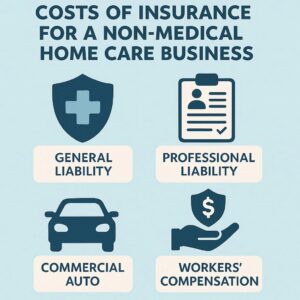
costs of insurance for a non-medical home care business
Understanding the “Non Medical” Distinction
Before we dive into dollars and cents, it is vital to understand why insurance for non-medical care is priced differently than for medical agencies (like home health skilled nursing).
Since you are not performing medical procedures (no injections, no wound care), the severity of potential liabilities is often lower. However, the frequency of interaction and the nature of physical assistance create a unique risk profile.
-
Lower Professional Risk: You don’t need “Medical Malpractice” insurance in the same way a nurse does.
-
Higher General Interaction: Your caregivers are constantly moving, lifting, and navigating personal environments.
This distinction places non-medical care in a specific category for insurers, often leading to more affordable premiums than skilled nursing, but requiring very specific types of coverage.
The Core Policies: What You Are Actually Paying For
To understand the cost, you first need to understand the product. A standard insurance package for a non-medical home care agency is typically a bundle of several distinct policies. Think of it as a toolbox; each tool fixes a different problem.
Here are the essential components you will be paying for:
1. General Liability Insurance (GL)
This is the foundation of your coverage. It protects you from third-party claims of bodily injury and property damage.
-
What it covers: A client trips over a caregiver’s bag and breaks their wrist. Your caregiver accidentally backs into a vase and shatters it. A dog bites your caregiver (the client sues for “attracting” the dog).
-
Why you need it: It pays for legal defense, medical bills, and settlements if you are found legally responsible for injuring someone or damaging their property.
2. Professional Liability Insurance (E&O)
Often called Errors and Omissions insurance, this covers claims related to the service you provided—or failed to provide.
-
What it covers: A client’s family claims your caregiver did not follow the care plan regarding medication reminders, leading to a health issue. A client accuses your staff of neglect by leaving them alone for too long.
-
Why you need it: Even though your services are non-medical, families rely on your professional duty of care. Allegations of negligence can be devastating, and this policy defends you.
3. Workers’ Compensation Insurance
In most states, this is not optional if you have employees. It is a state-mandated insurance that covers medical expenses and lost wages for employees who get injured or sick because of their job.
-
What it covers: A caregiver throws out their back while assisting a client from a chair. An employee slips on an icy driveway. A worker develops repetitive strain injuries.
-
Why you need it: It protects your employees. More importantly, it protects your business from lawsuits related to workplace injuries. If you don’t have it, you could be personally liable for massive medical bills.
4. Caregiver Liability / Bond
This is a specific type of coverage designed for home care. It often covers things that General Liability might not, or it provides an extra layer of protection.
-
What it covers: Theft of a client’s jewelry or cash by a caregiver. Forgery. Damage to a client’s property caused by a caregiver.
-
Why you need it: Trust is your currency. Advertising that you are “Bonded” provides immense peace of mind to potential clients, showing them you have a financial backstop if the unthinkable happens.
The Price Tag: Realistic Cost Breakdown
Now, let’s get to the heart of the matter. How much does this actually cost?
The honest answer is that a small agency might pay as little as $500 to $1,000 per year for a basic policy, while a larger agency with many employees could pay $5,000 to $15,000+ per year.
To help you visualize, here is a realistic breakdown based on business size and revenue.
Comparative Table: Estimated Annual Insurance Costs
| Business Profile | General Liability + Professional Liability | Workers’ Compensation (Estimate) | Estimated Total Annual Premium |
|---|---|---|---|
| Startup / Sole Proprietor | $500 – $800 | N/A (if no employees) or $300 – $600 | $500 – $1,400 |
| (No employees, low revenue) | |||
| Small Agency | $800 – $1,500 | $1,500 – $3,500 | $2,300 – $5,000 |
| *(5-15 employees)* | |||
| Medium Agency | $1,500 – $3,000 | $3,500 – $8,000+ | $5,000 – $11,000+ |
| *(16-40 employees)* | |||
| Large Agency | $3,000 – $6,000+ | $8,000 – $20,000+ | $11,000 – $26,000+ |
| *(50+ employees)* |
Important Note: These are estimated ranges. Your actual costs will vary based on the specific factors we will discuss next. Always get personalized quotes.
The 5 Key Factors That Influence Your Insurance Cost
Insurance companies are in the business of risk assessment. They use a complex algorithm to determine how likely you are to file a claim. The premium they quote you is the price of that calculated risk.
Here are the five main factors they look at:
1. Your Location (The State Factor)
Where your business operates is perhaps the biggest factor.
-
State Laws: Workers’ Compensation rates are set by the state. Some states, like California and New York, have higher base rates and more regulations, driving up costs.
-
Litigation Climate: In some regions, known as “judicial hellholes,” juries tend to award higher settlements. Insurers charge higher premiums in these areas to cover that potential exposure.
2. Your Payroll (The Size Factor)
For Workers’ Compensation, your premium is directly calculated based on your total payroll. The formula is simple:
-
Payroll ÷ $100 x Classification Code Rate = Premium.
-
If you have a large staff and a high payroll, your Workers’ Comp premium will be proportionally higher. This is why it is the most volatile and often the most expensive part of your insurance package.
3. Your Claims History (The Track Record)
Insurance is a pool. If you have filed claims in the past, you are considered a higher risk, and you will pay more to stay in the pool.
-
A single Workers’ Comp claim can raise your premiums for several years.
-
Starting fresh with no history is actually good—you start with a clean slate, which means lower “base” rates.
4. Your Coverage Limits (The Protection Level)
Insurance policies have limits. You will see numbers like $1 million per occurrence / $2 million aggregate.
-
Per Occurrence: The maximum the insurer will pay for a single claim.
-
Aggregate: The maximum they will pay for all claims during the policy year.
-
Higher limits mean more protection, but they also mean a higher premium. Most home care agencies opt for at least $1 million/$2 million to satisfy client contracts.
5. Your Risk Management Practices (The Safety Factor)
This is where you have the most control. Insurers love agencies that are proactive about safety.
-
Do you have a formal training program?
-
Do you conduct background checks on every caregiver?
-
Do you have a safety manual for lifting and transferring clients?
-
Do you have protocols for reporting incidents?
If you can demonstrate that you are actively reducing risk, insurers are often willing to offer lower rates. You are a safer bet.
How to Get an Accurate Quote (And Not Overpay)
Shopping for insurance can feel overwhelming. Here is a step-by-step approach to ensure you get the right coverage at the best price.
Step 1: Work with a Specialized Agent
Do not just go to a general insurance website. Look for an agent or brokerage that specializes in home care or social services. They understand your unique risks and know which insurance carriers are best suited for your industry. They will do the shopping for you.
Step 2: Gather Your Information
Before you call, have these details ready. It will make the process faster and the quote more accurate.
-
Business Structure: (LLC, Corporation, Sole Proprietor)
-
Payroll Estimates: Total annual payroll for all employees.
-
Job Duties: A clear description of what your caregivers do (e.g., companionship, bathing assistance, light housekeeping).
-
Number of Employees: Full-time, part-time, and contractors.
-
Safety Protocols: Details on your training and background check processes.
Step 3: Compare Apples to Apples
When you get quotes, don’t just look at the bottom-line price. Look at the declarations page. Are the coverage limits the same? Is the deductible the same? A cheaper policy might have lower limits or exclude crucial coverage for your specific services.
The Hidden Costs of Being “Cheap”
It is tempting to buy the cheapest policy you can find, especially when you are just starting out. But in the insurance world, you often get what you pay for.
Consider the story of a small agency owner in Florida. To save money, they bought a bare-bones General Liability policy from an online provider that didn’t specialize in home care. A caregiver accidentally left a stove on, causing a small kitchen fire. The damage was $15,000.
The owner filed a claim, confident they were covered. The insurance company denied it. Why? The policy had a specific exclusion for “caregiver activities” and property damage caused by an employee while on duty. The owner had unknowingly purchased a policy meant for an office worker, not a home care business.
The Lesson: Price is important, but coverage and expertise are paramount. An extra $200 a year is a small price to pay for knowing your claim will actually be paid.
Additional Resources
To help you continue your research and find the best protection for your agency, we recommend exploring the following resource:
-
Hiscox Insurance: Known for providing tailored small business insurance, including specific packages for home care businesses. They are a great starting point for getting a quick online quote. Visit Hiscox for a Quote
(Note: This is a suggestion based on market reputation. Always compare multiple quotes.)
Frequently Asked Questions (FAQ)
Q: Is insurance legally required for a non-medical home care business?
A: While a general business license may not require liability insurance, Workers’ Compensation is legally mandatory in almost every state as soon as you hire your first employee. Additionally, most clients and their families will require you to have liability insurance before they sign a contract.
Q: What is the difference between being “bonded” and “insured”?
A: Being insured (via General Liability) protects you and your business from third-party claims of injury or damage. Being bonded (via a Caregiver Bond) specifically protects the client from theft or dishonesty by your employee. It acts as a financial guarantee for the client.
Q: Can I insure independent contractors (1099 workers)?
A: This is a tricky area. In many states, if you control the work of a 1099 caregiver (scheduling, assigning tasks, providing training), they may legally be considered an employee for Workers’ Compensation purposes. You should never rely on a 1099 contractor’s personal insurance to cover your business liability. Consult with your insurance agent to ensure you are properly covered, regardless of worker classification.
Q: How can I lower my insurance premiums?
A: Focus on risk management. Implement rigorous background checks, provide ongoing safety training (especially for lifting and transferring), and maintain a drug-free workplace. Document all of this. A strong safety culture is the best way to negotiate lower rates.
Q: Does my insurance cover me if I operate in multiple cities or states?
A: It depends on your policy. You need to inform your insurer if you expand your service area. Coverage is often tied to the geographic limits stated in your policy. Operating outside of that area could leave you uninsured in the event of a claim.
Conclusion
The cost of insurance for your non-medical home care business is more than just a line item on a budget. It is the price of professional credibility, the shield that protects your life’s work, and the promise you make to your clients that they are in safe hands. While costs vary based on location, size, and risk factors, a well-structured policy is an investment in your agency’s longevity.
By understanding the coverage you need and the factors that drive the price, you can make informed decisions that protect your business without breaking the bank.