Let’s be honest for a second. Staring at a small chip in your tooth every time you smile—or avoiding selfies because of a stubborn stain—is frustrating. You know you want to fix it. You’ve probably heard of dental bonding as a quick, painless solution. But then comes the anxiety-inducing question: How much is this going to cost me, especially since I don’t have dental insurance?
You are not alone in feeling stuck between wanting a better smile and fearing an unaffordable bill. The world of dental pricing can feel like a secret club, especially for the nearly 77 million Americans without dental benefits.
This guide is designed to pull back the curtain. We are going to explore the real cost of dental bonding without insurance, why prices vary so much, and—most importantly—exactly how you can afford it. Forget confusing jargon and hidden fees; we’re going to break this down in plain English so you can walk into your consultation feeling informed and empowered.
What Exactly Is Dental Bonding?
Before we dive into the dollars and cents, let’s make sure we’re talking about the same procedure. Dental bonding is often called “composite bonding” or “cosmetic bonding.” It’s a cosmetic dentistry procedure where your dentist applies a tooth-colored resin material to your teeth to improve your smile.
Think of it as high-end sculpting for your teeth. The dentist carefully shades the putty-like resin, molds it into the perfect shape, hardens it with a special UV light, and then polishes it until it blends seamlessly with your natural tooth.
It is frequently used to fix:
-
Chipped or cracked teeth: A quick repair that restores the natural look.
-
Closing gaps: If you have a small gap between your front teeth (diastema), bonding can close it without the need for expensive orthodontics.
-
Reshaping teeth: Making a tooth longer or changing its shape.
-
Protecting exposed roots: When gums recede, bonding can cover the sensitive root area.
-
Covering stains: For deep discoloration that teeth whitening won’t fix.
Because it’s usually done without novocaine (unless we’re talking about filling a cavity) and in a single visit, it is the most conservative and affordable cosmetic dental treatment available.
Important Note: While we talk about “cosmetic” fixes, bonding is also used for “restorative” work—like filling a cavity. The price structure is often similar, but if the bonding is filling a decayed tooth, your insurance (if you had it) might cover a portion. Without insurance, you’re looking at the cash price, which we’ll detail below.
Dental Bonding Cost Without Insurance: The Real Numbers
Alright, let’s get to the heart of the matter. If you walk into a dentist’s office as an uninsured patient and ask for a price on dental bonding, what should you expect?
The short answer is that the cost varies significantly based on complexity, location, and the dentist’s expertise. However, to give you a reliable ballpark, here are the average costs you will encounter.
The National Average Price Range
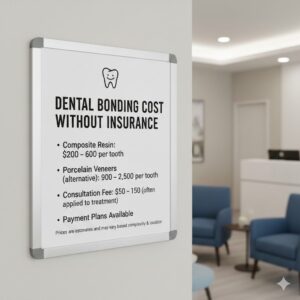
For a standard dental bonding procedure without insurance, you are generally looking at a range of $300 to $600 per tooth.
-
Simple bonding (small chip, minor repair): $250 – $400
-
Moderate bonding (closing a small gap, reshaping): $400 – $600
-
Complex bonding (large filling, rebuilding a tooth corner, multiple shades): $600 – $1,100
It is crucial to understand that this is usually a per tooth price. If you have three teeth that need work, you can roughly triple that cost.
Price Breakdown: What Are You Paying For?
Why does it cost this much? It helps to understand what the fee actually covers. When you pay for bonding, you aren’t just paying for the “putty.” You are paying for:
-
The Dentist’s Skill and Time: This is the biggest factor. Bonding is an art form. A skilled cosmetic dentist is essentially sculpting on a microscopic level to match the luster, contour, and translucency of your natural enamel. You are paying for their years of training and experience.
-
Materials: High-quality composite resins from brands like 3M or Kerr are expensive. They must be durable, stain-resistant, and polishable to a high shine.
-
Overhead: The dental office has costs—rent, staff salaries (the hygienist, the front desk), utilities, equipment sterilization, and the high-tech lights and tools used for the procedure.
-
The Consultation and Expertise: The time the dentist spends diagnosing the issue and discussing the best approach with you is factored into the final price.
Comparison Table: Bonding vs. Other Options
To truly understand the value of bonding, it helps to compare it to other procedures that fix similar issues. This table shows typical cash prices (without insurance).
| Procedure | Average Cost (Per Tooth/Unit) | Time to Complete | Longevity | Best For |
|---|---|---|---|---|
| Dental Bonding | $300 – $600 | 30-60 minutes | 3-10 years | Minor chips, gaps, stains |
| Porcelain Veneers | $900 – $2,500 | 2-3 visits (weeks) | 10-20 years | Major smile makeovers, severe discoloration |
| Dental Crowns | $1,100 – $3,500 | 2-3 visits (weeks) | 10-15 years | Severely broken or decayed teeth, after root canals |
| Teeth Whitening | $300 – $800 | 1-2 visits | 6 months – 2 years | Surface stains only (doesn’t fix chips/shape) |
As you can see, bonding is by far the most accessible entry point for improving your smile.
The Price Is a Range: 5 Factors That Influence the Final Bill
You might be thinking, “Okay, so it’s between $300 and $600. That’s still a wide gap.” You’re right. Here are the specific variables that determine whether your quote will be on the lower end or the higher end of the spectrum.
1. Geographic Location and Cost of Living
This is perhaps the biggest factor. Dental fees follow the real estate market.
-
High-Cost Areas: If you live in a major metropolitan city like New York, Los Angeles, San Francisco, or Boston, you can expect to pay a premium. A simple bonding procedure in Manhattan might easily start at $600-$800 per tooth.
-
Mid-Sized Cities: In cities like Austin, Denver, or Charlotte, prices will hover around the national average ($400-$550).
-
Rural or Lower-Cost Areas: In small towns or rural communities, overhead is lower, and you might find prices as low as $250-$350 per tooth.
2. The Dentist’s Expertise: General Dentist vs. Cosmetic Specialist
-
General Dentist: Your family dentist likely performs bonding for simple repairs. Their prices are usually at the lower end of the scale.
-
Prosthodontist or High-End Cosmetic Dentist: These specialists focus on the art of smile design. They invest heavily in advanced training and high-end materials. If you go to a “celebrity dentist” or a practice that markets itself exclusively for cosmetic makeovers, you could pay $800-$1,500+ per tooth. The result is often (but not always) more artistic and longer-lasting.
3. Complexity of the Case
-
The “One-Visit” Rule: Bonding is generally a single appointment. However, if a tooth is severely broken or if the bonding requires intricate layering of different resin shades to look natural, it takes more time and skill. More time = higher cost.
-
Number of Teeth: Some dentists may offer a slight discount if you are bonding multiple adjacent teeth, as they can work more efficiently. For example, bonding four front teeth might cost $2,000 total, rather than 4 x $500 = $2,000. (It’s still $500/ tooth, but you likely won’t get a discount unless you ask).
-
Prep Work: In rare cases, if the tooth has old, failing bonding that needs to be drilled away first, that adds to the chair time and cost.
4. Laboratory Process (Indirect vs. Direct Bonding)
In most cases, bonding is done “directly” in your mouth. But there is another method called “indirect composite bonding.”
-
Direct Bonding: Done in one visit. The dentist sculpts the tooth freehand. Cheaper and faster.
-
Indirect Bonding: The dentist takes an impression of your tooth, and a dental lab creates a composite veneer or “onlay.” You wear a temporary and come back for a second visit to have it glued on. This costs more (similar to a veneer price) because it involves lab fees, but it can be stronger and have a better shape for large restorations.
5. Additional Diagnostic Fees
This is the hidden cost that catches many uninsured patients off guard. The cost of the bonding itself is the “procedure” fee, but you may also be charged for:
-
New Patient Exam ($50 – $150): If you are a new patient, the dentist needs to examine your teeth and gums to ensure bonding is appropriate. They need to check for decay, gum disease, or bite issues.
-
X-Rays ($25 – $250): The dentist cannot see between your teeth or below the gum line with the naked eye. They will likely require X-rays to check the health of the tooth root and bone. A full set of X-rays is more expensive than a couple of small “bitewings.”
Pro Tip: When calling for a quote, always ask: “What is the total out-of-pocket cost for a new patient to have one tooth bonded? Does that include the exam and X-rays?” This prevents bill shock later.
How to Pay for Dental Bonding Without Insurance: 7 Practical Strategies
Okay, so you have a price in mind. Now, how do you actually pay for it without a benefits plan to help? You have more options than you might think.
1. In-Office Membership Plans (The Best Kept Secret)
Many private dental offices are moving away from traditional insurance and offering their own “in-house” membership plans.
-
How it works: You pay a flat annual fee (usually $300 – $400) to the dentist.
-
What you get: This fee typically covers 2 cleanings, 2 exams, and X-rays for the year. More importantly, it gives you 15% to 25% off all other treatments, including bonding.
-
The Math: If bonding costs $500, and you get 20% off, you save $100. If you need multiple teeth done, the membership pays for itself immediately and gives you preventive care for the year.
2. Third-Party Healthcare Financing (CareCredit)
This is the most popular option for uninsured patients facing a bill over $500.
-
How it works: Companies like CareCredit, Alphaeon Credit, or LendingClub offer medical credit cards.
-
Promotional Offers: The key is the “No Interest” promotions. Many offer 6, 12, or even 18-month financing with deferred interest. This means if you pay off the full balance within that time frame, you pay 0% interest.
-
Warning: Read the fine print. If you are even one day late or $1 short at the end of the promo period, they will charge you all the accrued interest from the original purchase date at a high rate (often 26.99%).
3. Shop Around and Compare Consultations
Don’t settle for the first quote you get. Dental fees are not regulated.
-
Strategy: Find 3 dentists in your area. Look for one with a “budget-friendly” rep (like a dental chain), one private practice in a regular neighborhood, and one high-end cosmetic office.
-
Pay for the Consult: You will likely have to pay for the exam and X-rays at each (around $150 total). This is money well spent. You’ll see three different treatment plans and three different prices. You can then make an informed decision based on the dentist’s rapport with you and their quoted fee.
4. Dental Schools: The Ultimate Discount
If you are on a very tight budget and have flexibility with your time, a dental school is your best option.
-
How it works: Senior dental students perform the procedure under the close supervision of licensed, experienced professors. Every step is checked.
-
The Cost: Prices are often 50% to 70% less than private practice. A $500 bonding case might cost $150 – $200.
-
The Catch: It takes much longer. A one-hour bonding appointment in a private office might take three hours at a school because of the teaching element. The quality can be excellent, but it requires patience.
5. Ask About a “Cash Discount”
Dentists hate dealing with insurance companies. The paperwork, the delayed payments, and the haggling are a headache.
-
The Strategy: When you get the treatment plan, politely ask, “Is there a discount if I pay cash or by check today?”
-
Why it works: By paying in full at the time of service, you save the office the cost of billing you, processing credit card fees, or waiting for insurance. They may be willing to knock off 3% to 5% just for the convenience.
6. Health Savings Account (HSA) or Flexible Spending Account (FSA)
If you have a high-deductible health insurance plan, you might have an HSA. If you have an employer-sponsored health plan, you might have access to an FSA.
-
The Benefit: These accounts allow you to set aside pre-tax dollars for medical expenses.
-
The Savings: If you are in the 22% tax bracket, using pre-tax dollars effectively gives you a 22% discount on your dental work. Check your card—most HSA/FSA debit cards work at the dentist just like a regular debit card.
7. Negotiate a Phased Treatment Plan
You don’t have to fix everything at once. Bonding is durable, but it’s not permanent.
-
The Strategy: Ask the dentist to prioritize. Which tooth bothers you the most? Can we fix that one this month, and then save up for the next one in three months?
-
The Benefit: This spreads the cost out over time, making it manageable within your monthly budget without accruing interest.
The Lifespan of Bonding: Is It Worth the Investment?
When you’re paying out of pocket, you want to know what you’re getting for your money. Bonding is not a permanent solution like a crown, but it’s a fantastic medium-term investment.
How Long Does Dental Bonding Last?
With good care, you can expect composite bonding to last between 3 and 10 years.
-
The 3-Year End: Bonding can chip or stain faster if you are a nail-biter, ice-chewer, or coffee/red wine drinker.
-
The 10-Year End: With meticulous care and a skilled dentist, some bonding holds up for a decade.
Maintenance and Repair Costs
Because it is prone to chipping and staining, you may need “touch-ups.”
-
Repairing a small chip: A dentist can often polish out a small chip or add a tiny bit of resin to fix it. This might cost a minimal fee ($50-$100) or even be free if you’re still within a warranty period (some dentists offer a 1-year warranty on bonding).
-
Full Replacement: Eventually, the bonding will need to be completely removed and replaced. This is the same cost as the original procedure.
How to Protect Your Investment (Without Insurance)
Since you are paying for this yourself, you want it to last. Here is how to make your bonding last longer:
-
Stop Bad Habits: Do not chew ice, pens, or your fingernails. Do not use your teeth as tools to open packages.
-
Be Mindful of Food: Hard candies and sticky candies (like caramel or taffy) are enemies of bonding.
-
Cut, Don’t Bite: Cut apples, corn on the cob, and ribs into smaller pieces rather than biting into them directly.
-
Oral Hygiene: Brush twice a day and floss. While the bonding material won’t decay, the tooth edge next to the bonding can. If that tooth gets a cavity, the whole bond has to be removed.
-
Avoid Staining Agents: The resin is porous. Smoking, drinking coffee, tea, and red wine will stain it faster than your natural enamel. Rinse with water immediately after consuming these.
Dental Bonding Cost Without Insurance vs. Traveling Abroad
A trend that comes up often in cost discussions is “dental tourism”—traveling to another country for cheaper treatment.
The “Medical Tourism” Temptation
Countries like Mexico, Costa Rica, Turkey, and Thailand offer dental bonding at significantly lower prices. You might pay $150 per tooth instead of $500.
The Risks to Consider
While the upfront cost is lower, you need to factor in the full equation:
-
Travel Costs: Airfare, hotels, and food eat into your savings.
-
Follow-up Care: What if the bonding chips in three months? You have to fly back, or find a local dentist who will likely charge you full price to fix someone else’s work. Most US dentists are hesitant to repair work done overseas because they don’t know the materials used.
-
Quality Variance: Standards of sterilization and material quality can vary widely. A complication could end up costing you more in the long run.
Verdict: For a simple, single-tooth bonding, it is rarely worth the hassle and risk of traveling abroad. The savings are minimal once you factor in travel. For full-mouth reconstruction, the math might work out differently, but for bonding, staying local is usually smarter.
Frequently Asked Questions (FAQ)
Q: Is dental bonding painful?
A: Usually not. Because it’s an additive process (adding material to the tooth) and doesn’t require drilling into the tooth structure, anesthesia is often unnecessary. If the bonding is being used to fill a cavity, the dentist will numb the area.
Q: Does insurance ever cover cosmetic bonding?
A: Typically, no, if it is purely for looks. However, if the bonding is deemed “medically necessary”—for example, to restore a fractured tooth or fill a cavity—your insurance (if you had it) might cover 50%-80% of the cost. Without insurance, this distinction doesn’t matter for your bill.
Q: How long does the procedure take?
A: For a single tooth, expect to be in the chair for about 30 to 60 minutes. It is often called “same-day dentistry” because you walk in with a problem and walk out with it fixed.
Q: Can I get bonding if I have gum disease?
A: A dentist will likely want to treat any active gum disease first. Bonding needs a healthy foundation. If your gums are inflamed, it can affect the fit and look of the bonding.
Q: Will my bonded tooth look exactly like my other teeth?
A: A skilled dentist can match the shade almost perfectly. However, bonding does not have the same light-reflecting properties as natural enamel. It might look slightly different in direct, bright light compared to a natural tooth, but to the average person, it will be invisible.
Q: Does teeth whitening work on bonding?
A: No. The hydrogen peroxide in whitening gels will not lighten the composite resin. If you are planning to whiten your teeth, you should do it before you get bonding so the dentist can match the resin to your new, brighter smile.
Making Your Decision: A Realistic Path Forward
Deciding to pay for dental bonding without insurance is an investment in your confidence and your health. It’s normal to feel overwhelmed by the numbers, but remember that you have control over the process.
Here is your simplified action plan:
-
Do Your Research: Look for 2-3 highly-rated dentists in your area. Don’t just look at the price of bonding; look at their “before and after” photos in their online galleries. This shows you their artistic ability.
-
Ask the Right Questions: When you call, ask for the total new patient cost including exam, X-rays, and the bonding procedure itself.
-
Explore Payment Options: Ask about in-house membership plans or if they accept CareCredit.
-
Prioritize: If money is tight, fix the tooth that bothers you the most first. You can always go back for more later.
Dental bonding offers a remarkable “bang for your buck.” It’s one of the few procedures in dentistry that can completely transform a smile in under an hour for a fraction of the cost of other treatments. By being an informed consumer, you can navigate the costs and walk away with a smile you love—even without insurance.
Additional Resources
For more information on maintaining your oral health and finding affordable care, we recommend visiting the American Dental Association (ADA) consumer section at MouthHealthy.org. They provide excellent, unbiased information on various procedures and oral health topics.
Conclusion
Paying for dental bonding without insurance requires a bit of planning, but the cost is far more manageable than other cosmetic fixes. With average prices between $300 and $600 per tooth and accessible payment plans like in-office memberships or CareCredit, a repaired smile is within reach. Ultimately, the investment in your confidence and dental health is one that pays dividends every time you smile.