Let’s be honest for a moment. When was the last time you really thought about your teeth? You brush them every day, maybe floss when you remember, and you hope that sharp pang you felt while drinking your morning coffee yesterday was just a one-time thing.
For millions of Canadians, visiting the dentist feels like a luxury they simply cannot afford. Unlike our doctor’s visits, which are covered by provincial health care, your teeth are treated differently by the system. A routine cleaning, a simple filling, or—heaven forbid—a root canal can turn into a bill that rivals a month’s rent.
But here is the good news: you are not alone in navigating this, and there is a way to take control. Whether you are a student just starting out, a freelancer dealing with the gig economy, a family trying to keep up with your kids’ growing smiles, or a retiree on a fixed income, understanding dental insurance Canada options is the first step to maintaining your health without breaking the bank.
This guide isn’t just another brochure rehashing the same old jargon. We are going to walk through the weeds together. We will look at what is actually covered, how much you should expect to pay, the difference between private plans and government programs, and most importantly, how to pick a plan that fits your life.
After all, a healthy smile isn’t just about looking good for photos. It is linked to your overall well-being. So, let’s dive in and demystify the world of Canadian dental coverage.
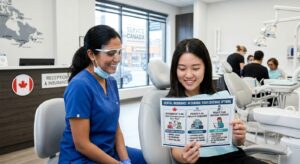
Dental Insurance in Canada
Why Dental Insurance is Different in Canada
Before we get into the nitty-gritty of premiums and deductibles, it is important to understand the landscape. If you have ever been to a hospital in Canada, you know you walk in, get treatment, and walk out without a bill. That is the magic of the Canada Health Act.
However, dental care falls outside of this act. It is considered a non-insured service for the most part.
Important Note: Provincial health cards typically cover dental surgeries that must be performed in a hospital (like reconstructive jaw surgery or removing impacted teeth under general anesthesia). But for the day-to-day stuff—checkups, cleanings, fillings, crowns—you are expected to pay out of pocket or through private insurance.
This separation is a holdover from history when dental disease was seen as less critical than other medical conditions. Today, we know that is not true. Inflammation in your gums is linked to heart disease, diabetes, and even pregnancy complications. Because dental care is treated separately, the onus is on us, the individuals, to figure out how to pay for it.
How Dental Insurance Actually Works (The Simple Version)
If you have never had a dental plan before, the terminology can sound like a foreign language. Let’s break it down into plain English.
Think of dental insurance like a gym membership for your mouth. You pay a monthly fee (the premium). In return, the insurance company agrees to pay for some of your services. But unlike a gym where you can go unlimited times, the insurance company puts limits on how much they will spend on you.
Here are the key pieces you need to understand:
-
The Premium: This is the monthly or yearly cost you pay to keep the policy active. Whether you use it or not, you pay this.
-
The Deductible: This is the amount you have to pay out of pocket before the insurance company starts paying. It is usually an annual amount. For example, if you have a $50 deductible, you pay the first $50 of your dental bills, and then the insurance kicks in.
-
Co-insurance: This is the split. Most plans don’t pay 100% of everything. They might pay 80% of a filling, and you pay the remaining 20%. That 20% is your co-insurance.
-
Annual Maximum: This is the cap. This is the total dollar amount the insurance company will pay for your care in one year. In Canada, the average annual maximum is often between $1,500 and $3,000. If you need a $5,000 procedure, you will hit your maximum, and the rest comes out of your pocket.
-
Waiting Periods: Insurance companies don’t want you to sign up, get a root canal tomorrow, and quit. So, they impose waiting periods. You might have to wait three months for basic work and up to 12 months for major work like bridges or dentures.
The Main Players: Types of Dental Plans Available
Not all dental insurance is created equal. Depending on your employment situation and life stage, you will likely be shopping in one of these three categories.
Employer-Sponsored Group Plans
This is the golden ticket for most Canadians. If you have a full-time job with benefits, this is likely what you have.
-
How it works: Your employer negotiates a group rate with an insurance company. You usually pay a portion of the premium through payroll deductions, and your employer pays the rest.
-
Pros: Group plans usually have better rates, fewer medical questions (guaranteed acceptance), and broader coverage than individual plans. Because the risk is spread across hundreds of employees, the insurance company can offer better terms.
-
Cons: You are stuck with whatever plan your boss picks. If it has a low annual maximum, you can’t upgrade it.
Individual and Family Plans
If you are self-employed, a contractor, retired early, or working for a company that doesn’t offer benefits, you need an individual plan.
-
How it works: You go directly to an insurance company (like Manulife, Sun Life, or Blue Cross) and purchase a policy.
-
Pros: You have total control. You can pick the level of coverage you want and customize it to your needs.
-
Cons: It is more expensive than group insurance. You will also face stricter underwriting. If you have pre-existing conditions, they might not be covered right away, or you could be denied.
Government-Subsidized Programs
These are often overlooked but are vital for specific segments of the population.
-
How it works: Funded by tax dollars, these programs provide free or low-cost dental care to specific groups, usually children in low-income families, seniors, or people with disabilities.
-
Examples: Many provinces have programs like the Healthy Kids program in Ontario or the B.C. Healthy Kids program. Eligibility is based on income.
-
The New Federal Plan: Recently, the Canadian government rolled out the Canadian Dental Care Plan (CDCP). This is a game-changer. It aims to provide dental coverage directly to uninsured Canadians with a household income under $90,000. It is not “insurance” in the traditional sense, but a federal grant program that pays providers directly for eligible patients.
What Do Dental Plans Typically Cover?
To make this as clear as possible, insurance companies usually split dental services into four categories. Understanding these categories helps you figure out if a plan is actually going to pay for what you need.
Category 1: Preventive Services (The Routine Stuff)
This is the bread and butter of dental insurance. Insurers love preventive care because it stops you from needing expensive surgery later.
-
What’s included: Routine exams (usually twice a year), teeth cleanings (scaling and polishing), fluoride treatments for kids, and X-rays.
-
Typical Coverage: Usually covered at 80% to 100%. These services rarely have waiting periods because insurers want you to do them.
Category 2: Basic Restorative Services (Fixing the Problem)
When prevention fails, we move to the basics.
-
What’s included: Fillings (amalgam or composite), simple extractions, and periodontal (gum) treatment like scaling and root planing.
-
Typical Coverage: Usually covered at 70% to 80%. There may be a short waiting period.
Category 3: Major Restorative Services (The Big Stuff)
This is where costs skyrocket, and coverage gets trickier.
-
What’s included: Crowns (caps), bridges, dentures (full and partial), inlays, and onlays.
-
Typical Coverage: Covered at 50% or less. There are often long waiting periods (6-12 months) for these services, and they are subject to the annual maximum. If your plan max is $2,000 and a crown costs $1,500, you’ve used up most of your budget for the year.
Category 4: Orthodontics (Straightening Teeth)
Braces and Invisalign fall into their own special category.
-
What’s included: Braces (metal or ceramic), clear aligners, and retainers.
-
Typical Coverage: This is often an optional add-on to a plan. If it is included, there is usually a lifetime maximum (e.g., $3,000 per person) rather than an annual one, and it is often only for children under 18.
The Real Cost: Breaking Down Premiums and Expenses
So, how much does this peace of mind actually cost? Let’s look at some realistic numbers. Remember, these are estimates and vary wildly based on where you live in Canada, your age, and the plan’s generosity.
Individual Monthly Premiums:
-
Basic Plan (mostly preventive): $40 – $80 per month.
-
Comprehensive Plan (includes major and orthodontics): $100 – $200+ per month.
Family Monthly Premiums:
-
Basic Plan: $80 – $150 per month.
-
Comprehensive Plan: $200 – $400+ per month.
Common Out-of-Pocket Costs (Without Insurance):
To help you understand why insurance might be worth it, here is what things typically cost if you pay cash:
-
Routine Cleaning & Exam: $200 – $350
-
Simple Filling (one surface): $150 – $300
-
Root Canal (molar): $1,000 – $1,800
-
Crown: $1,200 – $2,000
-
Braces (full treatment): $5,000 – $8,000
Cost-Benefit Analysis: Is It Worth It?
Let’s run a quick scenario.
Meet Sarah. She is a freelancer in Toronto. She buys an individual plan for $80/month ($960/year). Her plan has a $50 deductible, covers cleaning/exams at 90%, fillings at 80%, and has a $1,500 annual maximum.
-
Scenario A (Good year): Sarah just gets two cleanings ($400 total). Insurance pays 90% of $400 = $360. Minus her $50 deductible, she gets $310 back. She paid $960 in premiums but only got $310 in benefits. She “lost” $650.
-
Scenario B (Bad year): Sarah needs a filling ($250) and a crown ($1,500). Total bill: $1,750. Insurance pays 80% of the filling ($200) and 50% of the crown ($750) = $950. Minus the deductible, she gets $900 back. She paid $960 in premiums and got $900 back. Still a small loss, but better.
-
Scenario C (Really bad year): Sarah cracks a tooth needing a root canal and crown. Bill: $3,000. Insurance pays up to her $1,500 max. She gets $1,450 back after deductible. She paid $960, got $1,450. She comes out ahead by $490.
The Verdict: Insurance is a bet against yourself. You are betting you will need expensive care; the insurer is betting you won’t. For most people, it smooths out the financial bumps, turning unpredictable huge bills into predictable monthly payments.
Decoding the Fine Print: Exclusions and Limitations
Insurance policies are legal contracts, and they are full of traps for the unwary. Here are a few things to watch out for that might surprise you.
The “Missing Tooth” Clause
This is a classic. If you lost a tooth before you bought the insurance policy, most plans will not cover a replacement for that tooth, ever. They consider it a pre-existing condition. If you are missing a tooth and hoping insurance will help with an implant, buy a plan before you lose the tooth, not after.
Frequency Limitations
Insurance companies are very strict about timing. Most plans will only pay for a cleaning every nine months or a set of full X-rays every three years. If you go every six months like your dentist recommends, you might end up paying for that second cleaning entirely out of pocket if you are two weeks early.
Predetermination of Benefits
For any procedure over a certain amount (usually $300 or more), your dentist will likely recommend sending a “predetermination” to the insurance company.
-
What this is: The dentist sends the treatment plan and x-rays to the insurer.
-
Why it matters: The insurer sends back a document telling you exactly how much they will pay and how much you owe. This prevents nasty surprises when the bill arrives. Always ask for this for major work.
The Canadian Dental Care Plan (CDCP): What You Need to Know
You have likely heard about the new federal dental plan in the news. It is a significant shift in how Canada approaches oral health. Let’s clear up the facts, as there is a lot of misinformation floating around.
The CDCP is designed to help families with an income of less than $90,000 who do not have access to private insurance.
Who is eligible?
-
Canadian residents who file their taxes.
-
Adjusted family net income is less than $90,000.
-
No access to private dental insurance (there are exceptions for those with retiree or survivor benefits from work).
-
Coverage is being rolled out in phases, starting with seniors (87+), then moving to seniors 65+, then youth under 18, and finally disabled persons and all remaining eligible Canadians by 2025.
What does it cover?
It is designed to mirror a comprehensive private insurance plan. It covers:
-
Preventive services (cleanings, exams)
-
Basic services (fillings, extractions)
-
Major services (crowns, dentures)
-
Anesthesia and sedation if medically required
How does it work?
This is crucial: It is not insurance. It is a federal grant. You cannot “buy” this plan. You apply through Service Canada. If approved, you will receive a welcome package and a member card. You take this card to a participating dentist. The government pays the dentist directly for the covered portion. You may have to pay a co-payment if your income is between $70,000 and $89,999.
Important Note: If you currently have private insurance through work, you are not eligible for the CDCP. However, if you retire or lose your job, you can apply when your coverage ends.
Comparing Apples to Apples: Private vs. Federal vs. Provincial
To make the landscape even clearer, here is a side-by-side comparison of how you might get coverage.
| Feature | Employer/Private Insurance | Canadian Dental Care Plan (CDCP) | Provincial Programs (e.g., Healthy Kids) |
|---|---|---|---|
| Cost to You | Monthly premiums + co-pays | Free (with income-based co-pays) | Free |
| Eligibility | Employed or willing to pay | Low-to-middle income, no private insurance | Low-income families, specific demographics |
| Coverage Scope | Comprehensive (depending on plan) | Comprehensive | Usually basic and preventive only |
| Provider Choice | Any licensed dentist | Dentists who opt into the program | Specific public health clinics or participating dentists |
| Application | Apply online or through employer | Apply through Service Canada | Apply through provincial health ministry |
Practical Tips for Choosing Your Plan
Standing in the grocery store aisle, you compare prices of peanut butter. Standing in front of a computer screen comparing insurance quotes, you might feel paralyzed. Here is how to cut through the noise.
1. Audit Your Own Mouth
Take a honest look at your dental history.
-
The “Cavity-Prone” Crowd: If you have always had a lot of fillings, or you know you grind your teeth at night, look for a plan with strong basic and major coverage (high percentages for crowns and root canals). Don’t worry too much about orthodontics.
-
The “Healthy Teeth” Crowd: If you rarely have issues, a basic, low-premium plan that covers cleanings and exams at 100% might be your best bet. You are essentially buying a discount card for your twice-yearly visits.
-
The Parents: You need to check the orthodontics clause. Does it cover kids? What is the lifetime maximum? $2,000 doesn’t go far when braces cost $7,000.
2. Do the Math on the Annual Maximum
A plan with a $3,000 annual maximum is significantly more valuable than a $1,500 plan, but it will cost more. If you are healthy, you might never hit that $1,500 cap anyway. If you are older and worried about dentures or implants, you need that higher cap.
3. Look at the Network (or lack thereof)
In the US, dental insurance often requires you to see “in-network” dentists. In Canada, most private insurance is “fee-for-service.” This means you can go to any dentist you want. The insurance company will pay based on a set fee guide (often the provincial dental association guide). If your dentist charges more than that guide, you pay the difference.
4. Read the Waiting Periods Carefully
Some plans advertise “immediate coverage,” but read the fine print. Immediate usually means for preventive care only. If you need a bridge, you might be waiting a full year. If you have a toothache today, buying insurance today won’t help you—it will be considered a pre-existing condition.
Life Stages and Dental Coverage
Your dental needs change as you age, and your insurance strategy should too.
Students and Recent Grads
You are likely covered under your parents’ plan until age 25 or 26 (depending on the province and plan). Enjoy it while it lasts. When you graduate, you often lose that coverage. Many universities offer alumni plans or extended health plans for recent grads at a discounted rate for a year or two—take advantage of this bridge.
The Gig Economy and Freelancers
You are the entrepreneurs of your own health. Since you don’t have an HR department to lean on, you need to be proactive.
-
Strategy: Set aside a “health spending account” for yourself. Put the money you would have spent on premiums into a savings account. Use it to pay for your cleanings. For major emergencies, look into “stop-loss” insurance or high-deductible plans that only kick in for big expenses.
-
The CDCP: Keep a close eye on your income. If you have a lean year where your freelance income dips below $90,000, you may be eligible for the federal plan for that year. Apply!
Families with Children
Getting your kids used to the dentist early is vital for their long-term health.
-
What to look for: Ensure the plan covers recall exams and cleanings at least twice a year. Check for fluoride coverage and space maintainers (if a baby tooth is lost early, these hold space for the adult tooth).
-
Orthodontics: This is the big one. If your child has crowding issues, orthodontics can be a massive expense. Look for plans that offer orthodontic coverage as a separate rider. Start the plan before the orthodontist says your child needs treatment, or the waiting period won’t be served.
Seniors and Retirees
Retirement often means saying goodbye to employer benefits. However, maintaining dental health is crucial for nutrition and quality of life as you age.
-
The Reality: Seniors often need more major work—crowns on teeth that are weakening, or dentures.
-
The Federal Solution: The CDCP is a lifeline for seniors. If you are over 65 and have a modest income, this should be your first stop.
-
Private Options: If you have a higher income and want to keep your current dentist, you can buy a retiree plan. Be prepared for high premiums, as the risk for the insurer is higher with older patients.
How to Save Money Even Without Insurance
Maybe after reading all this, you decide insurance isn’t for you right now. That is a valid choice. But you still need to take care of your teeth. Here are some realistic strategies to keep costs down without a card to swipe.
1. Dental Hygiene Schools
This is the best-kept secret in dental care. Schools for dental hygienists and dentists need real patients for their students to practice on.
-
How it works: A supervised student performs the cleaning or exam. It takes much longer than a regular visit (sometimes 2-3 hours), but it is incredibly thorough.
-
Cost: Often 25% to 50% of the cost of a regular clinic. A cleaning might cost $35 instead of $200.
2. Negotiate with Your Dentist
You can do this. Dental offices are businesses. If you are paying cash, they are saving money on paperwork and billing staff. Ask them:
-
“Is there a cash discount?”
-
“Can we set up a payment plan for this crown?”
-
“Can I pay for this treatment over three months?”
Many offices are willing to work with you to ensure you get the care you need.
3. The Power of Prevention
It sounds cliché, but it is true. Spending $200 on a cleaning twice a year might feel expensive. But skipping those cleanings to save $400 can lead to gum disease, which leads to bone loss, which leads to teeth falling out or needing expensive implants. The cheapest filling is the one you never need.
4. Consider a Dental Discount Plan
This is not insurance. It is a membership card you buy that gives you access to reduced rates at participating dentists.
-
Pros: No waiting periods, no annual maximums, no exclusions for pre-existing conditions.
-
Cons: You still pay for the service, just at a discounted rate. It doesn’t cover the cost; it just lowers the bill. For families with multiple people needing work, this can sometimes be more cost-effective than insurance.
The Claims Process: From Chair to Reimbursement
So, you’ve done the hard part. You picked a plan, paid your premiums, and now you are sitting in the dentist’s chair. What happens next?
In modern Canada, the process is usually seamless. Most dental offices are “direct billers.”
-
The Appointment: You get your cleaning or filling done.
-
The Submission: The dental office enters the procedure codes into their computer and hits “send” to your insurance company. This happens in real-time.
-
The Adjudication: The insurance company’s computer instantly checks your eligibility, your annual maximum remaining, and your co-insurance.
-
The Result: The dental office’s screen shows exactly what the insurance will pay and what you owe. This happens in under a minute.
-
The Payment: You pay your portion (the co-pay) right there by debit or credit card. The insurance company sends a cheque directly to the dentist for their portion later.
If your dentist does not direct bill, you will have to pay the full amount upfront and mail or upload a claim form to your insurer to get reimbursed.
Looking Ahead: The Future of Dental Care in Canada
The landscape is shifting under our feet. For decades, dental care was a private expense. With the introduction of the CDCP, we are moving toward a hybrid model.
In the coming years, we will likely see:
-
More Integration: Dental health being taken more seriously as a part of overall health by the public healthcare system.
-
Changes in Private Insurance: Private insurers may pivot to offering “top-up” coverage for things the federal plan doesn’t cover, or for people with higher incomes who want more choice.
-
Potential for Expansion: If the federal plan proves successful and popular, there will be political pressure to expand eligibility or benefits.
For you, the consumer, this means more options. It means you are no longer at the mercy of the market if you are low-income. It is a time of change, and change, in this case, likely means better access for millions of Canadians.
Conclusion
Navigating the world of dental insurance Canada options doesn’t have to be a headache. Whether you are covered by a generous employer plan, shopping for an individual policy, or hoping to qualify for the new Canadian Dental Care Plan, the goal remains the same: keeping your mouth healthy without draining your bank account. Remember to look past the monthly premium and understand the details—the annual maximum, the waiting periods, and the exclusions. Your smile is an asset; treat it like one.
Frequently Asked Questions (FAQ)
Is dental insurance mandatory in Canada?
No, it is completely voluntary. Unlike car insurance, you are not legally required to have it. However, many employers offer it as part of a compensation package to attract talent.
Can I get dental insurance if I am self-employed?
Absolutely. You can purchase individual or family plans directly from insurance providers like Pacific Blue Cross, Manulife, or Sun Life. You can also use a brokerage to compare rates.
Does the new federal dental plan cover implants?
The CDCP covers services deemed medically necessary. Implants are often considered a major restorative service, but coverage can be complex and may require pre-approval. Generally, more conventional options like crowns or bridges may be covered more readily than implants, depending on the clinical situation.
What happens if I lose my job and my insurance?
You may be eligible for a temporary continuation of benefits through a federal program called COBRA (if your employer had more than 20 employees), but you will have to pay the full premium yourself. Alternatively, you can apply for the CDCP if your income has dropped below the threshold, or shop for an individual conversion policy from your previous insurer.
Can a dentist refuse to treat me if I don’t have insurance?
No. Dentists in Canada are private business owners. They can choose to accept or refuse any patient, but they do not refuse based solely on insurance status. Many accept patients who pay out-of-pocket.
Additional Resource
For the most up-to-date and official information on the federal government’s dental plan, including eligibility and how to apply, visit the official Government of Canada website: