Considering the All-on-4 dental implant procedure is a significant step toward restoring not just your smile, but your quality of life. However, before you get too excited about the prospect of eating an apple again or laughing without hesitation, there is one big question that weighs on every patient’s mind: does insurance cover All-on-4 dental implants?
If you have been searching for a straight answer, you know it is complicated. The world of dental insurance is notoriously dense, filled with fine print, annual maximums, and confusing terminology.
This guide is designed to be your roadmap. We will explore the realities of insurance coverage, break down the costs, reveal alternative payment options, and give you the tools you need to navigate your benefits. By the end of this article, you will have a clear understanding of what to expect financially and how to make this life-changing treatment more affordable.
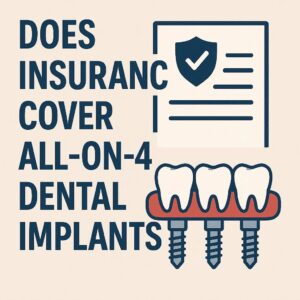
Does Insurance Cover All-on-4 Dental Implants
What Exactly is the All-on-4 Procedure?
Before we dive into the complexities of insurance policies, it is crucial to understand what you are actually paying for. All-on-4 is not just a “dental implant”; it is a full-arch rehabilitation system.
Unlike traditional dentures which rest on your gums, or individual implants which replace single teeth, the All-on-4 technique uses strategic placement to maximize existing bone.
-
The Concept: Four dental implants are surgically placed into the jawbone—two in the front (vertical) and two in the back (angled).
-
The Result: A fixed, non-removable prosthetic bridge (a full set of teeth) is attached to these implants.
-
The Benefit: Because the back implants are angled, they often eliminate the need for bone grafting, making the procedure faster and more cost-effective than traditional methods.
This is considered a major restorative procedure, and because it involves surgery, it sits at the intersection of general dentistry and oral surgery.
Important Note: Because this procedure restores function and health, not just appearance, some insurance companies may view it differently than purely cosmetic treatments.
The Million-Dollar Question: Does Insurance Cover All-on-4 Implants?
Here is the short answer: It depends.
The long answer is more nuanced. Generally speaking, traditional dental insurance plans were not designed to cover large-scale restorative work like All-on-4.
Most standard dental PPO or HMO plans operate on a “coverage model” designed for preventive care. They are great for covering:
-
Cleanings (100%).
-
Fillings and basic crowns (70-80%).
-
Simple extractions (50-80%).
However, they often fall short when it comes to “major procedures” like implants, bridges, and dentures. Here is the reality check:
The “Annual Maximum” Barrier
This is the single biggest hurdle for patients. Dental insurance plans typically have a low annual maximum benefit—usually between $1,000 and $2,000 per year.
Considering that a single implant crown can cost several thousand dollars, and the All-on-4 procedure can range from $20,000 to $40,000 per arch, the annual maximum is often exhausted by just a fraction of the total cost. Even if your plan covers implants (many do not), you will hit that cap almost immediately.
The “Missing Tooth Clause”
Some insurance policies have a specific clause regarding “missing teeth.” If you have already lost your teeth or are wearing dentures, the insurance company may classify the condition as pre-existing. They might argue that they are not responsible for replacing teeth that were already missing when you signed up for the plan.
The “Cosmetic” Exclusion
While All-on-4 is primarily a restorative health procedure (it prevents bone loss, improves chewing function, and prevents facial collapse), some insurers will try to classify it as “cosmetic” to avoid paying for it. Fighting this classification often requires a detailed letter from your surgeon explaining the medical necessity.
Medical Insurance vs. Dental Insurance: A Critical Distinction
This is where things get interesting. Because the All-on-4 procedure is surgical and involves the jawbone, there is a potential pathway to coverage through your medical insurance, not your dental insurance.
This is a complex area, and success is not guaranteed, but it is worth exploring.
| Feature | Dental Insurance | Medical Insurance |
|---|---|---|
| Primary Focus | Teeth, gums, and preventive care. | Overall body health, surgery, illness. |
| All-on-4 View | Usually sees it as a dental restoration. | May see it as a surgical procedure if medical necessity is proven. |
| Coverage Likelihood | Low for the implants; possibly for extractions. | Possible for the surgical placement if tied to a medical condition. |
| Annual Limits | Low ($1k-$2k). | High (Often $5k-$10k+ out-of-pocket max). |
How to Leverage Medical Insurance
To get medical insurance to contribute, your case must be deemed “medically necessary.” This is easier to prove if you have underlying health issues caused or exacerbated by your dental condition.
Reasons that might justify medical coverage:
-
Trauma: If you lost your teeth due to an accident or facial trauma, this is a clear medical event.
-
Pathology: If you have tumors, cysts, or other pathologies in the jaw requiring removal and reconstruction.
-
Obstructive Sleep Apnea: If your edentulism (lack of teeth) contributes to severe sleep apnea, and the implants are needed to secure a specific dental appliance.
-
Inability to Eat/Nutritional Deficiency: If your inability to chew has led to significant weight loss, malnutrition, or gastrointestinal issues, a doctor can document this.
-
Congenital Defects: Issues present from birth may be covered.
Expert Tip: Ask your provider’s insurance coordinator if they offer a “insurance advocacy” service. Many high-end clinics have specialists whose only job is to fight insurance companies to get claims paid. They will know the correct medical billing codes (CPT codes) to use for the surgery, as opposed to dental codes (CDT codes).
What Might Insurance Actually Pay For?
While it is rare for insurance to write a check for the entire $40,000 procedure, it is common for them to pay for parts of it. Thinking of the procedure in “components” helps you understand where your benefits might apply.
Component 1: Extractions
If you still have damaged or failing teeth that need to be removed, this part is often covered by dental insurance. Extractions are a standard procedure.
-
Coverage: 50% – 80% after your deductible.
-
Outcome: You might get several hundred dollars covered here.
Component 2: Bone Grafting / Sinus Lifts
If you require ancillary procedures to prepare the bone for implants, some dental policies (and very rarely, medical policies) may contribute.
-
Coverage: Varies wildly. Often considered part of the surgical package.
-
Outcome: Low probability, but possible if coded correctly.
Component 3: The Implant Surgery
This is the hardest part to get covered by dental. If you have a PPO plan with “Implant Coverage,” you might see a small benefit.
-
Coverage: If covered, usually 50% of the allowed amount, but subject to the annual maximum. If your plan allows $1,500 for an implant, you might get a check for $750.
-
Outcome: Uncommon, but check your “Summary of Benefits.”
Component 4: The Prosthetic Teeth (The Bridge)
This is the part that looks like teeth. Even if the implants aren’t covered, the denture or bridge might be covered under your plans “major restorative” clause.
-
Coverage: Traditional denture coverage is usually 50%. However, an implant-supported denture is more expensive than a standard one.
-
Outcome: You might get a portion of what a standard denture costs, which you can put toward your All-on-4 bridge.
Navigating Your Insurance Policy Like a Pro
You don’t need to be an expert, but you need to ask the right questions. Here is a checklist to use when you call your insurance provider.
The “Implant” Question
Don’t just ask, “Do you cover implants?”
Ask: “What is my plan’s specific coverage for surgical placement of dental implants and the associated abutments and crowns?”
The “Waiting Period” Question
Ask: “Are there waiting periods for major restorative care or oral surgery? I just got this plan, can I use it now?”
The “Medical Necessity” Question
Ask: “Does my plan have a process for reviewing ‘medical necessity’ for dental surgery if it is related to a health condition?”
The “Annual Maximum” Reality
Ask: “What is my annual maximum, and has any of it been used this year?” This tells you the absolute ceiling of what they will pay.
The “In-Network” Trap
Ask: “Is [Name of your surgeon/clinic] in-network?” Going out-of-network can significantly increase your out-of-pocket costs, even if coverage exists.
The Real Cost of All-on-4 (Without Insurance)
To understand what you might owe, you need to look at the full picture. The price varies based on location, the expertise of the surgeon, the materials used (acrylic vs. zirconia teeth), and the technology involved (3D imaging, guided surgery).
Average Price Range for All-on-4 per arch (Upper or Lower):
-
Entry Level/Mid-Range: $15,000 – $25,000
-
Often uses acrylic teeth and a titanium framework.
-
-
Premium/Zirconia: $25,000 – $40,000+
-
Uses monolithic zirconia for the bridge, which is more durable and stain-resistant.
-
Total for Full Mouth (Both Arches):
-
Average Total: $30,000 – $60,000+
What this includes:
Usually, these “package” prices include:
-
Diagnostic imaging (CT scans, x-rays).
-
All surgeries (extractions, implant placement).
-
The four implants (hardware).
-
A temporary set of teeth (worn during healing).
-
The final permanent bridge.
-
Follow-up appointments.
5 Realistic Ways to Pay for All-on-4 Implants
Since relying solely on insurance is risky, a solid financial plan is essential. Here are the most common ways patients afford this treatment.
H3: 1. In-House Dental Savings Plans
Many private dental practices do not accept insurance at all (or only as a courtesy). Instead, they offer their own “In-House Membership Plan.”
-
How it works: You pay a yearly fee (e.g., $300) to the clinic.
-
Benefit: You receive a percentage discount (usually 15-30%) on all procedures, including implants. It’s not insurance, but a direct discount.
2. Third-Party Financing (Healthcare Credit Cards)
This is the most popular method. Companies specialize in medical lending.
-
CareCredit: The largest player. They often offer promotional financing like 12, 18, or 24 months “Deferred Interest” or “No Interest if Paid in Full.”
-
Warning: If you do not pay off the full balance by the end of the term, you will be charged interest retroactively from the original purchase date (often at a high rate like 26.99%).
-
-
LendingClub / Prosper: These offer fixed-installment loans. You get a fixed interest rate based on your credit and pay a set amount monthly for 3-7 years.
-
Proceed with Caution: Always read the fine print. Understand the difference between “deferred interest” and “0% APR.”
3. Health Savings Account (HSA) or Flexible Spending Account (FSA)
If you have a high-deductible health plan, you likely have an HSA.
-
Tax-Advantaged: These accounts let you use pre-tax dollars to pay for qualified medical expenses. The IRS considers dental implants a qualified medical expense.
-
How it helps: If you have $5,000 saved in your HSA, that is $5,000 of tax-free money you can put directly toward your surgery. It effectively reduces the cost by your tax bracket (e.g., if you are in the 22% tax bracket, $5,000 in HSA money is worth more than $5,000 in cash).
4. Medical Travel / Dental Tourism
While this requires significant research, many Americans travel abroad for care.
-
Destinations: Mexico, Costa Rica, Hungary, Turkey.
-
Price Difference: You might pay $10,000 – $15,000 for a procedure that costs $30,000 in the US.
-
The Risk: The major downsides include lack of legal recourse if something goes wrong, difficulty with follow-up care, and varying sterilization standards. If you choose this route, vet the surgeon meticulously.
5. Negotiating a Cash Pay Discount
Dental offices have high overhead, but they also have costs associated with filing insurance. If you are paying in full on the day of surgery (or before), ask for a discount.
-
The Ask: “If I pay the entire fee in cash today, is there a discount?”
-
Savings: Some offices offer 3-5% off, which can add up to thousands of dollars on a large case.
A Realistic Example: Sarah’s Story
Let’s look at a hypothetical scenario to see how all these pieces fit together.
The Patient: Sarah needs an All-on-4 on her lower arch.
The Cost: $25,000.
Insurance: Delta Dental PPO, $1,500 annual max, 50% coverage on major care after a $100 deductible.
Step 1: Extractions
-
Cost of extractions built into package (Est. $1,500 value).
-
Insurance covers 50% of the allowed amount for extractions.
-
Insurance Pays: $500 (toward the extractions portion).
-
Remaining balance owed by Sarah: $24,500
Step 2: Implants & Bridge
-
Insurance reviews the claim. They do not cover implants.
-
However, they do have a benefit for a “lower partial denture” (even though she is getting a fixed bridge).
-
Insurance Pays: $750 (their portion of a standard denture).
-
Remaining balance owed by Sarah: $23,750
Step 3: Total Insurance Contribution
-
Total from Insurance: $1,250 (which is under her $1,500 max).
Step 4: Sarah’s Payment Plan
-
Sarah uses $4,000 from her HSA.
-
She puts the remaining $19,750 on a CareCredit card with a 24-month no-interest promotion.
-
She pays $822 per month for 24 months.
The Takeaway: Insurance didn’t pay for the implants, but it covered the extractions and gave a small denture credit. Combined with her HSA and financing, Sarah made it work.
Frequently Asked Questions (FAQ)
Q1: Will my insurance cover All-on-4 if I have a pre-existing condition like diabetes?
The pre-existing condition applies to the teeth, not your health. If you have been missing teeth, it’s a pre-existing dental condition. However, your diabetes might help argue medical necessity for the surgery if your current dental state is impacting your blood sugar control.
Q2: Does Medicare cover All-on-4?
Original Medicare (Part A and B) generally does not cover routine dental care or dental implants. However, if you have a Medicare Advantage (Part C) plan, some offer expanded dental benefits. You would need to check your specific plan’s brochure. Some may cover extractions or even part of an implant procedure.
Q3: Does Medicaid cover All-on-4?
Medicaid coverage varies by state. In most states, adult dental benefits are limited or non-existent. In some states, Medicaid may cover extractions and dentures, but covering implants is extremely rare and usually requires a significant medical exception.
Q4: Can I use two different insurance plans?
Yes, this is called “coordination of benefits.” If you have coverage through your employer and your spouse’s employer, the two plans can work together. However, the total payout usually cannot exceed 100% of the procedure cost. It can help you reach your annual maximum faster.
Q5: What happens if my insurance denies the claim?
Do not accept the first denial. Ask your surgeon’s office to file an appeal. Often, they will need to write a letter of medical necessity, include photos, and sometimes even have a peer-to-peer review (your doctor talks to the insurance company’s doctor) to explain why the procedure is necessary for your health, not just your appearance.
Q6: Are “dental discount plans” worth it for implants?
Dental discount plans (like Aetna Dental Access or Careington) are not insurance. You pay a monthly fee for access to a network of dentists who agree to discounted rates. If you find a surgeon in their network, you might save 20-30% off the retail price. This can be a good option if you don’t have insurance.
Conclusion
So, does insurance cover All-on-4 dental implants? The honest answer is that while traditional dental insurance rarely covers the full cost, it is not useless. It can significantly offset the ancillary phases of your treatment, such as extractions, consultations, and X-rays. The key is to manage your expectations, understand the difference between your dental and medical benefits, and work with a provider who has a strong insurance coordination team.
Ultimately, All-on-4 is an investment in your long-term health. By combining insurance benefits, tax-advantaged savings accounts, and flexible financing, you can transform a daunting upfront cost into a manageable monthly plan, paving the way for a healthier, more confident smile.