Selling your homemade jams, fresh vegetables, or handcrafted goods at the local farmers market is more than a business—it’s a passion. But between setting up your stall and charming customers, there’s a crucial, less-glamorous detail you can’t afford to overlook: insurance. Understanding farmers market vendor insurance cost is key to protecting your livelihood without breaking the bank. This guide will walk you through every factor, providing clear, actionable information to help you make the smartest decision for your small business.
Let’s demystify insurance costs together, ensuring your market venture is built on a solid, protected foundation.
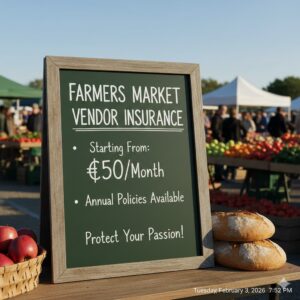
Farmers Market Vendor Insurance Cost
Why Insurance Isn’t Optional for Market Vendors
Imagine this: a customer slips on a spilled sample and gets injured. A food-borne illness is mistakenly linked to your product. A sudden storm destroys your tent and inventory. Without insurance, these scenarios could mean financial ruin, lawsuits, and the end of your business dream.
Insurance isn’t just a line item; it’s your safety net. Many farmers markets and local governments now require vendors to carry liability coverage. It protects you, your customers, and your assets, giving you peace of mind to focus on what you do best.
Key Insurance Policies for Vendors & What They Cover
Your insurance needs depend on what you sell. Here’s a breakdown of the core policies.
General Liability Insurance: Your Essential Shield
This is the cornerstone of vendor insurance. It covers third-party claims of bodily injury and property damage.
-
Example: A customer trips over your cooler and sprains an ankle. Your liability insurance would cover their medical bills and legal fees if they sue.
-
Typical Coverage Limits: $1,000,000 per occurrence, $2,000,000 aggregate is a common market requirement.
Product Liability Insurance: Crucial for Edible & Consumable Goods
This is often included in or added to a General Liability policy. It protects you if your product causes harm.
-
Example: Someone has a severe allergic reaction to your granola bars (despite your labeling) or claims food poisoning from your hot sauce.
-
Why it’s critical: Food vendors, bakers, and makers of body products (like soap or lotion) cannot operate without this.
Commercial Property Insurance: Protecting Your Stuff
This covers your physical business assets.
-
What it covers: Inventory (your jars of honey, boxes of produce), business equipment (tables, tents, card readers, slicers), and tools.
-
Important Note: It generally covers items at your market stall or in transit, not necessarily at your home. A Homeowners or Renters policy typically excludes business property.
Business Owner’s Policy (BOP): The Bundled Solution
A BOP bundles General Liability and Commercial Property insurance into one convenient, often more affordable, package. It’s an excellent, cost-effective solution for most small-scale vendors.
Additional Coverage Considerations
-
Commercial Auto Insurance: Required if you use a vehicle for business (e.g., a van to transport goods). Personal auto insurance won’t cover an accident that happens while you’re “working.”
-
Event Liability Insurance: Some markets offer a master policy you can buy into as a vendor for that specific event. It’s convenient but may offer less comprehensive protection than your own annual policy.
Breaking Down Farmers Market Vendor Insurance Cost: What to Expect
Costs vary widely, but we can provide realistic ranges. The average farmers market vendor insurance cost for a solid General Liability or BOP policy often falls between $300 and $1,200 annually.
Comparative Cost Table by Vendor Type
| Vendor Type | Key Risk Factors | Typical Annual Insurance Cost Range (Estimated) | Recommended Policy Type |
|---|---|---|---|
| Craft Vendor (e.g., candles, jewelry) | Low product risk, minor slip-and-fall hazard. | $300 – $600 | General Liability or BOP |
| Produce Vendor (fruits, vegetables) | Low product risk, higher slip hazard from debris. | $400 – $700 | General Liability or BOP |
| Prepared Food Vendor (e.g., baked goods, jams) | Moderate product liability risk. | $500 – $900 | BOP with Product Liability |
| Hot Food Vendor (e.g., ready-to-eat meals) | High burn risk, foodborne illness risk. | $800 – $1,500+ | Comprehensive BOP |
| Artisan Vendor (e.g., knives, ceramics) | Potential for product misuse causing injury. | $600 – $1,000 | BOP with enhanced Product Liability |
Important Note: “These are ballpark estimates. Your actual premium is like a fingerprint—unique to your business. An insurer will look at your sales, experience, claims history, and even your location to determine your specific risk and price.” – Industry Insurance Expert
The 5 Major Factors That Determine Your Premium
Insurance companies assess risk. Here’s what they evaluate:
-
What You Sell (Product Risk): This is the biggest driver. Non-edible crafts pose the lowest risk. Baked goods are medium risk. Raw meat, dairy, or alcohol are high-risk and will cost more to insure.
-
Your Annual Sales & Revenue: Higher sales mean more product in circulation and potentially larger claim sizes. You’ll report an estimated annual revenue, and your premium scales accordingly.
-
Your Experience & Claims History: A vendor with 10 years of incident-free operation is seen as less risky than a first-timer. A past claim will likely increase your cost.
-
Coverage Limits & Deductibles:
-
Higher Limits = Higher Premium. (e.g., $2 million coverage costs more than $1 million).
-
Higher Deductible = Lower Premium. The deductible is what you pay out-of-pocket before insurance kicks in. Choosing a $1,000 deductible over a $500 one can lower your annual cost.
-
-
Your Location & Market Requirements: Operating in a litigious area can affect cost. Also, if your market requires proof of $2 million coverage, you must buy that limit.
How to Get the Best Insurance for the Best Price: A Step-by-Step Strategy
Follow this plan to find affordable, reliable coverage.
Step 1: Accurately Assess Your Needs
List everything: your products, equipment, estimated annual sales, and markets you’ll attend. Know if your markets require specific coverage limits or additional insured endorsements.
Step 2: Shop Around & Compare Quotes
Get quotes from at least three different sources:
-
Specialty Insurers: Companies that focus on small business, farm, or artisan policies often understand market vendors best.
-
Independent Insurance Agents: They work with multiple carriers and can do the shopping for you.
-
Online InsurTech Providers: Platforms that offer fast, online quotes and purchase.
Step 3: Ask the Right Questions
When getting a quote, don’t just ask for price. Ask:
-
“Is Product Liability included?”
-
“Does this cover my inventory off-premises?”
-
“What is the process for adding a market as an ‘Additional Insured’?”
-
“What exactly is excluded from this policy?”
Step 4: Implement Cost-Saving Strategies
-
Bundle Policies: A BOP is almost always cheaper than buying General Liability and Property separately.
-
Choose a Higher Deductible: If you have cash reserves, this can significantly lower your annual premium.
-
Pay Annually: Many carriers offer a discount compared to monthly payments.
-
Ask About Associations: See if a farmers market association or craft guild you belong to offers a group discount program.
Helpful Checklist: Before You Buy Insurance
-
I have defined my business type (e.g., prepared food, craft).
-
I know my estimated annual gross sales/revenue.
-
I have a list of all markets I plan to attend.
-
I have collected the “Certificate of Insurance” requirements from my main markets.
-
I have compared quotes from at least three providers.
-
I understand the policy’s coverage limits and deductible.
-
I have confirmed that Product Liability is included (if I sell consumables).
-
I know how to request an “Additional Insured” endorsement.
Common Pitfalls to Avoid
-
Assuming Homeowners Insurance Covers You: It almost certainly does not. A standard home policy has exclusions for business activities and business property.
-
Buying the Cheapest Policy Without Reading It: A policy that doesn’t cover your key risks is money wasted. Read the exclusions.
-
Underreporting Sales to Get a Lower Premium: This is dangerous. If you have a claim and the insurer finds out your revenue was higher, they could deny the claim entirely for misrepresentation.
-
Forgetting to Update Your Policy: If you start selling at twice as many markets or launch a new product line, inform your insurer. Failure to do so could invalidate coverage.
Conclusion
Navigating farmers market vendor insurance cost is a vital step in building a resilient business. By understanding the types of coverage, the factors that influence price, and employing smart shopping strategies, you can secure essential protection that fits your budget. Invest in the right policy today, so you can sell with confidence tomorrow, knowing your passion is protected.
FAQ
Q: I only sell at one market a month. Do I still need insurance?
A: Absolutely. Liability is not based on frequency but on exposure. One incident at that single market is enough to result in a devastating lawsuit. Many markets also require it as a condition of vending.
Q: Can I get insurance for just one day or one event?
A: Yes, some insurers offer short-term or “event” liability policies. These can be perfect for trying out a new market or for a vendor who only does a few shows a year. Compare the cost to an annual policy if you plan to do more than 3-4 events.
Q: What is an “Additional Insured” and why do markets ask for it?
A: When you add a market manager (or the city) as an “Additional Insured” on your policy, it extends some protection to them under your policy for claims arising from your operations. It’s a common and usually simple request that your insurer can add, often for a small fee.
Q: I make my products in my home kitchen. Does my policy cover that?
A: This is a critical detail. You must specifically discuss your “home processor” status with your insurer. Some policies for market vendors include limited coverage for products made in a home kitchen, but you must confirm this and ensure you meet any local “cottage food” laws.
Additional Resources
For more information on small business regulations and food safety guidelines that complement your insurance, visit the U.S. Small Business Administration’s guide to business licenses and permits.