The journey to parenthood through fertility treatments is often an emotional rollercoaster, and the financial aspect can feel like another overwhelming hurdle. For many, medications like Gonal-f (follitropin alfa) are a critical component of protocols like IVF and IUI. The central question, “How much will Gonal-f cost with my insurance?” doesn’t have a single answer, but with the right information, you can chart a clear path forward.
This guide is designed to demystify the process. We’ll break down the factors that influence your out-of-pocket costs, provide you with a practical framework for investigating your own coverage, and explore all available options to make this essential medication more affordable. Consider this your roadmap to managing the financial side of treatment with confidence.
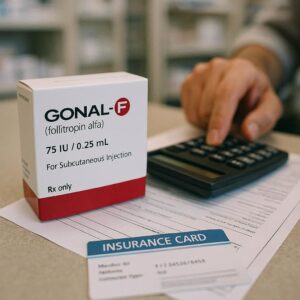
Gonal-f Cost with Insurance
TABLE OF CONTENTS
ToggleUnderstanding Gonal-f and Its Role in Treatment
Before diving into costs, it’s helpful to understand what Gonal-f is and why it’s prescribed. Gonal-f is a brand-name injectable medication containing follicle-stimulating hormone (FSH). It works by stimulating the ovaries to develop multiple mature follicles, each containing an egg. This is fundamental for treatments where maximizing egg yield is important, such as:
-
In Vitro Fertilization (IVF): To stimulate the ovaries prior to egg retrieval.
-
Intrauterine Insemination (IUI): To induce ovulation or stimulate the development of multiple follicles.
-
Treatment of Ovulatory Disorders: For individuals who do not ovulate on their own.
The dosage and duration of treatment are highly individualized, based on factors like age, diagnosis, and ovarian reserve. This personalization is a key reason why medication costs can vary so dramatically from one person to the next.
The Core Factors That Determine Your Out-of-Pocket Cost
The final amount you pay for Gonal-f is not a fixed price. It’s the result of a complex equation involving your insurance policy, pharmacy, and specific treatment plan. Here are the primary variables:
1. Your Insurance Plan’s Fertility Benefits
This is the most significant factor. Insurance plans fall on a broad spectrum regarding fertility coverage.
-
Comprehensive Coverage: Some plans, often offered by larger employers in certain states, cover a wide range of fertility medications and procedures with reasonable copays or coinsurance.
-
Medication-Only Coverage: A more common scenario is a plan that excludes IVF procedures but may still cover FDA-approved fertility medications like Gonal-f, often with prior authorization.
-
No Fertility Coverage: Many plans explicitly exclude all fertility treatments and related medications. In this case, you will be responsible for the full cash price.
2. Pharmacy Benefit Manager (PBM) and Specialty Pharmacy
Your insurance plan contracts with a PBM to manage prescription drug benefits. They will have a specialty pharmacy network you must use for medications like Gonal-f. Your cost is determined by:
-
Formulary Status: Is Gonal-f on your plan’s preferred drug list (formulary)? A non-preferred drug will have a higher copay/coinsurance.
-
Tier Placement: Specialty drugs are often placed on Tier 4 or higher. You typically pay a percentage of the drug’s cost (coinsurance) rather than a flat copay.
-
In-Network vs. Out-of-Network: Using a non-contracted pharmacy can result in no coverage or drastically higher costs.
3. Your Plan’s Cost-Sharing Structure
Even with coverage, you will share the cost. You need to understand your plan’s specific terms:
-
Deductible: The amount you pay out-of-pocket before insurance starts to pay. If you haven’t met your annual deductible, you may pay the full negotiated rate until you do.
-
Coinsurance: A percentage of the drug cost you pay (e.g., 20% of a $3,000 medication order is $600).
-
Copay: A fixed amount for a prescription (less common for high-cost specialty drugs).
-
Out-of-Pocket Maximum: The absolute limit you will pay in a policy year. Once reached, insurance covers 100% of covered services.
4. Required Authorizations and Step Therapy
Insurance rarely provides coverage without hurdles. Be prepared for:
-
Prior Authorization (PA): Your doctor must prove medical necessity to the insurer before they will approve coverage.
-
Step Therapy: Your plan may require you to try and fail with a less expensive medication (like clomiphene citrate) before they will approve coverage for Gonal-f.
A Realistic Look at Potential Cost Scenarios
To illustrate how these factors combine, let’s examine three common patient scenarios. The following table compares potential out-of-pocket costs for a single treatment cycle requiring 900 IU of Gonal-f (a typical starting point, though doses vary).
Comparative Cost Scenarios for Gonal-f (900 IU)
| Scenario | Insurance Coverage Type | Key Factors & Assumptions | Estimated Patient Cost (Per Cycle) | Notes |
|---|---|---|---|---|
| Scenario A: Comprehensive Coverage | Robust fertility benefits, including medications. | – Gonal-f is on formulary. – Deductible is met. – Coinsurance rate of 20% for Tier 4 specialty drugs. |
$400 – $800 | Cost is based on the insurer’s negotiated rate with the pharmacy (e.g., 20% of a $2,000-$4,000 negotiated price). This is often the best-case financial outcome. |
| Scenario B: Medication-Only Coverage | Fertility procedures excluded, but drugs are covered. | – Prior authorization is approved. – Annual deductible of $1,500 is not yet met. – Coinsurance of 30% after deductible. |
$1,500 – $2,500+ | Patient pays 100% until the deductible is met (first order may hit this), then a percentage. Total cost depends heavily on the negotiated drug price and deductible status. |
| Scenario C: No Fertility Coverage | Specific exclusion for infertility treatments/drugs. | – Insurance provides $0 reimbursement. – Patient pays cash price at pharmacy. – Patient utilizes manufacturer savings program. |
$1,000 – $2,500 (with savings card) $3,000 – $5,000+ (cash retail) |
Out-of-pocket cost is entirely dependent on the pharmacy’s cash price and the patient’s ability to use discount programs, coupons, or international options. |
Important Note for Readers: These are illustrative estimates. Your actual cost can only be determined by a verification of benefits (VOB) conducted by your doctor’s office or your specialty pharmacy. Always get this VOB in writing before ordering medications.
Your Action Plan: 8 Steps to Determine and Manage Costs
Don’t navigate this process in the dark. Follow this step-by-step plan to gain clarity and control over your medication expenses.
Step 1: Conduct a Deep Dive into Your Insurance Policy
Start with your plan’s Summary of Benefits and Coverage (SBC). Look for sections titled “Pharmacy Benefits,” “Exclusions and Limitations,” or “Infertility Services.” The specific language is crucial. Call the member services number on your insurance card and ask these direct questions:
-
“Does my plan cover injectable fertility medications (specifically FSH like Gonal-f)?”
-
“Is there a separate pharmacy deductible? Has it been met?”
-
“What is my coinsurance percentage for Tier 4 specialty medications?”
-
“Which specialty pharmacy am I required to use?”
Step 2: Engage Your Fertility Clinic’s Financial Team
Your clinic is your greatest ally. Their financial counselors do this daily. Provide them with your insurance information and authorize them to perform a formal Verification of Benefits (VOB). They will:
-
Confirm coverage details.
-
Initiate the Prior Authorization process with your doctor.
-
Provide you with a detailed financial estimate.
Step 3: Understand the Prior Authorization Process
Work closely with your clinic. They will submit clinical documentation (diagnosis, treatment plan, previous medications tried) to your insurer. This process can take days to weeks. Do not order medications until you have a PA approval number.
Step 4: Investigate All Financial Assistance Avenues
Even with high out-of-pocket costs, help is available. Explore these layers of support:
Manufacturer Savings Programs
EMD Serono, the maker of Gonal-f, offers the Compassionate Care Program and Co-pay Assistance Programs. These are income-based and can significantly reduce costs for eligible patients. Visit the EMD Serono website or ask your nurse for an application.
Non-Profit Grants and Foundations
Organizations like The Baby Quest Foundation, Resolve: The National Infertility Association, and The Cade Foundation offer grants to help cover treatment costs, including medications. Applications are competitive and have specific deadlines.
Pharmacy Discount Programs
Specialty pharmacies often have in-house financial advocates. Additionally, use tools like GoodRx Gold or SingleCare to compare cash prices, though these may not be usable with insurance.
Step 5: Consider Alternative Purchasing Options (With Caution)
-
International Pharmacies: Licensed pharmacies in countries like Canada, the UK, or Australia may offer lower cash prices. Crucially, you must ensure the pharmacy is verified and legitimate, and you must have a valid prescription from your doctor. Factor in shipping costs and time delays.
-
Medication Donation/Swap Programs: Some clinics or online communities (like Medi-Share) facilitate the legal donation of unused, unopened medications. Understand the legal and safety protocols in your state.
Step 6: Plan for the Pharmacy Experience
Once authorized, your clinic will send the prescription to your designated specialty pharmacy. They will call you to:
-
Confirm shipping address (medications require overnight, temperature-controlled shipping).
-
Provide your final out-of-pocket cost.
-
Schedule delivery for a specific date, aligning with your cycle start.
Step 7: Keep Meticulous Financial Records
Create a dedicated folder (digital or physical). Save every document:
-
Insurance VOB letters.
-
Prior Authorization approvals/denials.
-
All itemized receipts from the pharmacy.
-
Explanation of Benefits (EOB) statements.
-
Correspondence with assistance programs.
Step 8: Appeal if Necessary
If coverage is denied, you have the right to an appeal. Your doctor can write a letter of medical necessity arguing why Gonal-f is specifically required for your treatment over a lower-cost alternative. The denial letter from your insurer will outline the specific appeals process.
Beyond Insurance: A Checklist for Affording Treatment
If insurance coverage is minimal or nonexistent, use this checklist to build your financial strategy:
-
Maximize HSA/FSA Funds: Use pre-tax dollars from a Health Savings Account (HSA) or Flexible Spending Account (FSA) to pay for eligible out-of-pocket expenses.
-
Explore Clinic-Specific Financing: Many fertility clinics partner with third-party lenders (like Future Family or ARC Fertility) that offer loans or multi-cycle packages.
-
Budget for the Full Cycle: Medication is often 20-35% of a total IVF cycle cost. Ensure your financial plan accounts for monitoring, procedures, and anesthesia.
-
Ask About Shared-Risk or Refund Programs: Some clinics offer programs where you pay a higher upfront fee but receive a partial or full refund if treatment is not successful.
Conclusion
Understanding the cost of Gonal-f with insurance requires peeling back the layers of your specific policy, engaging proactively with your care team, and diligently seeking out all available financial support. While the process is complex, taking it step-by-step—from verifying benefits to applying for assistance—can transform a source of anxiety into a manageable part of your treatment journey. With preparation and persistence, you can focus your energy where it matters most: on your path to building a family.
Frequently Asked Questions (FAQ)
Q: My insurance says they cover fertility medications, but I have a $5,000 deductible. What will I likely pay?
A: You will likely pay the full negotiated rate for your Gonal-f until your $5,000 pharmacy deductible is met. Since a single cycle of medication can cost several thousand dollars, your first order may satisfy the entire deductible. After that, you would only pay your coinsurance (e.g., 20%) for any subsequent medication orders within the same policy year.
Q: What’s the difference between the manufacturer’s Compassionate Care Program and a co-pay card?
A: The Compassionate Care Program is an income-based assistance program that can provide medication at low or no cost for eligible patients. A co-pay assistance card (or savings card) is typically for commercially insured patients and helps reduce their coinsurance or copay amount, often capping it at a specific dollar amount per cycle (e.g., $200). Eligibility requirements differ.
Q: My prior authorization for Gonal-f was denied. What are my options?
A: First, understand the reason for denial. Then, work with your doctor to file an appeal. This often involves your doctor writing a detailed letter of medical necessity explaining why Gonal-f is specifically required for your case and why a recommended alternative is not suitable. Your insurance packet will include formal appeal instructions.
Q: Is it safe to buy Gonal-f from an online international pharmacy?
A: It can be, but you must exercise extreme diligence. Only use pharmacies that require a valid prescription from your U.S. doctor and are licensed in their home country. Look for verification through programs like CIPA (Canada) or check the website for a physical address and licensed pharmacist contact. Avoid sites that offer medications without a prescription.
Additional Resources
-
RESOLVE: The National Infertility Association: A wealth of information on insurance advocacy, financial resources, and support groups. Visit: https://resolve.org/
-
EMD Serono (Maker of Gonal-f) Patient Support: Access information on savings programs and patient education. Visit: https://www.emdserono.com/
-
FertilityIQ: Provides data on clinic success rates, costs, and patient reviews to help in your research.