A complete breakdown of prices, generic alternatives, and ways to save money.
If you have ever felt that burning sensation or the constant urge to go, you know a Urinary Tract Infection (UTI) is not something you can ignore. The next thought is usually panic about the doctor visit. The second thought? “How much do UTI antibiotics cost without insurance?”
If you are uninsured, underinsured, or simply paying out-of-pocket, medication costs can feel like a guessing game. One pharmacy might charge you $15, while another down the street wants $150 for the exact same pill.
This guide is designed to give you the real numbers. We are not going to throw around vague estimates. We are going to look at the specific costs of common antibiotics, why prices vary so wildly, and exactly how you can pay less today.
How Much Do UTI Antibiotics Cost Without Insurance?
The Real Cost of Treating a UTI (Without Insurance)
Before we get to the pill prices, it is important to understand the full picture. The antibiotic is only one part of the bill.
The total cost usually breaks down like this:
-
The Consultation: $50 – $250 (Telehealth or clinic)
-
The Lab Test: $0 – $100 (Sometimes required; sometimes skipped)
-
The Antibiotic: $10 – $200+
The Bottom Line: You are likely looking at a total bill between $80 and $400 to treat a simple UTI from start to finish without insurance.
However, this article focuses specifically on the drug costs. Let’s dive into the medications themselves.
Price Breakdown of Common UTI Antibiotics
Not all UTI antibiotics are created equal—especially when it comes to price. The cost depends on three things:
-
Generic vs. Brand Name: Generics are almost always cheaper.
-
Pharmacy Markup: Some pharmacies have higher base prices than others.
-
Dosage & Quantity: A 3-day course costs less than a 10-day course.
Below is a realistic look at what you can expect to pay at a retail pharmacy counter (like CVS, Walgreens, or a local independent pharmacy) if you walk in without insurance and pay cash.
H3: Nitrofurantoin (Macrobid / Macrodantin)
This is one of the most commonly prescribed first-line antibiotics for uncomplicated UTIs.
-
Typical Dose: 100mg twice daily for 5 days.
-
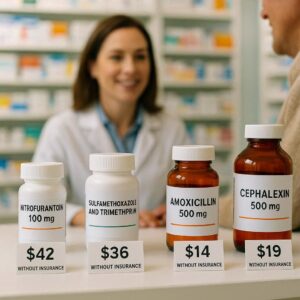
Cash Price: $40 – $150.
-
Note: Brand name Macrobid is significantly more expensive, often exceeding $200.
Trimethoprim-Sulfamethoxazole (Bactrim / Septra)
Often prescribed if you are not allergic to sulfa drugs. It is usually very effective and very affordable.
-
Typical Dose: Double strength (800/160mg) twice daily for 3 days.
-
Cash Price: $15 – $50.
-
Note: This is usually the cheapest cash-pay option.
Fosfomycin (Monurol)
This is a single-dose sachet. You mix it with water, drink it once, and you are done.
-
Typical Dose: One 3gm packet.
-
Cash Price: $50 – $200+ .
-
Note: This drug is expensive. There is currently no generic available in the US, which keeps the price high.
Ciprofloxacin (Cipro) & Levofloxacin (Levaquin)
These are fluoroquinolones. Due to side effect risks, they are usually reserved for more complicated infections or when other options fail.
-
Typical Dose: Varies (3-7 days).
-
Cash Price: $20 – $100.
-
Note: Generics are widely available and cheap.
Amoxicillin / Augmentin
Not always the first choice for UTI due to rising resistance, but still prescribed occasionally.
-
Typical Dose: 500mg three times daily.
-
Cash Price: $15 – $60.
Comparative Table: UTI Antibiotic Costs at Major Pharmacies (Estimate)
| Medication | Strength/Quantity | Walmart | CVS | Walgreens | Kroger |
|---|---|---|---|---|---|
| Nitrofurantoin (Mono-Macro) | 100mg (#20 caps) | $45.00 | $102.00 | $110.00 | $48.00 |
| Bactrim DS | 800-160mg (#10 tabs) | $16.00 | $41.00 | $43.00 | $19.00 |
| Ciprofloxacin | 500mg (#14 tabs) | $21.00 | $58.00 | $62.00 | $24.00 |
| Amoxicillin | 500mg (#21 caps) | $14.00 | $36.00 | $38.00 | $16.00 |
*Disclaimer: Prices are based on national averages and spot checks. Your local price may vary by $5-$10.*
Why Do the Same Antibiotics Cost Different Amounts?
It is easy to assume that every pharmacy charges the same rate. They do not. In fact, the variation can be shocking.
1. The “Discount Card” Secret
When you walk up to the counter and say, “I don’t have insurance,” the pharmacist usually types “CASH” into the system. This cash price is often the highest price on file. It is a retail price meant for insurance companies to negotiate down from.
2. Pharmacy Business Models
-
Walmart & Costco: Operate on a “loss leader” model for many generics. They sell certain antibiotics (like amoxicillin or Bactrim) for very low margins to get you in the door. You do not need a membership to use the Costco pharmacy.
-
CVS & Walgreens: Convenience stores. They charge a premium for the convenience of location and 24-hour access.
3. Independent Pharmacies
These can go either way. Some offer lower prices to compete; others charge more due to higher wholesale costs.
“I always tell patients to ask for the ‘generic discount price’ or to check GoodRx right in front of me. The cash price is rarely the price you actually have to pay.”
— A former CVS pharmacy technician.
How to Get UTI Antibiotics for Cheap (Even Without Insurance)
You do not need to pay $100 for a simple course of antibiotics. Here is how you fight back against high drug prices.
H3: 1. Use a Free Discount Card (GoodRx, SingleCare, Optum Perks)
This is the number one way to save. These apps negotiate bulk rates with pharmacies, and you get to use those rates for free.
-
How it works: Go to GoodRx.com, search the drug name, and it shows you the price at every pharmacy near you.
-
The Savings: A $100 antibiotic can drop to $20 or less.
-
Cost: Free.
2. Choose the “$4 List” Pharmacies
Walmart, Target (CVS inside Target often honors this), and some grocery chains like HEB and Publix have lists of common generics for a flat rate.
-
Look for: Bactrim, Amoxicillin, Ciprofloxacin.
-
Price: Usually $4 to $10 for a typical UTI course.
3. Skip the ER, Use Telehealth
If you go to the Emergency Room for a UTI, you will pay an ER copay/fee (often hundreds of dollars) plus the medication. Instead, use a telehealth app. They can send the prescription directly to the cheap pharmacy.
H3: 4. Ask for the “Prescription Savings Club”
Major pharmacies have internal discount programs.
-
CVS: Health Savings Pass (~$10/year for discounts on generics).
-
Walgreens: Prescription Savings Club ($20/year for individuals, $35/family).
-
Result: You might get 90-day supplies for the price of a 30-day supply.
Antibiotics vs. “Lifestyle” Costs
There is a dangerous trend online of people trying to avoid these costs by buying “UTI treatments” that aren’t antibiotics.
Remember:
-
Cranberry juice will not cure an active infection.
-
AZO (Phenazopyridine) will numb your bladder so you feel better, but it does not kill the bacteria. You still need an antibiotic.
-
Apple cider vinegar will not cure a UTI.
While these items are cheap ($5 – $15), they are not a replacement for antibiotics. Relying on them can cause the infection to travel to your kidneys, which is far more expensive (and dangerous) to treat.
Essential Checklist: What to Do Right Now
If you are currently sick and worried about the cost, follow this flow:
-
Consult: Use a telehealth service like GoodRx Care, Amazon Clinic, or your local health department. Cost: $30 – $50.
-
Get the Script: Ask the doctor to prescribe a first-line, generic medication (Bactrim or Nitrofurantoin are standard).
-
Check Prices: Open GoodRx or SingleCare. Type in the exact medication name, dosage, and quantity.
-
Choose Location: Pick the pharmacy with the lowest price. It might be a grocery store 5 minutes further away.
-
Transfer or Send: Have the doctor send it there, or call the pharmacy to transfer the prescription.
-
Show the Card: Show the pharmacist the discount card on your phone at pickup.
Important Note on Resistance
Taking the wrong antibiotic or the wrong dose is dangerous. Do not pressure your doctor for a specific drug just because it is cheap (like Bactrim) if you are allergic or if it is not suitable for your specific health history. Always follow medical advice over financial advice if the two conflict.
Frequently Asked Questions (FAQ)
Q: Can I buy UTI antibiotics over the counter?
A: No. In the United States, antibiotics require a prescription from a licensed provider. You cannot buy them OTC at CVS or Walgreens like you can in some other countries.
Q: Is the emergency room the only place to get antibiotics on a Sunday?
A: No. Use 24-hour pharmacy locations (like a 24-hour Walgreens) in conjunction with a 24/7 telehealth service. You can have a prescription sent to a 24-hour pharmacy within 30 minutes without ever leaving your house or paying ER prices.
Q: What is the absolute lowest price I can pay for the pills?
A: If you get a prescription for Bactrim and take it to a Walmart or Costco, you can often pay under $10 for the full course.
Q: Why is the pharmacist asking if I have insurance when I have a discount card?
A: They are required to ask. You should explicitly say, “I am paying cash, but I have a discount card.” If you say “No” to insurance, they might give you the cash price. You must specifically ask them to apply the discount card.
Q: Does Medicaid cover this if I just got it?
A: If you are enrolled in Medicaid, even pending enrollment, prescriptions are usually covered retroactively or at the point of sale. Do not assume you have to pay cash if you qualify for state aid.
Additional Resource
For the most accurate, real-time pricing tailored to your zip code, you should always check a price aggregator.
👉 Check Current UTI Antibiotic Prices on GoodRx
This link directs you to a free, external tool that is updated daily with pharmacy prices. We are not affiliated with GoodRx, but it is an industry-standard resource for uninsured patients.
Conclusion
Treating a UTI without insurance does not have to mean choosing between your health and your rent. While the cash price for antibiotics can range from $15 to over $150, the actual cost for effective generic medications like Bactrim or Amoxicillin is often under $20 when using discount cards or store savings programs. The secret is avoiding the default “cash price” at major chains and taking five minutes to compare costs online. Your health is worth the small effort to save.