Navigating healthcare costs can feel like a test of its own. If your doctor has recommended a cardiac stress test—a common procedure to evaluate how your heart performs under physical exertion—one of your first questions is likely, “How much will this cost with my insurance?”
The short answer is: it varies widely. With insurance, your out-of-pocket cost for a stress test can range from a $0 copay to over $1,000, depending entirely on your specific plan details and where you have the test done.
This comprehensive guide will walk you through every factor that influences the final price you pay. We’ll demystify insurance terms, provide realistic price ranges, and give you practical steps to get an accurate estimate for your situation. Our goal is to turn a source of stress into a clear, manageable plan.
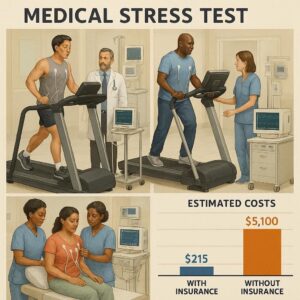
how much does a stress test cost with insurance
Understanding the Cardiac Stress Test: What Are You Paying For?
Before diving into costs, it’s helpful to know what the procedure entails. A standard exercise stress test involves walking on a treadmill or riding a stationary bicycle while your heart rhythm, blood pressure, and breathing are monitored. It helps diagnose coronary artery disease, identify irregular heartbeats, and evaluate your heart’s overall fitness.
Sometimes, a nuclear stress test or stress echocardiogram is ordered. These are more complex, involving imaging (like an injection of a radioactive tracer or an ultrasound) to get a more detailed view of blood flow and heart function. These advanced tests are significantly more expensive.
Your total bill isn’t for one single thing. It’s a bundle of fees:
-
Professional Fee: For the cardiologist or physician who supervises and interprets the test.
-
Technical/Facility Fee: For the use of the clinic, hospital department, or outpatient center, including equipment and staff.
-
Additional Charges: For the imaging agent (for nuclear tests) or the ultrasound (for an echo).
The Core Factors That Determine Your Out-of-Pocket Cost
Your final cost is a puzzle made up of several pieces. Understanding each one is key.
1. Your Insurance Plan’s Structure: Deductible, Copay, and Coinsurance
This is the most critical factor. You must know your plan’s specifics.
-
Deductible: The amount you pay out-of-pocket for covered services before your insurance starts to pay. If you have a $2,000 deductible and haven’t met any of it, you will likely pay the full negotiated rate for the stress test until you hit that $2,000.
-
Copay: A fixed fee (e.g., $30) you pay for a covered service. Some plans have a copay for specialist visits or outpatient procedures.
-
Coinsurance: Your share of the costs after you’ve met your deductible, expressed as a percentage. A common coinsurance is 20%. If the insurance-allowed amount for the test is $800, you’d pay $160.
Key Insight: “The difference between paying a $50 copay and the full $800 negotiated rate often comes down to whether you’ve met your annual deductible. Always check your deductible status first.”
2. The Type of Facility: Where You Have the Test Done
Location dramatically impacts the “sticker price” that insurance negotiates from.
-
Hospital Outpatient Department: Typically the most expensive setting. Facility fees here are often 2-3 times higher than at an independent center.
-
Independent Diagnostic Testing Facility (IDTF) or Cardiology Clinic: Usually offers the most competitive and lower negotiated rates with insurers.
-
Physician’s Office: If the doctor’s office has the equipment, this can also be a cost-effective setting.
Comparative Table: Estimated Insurance-Negotiated Rates by Setting
| Test Type | Independent Clinic / Office | Hospital Outpatient Department | Potential Cost Difference |
|---|---|---|---|
| Basic Exercise Stress Test | $300 – $600 | $800 – $1,500 | Can be 2-3x more expensive |
| Nuclear Stress Test | $800 – $1,200 | $2,000 – $5,000+ | Can be 3-5x more expensive |
| Stress Echocardiogram | $500 – $1,000 | $1,500 – $3,000 | Can be 2-4x more expensive |
Note: These are estimated national averages for the total negotiated rate. Your out-of-pocket cost depends on your deductible, copay, or coinsurance applied to these amounts.
3. Medical Necessity and Prior Authorization
Insurance will only cover the test if it’s deemed “medically necessary.” Your doctor must provide a justification based on symptoms (like chest pain, shortness of breath) or risk factors. For many advanced stress tests, your insurer may require prior authorization—pre-approval before the test is performed. Without it, your claim may be denied, leaving you responsible for the entire bill.
Realistic Price Scenarios: What You Might Actually Pay
Let’s look at how this plays out for two different people.
Scenario 1: Maria, who has met her deductible.
-
Plan: $1,500 deductible, 20% coinsurance.
-
Situation: Maria has already paid $1,800 in medical costs this year, so she’s past her deductible.
-
Test: Nuclear stress test at an independent clinic. Total allowed amount: $1,000.
-
Maria’s Cost: She pays 20% coinsurance. $1,000 x 20% = $200.
Scenario 2: David, who has NOT met his deductible.
-
Plan: $3,000 deductible, then 20% coinsurance.
-
Situation: David has only paid $200 toward his deductible so far this year.
-
Test: Same nuclear stress test at a hospital outpatient department. Total allowed amount: $3,500.
-
David’s Cost: He is responsible for the full allowed amount until he hits his $3,000 deductible. He pays $3,500. This satisfies his deductible for the year, and any further care would only cost him coinsurance.
Important Note for Readers: These scenarios highlight why knowing your deductible status and the test location is non-negotiable. A simple question to your doctor—“Can this be performed at an independent imaging center?”—could save you thousands.
Your Action Plan: How to Get an Accurate Estimate
Don’t guess. Follow these steps:
-
Call Your Insurance Company. Have your plan details ready (member ID, group number). Ask:
-
“Is a [type of] stress test a covered benefit under my plan?”
-
“Does it require prior authorization? Has my doctor obtained it?”
-
“What is my cost-share (deductible, copay, coinsurance) for this outpatient diagnostic procedure?”
-
“Can you tell me the allowed amount for CPT codes 93015 (basic stress test), 93017 (nuclear, professional), and 78452 (nuclear, imaging)?”
-
-
Call the Billing Department of the facility where the test is scheduled. Provide the CPT codes from your insurer and ask for their contracted rate with your specific insurance plan. Then, ask them to calculate your estimated portion based on the cost-share information you got from your insurer.
-
Ask About Cash-Pay Discounts. If you are uninsured or have a very high deductible, ask the facility if they offer a discounted self-pay rate. It is sometimes lower than the insurance-negotiated rate.
Frequently Asked Questions (FAQ)
Q: Can I get a stress test without insurance, and how much would it cost?
A: Yes, you can. Cash prices vary wildly but can range from $300-$800 for a basic test at a clinic to $1,500-$3,000+ for a nuclear test at a hospital. Always ask for the self-pay price upfront; it is often lower than the billed charge.
Q: What if my insurance denies the claim?
A: First, talk to your doctor’s office. They can often provide additional medical records to support an appeal. You can also appeal directly with your insurance company. Do not delay, as appeals have strict deadlines.
Q: Does Medicare cover stress tests?
A: Yes, Medicare Part B covers medically necessary stress tests. You will typically pay 20% of the Medicare-approved amount after meeting your Part B deductible ($240 in 2024). It’s crucial to ensure the provider accepts Medicare assignment.
Q: Are there any hidden costs I should ask about?
A: Always confirm if the quote includes both the professional (doctor) and technical (facility) fees. Also, ask if the intake consultation or the review of results is billed separately.
Conclusion
The cost of a stress test with insurance is a personalized equation, hinging on your plan’s deductible, the test’s location, and its medical necessity. By proactively contacting both your insurer and the provider for estimates, you can transform an uncertain expense into a planned one. Your financial well-being, much like your heart health, benefits greatly from informed, preventative action.
Additional Resources
-
Healthcare.gov Glossary: For clear definitions of deductible, copay, coinsurance, and more.
-
American Heart Association – Understanding Your Risks: Provides context on why your doctor may recommend certain tests.
-
CMS.gov Guide to Medicare Coverage: Official resource for Medicare beneficiaries on covered services.