You’ve done your research. You know that dry needling—a technique used by physical therapists and chiropractors to release trigger points and tight muscles—is different from acupuncture. You know it might help with that nagging shoulder pain or chronic back tightness that just won’t quit.
But then comes the question nobody likes to ask: How much is this going to cost me?
If you are uninsured, underinsured, or simply choosing to pay cash to keep a claim off your medical record, the uncertainty around pricing can be paralyzing. Unlike a gallon of milk or a pair of shoes, healthcare pricing often feels like a secret.
This guide is designed to pull back the curtain. We will look at exactly what you can expect to pay for dry needling without insurance, why prices vary so much, and how to get the best care without breaking the bank.
How Much Does Dry Needling Cost Without Insurance?
The Short Answer: What Is the Average Cost?
If you are paying entirely out of pocket, the average cost of a single dry needling session ranges from $50 to $150.
However, this is rarely a “one and done” treatment. Most patients require a series of visits.
Quick Cost Snapshot (Without Insurance):
| Treatment Type | Average Cost Range | Typical Duration |
|---|---|---|
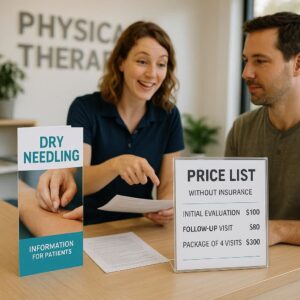
| Initial Evaluation | $75 – $200 | 45–60 minutes |
| Follow-up Session (with dry needling) | $50 – $150 | 30–45 minutes |
| Package Deal (4-6 sessions) | $250 – $550 | Varies |
| Cash Discount Rate | $45 – $80 | Varies |
Important Note: These figures represent the national average in the United States as of 2025. If you live in a major metropolitan area or a region with a high cost of living, expect to be on the higher end of this spectrum—or even slightly above it.
Why the Price Varies So Much (And Why It’s Not Random)
Unlike a standardized medical procedure, dry needling pricing is highly variable. This isn’t a flaw in the system; it reflects the different levels of expertise, time, and overhead involved.
1. The Practitioner’s Credentials
Not all needles are created equal, and neither are the people holding them.
-
Physical Therapists (PTs): Usually charge $75–$150. They focus on integrating dry needling with therapeutic exercise.
-
Chiropractors: Usually charge $50–$120. Often bundled with adjustments.
-
Athletic Trainers: Usually charge $40–$90. Often found in sports medicine clinics.
2. Geography and Local Competition
Pricing is heavily influenced by your zip code.
-
Rural Areas: $45 – $70 per session.
-
Suburban Areas: $60 – $100 per session.
-
Urban Centers (NYC, LA, Chicago): $100 – $200+ per session.
3. The “New Patient” Factor
Your first visit will always cost more. Why? Because the practitioner must perform a full evaluation. They need to assess your posture, range of motion, and medical history to ensure dry needling is safe for you. You aren’t just paying for needles; you are paying for a diagnostic session.
Breaking Down the Bill: What Are You Actually Paying For?
When you pay $100 for dry needling, it is easy to look at a box of 100 needles (which costs the clinic roughly $5 to $10) and feel like you are overpaying.
However, the cost of the needles is the smallest fraction of the equation. Here is what your money actually covers:
-
The Expertise (The biggest cost): Years of schooling, continuing education, and specific certification courses (often costing practitioners thousands of dollars).
-
The Time: A session isn’t just 5 minutes of needling. It includes assessment, needling, monitoring, and post-care advice.
-
Overhead: Rent for the clinic space, utilities, liability insurance, administrative staff, and medical-grade sanitation supplies.
-
Single-Use Supplies: Alcohol wipes, gloves, sharps disposal containers, and the needles themselves.
Cash Pay vs. Package Deals: How to Save
If you are paying without insurance, you have a distinct advantage over insured patients: you are the customer.
When insurance is involved, clinics sign contracts that prevent them from lowering prices. When you pay cash, those rules go out the window.
The Power of the Package
Most cash-based PTs and chiropractors expect you to need multiple visits. They incentivize commitment.
-
Single Session: $90
-
Package of 4: $300 ($75 per session)
-
Package of 6: $420 ($70 per session)
The Verdict: Buying a package almost always reduces the per-session cost by 20% to 30%.
The Sliding Scale Option
Some independent clinics offer a sliding scale based on income. This is not heavily advertised. It never hurts to ask, “Do you offer a cash discount or an income-based rate for self-pay patients?”
Does Location Type Matter? Private Practice vs. Franchise
Where you go dictates how much you pay.
Private Practice (Independent PT/Chiro):
-
Pros: More likely to negotiate prices, high level of personalized care, often runs “cash discount” specials.
-
Cons: May have less availability for scheduling.
-
Cost: Generally lower ($50 – $110).
Franchise Clinics (ATI, Physioworks, etc.):
-
Pros: Standardized care, multiple locations.
-
Cons: Corporate pricing structures are rigid; very little room for negotiation.
-
Cost: Generally higher ($90 – $160).
University/Teaching Clinics:
-
Pros: Supervised students perform the needling. Significantly reduced rates.
-
Cons: Sessions take longer. You are part of an educational process.
-
Cost: $20 – $45.
Real-World Pricing Scenarios
Let’s look at three hypothetical patients to see how these costs stack up in the real world.
Scenario A: The Rural Athlete
Location: Central Kansas
Provider: Private Practice PT
Care: Hamstring tightness, 1x per week
Cost: $65 per session. Buys a 5-pack for $300.
Total out-of-pocket (5 weeks): $300
Scenario B: The Urban Office Worker
Location: Downtown Seattle
Provider: Franchise Chiropractic Clinic
Care: Neck and upper back tension, 2x per month
Cost: $125 per session. No package available.
Total out-of-pocket (1 month): $250
Scenario C: The Student
Location: Austin, Texas
Provider: University Health Center
Care: General shoulder stiffness
Cost: $30 per session.
Total out-of-pocket (4 sessions): $120
Hidden Costs and Sneaky Fees to Watch For
When calling around to compare prices, don’t just ask, “How much is dry needling?” Ask these specific questions to avoid surprises:
-
Is there a separate “Evaluation” fee? Some clinics charge a high eval fee, then a lower treatment fee.
-
Is dry needling billed as “therapeutic exercise” or “neuromuscular re-education”? Even without insurance, some clinics itemize this way. If you do eventually submit this to insurance, you need to know exactly what you are paying for.
-
Cancellation Policy: Cash-based clinics are strict. A same-day cancellation might cost you 50%–100% of the session fee.
Reader Note: Always confirm the clinic’s “Good Faith Estimate” policy. Under the US No Surprises Act, you have the right to receive a reasonable estimate of total costs before you schedule treatment. This is a fantastic tool for cash-pay patients.
Is It Worth Paying Out of Pocket?
This is the million-dollar question (or rather, the hundred-dollar question).
If you have a high-deductible health plan (HDHP) that requires you to pay $3,000 or $5,000 before coverage kicks in, paying cash for dry needling is often significantly cheaper than filing a claim.
The Math:
-
Insurance Route: $200 for an office visit + $75 for the needling = $275 applied toward your deductible. You pay $275.
-
Cash Route: $90 flat rate. You pay $90.
In this case, paying cash saves you $185 immediately.
However, if you have already met your deductible, using insurance (if they cover it—and many do not) is likely the better financial move.
How to Find Affordable Dry Needling Near You
Finding the right provider at the right price requires a bit of detective work. Here is your action plan:
-
Use Specific Google Searches: Don’t just search “dry needling.” Search “cash-based physical therapy [Your City]” or “dry needling sliding scale [Your City].”
-
Check University Bulletin Boards: Local massage schools or PT schools often have alumni clinics open to the public.
-
Ask About New Patient Specials: Many clinics offer a “First Visit: $49” special just to get you in the door.
-
Consider Direct Access: In many states, you can see a physical therapist without a physician’s referral. This saves you the cost of a separate doctor’s visit.
Comparing Dry Needling to Other Treatments
To determine if the cost is “worth it,” it helps to compare it to the alternatives.
| Treatment | Average Cost (No Insurance) | Typical Frequency | Key Difference |
|---|---|---|---|
| Dry Needling | $50 – $150 | 1x week | Targets specific knots/trigger points. Immediate release. |
| Acupuncture | $75 – $200 | 1x week | Focuses on energy meridians; systemic approach. |
| Deep Tissue Massage | $80 – $130 | 1x-2x month | Relaxation + tissue manipulation; less specific on knots. |
| Cupping Therapy | $40 – $80 | As needed | Adds-on to other treatments usually. |
Key Takeaway: Dry needling often sits in the middle of the price spectrum. It is generally more affordable than a full acupuncture session but can be comparable to—or slightly cheaper than—a deep tissue massage, depending on your location.
Frequently Asked Questions (FAQ)
Q: Can I use my HSA or FSA to pay for dry needling?
A: Yes. If you have a Health Savings Account (HSA) or Flexible Spending Account (FSA), these funds are almost universally accepted for dry needling. You simply use your HSA debit card at the clinic. This allows you to pay with pre-tax dollars, effectively giving you a discount of 20-30% depending on your tax bracket.
Q: Why is dry needling so expensive if the needles are cheap?
A: This is the most common question. As noted above, you are paying for the specialized skill of placing the needle into a specific “knot” (trigger point) to elicit a twitch response. Doing this incorrectly can cause bruising, pain, or pneumothorax (punctured lung). You are paying for precision and safety, not inventory.
Q: How many sessions will I need?
A: For acute issues (painful for less than 3 months), patients often see significant relief in 1 to 3 sessions. For chronic issues (painful for years), it may require 6 to 10+ sessions, often combined with strengthening exercises.
Q: Does Medicare cover dry needling?
A: Currently, traditional Medicare does not cover dry needling performed by physical therapists. However, coverage is expanding slowly. Always check with your specific Medicare Advantage plan, as some private supplemental plans are beginning to offer it.
Q: Is it cheaper to go to a chiropractor than a physical therapist?
A: On average, yes. Chiropractors tend to have slightly lower base rates for dry needling add-ons ($10–$30 less per session) compared to dedicated physical therapy clinics. However, PTs may spend more time on rehabilitative exercises immediately following the needling.
Final Thoughts: Planning Your Investment in Health
Navigating the cost of dry needling without insurance doesn’t have to be a guessing game. By understanding the market rates, knowing the right questions to ask, and leveraging cash-pay advantages like packages and HSA funds, you can access this powerful treatment without financial stress.
Dry needling is an investment in mobility. The average cost ranges from $50 to $150. Save money by buying session packages or seeking care at teaching clinics.
Additional Resource: Find a Certified Provider
To ensure you are getting the best value for your money, you need to ensure the provider is properly trained. Don’t pay premium prices for sub-par training.
Link: Find a Dry Needling Provider – AAOMPT
The American Academy of Orthopaedic Manual Physical Therapists provides a directory of fellowship-trained clinicians. While not exclusively for dry needling, this resource helps you find highly qualified manual therapists.