Running a lawn care business is more than just mowing lawns and trimming hedges. It’s about managing equipment, leading a team, and protecting the company you’ve built. One of the most critical, yet often confusing, aspects of that protection is insurance. For many owners, the central question is: “How much will it cost, and what do I really need?”
The cost of insurance for a lawn care business isn’t a one-size-fits-all number. It’s a tailored figure based on your specific operations, size, and risk. Think of it not as an expense, but as an investment in your business’s longevity and your own peace of mind. A single accident or lawsuit without proper coverage could mean financial ruin. This guide will demystify insurance costs, break down the essential policies, and provide you with the knowledge to make smart, cost-effective decisions for your landscaping venture.
Insurance Costs for Your Lawn Care Business
Why You Can’t Afford to Skip Insurance
Before we dive into costs, let’s solidify the “why.” Operating a lawn care business involves inherent risks: a flying rock from a mower could break a client’s window or, worse, injure someone. An employee could be hurt on the job. Your trailer full of expensive equipment could be stolen. General liability insurance, workers’ compensation, and commercial auto insurance are not mere formalities; they are fundamental shields.
“Insurance is the silent partner in every successful lawn care business,” says Michael Torrell, a risk management consultant specializing in green industries. “It doesn’t mow a single blade of grass, but it ensures that an unexpected event doesn’t halt operations permanently.”
Beyond protection, insurance is often a prerequisite. Most commercial clients, property management companies, and government contracts will require you to provide a Certificate of Insurance (COI) before you even start the first job. Without it, you’re locking yourself out of your most profitable opportunities.
Core Insurance Policies: What You Need and Why
Your insurance portfolio should be built on a foundation of three core policies. Understanding each is key to understanding your total cost.
1. General Liability Insurance: Your First Line of Defense
This is the most common and essential policy. It covers third-party bodily injury and property damage claims. For example:
-
A client trips over your hose and breaks an ankle.
-
Your weed whipper sends a stone through a sliding glass door.
-
You accidentally spray herbicide on a prized flower bed.
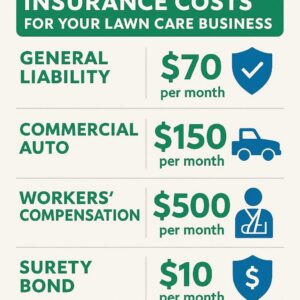
What it typically costs: For a small to mid-sized lawn care operation, general liability insurance often starts between $500 and $1,200 per year. This is usually the baseline cost.
2. Commercial Auto Insurance: Covering Your Rolling Assets
Personal auto policies explicitly exclude vehicles used for business. If you use a truck, van, or trailer for work, you need commercial coverage. This protects against accidents, theft, and damage involving your business vehicles.
What it typically costs: Significantly more than personal auto insurance. Annual premiums can range from $1,200 to $2,400+ per vehicle, heavily dependent on driving records, vehicle type, and coverage limits.
3. Workers’ Compensation Insurance: Protecting Your Team (And You)
If you have employees, this is almost always legally required. It covers medical expenses and lost wages for work-related injuries or illnesses. For a landscaper, this could be a back injury, a cut from equipment, or heat stroke.
What it typically costs: Premiums are calculated based on your total payroll and the “risk class” of your employees (lawn care is considered moderate-risk). Rates are expressed per $100 of payroll. You might see rates between $5 to $15 per $100 of payroll. For a crew of three with a total payroll of $120,000, that could mean $6,000 to $18,000 annually.
Additional Coverages to Consider
As your business grows, so do your risks. These add-ons or standalone policies can be crucial.
-
Inland Marine (Equipment) Insurance: Covers your mowers, blowers, trimmers, and other tools—whether they’re in your truck, on a job site, or in storage. This is often an add-on to a Business Owner’s Policy (BOP).
-
Professional Liability (Errors & Omissions): Covers financial loss if a client sues you for a professional mistake, like incorrectly diagnosing a lawn disease that kills their grass.
-
Umbrella Insurance: Provides an extra layer of liability coverage above the limits of your general liability and auto policies. It’s relatively inexpensive for the high coverage it provides.
Factors That Directly Impact Your Insurance Premiums
Insurance providers assess risk. The higher your perceived risk, the higher your premium. Here are the key levers:
-
Business Size & Revenue: More employees, more vehicles, and higher revenue generally equal higher premiums.
-
Services Offered: Basic mowing is lower risk than tree trimming, pesticide application, or hardscaping. More hazardous services mean higher costs.
-
Claims History: A clean record is your best friend. Past claims signal higher future risk.
-
Location: Operating in a litigious area or a region with high theft rates can increase costs.
-
Coverage Limits & Deductibles: Choosing a $1 million liability limit will cost more than a $500,000 limit. Opting for a higher deductible (the amount you pay out-of-pocket on a claim) can lower your premium.
-
Safety Programs: Having documented safety training, equipment checklists, and drug-free workplace policies can make you eligible for discounts.
Comparative Cost Table: Typical Annual Premium Ranges
| Business Profile | General Liability | Commercial Auto (1 Truck) | Workers’ Comp (Est. 2 Employees) | Estimated Total Annual Range |
|---|---|---|---|---|
| Sole Proprietor (No employees, 1 truck, basic mowing) | $500 – $900 | $1,200 – $1,800 | Not Applicable | $1,700 – $2,700 |
| Small LLC (2-3 crew, 2 vehicles, mowing & trimming) | $700 – $1,200 | $2,400 – $3,600 | $4,000 – $12,000 | $7,100 – $16,800 |
| Growing Company (5+ crew, multiple vehicles, added services like spraying) | $1,000 – $2,000 | $4,000 – $6,000+ | $10,000 – $25,000+ | $15,000 – $33,000+ |
Note: These are illustrative estimates. Your actual quotes will vary widely based on the factors listed above. Always get multiple personalized quotes.
How to Get the Best Coverage at the Best Price
-
Bundle with a BOP: A Business Owner’s Policy (BOP) bundles general liability and business property insurance (for your office/warehouse) at a rate that’s usually 10-20% cheaper than buying them separately. You can often add equipment coverage.
-
Shop Around & Compare: Get quotes from at least three different insurers. Consider both national providers and specialty insurers familiar with the lawn care industry.
-
Raise Your Deductible Wisely: If you have sufficient cash reserves, choosing a higher deductible can meaningfully lower your premium.
-
Prioritize Safety: A strong safety record is a demonstrable way to reduce risk and earn discounts over time.
-
Review and Adjust Annually: Don’t just auto-renew. As your business changes, your insurance should too. An annual review with your agent is essential.
Important Note for Readers: Never operate without insurance to save money. The potential cost of a single uninsured claim—a lawsuit, a totaled truck, a serious employee injury—will dwarf a lifetime of insurance premiums. It is the single most risky financial decision a business owner can make.
Conclusion
Navigating insurance costs for your lawn care business is a vital step in responsible entrepreneurship. By understanding the core policies—general liability, commercial auto, and workers’ compensation—and the factors that affect their price, you can make informed choices. Proactively managing risk through safety and smart bundling allows you to secure essential protection without overpaying, ensuring your business is built to last through every season.
Frequently Asked Questions (FAQ)
Q: I’m a one-person operation with just a lawn mower. Do I really need insurance?
A: Absolutely. Even solo operators face liability risks (e.g., damaging property). Many clients require it. A low-cost General Liability policy or a Micro-Business policy is a minimal, essential investment.
Q: Can I just add a rider to my personal auto insurance for business use?
A: This is rarely sufficient for a lawn care business. Insurers typically require a separate Commercial Auto Policy for vehicles primarily used to transport equipment, tools, or crew to job sites.
Q: How can I lower my workers’ compensation costs?
A: The most effective ways are maintaining a strong safety record, ensuring proper employee classification (e.g., clerical vs. landscaping labor), and working with your agent to ensure your payroll audits are accurate.
Q: What is a Certificate of Insurance (COI), and how do I get one?
A: A COI is a one-page document from your insurer that proves you have active coverage. You simply request it from your insurance agent or provider, and they will issue it, often listing your client as an “additional insured” if required.
Additional Resources
For further reading on business risk management and industry best practices, a great resource is the National Association of Landscape Professionals (NALP) website. They offer member and non-member guides on safety, business operations, and insurance: https://www.landscapeprofessionals.org