Navigating the world of dental insurance can often feel like trying to read a map in a foreign language. Just when you think you understand what your plan covers—cleanings, fillings, crowns—a new term pops up. If your dentist has recently recommended a CBCT scan, you are likely sitting in their chair thinking, “This sounds important, but is a CBCT scan covered by dental insurance?”
You are not alone in asking this question. It is one of the most common queries patients have when faced with this advanced diagnostic tool.
CBCT scans (Cone Beam Computed Tomography) represent a massive leap forward in dental technology. Unlike the standard two-dimensional x-rays you are used to (the ones where you bite down on a piece of plastic), a CBCT scan provides a 3D view of your teeth, bones, nerves, and soft tissues.
But with great technology often comes a greater price tag. This guide is designed to walk you through everything you need to know about insurance coverage for CBCT scans. We will look at why these scans are done, when insurance usually says “yes,” when they might say “no,” and exactly what you can do to avoid an unwelcome surprise on your bill.
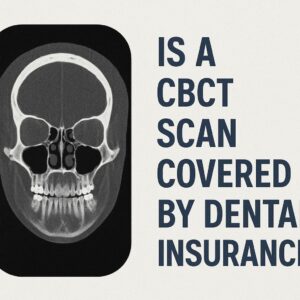
Is a CBCT Scan Covered by Dental Insurance
What is a CBCT Scan? (And Why is Your Dentist Recommending It?)
To understand the insurance side of things, it helps to first understand what makes a CBCT scan special. Think of traditional dental x-rays like a roadmap of a city. You can see the streets (your teeth), but you cannot see the traffic lights, the underground wiring, or the height of the buildings.
A CBCT scan is like switching to a 3D satellite view. It allows your dentist or oral surgeon to see:
-
Bone structure in three dimensions: Crucial for dental implants.
-
The precise location of nerves: To avoid damaging them during extractions or surgery.
-
Pathologies: Such as cysts, tumors, or infections that might be hidden between teeth or inside the jawbone.
-
Impacted teeth: Particularly wisdom teeth, to see their exact relationship to the nearby nerves.
Because of this level of detail, your dentist might recommend a CBCT scan for several specific reasons:
-
Dental Implant Planning: This is the most common reason. The surgeon needs to know exactly how much bone you have, its density, and where to place the implant safely.
-
Complex Tooth Extractions: Especially for lower wisdom teeth that are sitting close to the inferior alveolar nerve (the nerve that gives feeling to your lip and chin).
-
Orthodontics: For severe cases, orthodontists use CBCT scans to see the roots of the teeth and ensure that moving teeth won’t cause damage.
-
Diagnosing Pain: If you have mysterious facial pain or swelling, a CBCT scan can reveal issues in the roots of teeth or the jaw joint (TMJ) that standard x-rays miss.
-
Sinus and Airway Analysis: For procedures involving the upper jaw or for sleep apnea assessments.
Important Note: While a CBCT scan uses radiation, the amount is typically much lower than a medical CT scan. However, it is higher than a standard dental bitewing. Dentists follow the “ALARA” principle (As Low As Reasonably Achievable) to ensure the scan is only taken when absolutely necessary.
The Big Question: Is CBCT Scan Covered by Dental Insurance?
Now, let’s get to the heart of the matter. The honest answer is: It depends.
There is no universal “yes” or “no.” Dental insurance in the United States and many other countries is not one-size-fits-all. Coverage for a CBCT scan hinges on a few key factors: the reason for the scan, the specific details of your insurance plan, and whether the scan is considered “medically necessary.”
The “Medical Necessity” Factor
Insurance companies are in the business of risk management. They want to pay for things that are proven to be necessary for your health. This is the concept of medical necessity. If a CBCT scan is the standard of care for a specific procedure, you have a much higher chance of getting coverage.
For example, placing a dental implant without a CBCT scan is like trying to dig a fence post hole in the dark. You might hit a rock, a pipe, or a root. Because the scan prevents surgical complications, insurers are more likely to cover it as part of the implant procedure.
Diagnostic vs. Routine
Is the scan part of a routine check-up? Generally, no. Insurers expect dentists to start with basic diagnostics (clinical exam and standard x-rays). A CBCT scan is considered an advanced diagnostic service. Therefore, it usually needs to be justified by a specific clinical condition or surgical plan.
When Will Insurance Likely Say “Yes”?
Based on common industry practices and policy language, here are the scenarios where you are most likely to receive coverage or partial coverage for a CBCT scan.
1. Pre-Surgical Assessment for Implants
Most modern dental insurance plans that include major restorative coverage (like implants) recognize that a 3D scan is essential for success. If your plan covers implants, it will very often cover the CBCT scan used to place them.
2. Evaluation of Impacted Teeth
If you have a wisdom tooth that is deeply impacted and sitting near a nerve, an oral surgeon will almost certainly require a CBCT scan to map the area safely. Insurance companies prefer paying for a scan rather than paying for a much larger lawsuit if a nerve is severed. This is usually well-covered.
3. Diagnosis of Pathology
If you have a suspicious lump, a cyst, or signs of oral cancer, a CBCT scan becomes a diagnostic necessity. In these cases, it is often coded in a way that overlaps with medical necessity, and sometimes, your medical insurance might even get involved.
4. Complex Endodontics (Root Canals)
If a tooth requires a root canal but has complex root anatomy that isn’t visible on a 2D x-ray, a limited-area CBCT scan (often called a “3D apex” or “limited field of view”) is becoming the standard of care. Many insurance plans are starting to recognize this.
When Will Insurance Likely Say “No”?
Just as there are clear “yes” scenarios, there are also common “no” scenarios. This doesn’t mean the scan isn’t useful; it just means the insurance company views it as elective or not yet proven necessary for that specific case.
1. Routine Orthodontic Records
Some orthodontists like to take a full-head CBCT scan on every single patient. While this provides amazing data, many insurance companies view this as “excessive” and not yet the universal standard of care for simple braces. If you have a straightforward case of crooked teeth, your insurer may deny the scan.
2. Screening for Hidden Problems
If you have no symptoms, no clinical signs, and are just getting a scan “to check for things,” your insurance will likely deny the claim. They expect a specific diagnostic reason.
3. TMJ Disorder Evaluation (in some cases)
While a CBCT can show the bone structure of the jaw joint, many insurers still consider advanced imaging for TMJ to be investigational or not always necessary, preferring to start with conservative treatment first.
4. Frequency Limits
Even if your plan covers CBCT scans, it likely has a frequency limit. You cannot have a full-mouth CBCT scan every six months. You might be limited to one every three to five years, or only once per lifetime for a specific area.
Dental Insurance 101: How Your Plan Affects Your Scan
To really understand the answer to “is a CBCT scan covered by dental insurance,” you need to understand the anatomy of your specific insurance plan. Look at your “Summary of Benefits” or call your provider to ask about these three things:
1. The Waiting Period
Many plans have waiting periods for “Major Services.” A CBCT scan often falls into this category.
-
Preventive: Cleanings, exams (usually covered 100%).
-
Basic: Fillings, simple extractions (usually covered 80%).
-
Major: Crowns, bridges, dentures, implants, and complex diagnostics like CBCT scans (usually covered 50%).
If you just got your insurance last week, you might still be in the waiting period for major services, meaning you would have to pay the full cost out of pocket.
2. The Annual Maximum
This is the total amount of money your insurance company will pay in a given year (usually $1,000 to $2,000). A CBCT scan can cost between $300 and $700. If you have already had a crown or other major work done this year, you might have hit your annual maximum, and insurance will pay $0 towards the scan until your plan resets.
3. In-Network vs. Out-of-Network
If your dentist is “in-network,” they have negotiated a lower rate with the insurance company. You will pay less. If they are “out-of-network,” the insurance might still pay, but the dentist can charge whatever they want, and you will be responsible for the difference (balance billing).
CBCT Scan Costs vs. Coverage: A Comparative Look
To give you a realistic picture, let’s look at a hypothetical scenario. Please note that these are average estimates and will vary based on your location and provider.
| Scenario | Estimated Cost of CBCT | Insurance Plan Type | Typical Coverage | Your Estimated Out-of-Pocket Cost |
|---|---|---|---|---|
| Implant Placement | $400 | PPO Plan (Major Services 50% after deductible) | Covers 50% as part of implant treatment. | $200 + Deductible |
| Wisdom Tooth Extraction | $350 | HMO/DMO Plan (Low monthly premium) | Often pays a fixed fee, or nothing for advanced imaging. | $250 – $350 |
| Routine Orthodontics | $450 | Orthodontic Benefit Included | May deny as “not necessary”; ortho benefit often covers records, but limits apply. | $0 – $450 (depends on plan specifics) |
| TMJ Pain | $500 | Medical Insurance (not dental) | May cover if billed as medical necessity for TMJ disorder. | Varies by medical plan (deductible/co-insurance) |
The Dental/Medical Crossover: A Potential Game Changer
This is one of the most overlooked aspects of CBCT coverage. While your dental insurance might say no, your medical insurance might say yes.
If the reason for the scan falls under a medical condition, it might be billable to your medical plan. This is common for:
-
Sleep Apnea: CBCT scans for airway analysis.
-
Oral Pathology: Biopsy or diagnosis of tumors/cysts.
-
Trauma: Fractures of the jaw or facial bones.
-
TMJ Disorders: If diagnosed as a medical condition.
How to navigate this:
Ask your dentist’s billing coordinator if they think the procedure code (CDT code) might be eligible for a “crossover” to medical insurance. They may have you sign a medical release form to file the claim on your behalf.
Reader Tip: If you have a high-deductible medical plan, this might not save you money, but if you have met your medical deductible, it could save you thousands.
5 Steps to Take Before Your CBCT Scan
To ensure you aren’t blindsided by a bill, follow this checklist:
-
Ask “Why?”: First, ask your dentist why the scan is necessary. Understanding the reason (e.g., “to protect your nerve during extraction”) helps you advocate for yourself with the insurance company.
-
Call Your Insurance: Before the scan, call the number on the back of your card. Ask the representative:
-
“Is procedure code D0364 (or D0367) covered under my plan?” (D0364 is a common code for a CBCT scan).
-
“Is there a waiting period for this service?”
-
“Does this count toward my annual maximum?”
-
“Do I need a pre-authorization?”
-
-
Ask About Pre-Authorization: A pre-authorization (or predetermination) is when the dentist sends the X-rays and treatment plan to the insurance company before the work is done. The insurance sends back a letter stating exactly what they will pay. This is the gold standard for avoiding surprises.
-
Discuss Payment Plans: If insurance denies the claim, ask the dental office if they offer payment plans or a prompt-pay discount. Many offices are happy to work with you.
-
Check the Fine Print: Review your benefits booklet. Look for the section on “Diagnostic Imaging” or “Oral Surgery.”
The Codes: A Peek Behind the Curtain
If you want to get specific with your insurance company, here are the common Current Dental Terminology (CDT) codes used for CBCT scans. Knowing these can help you ask better questions.
-
D0364: Cone beam CT capture and interpretation, focusing on a specific area of the mouth (e.g., one or two teeth). This is the most common code for implant sites or single-tooth issues.
-
D0365: Cone beam CT capture and interpretation of both jaws (maxilla and mandible).
-
D0366: Cone beam CT capture and interpretation focusing on the mandible (lower jaw).
-
D0367: Cone beam CT capture and interpretation focusing on the maxilla (upper jaw).
-
D0368: Cone beam CT capture and interpretation for the temporomandibular joint (TMJ).
When you call your insurance, using these codes will get you a much more accurate answer than asking a general question.
Frequently Asked Questions (FAQ)
Is a panoramic x-ray the same as a CBCT scan?
No. A panoramic x-ray (PAN) is a 2D flat image of your entire mouth. A CBCT is a 3D volumetric scan. The PAN is cheaper and has less radiation, but the CBCT provides infinitely more detail. Insurance usually covers PANs as routine, while CBCT is considered advanced.
Does Medicare cover CBCT scans?
Original Medicare (Part A and B) does not cover routine dental care or most dental procedures. However, if the CBCT scan is part of a medically necessary treatment for a covered condition (like jaw reconstruction after cancer or evaluation of a tumor), Part B may cover it. Medicare Advantage plans (Part C) sometimes offer dental benefits, but coverage varies wildly.
Can I use my FSA or HSA to pay for a CBCT scan?
Absolutely. If your insurance denies the claim or only pays partially, you can almost always use your Flexible Spending Account (FSA) or Health Savings Account (HSA) funds to pay for the remaining balance. These are pre-tax dollars, so it softens the financial blow.
What if my dentist owns the CBCT machine? Will that change the cost?
If the dentist owns the machine (in-office CBCT), the cost is usually lower than if they send you to an outside imaging center. However, you should still check if your insurance requires you to use an in-network provider for the scan, as this could affect coverage even if it’s in the dental office.
Conclusion
So, is a CBCT scan covered by dental insurance? In short, yes, it often is—but primarily when it is deemed medically necessary for specific procedures like dental implants, complex extractions, or diagnosing pathology. Coverage is rarely automatic; it depends on your plan’s details, waiting periods, and annual maximums. The best way to ensure coverage is to communicate openly with your dentist, verify your benefits directly with your insurance provider using the correct procedure codes, and always ask about pre-authorization before proceeding. This advanced 3D technology is a powerful tool for your health, and a little proactive research can make it financially manageable.
Additional Resource
For the most up-to-date information on dental procedure codes and coverage guidelines, you can visit the American Dental Association’s (ADA) website. They provide resources on the CDT codes which are the standard for dental insurance claims.
Visit the ADA Website for CDT Code Information