Let’s be honest: moving is expensive. Between hiring the truck, buying boxes, and taking time off work, the costs add up fast. So, when your mover starts talking about “insurance,” it is tempting to just nod and sign, hoping for the best. But here is the reality check: The “insurance” your moving company offers is rarely what you think it is.
Understanding Moving Company Insurance Cost Essentials isn’t just about finding the cheapest line item on your quote. It is about risk management. It is the difference between dropping a vase and getting reimbursed for it, or dropping a vase and having to buy a new one out of your own pocket.
In this guide, we are going to strip away the confusing jargon. We will look at what coverage actually costs, what it covers, and most importantly, how to avoid getting ripped off. Whether you are moving across town or across the country, you need to know how to protect your stuff without breaking the bank.
Let’s get started.
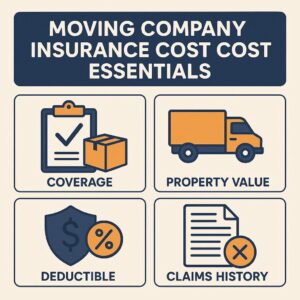
Moving Company Insurance Cost Essentials
What Is Moving Insurance? (And Why It’s Not Really Insurance)
First, we need to clear up a massive misconception. When you hire a professional moving company, they are legally required to assume responsibility for your goods. This responsibility is called liability. What most people call “moving insurance” is technically “valuation.”
Valuation is not an insurance policy you buy from a third party. It is a tariff or a level of responsibility the mover agrees to take regarding the value of your items. Think of it as a warranty or a service contract. You are declaring how much financial risk the mover is willing to accept if they break or lose your stuff.
There are two primary levels of valuation offered by movers, and they cost vastly different amounts.
Released Value Protection (The Free Option)
This is the baseline. By federal law (in the US) and similar regulations in other countries, moving companies must offer this at no additional charge.
-
The Cost: $0.00.
-
The Coverage: The mover assumes liability for 60 cents per pound per article.
-
The Reality Check: If your mover drops a 10-pound box containing a brand new $1,000 laptop, they are only liable for $6.00 (10 lbs x $0.60). It is an outdated formula that dates back to a time when most household goods were heavy furniture, not lightweight electronics. This is usually a bad deal for the customer, but it is free.
Full Value Protection (The Paid Option)
This is the upgrade. It is the most common recommendation from moving consultants, and it comes with a cost.
-
The Cost: Typically between $10 and $15 per $1,000 of declared value.
-
The Coverage: The mover is liable for the replacement value of lost or damaged items. If your $1,000 laptop is destroyed, the mover must either repair it, replace it with a similar item, or pay you the current market value for the loss.
-
The Fine Print: This does not mean you get a blank check. If you have an antique table worth $5,000, you must declare it separately and may need to provide an appraisal. The mover is not responsible for “mysterious disappearance” (items that simply vanish without proof of theft) or acts of nature.
Important Note: “Full Value” usually covers the depreciated value of your items unless you specifically insure them for a set amount (like a fine art rider).
The Real Cost Breakdown of Moving Insurance
So, how much should you actually pay? If you look at your moving quote, you might see a line item for “valuation” that seems arbitrary. Let’s break down the numbers based on industry standards.
How Premiums Are Calculated
Movers calculate the cost of Full Value Protection based on the total weight of your shipment and the valuation you choose. However, they translate weight into a dollar value. Here is the standard math:
-
Estimate the Total Value: You and the mover estimate the total replacement cost of all your belongings. Let’s say you agree your stuff is worth $50,000.
-
Apply the Rate: The mover charges a fee per $1,000 of that declared value.
-
Low End: $7 per $1,000
-
Average: $10 per $1,000
-
High End: $15 per $1,000
-
-
Calculate the Cost:
-
Low End: ($50,000 / $1,000) x $7 = $350
-
Average: ($50,000 / $1,000) x $10 = $500
-
High End: ($50,000 / $1,000) x $15 = $750
-
You will pay this premium on top of your moving freight charges. For a cross-country move, this is usually a worthwhile investment.
Comparative Table: Valuation vs. Actual Cost
To help you visualize the difference, look at this comparison of the two main options offered by movers.
| Feature | Released Value Protection | Full Value Protection |
|---|---|---|
| Cost to You | $0 (Included in base rate) | $7 – $15 per $1,000 of declared value |
| Basis of Claim | Weight of the item (60 cents/lb) | Replacement cost or repair cost |
| Good For | Extremely low-value items, students | Families, electronics, artwork, furniture |
| Claim Example | 50lb TV stand broken -> $30 payout | 50lb TV stand broken -> Cost of a new stand |
| Paperwork | Minimal (Default option) | Requires a signed inventory and valuation form |
Third-Party Moving Insurance: An Alternative Path
While valuation is what the mover offers, you are not strictly limited to buying it from them. In many cases, you can opt-out of their high-cost Full Value Protection and buy your own policy from a third-party insurance company. This is often cheaper and more comprehensive.
Why Go Third-Party?
Moving companies are experts at moving boxes, not necessarily at settling claims. Third-party insurers are experts at claims. Here is why you might consider this route:
-
Lower Cost: A separate inland marine policy (the technical name for moving insurance) can cost as little as $1 to $3 per $1,000 of value. That is significantly cheaper than the mover’s rate.
-
Better Coverage: Mover valuation often excludes certain perils. Third-party policies can cover things like flood, earthquake, or accidental damage that occurs while you are packing (not just the movers).
-
Deductible Choices: You can often choose a higher deductible to lower the premium, giving you more control over the cost.
The “Released Value + Third-Party” Strategy
This is the smart money move for savvy movers.
-
Accept Released Value Protection from the mover (the free 60 cents/lb option). This keeps your contract valid and the mover responsible for basic liability.
-
Purchase a separate moving insurance policy from an independent insurance agent or a company specializing in moving coverage.
Now, you have a safety net. If the mover damages something, you file a claim with the mover first. If they deny it or only offer you 60 cents per pound, you file a claim with your third-party insurer for the difference.
Factors That Influence Your Insurance Premium
Not all moves are priced equally. The cost of protecting your goods depends on several variables. Knowing these can help you estimate your costs before you even call for a quote.
1. Distance of the Move
Surprisingly, this matters less than you think for valuation. Movers usually charge the same rate per $1,000 whether you are going 10 miles or 1,000 miles. However, the risk increases with distance (more handling, more loading/unloading), so the declared value might be calculated more carefully. For third-party insurance, distance can affect the premium slightly due to increased transit time.
2. Weight and Volume
This is the king of moving costs. A heavier truck means more stuff, which means a higher total declared value. A small studio apartment (2,000 lbs) might only need $15,000 in coverage. A four-bedroom house (10,000 lbs) might need $100,000 in coverage. The insurance cost scales directly with the value of the goods.
3. High-Value Items
If you own a Steinway piano, a Persian rug, or a massive flat-screen TV, standard valuation might not cut it. These items often require:
-
Appraisals: Proof of value.
-
Riders: Separate insurance schedules specifically for that item.
-
Special Handling Fees: Which can increase the administrative cost of the insurance.
If you declare these items, expect the mover to quote a higher valuation fee because their risk is higher.
4. Packing Services
Who packs the box matters to the insurer.
-
Mover-Packed: If the mover packs it and it breaks, they have a very hard time denying liability. Insurance is straightforward.
-
Owner-Packed: If you pack it and it breaks, the mover (and their insurance) can argue that the damage was due to insufficient packing. This can complicate claims. Some third-party policies cover owner-packed goods; many mover valuation plans are stricter on this.
Hidden Costs and Red Flags in Moving Insurance
The moving industry has a reputation for scams, and insurance is a prime area where shady operators try to make a quick buck. Here is what to watch out for.
The “Binding Estimate” Trap
Some movers will give you a lowball estimate to get your business. Then, on moving day, they “discover” you have more stuff than anticipated. They will demand you sign a new valuation agreement with a higher declared value (and higher premium) right there on the spot. If you refuse, they might refuse to load the truck.
How to avoid it: Get a binding estimate and a binding valuation agreement in writing before the truck arrives. Do a thorough walkthrough with the estimator.
The Deductible Game
Some moving companies offer Full Value Protection but attach a massive deductible. You might see a policy with a 1% or 2% deductible of the total shipment value.
-
Scenario: Your shipment is valued at $50,000. A 2% deductible is $1,000.
-
The Catch: If they damage a $900 coffee table, you pay for it entirely because the damage is below the deductible. You only get paid if the total damage exceeds $1,000. Always ask: “Is there a per-occurrence deductible?” If so, negotiate it down or go with a third-party provider.
Valuation Caps on Specific Items
Read the fine print. Even under Full Value Protection, many movers limit liability on certain items, regardless of their value. Common caps include:
-
Electronics: Limited to $100 per item unless specifically listed.
-
Antiques/Collectibles: Often excluded unless a separate rider is purchased.
-
Plants and Perishables: Usually excluded entirely (they won’t insure your tomato plants).
How to Save Money on Moving Insurance
You want protection, but you don’t want to pay an arm and a leg. Here are realistic ways to balance cost and coverage.
1. Check Your Existing Policies First
Before you buy anything, pick up the phone. Call your:
-
Homeowners/Renters Insurance Agent: Ask if your policy covers goods in transit. Many policies extend “off-premises” coverage up to 10% of your total contents value. If you have $100,000 in coverage on your house, you might have $10,000 in coverage for your move.
-
Credit Card Benefits: Some premium travel credit cards offer damage and theft protection for personal effects when you pay for the moving truck or service with that card. Read the benefits guide carefully.
2. Do a Proper Inventory
The easiest way to overpay for valuation is to overestimate the value of your stuff. Don’t just guess high to be safe. Go room by room. Use a moving inventory app or a spreadsheet.
-
Be realistic about depreciation. That 5-year-old sofa might have cost $2,000 new, but its current market value is closer to $500.
-
By accurately valuing your goods, you lower the “declared value” number, which directly lowers the premium.
3. Negotiate the Valuation Rate
Yes, you can negotiate. The rates of $10 to $15 per $1,000 are often starting points. If you have multiple moving quotes, use them as leverage.
-
Say this: “Mover A is offering Full Value Protection at $8 per thousand. Can you match that to get my business?”
-
If they are hungry for work, they might lower their administrative fee.
4. Bundle with Storage
If your items are going into storage before the final delivery, the risk period extends. Movers will charge a monthly valuation fee for items in storage.
-
Tip: Ask if the mover offers a discounted “storage-in-transit” rate that bundles the moving insurance with the first 30 or 60 days of storage. This is often cheaper than paying for separate moving and storage coverage.
The Claims Process: What Happens When Something Breaks?
Knowing the cost of insurance is pointless if you don’t know how to use it. The claims process is where the rubber meets the road.
Step 1: Notation on Delivery
Do not sign the delivery receipt until you have inspected your items! If a box is crushed, write it on the delivery receipt before the movers leave. Write: “Box 12 crushed – contents subject to inspection.” If you sign a clean receipt, you are legally acknowledging you received everything in good condition, making claims much harder.
Step 2: File Within the Time Limit
Moving contracts have strict time limits for filing claims, often as short as 90 days (or even 30 days for interstate moves in some jurisdictions). Once you unpack and find damage, file the claim immediately.
Step 3: Repair vs. Replace
The mover has the right to try to repair the item. If they can fix your scratched table, they will. If they can’t, they will offer a settlement. Be prepared to provide receipts, credit card statements, or appraisals to prove the value of the item.
“The biggest mistake people make is throwing away packaging before inspecting the contents. If the box is damaged, keep the box. It is your best evidence that the item was packed well and the carrier caused the damage.” — Sarah Jenkins, Senior Claims Adjuster
FAQ: Moving Company Insurance Cost Essentials
Q: Is moving insurance required by law?
A: Technically, no. However, moving companies are required by federal law (in the U.S.) to assume liability for your goods. They offer “Released Value Protection” (60 cents per pound) for free to meet this requirement. You can decline additional coverage, but you cannot decline their basic liability.
Q: Does my homeowner’s insurance cover my belongings during a move?
A: Sometimes, but not always. Most standard homeowners and renters policies cover personal property anywhere in the world, but they often have limits for “property in transit” (usually around 10% of your total coverage). Additionally, they may not cover damage caused by the specific perils of moving, like dropping or mishandling. Always check with your agent.
Q: What is the difference between “replacement cost” and “actual cash value”?
A: This is crucial. Actual Cash Value is the item’s worth minus depreciation. That 5-year-old TV is worth very little. Replacement Cost is what it would cost to buy a new, similar TV today. Full Value Protection from movers often defaults to Actual Cash Value unless you specifically negotiate or insure for Replacement Cost.
Q: Can I buy moving insurance after I have already moved?
A: No. Insurance must be in place before the risk begins (i.e., before the movers load the truck). You cannot buy coverage for items that are already in transit or have already been delivered.
Q: My mover offered me “waiver of full value.” What is that?
A: This is a confusing term. It usually refers to a type of Full Value Protection where the mover waives their right to depreciate the item. In other words, they agree to pay the replacement cost rather than the actual cash value. It is a premium upgrade. If offered, ask specifically: “Does this mean you pay full retail price for a lost item?”
Q: How much does it cost to insure a piano during a move?
A: Piano moving insurance is specialized. It is often not included in standard valuation. You might need a separate “fine arts” floater. Costs vary wildly based on the piano’s value, but expect to pay a higher premium rate (perhaps $15-$25 per $1,000) for a specialized instrument due to the fragility and cost of specialized movers.
Additional Resource
To ensure you are hiring a reputable mover and not a scam artist, always check their credentials. The American Moving & Storage Association (AMSA) provides resources and a checklist for consumers. You can also verify a mover’s USDOT number with the Federal Motor Carrier Safety Administration (FMCSA) to ensure they are registered and insured to perform interstate moves.
-
FMCSA Search Tool: Protect Your Move
Conclusion
Navigating moving insurance doesn’t have to be a headache. Remember the essentials: the free option offers almost no protection, Full Value Protection is safer but costs between $7 and $15 per $1,000, and third-party insurance can offer a budget-friendly alternative. Always read the fine print, negotiate the rates, and inspect everything before the movers leave to ensure your belongings—and your wallet—are fully protected.