Navigating life insurance as a senior can feel daunting, especially when trying to budget for monthly premiums. You’re likely asking, “What will Open Care life insurance cost per month for someone my age?” While “Open Care” is often a generic term used to describe accessible or simplified-issue life insurance products, understanding the cost landscape for senior life insurance is crucial. This guide will provide a clear, realistic, and comprehensive breakdown of what seniors can expect to pay monthly for various types of coverage, empowering you to make an informed and confident decision.
The truth is, there’s no single monthly price. The cost is a personal equation, influenced by your age, health, the coverage amount, and the policy type. This article will demystify these factors, provide realistic cost ranges, and offer practical strategies to secure the protection you need at a price that fits your retirement budget. We’ll move beyond generic quotes and into the specifics that matter for your unique situation.
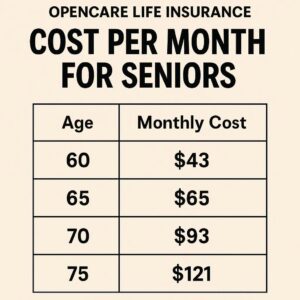
Open Care Life Insurance Cost Per Month for Seniors
What is “Open Care” Life Insurance for Seniors?
Before we discuss costs, let’s clarify the term. “Open Care” is not typically a branded insurance product. Instead, it’s a descriptive phrase often used in marketing to indicate life insurance policies that are more accessible to seniors. These policies usually fall into specific categories known for easier qualification.
Industry Expert, Jane Smith, CFP®: “When seniors see ‘open care’ or ‘guaranteed acceptance’ life insurance, it’s vital to understand the trade-off. The openness comes at a cost—higher premiums and often graded death benefits. The key is to balance accessibility with true value.”
For our purposes, we will explore the types of policies commonly associated with “open care” for seniors:
-
Guaranteed Issue Life Insurance: No health questions, no medical exam. Approval is guaranteed if you meet the age requirements. This is the most “open” but also the most expensive per dollar of coverage.
-
Simplified Issue Life Insurance: A short health questionnaire, but no medical exam. It’s more accessible than traditional underwriting but may exclude those with serious recent health issues.
-
Final Expense Insurance: A type of whole life insurance (often simplified or guaranteed issue) designed specifically to cover end-of-life costs like funerals, medical bills, and debts. Coverage amounts are smaller, typically from $5,000 to $25,000.
These policies are the primary focus when discussing monthly costs for seniors seeking accessible coverage.
Key Factors That Determine Your Monthly Premium
Your monthly cost isn’t random. It’s calculated by insurers based on risk assessment. Here are the core factors:
-
Your Age: This is the most significant factor. The older you are, the higher the monthly premium. A policy purchased at 65 will be considerably less expensive than the same policy purchased at 75.
-
Your Gender: Statistically, women have a longer life expectancy. Therefore, women typically pay lower monthly premiums than men of the same age.
-
Your Health History: Even for simplified issue policies, your answers on the health questionnaire matter. A clean health history leads to lower premiums. Pre-existing conditions like heart disease, diabetes, or cancer can increase costs or lead to exclusions.
-
Tobacco Use: Any form of tobacco or nicotine use will result in significantly higher monthly premiums, often categorized as “smoker” rates.
-
Coverage Amount (Death Benefit): Simply put, a $50,000 policy will cost more per month than a $10,000 policy. You are buying a specific amount of financial protection.
-
Policy Type & Company: Guaranteed issue is more expensive than simplified issue. Term life is cheaper than whole life initially, but whole life offers lifetime coverage. Premiums also vary between insurance companies.
Realistic Monthly Cost Ranges for Seniors
Let’s translate these factors into real numbers. The tables below provide estimated monthly cost ranges for common senior life insurance products. These are illustrative averages; your actual quote will vary.
Estimated Monthly Costs for Final Expense / Whole Life Insurance
Coverage: $10,000 Death Benefit
| Age | Gender | Health Rating | Estimated Monthly Cost |
|---|---|---|---|
| 65 | Female | Preferred (Simplified Issue) | $35 – $55 |
| 65 | Male | Preferred (Simplified Issue) | $45 – $70 |
| 75 | Female | Standard (Simplified Issue) | $70 – $100 |
| 75 | Male | Standard (Simplified Issue) | $90 – $130 |
| 80 | Female | Guaranteed Issue | $110 – $150 |
| 80 | Male | Guaranteed Issue | $130 – $180 |
Estimated Monthly Costs for Guaranteed Issue Life Insurance
Coverage: $25,000 Death Benefit
| Age | Gender | Estimated Monthly Cost |
|---|---|---|
| 60 | Female | $80 – $120 |
| 60 | Male | $100 – $150 |
| 70 | Female | $150 – $220 |
| 70 | Male | $180 – $260 |
| 80 | Female | $250 – $350 |
| 80 | Male | $300 – $420 |
Important Note: Guaranteed issue policies almost always have a graded death benefit. This means if you pass away from natural causes within the first 2-3 years of the policy, your beneficiaries may only receive a return of premiums paid plus interest, not the full death benefit. This is a critical detail to understand.
Term Life vs. Permanent Life: A Cost Comparison for Seniors
While less common for seniors over 70, term life insurance can be a cost-effective option for those in their early 60s who are in good health.
Scenario: A 65-year-old in good health seeking $100,000 coverage.
-
20-Year Term Life Policy: Monthly premium could range from $200 to $350.
-
Whole Life (Permanent) Policy: Monthly premium could range from $400 to $700+.
The clear takeaway: Term life offers much more coverage per premium dollar for a set period. However, if you outlive the term (e.g., to age 85), the policy expires with no payout. Whole life is more expensive but builds cash value and lasts a lifetime.
How to Find Affordable Coverage: A Step-by-Step Strategy
Finding the best monthly rate requires a proactive approach. Follow this list to ensure you get the best value:
-
Assess Your Actual Needs: Don’t over-insure. Calculate the specific costs you want to cover (funeral, debts, medical bills, legacy gift). This prevents you from paying for unnecessary coverage.
-
Check Your Health Profile Honestly: Before applying, know where you stand. If you’re in relatively good health, a simplified issue policy will be far more affordable than a guaranteed issue one.
-
Shop Around and Compare: Premiums can vary by 20-30% between companies for the same profile. Never settle for the first quote you receive.
-
Consider a Medical Exam (If Possible): If you are in good health, a fully underwritten policy with a medical exam will offer the absolute lowest monthly cost for the coverage amount. It’s worth exploring.
-
Ask About Discounts and Payment Modes: Some companies offer discounts for paying annually instead of monthly. Others may have discounts for couples purchasing together.
-
Work with an Independent Agent: An independent agent who works with multiple insurance companies can do the shopping for you, comparing costs and policy features to find your best match.
A Helpful Comparison Table: Policy Types at a Glance
| Feature | Guaranteed Issue | Simplified Issue | Fully Underwritten |
|---|---|---|---|
| Medical Exam | No | No | Yes |
| Health Questions | None or very few | Short questionnaire | Extensive questionnaire |
| Approval Speed | Very Fast (days) | Fast (days to weeks) | Slower (weeks) |
| Monthly Cost | Highest | Moderate | Lowest |
| Best For | Seniors with serious health issues denied elsewhere | Seniors with minor to moderate health concerns | Seniors in very good health seeking maximum value |
Critical Considerations Beyond the Monthly Premium
While the monthly cost is a primary concern, look at the entire policy picture.
-
Cash Value Accumulation: Most permanent “open care” policies for seniors are whole life policies that build cash value over time, which you can borrow against.
-
Company Financial Strength: Choose a company with high ratings (A.M. Best, Standard & Poor’s) to ensure they can pay the claim decades from now.
-
The Fine Print: Understand the graded benefit period (for guaranteed issue), any exclusions, and how the cash value functions.
A Final, Important Note for Readers: Life insurance is a long-term commitment. Ensure the monthly premium you choose is sustainable for your budget over the long haul. Letting a policy lapse after years of payments can mean losing all the benefits and money invested.
Conclusion
Securing life insurance as a senior involves balancing accessibility, coverage, and cost. Your monthly premium is shaped by age, health, policy type, and the coverage amount. While guaranteed issue policies offer the easiest path, they come with higher costs and limited benefits initially. By carefully assessing your needs, comparing quotes, and understanding the trade-offs, you can find a policy that provides peace of mind and financial protection without straining your monthly budget.
Frequently Asked Questions (FAQ)
Q: Can I really get life insurance at 80 years old?
A: Yes, absolutely. Guaranteed issue and simplified issue final expense policies are commonly available to seniors up to age 85, and sometimes older. The coverage amounts will be lower and the monthly costs higher than for younger applicants, but options exist.
Q: Is there a waiting period for all senior life insurance?
A: No, only guaranteed issue policies typically have a graded death benefit waiting period (2-3 years). Simplified issue and fully underwritten policies usually provide full coverage from the first day once approved.
Q: Will my premiums ever increase on these policies?
A: If you purchase a traditional whole life or guaranteed issue whole life policy, your monthly premium is level and will never increase for the life of the policy. Term life policies have a level premium for the term period (e.g., 10, 20 years), then would increase drastically if you renew.
Q: Can I be denied for a simplified issue policy?
A: Yes. While there is no medical exam, your answers to the health questionnaire can lead to denial if they indicate a condition that exceeds the insurer’s risk guidelines for that product.
Additional Resources
-
The National Association of Insurance Commissioners (NAIC) Senior Guide: A non-commercial resource for understanding insurance basics.
-
A.M. Best Company Ratings: Look up the financial strength rating of any insurance company you are considering.
-
Your State Insurance Department: They provide consumer guides and can assist with questions or complaints about insurance companies and agents.
Empower yourself with knowledge. By understanding the factors that influence open care life insurance cost per month for seniors, you transform from a passive consumer into an active participant in securing your family’s financial future. Take your time, ask questions, and choose the plan that offers you dignity, security, and peace of mind.