Planning for the future is one of the most loving gifts you can give your family. If you are exploring your options, you have likely come across the term “Senior Legacy Life Insurance.” It sounds official, maybe even like a specific product you can buy off a shelf.
The truth is a little different, but just as manageable. “Senior Legacy” is not a one-size-fits-all insurance company. It is a concept, and often a brand name used by different providers to describe policies aimed at people aged 50, 60, 70, and beyond. The goal? To leave a financial legacy—a lump sum of money—to cover final expenses, unpaid debts, or even a little extra for the kids.
The biggest question on everyone’s mind is simple: What is the senior legacy life insurance cost per month?
You want a number. You want to budget. And we are going to give you the tools to find that number. But because life insurance pricing is deeply personal—based on your age, health, and where you live—giving you a single flat rate would be misleading.
Instead, this guide will break down the exact factors that determine your monthly payment. We will look at real-world scenarios, compare policy types, and provide clear tables so you can estimate your own costs with confidence. By the end, you will know exactly what to expect and how to find a plan that fits your budget like a glove.
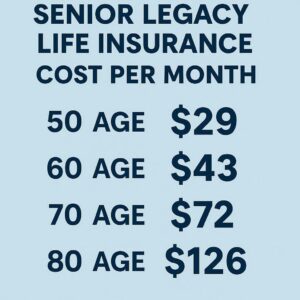
Senior Legacy Life Insurance Cost You Per Month
Understanding the “Senior Legacy” Landscape
Before we dive into the dollars and cents, we need to clarify what we are actually talking about. When you search for “senior legacy life insurance,” you are generally looking at two main types of permanent life insurance designed for older adults.
Whole Life Insurance vs. Term Life Insurance for Seniors
It is vital to know the difference, as the cost varies dramatically.
-
Term Life Insurance: This is temporary coverage. You buy it for a specific “term,” usually 10, 15, or 20 years. If you pass away during that term, your beneficiary gets the payout. If you outlive the term, the coverage ends. For seniors, this is often the most budget-friendly option upfront, but it leaves you without coverage in your later years.
-
Whole Life Insurance (Permanent): This is coverage that lasts your entire life, as long as you pay the premiums. It also builds a cash value over time, which is a savings component you can borrow against. “Senior Legacy” policies are almost always a form of whole life insurance, often simplified into two sub-categories:
-
Simplified Issue Whole Life: You answer a few health questions, but there is no medical exam.
-
Guaranteed Issue Whole Life: There are no health questions at all. Acceptance is guaranteed. However, these policies usually have a “graded death benefit,” meaning if you pass away in the first two or three years, the company returns your premiums plus interest, not the full death benefit.
-
Why “Legacy” Policies Are Different
Policies marketed as “legacy” plans for seniors are designed with one primary purpose: to provide a guaranteed payout. They are not investment vehicles meant to compete with the stock market. They are safety nets. This simplicity is reflected in their structure and, consequently, their cost.
| Feature | Typical Term Life | Typical Senior Legacy (Whole Life) |
|---|---|---|
| Duration | 10, 15, or 20 years. | Lifetime (to age 100 or 121). |
| Premium | Low initially, but increases sharply at renewal. | Level (stays the same forever). |
| Medical Exam | Often required. | Rarely required (health questions or none). |
| Cash Value | No. | Yes (grows slowly, tax-deferred). |
| Primary Goal | Income replacement during working years. | Final expenses / leaving a legacy. |
The Big Reveal: Senior Legacy Life Insurance Cost Per Month Averages
Let’s get to the heart of it. We have analyzed rates from major insurers to bring you realistic examples. Remember, these are estimates based on a standard, non-smoking female in good health (for simplified issue) to give you a baseline.
The Golden Rule: For a simplified issue whole life policy (the most common “legacy” plan), you can generally expect to pay between $30 and $200 per month for a policy worth $5,000 to $25,000.
To be more specific, here is a breakdown by age and coverage amount.
Cost by Age Bracket (Monthly Premiums)
We have based these figures on a standard $10,000 policy, which is the most common amount purchased to cover funeral costs.
| Age | Gender | Health Class | Estimated Monthly Cost (Simplified Issue) |
|---|---|---|---|
| 55 | Female | Preferred | $28 – $38 |
| 55 | Male | Preferred | $32 – $42 |
| 65 | Female | Standard | $45 – $60 |
| 65 | Male | Standard | $52 – $70 |
| 75 | Female | Standard | $85 – $120 |
| 75 | Male | Standard | $100 – $140 |
| 80 | Female | Standard | $135 – $190 |
| 80 | Male | Standard | $155 – $220 |
| 85+ | Any | Guaranteed Issue | $150 – $300+ |
Important Note: These are estimates. A 65-year-old male in excellent health might pay less than the table shows, while a 65-year-old with specific health conditions might pay more, even with a “no exam” policy.
Cost by Coverage Amount
To give you an idea of how the coverage scales, here is what a 70-year-old female might expect to pay per month for different policy sizes.
| Policy Face Value | Estimated Monthly Cost (Age 70, Female, Standard Health) |
|---|---|
| $5,000 | $40 – $60 |
| $10,000 | $70 – $100 |
| $15,000 | $105 – $145 |
| $25,000 | $160 – $220 |
| $50,000 | $300 – $450+ |
As you can see, the cost per thousand dollars of coverage usually goes down slightly as the policy size increases, but the total monthly payment will always go up. It is a direct relationship.
5 Critical Factors That Influence Your Monthly Rate
Why can’t we just print a list of prices and be done with it? Because insurance companies are in the business of risk assessment. They look at you and try to predict the future. Here are the five things they look at most closely.
1. Your Current Age (The #1 Factor)
This is the big one. The older you are when you buy the policy, the higher your monthly premium will be. This is simple math: the insurance company has a shorter time to collect premiums before they likely have to pay the claim. Buying even a few years earlier can lock in a significantly lower rate for life.
2. Your Health and Medical History
Even with “no exam” policies, insurers ask questions. They want to know about:
-
Tobacco use: Smokers and vapers pay dramatically more—sometimes double or triple the rate of non-smokers.
-
Serious conditions: Recent diagnoses of cancer, heart disease, stroke, or diabetes can affect your rate or even your eligibility for simplified issue plans.
-
Medications: The types of medication you take tell a story about your health.
3. The Type of Policy You Choose
As we touched on earlier:
-
Simplified Issue (health questions) will have a lower premium than…
-
Guaranteed Issue (no health questions), which has the highest premium for the least amount of coverage, especially in the first few years.
4. The Amount of Coverage (The Death Benefit)
This is straightforward. A $25,000 policy will cost more than a $10,000 policy. You need to find the sweet spot between what your family will need and what you can comfortably afford every month.
5. Your Gender and Location
Statistically, women live longer than men. This means the insurance company can typically spread their premiums over a longer period, resulting in slightly lower monthly costs for women. Your state of residence can also impact the price due to different regulations and cost-of-living adjustments.
Guaranteed Issue vs. Simplified Issue: A Cost Comparison
If you have health issues, you might be torn between these two. Let’s compare them directly for a 72-year-old male looking for $10,000 in coverage.
| Feature | Simplified Issue Plan | Guaranteed Issue Plan |
|---|---|---|
| Health Questions | Yes (about 10-15 questions). | None. |
| Medical Exam | No. | No. |
| Estimated Monthly Cost | $95 – $130 | $140 – $190 |
| Waiting Period | None (full coverage day one). | 2-3 Years (graded benefit). |
| Best For… | People in decent health. | People with serious health conditions. |
The Verdict: If you can answer “no” to questions about terminal illnesses, recent hospitalizations, or hospice care, you will almost always save money by choosing a Simplified Issue plan. The premium is lower, and your family gets the full benefit immediately. Only choose Guaranteed Issue if you cannot qualify for anything else.
Strategies to Lower Your Senior Legacy Life Insurance Cost Per Month
Life insurance doesn’t have to break the bank. Here are four proven strategies to get the coverage you need at a price you can afford.
Strategy 1: Be Smart About the Amount
It is easy to think, “I want to leave $50,000 for my kids.” That is a noble goal. But what is the need? The average funeral in the U.S. today costs between $7,000 and $12,000.
-
Start there. Cover the funeral.
-
Then, add debts. Do you have a small mortgage or credit card debt you don’t want to pass on?
-
Consider a “starter” policy. It is better to have a $7,000 policy you can afford than a $20,000 policy you have to cancel in two years.
Strategy 2: Compare Quotes (But Do It Smartly)
You should absolutely shop around. Rates can vary by 20-30% between companies for the exact same person.
-
Work with an independent agent. They can shop multiple carriers at once.
-
Compare the same thing. Make sure you are comparing $15,000 Simplified Issue policies, not mixing in Term or Guaranteed Issue quotes.
-
Look beyond the price. Check the company’s financial strength ratings (A.M. Best, Standard & Poor’s). You want a company that will be around to pay the claim.
Strategy 3: Apply Sooner Rather Than Later
Every birthday that passes is another tick up in premium. If you are on the fence, don’t wait. The “senior legacy life insurance cost per month” is a moving target, and it only moves in one direction: up.
Strategy 4: Consider a Smaller Policy with a Burial Rider
Some insurers offer “final expense” policies that are essentially whole life insurance with a smaller face value. These are often the most competitively priced products for seniors. They are the same as legacy policies, just with a different name.
Common Questions Seniors Ask About Cost
Let’s tackle some of the most frequent concerns head-on.
“What if I can’t afford the premium later?”
This is a valid concern. With the whole life policies we are discussing, the premium is level. It will not go up because you get older or your health changes.
-
However: If you stop paying, the policy will lapse, and you will lose coverage. To avoid this, be honest with your agent about your budget. It is better to buy a smaller policy you can keep forever.
“Do I really need a legacy policy if I have savings?”
If you have liquid savings set aside specifically to cover your funeral and any final bills, you may not need a policy. But ask yourself:
-
Is that money protected from market downturns?
-
If you use those savings for a medical emergency, will they still be there?
-
Would you rather preserve that savings for your family as an extra inheritance, while a small insurance policy covers the costs?
Many people use life insurance to protect their savings, not replace them.
“My friend pays less than the quotes I’m getting. Why?”
This could be for several reasons.
-
They are younger. Even a year or two makes a difference.
-
They are healthier. They may have qualified for a “preferred” health rating you don’t know about.
-
They bought a different type of policy. They may have bought term life insurance 15 years ago, which is very different from a senior legacy whole life policy today.
-
They bought it years ago. If they bought their policy at 60 and are now 75, their rate is locked in at the 60-year-old price, which is much lower.
Real-World Scenarios: What People Like You Pay
Theory is helpful, but examples make it real.
-
Sarah, Age 62: Sarah is a retired teacher. She is healthy, walks daily, and just wants to cover her funeral so her daughter doesn’t have to worry. She applies for a $12,000 simplified issue whole life policy. Her monthly premium is $48.50. It will never change.
-
Robert, Age 70: Robert has high blood pressure, controlled by medication, but was treated for cancer five years ago and is now in remission. He qualifies for a standard-rate simplified issue policy. He chooses $15,000 to cover funeral costs and a small debt. His monthly premium is $124.00.
-
Eleanor, Age 78: Eleanor has congestive heart failure and uses oxygen. She cannot pass the health questions for a simplified issue plan. She applies for a $7,000 guaranteed issue policy. Her monthly premium is $135.00. Her family will receive the full $7,000 plus any premiums paid if she passes away after the first three years.
Conclusion
Finding the right senior legacy life insurance policy is a balancing act. You want to leave a meaningful gift for your loved ones, but you need to do it within a fixed budget. The “senior legacy life insurance cost per month” is not a mystery—it is a formula based on your age, health, and the amount of coverage you choose.
For most seniors, a simplified issue whole life policy offering between $5,000 and $25,000 in coverage will cost between $30 and $200 per month. By getting quotes, being realistic about your needs, and applying now rather than later, you can secure a policy that provides peace of mind and a lasting legacy, all without straining your monthly finances.
Frequently Asked Questions (FAQ)
Q: Is there a “Senior Legacy” life insurance company?
A: Not exactly. “Senior Legacy” is a marketing term used by various insurance companies to describe permanent life insurance policies aimed at older adults. It is not a single company but a type of product.
Q: Can I get senior legacy life insurance if I have pre-existing conditions?
A: Yes, absolutely. If you have conditions like diabetes or heart disease, you will likely qualify for a Simplified Issue plan. If you have more serious, recent conditions, a Guaranteed Issue plan is designed specifically for you, although it costs more and has a waiting period.
Q: What is the average cost of a $10,000 senior whole life policy?
A: For a healthy 65-year-old, you can expect to pay between $45 and $70 per month. For a healthy 75-year-old, that same $10,000 policy will likely cost between $85 and $140 per month.
Q: Will my premium go up as I get older?
A: No. If you buy a whole life (permanent) policy, your premium is “level.” It will stay exactly the same for the rest of your life. Term life insurance premiums can increase when you renew the term.
Q: Is it better to get a policy through my job?
A: Employer-provided life insurance is a great supplement, but it usually ends when you leave the job or retire. For a true legacy that lasts the rest of your life, you need an individual policy that you own and control.
Additional Resource: Smart Steps to Take Today
Ready to move forward? Here is a simple checklist to guide you.
-
Calculate Your Needs: Use the [Bureau of Labor Statistics] (https://www.bls.gov/) or a local funeral home’s website to get a realistic estimate of funeral costs in your area. Add any unpaid debts you don’t want to leave behind.