Let’s be honest: insurance is one of those expenses we all have to deal with, but very few of us actually look forward to researching. If you’ve been searching for “tpl insurance cost,” you’re probably not looking for a fancy lecture on legal jargon. You want straight answers. You want to know what you’re going to pay, why you have to pay it, and—most importantly—how to make sure you’re not overpaying.
TPL, or Third-Party Liability insurance, is the bedrock of vehicle ownership in many parts of the world. It’s the legal minimum you need to drive on public roads. But here is the thing: while the coverage is standard, the cost is anything but.
In this guide, we are going to pull back the curtain. We’ll look at the nuts and bolts of pricing, the sneaky factors that might be hiking your premium, and how to navigate the market like a pro. Forget the confusing tables of data you see on comparison sites; we are going to talk about real-world numbers and realistic expectations.
TPL Insurance Cost
What Exactly is TPL Insurance? (And Why Do You Need It?)
Before we dive into the dollars and cents, it helps to understand exactly what you are buying. TPL insurance is designed to protect other people from you. It sounds harsh when put that way, but that’s the core of it.
If you cause an accident, the costs for the other party can be astronomical—vehicle repairs, medical bills, legal fees, even lost income if they can’t work. TPL steps in to cover those costs on your behalf. It does not, however, cover a single scratch on your own car or a bruise on your own body.
Why is it mandatory?
Governments mandate this coverage to ensure that victims of road accidents aren’t left with crippling financial debt. It’s a social safety net funded by drivers. Without it, a simple fender-bender could bankrupt someone.
The Coverage Gap
Understanding the limits of TPL is crucial when discussing cost. Because TPL only covers third parties, the cheapest policy you can find might leave you vulnerable. If you write off your own car in an accident you caused, you’re walking home empty-handed. This is why, later in this article, we’ll weigh the cost of TPL against more comprehensive options.
The Million-Dollar Question: How Much Does TPL Insurance Cost?
So, what is the actual number? I know that’s why you’re here. However, giving you a single price would be misleading and dishonest. Unlike a loaf of bread or a gallon of gas, insurance doesn’t have a fixed retail price.
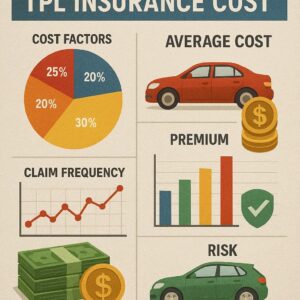
In the United States, for example, the average cost for a minimum-coverage liability policy (which is the closest equivalent to TPL) hovers around $500 to $700 per year. But that is just an average. In some states, you might pay $350; in others, you might be looking at over $1,200.
In countries like the UK, a basic Third-Party Only policy might start around £400-£600 for a safe driver, but young drivers often face quotes exceeding £1,500. In places like the Philippines, TPL is often bundled with the vehicle registration and can be as low as PHP 500 to PHP 1,200 for basic coverage, though private comprehensive policies are far more expensive.
The key takeaway here is that the cost is highly personal. It depends on a cocktail of factors that we are about to explore.
The Primary Factors Influencing Your TPL Premium
Insurance companies are not random number generators. They are in the business of risk assessment. They use massive amounts of data to predict how likely you are to file a claim. The higher the perceived risk, the higher your premium. Here are the biggest ingredients in that pricing recipe.
Your Vehicle: The Machine Matters
You might think insurance is about you, but it starts with your car.
-
Make and Model: A high-performance sports car is statistically more likely to be driven fast and cause severe accidents. Insuring a Ford Fiesta versus a Porsche 911 will yield wildly different TPL costs because the potential damage the Porsche can cause (and the cost to repair the other guy’s car) is higher.
-
Age of the Vehicle: Surprisingly, older cars are often cheaper to insure for TPL because the owner is less likely to file a claim for their own damage. However, some insurers view older cars as less safe, which can slightly nudge liability prices up.
-
Engine Size: Larger engines generally mean more power and higher speeds, which translates to higher risk.
Your Driving History: The Proof is in the Past
This is the single biggest factor within your control.
-
Clean Record: If you have been driving for ten years without a single at-fault accident, you are the insurance company’s dream client. You will get the best rates.
-
Accidents and Claims: If you caused an accident last year, the insurer knows they might have to pay out for you again. Your premium will increase, sometimes significantly, for three to five years.
-
Traffic Violations: Speeding tickets, running red lights, or reckless driving citations are red flags. They indicate risky behavior, and your TPL insurance cost will reflect that.
Your Location: The Geography of Risk
Where you park your car at night matters just as much as where you drive it during the day.
-
Urban vs. Rural: A driver in a bustling city like Los Angeles, London, or Manila faces a much higher chance of an accident than someone driving on quiet country roads in Wyoming or the Scottish Highlands. City drivers pay more.
-
Crime Rates: If you live in an area with high rates of vehicle theft or vandalism, insurers see that as a marker for general instability and risk. Even though TPL doesn’t cover theft of your car, statistics show that high-crime areas often correlate with higher accident rates.
-
Weather Patterns: Living in an area prone to harsh winters, heavy rains, or hailstorms increases the statistical likelihood of accidents, which increases your premium.
Personal Demographics: The Unfair, But Real, Factors
This is where insurance gets personal, and sometimes, feels a little unfair.
-
Age: Statistics prove that young and inexperienced drivers (teens to mid-20s) are involved in more accidents than any other demographic. Consequently, they pay the highest TPL costs. Drivers over 50 or 60 often enjoy the lowest rates, before prices creep up again for seniors over 80.
-
Gender: Statistically, young male drivers are involved in more severe and frequent accidents than young female drivers. Therefore, a 19-year-old man will almost always pay more for TPL than a 19-year-old woman. This gap usually narrows and disappears by the time drivers reach their 30s.
-
Marital Status: Married people are statistically more stable and file fewer claims. If you get married, tell your insurer—it might lower your rate.
TPL vs. Comprehensive: A Cost Comparison Table
Sometimes, looking at what you don’t get helps you understand the value of what you do get. Here is a quick comparison to help you visualize where TPL stands in the insurance family.
| Feature | TPL (Third-Party Liability) | Third-Party, Fire & Theft | Comprehensive |
|---|---|---|---|
| Damage to others | ✅ Yes | ✅ Yes | ✅ Yes |
| Injury to others | ✅ Yes | ✅ Yes | ✅ Yes |
| Your car stolen | ❌ No | ✅ Yes | ✅ Yes |
| Your car fire damage | ❌ No | ✅ Yes | ✅ Yes |
| Your car accident damage | ❌ No | ❌ No | ✅ Yes |
| Weather damage (flood/hail) | ❌ No | ❌ No | Usually Yes |
| Typical Cost Level | Lowest | Medium | Highest |
| Best For | Older cars, tight budget | Mid-range cars | New/expensive cars |
As you can see, the low cost of TPL comes with significant gaps in protection. For an older car that is only worth a few thousand dollars, it often doesn’t make financial sense to pay for comprehensive coverage. If you crash it, you can simply replace it yourself. But for a car you rely on daily, the savings on TPL might be a false economy.
7 Realistic Ways to Lower Your TPL Insurance Cost
Enough theory. Let’s talk about action. How do you actually reduce what you pay?
-
Shop Around Relentlessly
Loyalty to an insurance company is rarely rewarded. Prices vary wildly between providers for the exact same coverage. Get at least three to five quotes every time your policy is up for renewal. Use comparison websites, but also call local agents directly. -
Bundle Your Policies
If you have home, renters, or life insurance, try to get your auto insurance from the same company. The multi-policy discount can slash your total bill by 10% to 20%. -
Increase Your Deductible (If you have Collision)
Wait, you thought TPL didn’t have a deductible? You’re right, it doesn’t. However, if you are comparing TPL to a policy that includes Collision, raising the deductible on the Collision part of the policy lowers the premium for the whole package. This is a useful trick if you are thinking of upgrading your coverage. -
Take a Defensive Driving Course
Many insurers offer a discount for completing an accredited defensive driving or accident prevention course. It costs a little time and a small fee, but it can save you money for years. -
Check Your Credit Score (Where Legal)
In many countries (including most of the U.S.), insurers use credit-based insurance scores to predict risk. A better credit score can lead to significantly lower TPL costs. Paying down debt and correcting errors on your credit report can help. -
Reduce Your Annual Mileage
The less you drive, the less chance you have of getting into an accident. If you’ve started working from home or switched to public transport, tell your insurer. Lower mileage often qualifies you for a low-usage discount. -
Park Smart
If you have a garage, use it. Parking on the street, especially in a city, is considered higher risk. If you can honestly say the car is kept in a garage overnight, you might snag a small discount.
Important Note: Always be honest with your insurer. Misrepresenting your mileage, where you park, or who the main driver is (watch out for “fronting,” especially with young drivers) can lead to your policy being voided when you need it most. If you have to make a claim and they discover the lie, they can refuse to pay and cancel your coverage.
The “Too Good to Be True” Trap
When you are shopping for TPL insurance cost, you will inevitably see a quote that is dramatically lower than all the others. It feels like winning the lottery. But in insurance, you generally get what you pay for.
Beware of:
-
Bare Minimum Limits: The legal minimum might be $25,000 in liability coverage. But if you cause an accident involving a new luxury car and someone’s medical bills, $25,000 won’t even scratch the surface. You will be personally sued for the rest. Sometimes, paying a little more for higher liability limits is the smartest financial move you can make.
-
Hidden Fees: Some ultra-cheap policies have high administrative fees, cancellation fees, or installment fees that aren’t apparent until checkout.
-
Weak Financial Backing: Is the insurance company financially stable? If they go bankrupt, your policy is worthless. Check ratings from agencies like A.M. Best or Standard & Poor’s.
How to Get an Accurate Quote
To get a realistic idea of your TPL insurance cost, you need to have your information ready. Before you sit down to compare, gather the following:
-
Your driver’s license number and the issue date.
-
The Vehicle Identification Number (VIN) of your car.
-
Current odometer reading.
-
Details of all drivers in your household (even if they don’t usually drive your car, they might need to be listed).
-
Information on your current policy (if you have one) for easy renewal comparison.
Entering accurate information from the start ensures the quotes you get are the quotes you can actually use.
Conclusion
Understanding TPL insurance cost is about more than just finding the cheapest number. It’s about understanding the balance between price, protection, and peace of mind. Your premium is a reflection of your personal risk profile, from the car you drive to the neighborhood you live in. By shopping smart, maintaining a clean record, and knowing exactly what you’re buying, you can secure the coverage you need at a price that fits your life.
Frequently Asked Questions
1. Is TPL insurance the cheapest option available?
Generally, yes. Because it offers the least amount of coverage (protecting only others, not you or your car), it usually carries the lowest premium compared to Third-Party Fire & Theft or Comprehensive policies.
2. Why did my TPL insurance cost go up even though I didn’t have an accident?
Rates can increase for many reasons unrelated to your driving. Your insurer may have raised rates across the board due to inflation in repair costs, an increase in claims in your area, or because you lost a discount (like turning 25 or no longer bundling). It’s always a good time to shop around when your renewal comes in.
3. Does my TPL insurance cover me if I drive someone else’s car?
This varies greatly by country and company. In some regions, insurance follows the car, not the driver, meaning the owner’s policy is primary. In others, you may have limited coverage. It is best to assume you are not covered and check your policy documents or ask your agent before borrowing a friend’s car.
4. Can I get TPL insurance if I have a suspended license?
It is extremely difficult and usually illegal to insure a car you intend to drive if your license is suspended. Insurance is a contract based on a valid license. You may be able to get insurance for a vehicle that is parked and not driven, but this is a specialized situation.
5. Will a minor speeding ticket affect my TPL cost?
It can. A single minor infraction might not cause a massive hike, but it signals to insurers that you are a slightly higher risk. If you have multiple tickets, your rates will almost certainly increase. The impact usually fades after a few years.
Additional Resource
For a deeper dive into the legal requirements for vehicle insurance in your specific area, the Insurance Information Institute (III) is an excellent, unbiased resource. You can find state-by-state guides and detailed explanations of coverage types at www.iii.org.