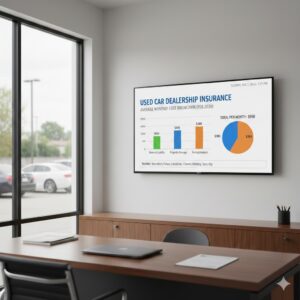
For any entrepreneur in the pre-owned vehicle business, understanding and managing operating expenses is key to profitability. One of the most significant yet variable costs is commercial insurance. If you’re asking, “What will my used car dealership insurance cost per month?” you’re asking the right question for your bottom line. The short answer is: it varies widely, typically ranging from $250 to $1,500+ per month. However, that range is influenced by a complex web of factors specific to your business.
This guide will demystify those factors, explain the essential types of coverage you need, and provide you with realistic frameworks for estimating and managing your monthly premiums. Think of this not just as an expense, but as a crucial investment in the longevity and stability of your dealership.
Used Car Dealership Insurance Cost Per Month
What Exactly Are You Insuring? Breaking Down Dealership Coverage
A used car dealership isn’t just a retail space; it’s a dynamic operation with unique risks. Your insurance policy is a package, often called a Garage Liability Policy or Auto Dealer Insurance, designed to address these specific hazards. Let’s break down the core components that will make up the bulk of your monthly cost.
1. Garage Liability Insurance
This is the cornerstone of your policy, functioning similarly to general liability for other businesses. It protects you if a customer or other third party is injured on your lot or if you cause damage to someone else’s property. For example, if a customer slips on an icy patch in your parking lot and gets injured, garage liability would cover their medical expenses and your legal fees.
2. Garagekeepers Liability Insurance
This is non-negotiable and a major cost driver. Garagekeepers coverage protects your customers’ vehicles while they are in your care, custody, or control. This includes vehicles:
-
Awaiting service or repair.
-
Being used for test drives.
-
Stored on your lot for sale on consignment.
If a hailstorm damages ten customer cars left in your open lot, or if a vehicle is stolen during a test drive, garagekeepers liability is what responds. The limit you choose (e.g., $100,000, $500,000) and your deductible directly impact your monthly premium.
3. Dealers Open Lot (DOL) / Physical Damage Insurance
This covers your own inventory—the cars you own and intend to sell. It protects against perils like fire, theft, vandalism, and weather damage. The coverage is typically written on a “blanket” basis, meaning all vehicles on your lot are covered up to a total limit, rather than insuring each car individually. The total value of your inventory is a primary factor in pricing this coverage.
4. Commercial Auto Liability Insurance
This covers vehicles you own that are used for business purposes off the lot—like a chase car, a parts pickup truck, or a courtesy shuttle. It provides liability (for injuries/damage you cause) and often physical damage coverage for these specific, titled business vehicles.
5. Additional Essential Coverages
-
General Liability: Broader protection for non-vehicle-related incidents (e.g., a sign falls and injures someone).
-
Property Insurance: For your office building, tools, computers, and other business personal property.
-
Workers’ Compensation: Mandatory in most states if you have employees, covering work-related injuries or illnesses.
-
Umbrella/Excess Liability: Provides an extra layer of liability protection above the limits of your core policies, crucial for significant asset protection.
Key Factors That Determine Your Monthly Premium
Why does one dealer pay $300 a month while another pays $1,200? Here are the primary levers that insurance companies pull when calculating your cost.
Your Dealership’s Profile & Operations
-
Location, Location, Location: A dealership in a metropolitan area with high traffic density and theft rates will pay more than one in a rural setting. Local crime statistics and weather risks (e.g., flood zones) are heavily weighted.
-
Size of Inventory: More cars on the lot mean a higher potential loss value for your DOL coverage. The average value per vehicle also matters—a lot specializing in luxury used cars will have a higher premium than one focusing on economy models.
-
Annual Sales Volume: Higher sales often correlate with more customer test drives and more vehicle movement, increasing risk exposure.
-
Years in Business: A long, loss-free history demonstrates stability and can earn you lower rates.
-
Security Measures: Do you have a fenced, well-lit lot? Security cameras? An after-hours security guard? These tangible risk-reduction steps can lead to direct discounts.
Your Coverage Choices & Limits
-
Coverage Limits Selected: Higher liability limits (e.g., $1 million vs. $300,000) cost more. You must balance cost with adequate protection.
-
Deductible Amounts: Choosing a higher deductible on coverages like Garagekeepers or DOL can lower your monthly premium. You must be prepared to pay that amount out-of-pocket if a claim occurs.
-
Optional Coverages: Adding specialized endorsements like cyber liability (for protecting customer data) or inventory financing gap coverage will increase your cost.
Your Claims History & Driving Records
This is critical. A history of frequent or severe claims, or poor driving records for you and your employees, signals higher risk and results in significantly higher premiums. Insurers look at the last 3-5 years.
Estimated Monthly Cost Ranges: A Realistic Breakdown
It’s important to ground expectations in reality. The following table provides a snapshot of how different dealership profiles might influence monthly insurance costs. These are estimates for the total policy package.
| Dealership Profile | Low-End Estimate (Monthly) | High-End Estimate (Monthly) | Key Influencing Factors |
|---|---|---|---|
| Small, Rural Lot (< 25 cars, economy models) |
$250 – $450 | $400 – $600 | Low inventory value, low traffic, minimal claims history. Basic coverage limits. |
| Standard Independent Dealer (25-75 cars, mixed value) |
$500 – $900 | $800 – $1,200 | Moderate inventory value, suburban location, standard security. |
| Large Volume or Specialty Dealer (75+ cars, luxury/performance) |
$1,000 – $1,500+ | $1,500 – $2,500+ | High inventory value, urban location, need for high liability/umbrella limits. |
| Dealer with Prior Claims | Add 25% – 50%+ | Add 50% – 100%+ | A single major claim or multiple small claims can drastically increase premiums. |
Important Note for Readers: “These figures are national averages. Your actual quote will be unique. The best way to get an accurate picture is to provide detailed, honest information to several specialized insurance agents. Never under-report your sales volume or inventory to get a lower quote—it can lead to a denied claim later.”
Actionable Strategies to Manage Your Insurance Costs
Viewing insurance as a static cost is a mistake. Proactive management can yield substantial savings without sacrificing necessary protection.
1. Shop Around with Specialists
Don’t just go to a generic commercial insurer. Seek out agencies and carriers that specialize in auto dealership insurance. They understand the industry nuances and can often secure better terms. Get quotes from at least three different providers annually.
2. Bundle Your Policies
Purchasing your Garage Liability, Property, and other core coverages from a single insurer (a “Business Owner’s Policy” or BOP for dealers) almost always results in a significant multi-policy discount compared to buying piecemeal.
3. Optimize Your Deductibles
Consider increasing your deductibles, especially on physical damage coverages where you have more control over risk. Moving a deductible from $500 to $1,000 or $2,500 can reduce your monthly premium. Ensure the savings are worth the potential out-of-pocket expense.
4. Invest in Loss Prevention
-
Enhance Security: Install monitored alarm systems, comprehensive camera coverage, and perimeter fencing. Provide proof of these measures to your insurer.
-
Implement Formal Procedures: Create and enforce strict check-in/check-out logs for test drives, require copies of driver’s licenses, and have clear lot management and key control policies.
-
Train Your Staff: Regularly train all employees on safe driving, loss prevention protocols, and customer interaction safety. A well-trained team is your best defense against claims.
5. Review and Adjust Coverage Annually
Your business evolves, and so should your policy. Before renewal:
-
Re-evaluate Inventory Values: Is your blanket limit still accurate for your current stock?
-
Analyze Sales Trends: Has your volume changed?
-
Discuss Changes with Your Agent: Have you added a new service? Started online sales? Your agent needs to know to ensure you’re properly covered and not paying for obsolete protections.
Conclusion: Making an Informed Investment
Your used car dealership insurance cost per month is not just a line-item expense; it is the financial backbone of your risk management strategy. By understanding the core coverages, recognizing the factors that shape your premium, and proactively engaging in loss prevention and smart shopping, you can secure robust protection at a sustainable cost. This transforms your policy from a necessary burden into a strategic asset that safeguards your investment and allows your business to thrive with confidence.
Frequently Asked Questions (FAQ)
Q: Can I get insurance if I’m a new dealer with no prior history?
A: Yes, but you may pay a higher initial premium. Specialized markets exist for new dealers. Providing a solid business plan, detailing your experience, and demonstrating strong security measures can help you get a favorable quote.
Q: Are test drives covered under my policy?
A: Yes, but this is precisely what Garagekeepers Liability is for. It covers damage to the customer’s vehicle during a test drive. Your Garage Liability would cover injuries or damage to other property caused by the vehicle during the test drive.
Q: How does my credit score affect my dealership insurance cost?
A: In most states, insurers can use business credit-based insurance scores as a rating factor. A strong credit score is often correlated with responsible management and lower risk, which can lead to lower premiums.
Q: What is the single most effective way to lower my premium?
A: Maintaining a clean, claim-free history over time is the most powerful factor. Coupled with investing in verifiable security improvements, this will yield the best long-term results.
Additional Resource
For a deeper dive into state-specific regulations and to find certified insurance specialists in the automotive retail industry, visit the National Independent Automobile Dealers Association (NIADA) Resource Center at www.niada.com (Note: This is a real industry association link provided for reader value).