Let’s be honest for a second: looking in the mirror and realizing you haven’t been to the dentist in a few years can feel a little nerve-wracking. You know you probably need a cleaning, but there is that lingering worry about what the dentist might find. And if you don’t have dental insurance, that worry is usually doubled by the financial anxiety of, “How much is this going to cost me?”
You are not alone in this. Millions of Americans put off dental care simply because they don’t have coverage. But here is the good news: not having insurance doesn’t mean you have to break the bank to get healthy gums. The key is understanding exactly what you are paying for.
When a dentist recommends a “deep cleaning,” they aren’t talking about your standard polish and fluoride treatment. This is a therapeutic procedure officially known as Scaling and Root Planing (SRP). Because it is a treatment for active disease (gum disease), the pricing structure is very different from a routine check-up.
In this guide, we are going to strip away the mystery surrounding deep cleaning cost and pricing without insurance. We’ll look at the real numbers, the hidden fees to watch out for, and—most importantly—the practical strategies you can use to afford the care you need today.
What Is a “Deep Cleaning”? (And Why It Costs More)
Before we dive into the dollar amounts, it is vital to understand why a deep cleaning is priced the way it is. Many patients are shocked when they see the price difference between a regular cleaning and a deep cleaning. They assume it is just a more thorough scrub.
In reality, it is a entirely different medical procedure.
The Difference Between Routine Cleaning and Deep Cleaning
To put it simply: a routine cleaning is maintenance. A deep cleaning is a treatment.
-
Routine Cleaning (Prophylaxis): This is preventive. It removes soft plaque, light tartar, and stains from above the gum line. It assumes your gums are generally healthy. Think of it like changing the oil in your car.
-
Deep Cleaning (Scaling and Root Planing): This is therapeutic. It removes hard calculus (tartar), bacteria, and toxins from below the gum line. It smooths out the tooth root to help the gum re-attach to the tooth. This is like fixing a transmission that is already slipping.
If you have gum disease (gingivitis or periodontitis), a regular cleaning won’t cut it. The bacteria is hiding in “pockets” around your teeth that a standard polisher can’t reach.
Why Dentists Recommend Scaling and Root Planing
Your dentist or hygienist measures the depth of the pockets around your teeth using a tiny probe. Healthy pockets are usually 1 to 3 millimeters deep. If your pockets are 4mm or deeper, bacteria can thrive in an environment your toothbrush and floss can’t reach. Left untreated, this leads to bone loss and, eventually, tooth loss.
Because this procedure is medical necessity to stop disease, it is billed similarly to how a doctor bills for setting a broken bone—not like a spa service.
The Real Numbers: Deep Cleaning Cost Without Insurance
So, let’s get down to business. What does it actually cost to walk into a dentist office, pay cash, and get this done?
The price of a deep cleaning varies wildly depending on where you live, the severity of your condition, and the dentist’s overhead. However, we can look at reliable national averages to give you a realistic budget.
Average National Price Range
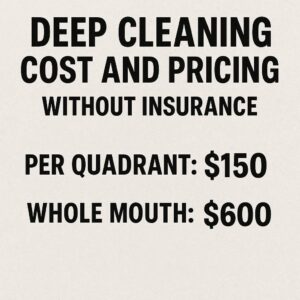
When paying without insurance, you are typically looking at a cost between $150 and $400 per quadrant.
To understand that, you need to know how dentists divide your mouth. The mouth is split into four parts (quadrants):
-
Upper Right
-
Upper Left
-
Lower Right
-
Lower Left
If your entire mouth requires treatment, you are looking at four quadrants. Based on the averages above, a full-mouth deep cleaning (all four quadrants) usually ranges from $600 to $1,600.
Here is a realistic breakdown of the national averages for cash patients:
| Treatment Area | Average Cost Range (Without Insurance) | Notes |
|---|---|---|
| Per Quadrant | $150 – $400 | Most common way to bill. Usually includes local anesthesia. |
| Full Mouth (4 Quads) | $600 – $1,600 | The total cost for treating all areas. |
| Per Tooth | $30 – $100 | Sometimes used if only a few teeth need treatment, though quadrant billing is standard. |
Breakdown by Quadrant vs. Full Mouth
You might wonder why dentists often prefer to bill by quadrant. The main reason is severity. Not every part of your mouth is always equally sick. You might have heavy buildup in the lower front teeth (where saliva glands are) but healthier gums in the upper back.
Billing by quadrant allows the dentist to charge specifically for the work done in that specific section of the mouth. If you need only two quadrants done, you shouldn’t have to pay for four.
Cost Factors That Influence the Final Bill
The “average” is just a starting point. Your final quote might be higher or lower based on these specific factors:
-
Geographic Location: A dentist in downtown Manhattan or Los Angeles has higher rent and staff salaries than a dentist in rural Iowa. Those costs are passed on to you. Expect prices to be higher in major metropolitan areas.
-
Severity of Disease (Mild vs. Advanced): If you have early-stage gum disease (gingivitis), the cleaning might be less invasive. If you have advanced periodontitis with deep pockets and heavy buildup, it requires more time, skill, and effort, driving the price up.
-
Anesthesia: Most deep cleanings require local anesthetic (novocaine shots) to keep you comfortable. This is usually included in the quadrant price, but it is always worth confirming. Some offices might bill it separately.
-
Antibiotic Treatments: After cleaning, the dentist might place a topical antibiotic (like Arestin) directly into the deep pockets to kill lingering bacteria. This is highly effective but can add $25 to $75 per tooth to your bill.
-
Laser Dentistry: Some offices use lasers in addition to or instead of traditional scalers. Laser therapy can be more comfortable, but it often carries a premium price tag.
The Sticker Shock: Why It Feels Expensive
When you hear “$1,200 for a cleaning,” it is natural to feel a bit of shock. After all, you can get your teeth “cleaned” at a mall kiosk for a fraction of that. However, understanding what goes into that cost can help you see the value—and justify the expense.
Time and Skill Involved
A routine cleaning might take 30 to 45 minutes. A deep cleaning for a single quadrant can take 45 minutes to an hour by itself.
The hygienist isn’t just “scrubbing” your teeth. They are performing a delicate surgical procedure. They are working below the gum line, where they cannot see directly. They have to use their instruments to “feel” the calculus on the root of the tooth and carefully scrape it off without damaging the tooth or the surrounding tissue.
This requires years of training and a great deal of precision. When you pay for a deep cleaning, you are paying for that expertise and the time it takes to do it right.
The Cost of Equipment and Sterilization
Dentist offices are not like regular stores. They are sterile medical environments. The instruments used on you (scalers, curettes) must be sterilized after every single use in industrial-grade machines called autoclaves.
The chair you sit in costs tens of thousands of dollars. The x-ray sensors cost thousands. The water lines must be treated to prevent bacterial growth. Every aspect of the environment is regulated by OSHA (Occupational Safety and Health Administration) to keep you safe. This overhead is significant, and it is factored into the price of every procedure.
Additional Costs to Anticipate
Very rarely does a deep cleaning happen in a vacuum. It is usually part of a larger treatment plan. When you are budgeting for deep cleaning cost and pricing without insurance, you must look at the whole picture, not just the cleaning itself.
The Cost of the Initial Exam and X-Rays
Before you get the cleaning, the dentist has to diagnose the problem. You cannot simply call up an office and say, “I’d like one deep cleaning, please.”
You will first need a comprehensive exam and a full set of x-rays. The x-rays are crucial because they show the dentist how much bone you have supporting your teeth. Bone loss is the hallmark of gum disease, and you can’t see it with the naked eye.
-
Comprehensive Exam: $50 – $150
-
Full Series of X-Rays: $100 – $250
Total Diagnostic Cost: You are likely looking at an additional $150 to $400 just to get the treatment plan.
Follow-Up Visits (Periodontal Maintenance)
This is the part of the deep cleaning cost and pricing without insurance that surprises patients the most. A deep cleaning is not a “one and done” deal.
Once you have been treated for gum disease, you are considered “periodontally compromised.” You cannot go back to the regular 6-month cleaning schedule. You will need what is called Periodontal Maintenance (often coded as D4910).
These cleanings are more frequent (usually every 3-4 months) and more involved than a standard cleaning. They are designed to keep the bacteria from coming back.
-
Cost of Periodontal Maintenance: $100 – $250 per visit.
If you need these visits 3 or 4 times a year, your annual maintenance cost after the initial deep cleaning can range from $300 to $1,000.
Potential Restorative Work
Sometimes, gum disease is discovered alongside cavities or broken fillings. While you are getting your gums healthy, the dentist may also recommend fixing those teeth. This is separate from the deep cleaning cost.
How to Save: Paying for a Deep Cleaning with No Insurance
Okay, so the numbers might look a little scary. But don’t close this tab in despair. There are more ways to afford dental care today than ever before. You just have to know where to look. Here is your action plan for affording a deep cleaning without insurance.
1. Dental Discount Plans (The Best Kept Secret)
This is usually the first thing I recommend to uninsured patients. Dental discount plans are not insurance. They are membership programs.
You pay a low annual fee (usually $80 to $200 per year), and in return, you get access to a network of dentists who have agreed to give you a discount (typically 20% to 50%) on their services.
-
How it works with Deep Cleaning: If a dentist normally charges $300 per quadrant, the discount plan might bring that down to $180 per quadrant. You pay the discounted rate directly to the dentist at the time of service.
-
Pros: No waiting periods, no claim forms, no annual maximums. You can often use it the very next day.
-
Popular Plans: Careington, Aetna Dental Access, Cigna Dental Savings.
-
Cost/Benefit: If you are facing a $1,500 deep cleaning bill, paying $100 for a plan that saves you $500 is a no-brainer.
2. In-House Membership Plans
Many private dental offices are moving away from the hassle of insurance altogether. They now offer their own “In-House Savings Plans.”
Think of this like a gym membership, but for your teeth. You pay the dentist a flat monthly or annual fee. In exchange, you get free or heavily discounted preventive care.
-
What it usually includes: Routine exams and cleanings (often 2 per year) are included in the membership price. Then, you usually get a significant discount (like 15%-20%) on other treatments like deep cleanings, fillings, and crowns.
-
Why it’s great: It keeps your money local, and the dentist doesn’t have to deal with insurance company restrictions. Call around to local offices and ask, “Do you offer an in-house savings plan for patients without insurance?”
3. Dental Schools: Supervised, Safe, and Affordable
If you live near a university with a dental school, this is the absolute cheapest way to get high-quality care. At a dental school, the procedure is performed by a student who is in their final years of training. However, they are closely supervised by experienced, licensed instructors.
-
The Catch: It takes time. A lot of time. A deep cleaning that takes an hour in a private practice might take three hours in a dental school because the student is learning and every step is checked.
-
The Savings: You can often get a deep cleaning for 50% to 70% less than a private practice. It is not uncommon to pay $100 to $200 for a full-mouth deep cleaning at a dental school.
-
Finding One: Search online for “dental schools near me” or check the American Dental Association’s website for a list of accredited programs.
4. Negotiating a Cash Discount
Never be afraid to have an honest conversation with the dentist’s office manager. Dental offices hate dealing with insurance as much as patients do. Many prefer cash-paying patients because they get paid on the spot and don’t have to wait 60 days for an insurance check.
Simply ask: “I don’t have insurance and I’m planning to pay with cash or card today. Do you offer a cash discount for self-paying patients?”
Many offices have a standard “self-pay discount” of 5% to 15% built into their policy. You won’t get it if you don’t ask.
5. Third-Party Financing (CareCredit)
For larger bills, you might need to spread the cost out over time. This is where healthcare credit cards like CareCredit come in.
-
How it works: You apply for the card and, if approved, you can use it to pay for medical and dental expenses.
-
The “Zero Interest” Trap: They often offer promotional financing like “6 months same as cash” or “12 months interest-free.” This is great if you can pay off the balance within that time.
-
Warning: If you fail to pay it off in the promotional period, they will charge you deferred interest on the original amount from the original purchase date. This can add up fast. Read the fine print carefully.
Comparing Your Payment Options
To help you visualize the best path forward, here is a comparison of how you might pay for a $1,200 deep cleaning procedure.
| Payment Method | Upfront Cost | Total Cost for Procedure | Best For… |
|---|---|---|---|
| Cash (No Plan) | $1,200 | $1,200 | Patients who have the funds readily available. |
| Dental Discount Plan | $100 (annual fee) + $840 (discounted rate) | $940 | Saving money immediately with little effort. |
| Dental School | $300 – $400 | $300 – $400 | Patients who are flexible with time and on a tight budget. |
| In-House Plan | Varies ($200-$400/year) + 15% off SRP | ~$1,100 | Patients who plan to stay with that dentist long-term. |
| CareCredit (12 Months) | $0 down, $100/month | $1,200 (if paid in 12 mos) | Patients who need to break payments into manageable chunks. |
The Hidden Cost of Waiting
When facing a big bill like this, our human instinct is often to procrastinate. “I’ll deal with it next year,” we tell ourselves. But in dentistry, time is literally money. Waiting doesn’t just make your gums worse; it makes your wallet thinner.
How Gum Disease Progresses
If you have been told you need a deep cleaning, you have active gum disease. This disease is not static. It is degenerative. The bacteria in the pockets slowly eats away at the bone that holds your teeth in place.
-
Today: You have deep pockets and inflammation. You need a deep cleaning (Scaling and Root Planing).
-
In a Year: You have lost bone structure. The deep cleaning might not be enough. Now you might need gum surgery or laser therapy to regenerate the lost bone. This can cost $2,000 to $5,000 per quadrant.
-
In a Few Years: You have lost so much bone that teeth become loose and need to be extracted. Replacing a tooth with an implant or bridge costs $3,000 to $6,000 per tooth.
Delaying a $1,200 deep cleaning today can easily turn into a $10,000+ reconstructive nightmare tomorrow. In this case, paying for the cleaning is actually the money-saving option.
Health Implications Beyond Your Mouth
Furthermore, gum disease isn’t confined to your mouth. It is a chronic inflammatory condition that has been linked to serious systemic health issues, including:
-
Heart disease
-
Diabetes complications (it makes it harder to control blood sugar)
-
Pregnancy complications
-
Respiratory infections
Paying for dental care is an investment in your total body health.
What to Expect During the Procedure
Knowing what is going to happen can reduce anxiety. Here is a step-by-step look at the deep cleaning process so you feel prepared when you go in for your appointment.
Numbing and Comfort
The first step is ensuring you are comfortable. The hygienist or dentist will apply a topical gel to your gums to numb the surface. Then, they will inject a local anesthetic (like novocaine). You will be completely awake, but you shouldn’t feel any sharp pain. You might feel vibrations and pressure, but that is normal.
Scaling and Root Planing
Once you are numb, the work begins.
-
Scaling: The hygienist uses specialized metal instruments called scalers or an ultrasonic device. The ultrasonic tool vibrates at a high frequency and sprays water to wash away debris. This breaks up the large chunks of tartar above and below the gum line.
-
Root Planing: This is the detailed part. The hygienist uses finer instruments called curettes to reach deep into the pockets. They carefully scrape the surface of the tooth root to remove the last bits of bacteria and toxins. They also smooth the root so that it is harder for bacteria to stick to it in the future, and easier for your gum tissue to re-attach.
Recovery and Aftercare
After the anesthetic wears off, your gums will likely be sore for a few days. They might bleed slightly when you brush. This is normal.
-
Pain Management: Over-the-counter pain relievers like ibuprofen (Advil) or acetaminophen (Tylenol) usually do the trick.
-
Diet: Stick to soft foods for the first 24-48 hours. Avoid anything too hot, spicy, or crunchy that might irritate your gums.
-
Oral Hygiene: You must keep the area clean. Brush gently but thoroughly. The dentist may recommend a special mouthwash or an irrigation syringe (like a Waterpik) to flush out the pockets as they heal.
Important Note: It is normal for your teeth to feel a little “rough” or for the gums to look like they are shrinking. The “shrinkage” is actually the swelling going down and the gums healing tightly around the tooth, which is exactly what you want.
Conclusion
Navigating deep cleaning cost and pricing without insurance can feel overwhelming, but knowledge is your best tool. While the average cost ranges from $600 to $1,600 for a full mouth, this is an investment in stopping a progressive disease that only gets more expensive (and dangerous) over time. By exploring options like dental discount plans, dental schools, and in-house memberships, you can make this essential treatment affordable. Remember, the most expensive route is always the path of delay.
Frequently Asked Questions (FAQ)
1. Is a deep cleaning really necessary? Can’t I just brush better?
If your gum pockets are deeper than 4mm, brushing and flossing simply cannot reach the bacteria hiding there. A deep cleaning is the only way to remove the hard tartar below the gum line and allow your gums to heal. Without it, you will continue to lose bone around your teeth.
2. How long does a deep cleaning take?
It depends on the severity. Usually, the dentist will treat half of your mouth per appointment. One quadrant can take 45 minutes to an hour. If you are getting two quadrants done in one visit, expect to be there for 90 minutes to two hours.
3. Does it hurt?
The procedure itself is performed under local anesthesia, so you should not feel sharp pain. You will feel pressure and vibration. After the anesthesia wears off, your gums will likely be tender for a day or two, similar to a healing wound.
4. Will my teeth look different after a deep cleaning?
Yes, often in a good way. You might notice that your teeth look cleaner and whiter. However, if you had significant tartar buildup, you might notice that your gums appear to have “shrunk” or that the spaces between your teeth look slightly larger. This is because the swollen, diseased gum tissue has healed and tightened up around the teeth, exposing the natural shape of your tooth.
5. Can I get a deep cleaning if I’m pregnant?
Yes, in fact, it is recommended. Hormonal changes during pregnancy can increase the risk of gum disease (pregnancy gingivitis), which has been linked to preterm birth. However, always inform your dentist that you are pregnant so they can take appropriate precautions.
6. Why did my dentist quote a different price than what I see online?
Online averages are just estimates. Your specific price is based on the severity of your gum disease, the time it will take, the cost of living in your city, and the specific techniques or technologies the dentist uses. Always ask for a written treatment plan with a detailed breakdown of costs.
Additional Resource
For a deeper dive into what gum disease is and how to prevent it from coming back, the American Academy of Periodontology offers a wealth of patient-friendly information. You can read more about the causes, symptoms, and maintenance of periodontal health here:
[Visit the American Academy of Periodontology Patient Page] (https://www.perio.org/for-patients/)