Facing the need for cataract surgery is stressful enough without the added anxiety of figuring out how to pay for it. If you don’t have health insurance—or if your insurance doesn’t cover the specific type of procedure you want—the financial aspect can feel overwhelming. You might be asking yourself, “Can I actually afford this?”
The honest answer is: it’s a significant expense, but it is manageable. You are not alone in this situation, and having a clear understanding of the costs involved is the first and most important step toward restoring your vision.
This guide is designed to pull back the curtain on the pricing of cataract surgery. We will break down exactly where your money goes, explore the different pricing tiers based on the lens you choose, and provide realistic, actionable strategies to help you afford the procedure without insurance. Let’s bring things into focus.
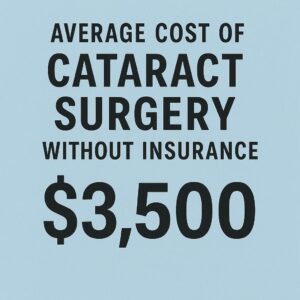
TABLE OF CONTENTS
ToggleThe Realistic Baseline: What You Can Expect to Pay
If you are paying for cataract surgery entirely out of pocket, you need to be prepared for a significant range in pricing. It is not a one-size-fits-all cost.
On average, the total price for standard cataract surgery in the United States typically falls between $3,500 and $7,000 per eye.
However, this is just the starting point. This baseline usually covers the most basic version of the surgery. Once you factor in different types of lenses (known as intraocular lenses or IOLs) and advanced laser technology, the price can climb to $10,000 or more per eye.
Important Note: This cost is almost always billed per eye. Cataracts usually develop in both eyes, but they are almost always operated on during separate sessions, usually a few weeks apart. Therefore, if you need surgery on both eyes, you should budget for double the per-eye cost.
Why is there such a huge price difference between a standard procedure and a premium one? It all comes down to the technology and the lens. Let’s open the hood and look at the itemized bill.
The Itemized Bill: Where Does the Money Go?
When you receive a quote for cataract surgery, it isn’t just one lump sum for “surgery.” It’s a package that combines several distinct services. Understanding these components will help you decipher quotes and ask better questions.
Here is a breakdown of the three main components of your bill:
1. The Surgeon’s Fee
This is the payment for the ophthalmologist’s time, skill, and expertise. It covers the pre-operative appointments, the surgery itself, and the standard post-operative care (usually for about 90 days). This fee varies based on the surgeon’s experience and location.
2. The Facility Fee (or Ambulatory Surgery Center Fee)
This covers the cost of using the operating room. Think of it like renting a venue. It includes the cost of nurses, technicians, equipment sterilization, and the supplies used during the procedure (other than the lens itself). This fee is often a significant portion of the total bill.
3. The Lens (Intraocular Lens or IOL)
This is the artificial lens that replaces your eye’s natural cloudy lens. The type of lens you choose has the biggest impact on the final price. We’ll dive deep into this in the next section.
4. Anesthesia Fee
A trained anesthesia provider (often a nurse anesthetist or an anesthesiologist) will be present to numb your eye and ensure you are comfortable during the procedure. This is typically a separate charge.
5. Pre- and Post-Operative Care
While often bundled into the surgeon’s fee, some practices may bill separately for specific pre-operative tests (like a special ultrasound to measure your eye) or post-operative visits beyond the standard follow-up period.
Visualizing the Costs:
To make this clearer, here’s a simplified look at how these fees might break down in a typical, standard surgery quote.
| Service Component | Estimated Cost Range (Per Eye) | What It Covers |
|---|---|---|
| Surgeon’s Fee | $1,500 – $2,500 | The doctor’s time, expertise, and standard follow-up care. |
| Facility / ASC Fee | $1,200 – $2,500 | Operating room use, staff, equipment, and standard supplies. |
| Anesthesia Fee | $400 – $800 | Professional fee for numbing and monitoring you during surgery. |
| Standard IOL (Monofocal) | Included (in standard package) | The basic lens implanted during the procedure. |
| Pre-Op & Post-Op Care | Often included in surgeon/facility fees | Measurements, exams, and follow-up visits. |
| TOTAL ESTIMATE | $3,500 – $6,500 | The final out-of-pocket cost for standard surgery. |
The Lens Factor: Why Your Choice of IOL Changes Everything
The most critical decision you will make—and the one with the biggest financial impact—is the type of intraocular lens (IOL) you choose. The standard lens included in the base price is called a monofocal lens. However, there are premium lenses that offer greater visual freedom but come with a significant additional cost.
Here is a breakdown of your options:
Standard Lens: Monofocal IOLs
-
What it does: It provides excellent vision at one distance—usually far. You will almost certainly need glasses for reading, using a computer, or other near-vision tasks.
-
Cost: This is the “baseline” lens. Its cost is included in the standard surgery package price mentioned above.
-
Who it’s for: People who don’t mind wearing glasses for near or intermediate tasks and want the most cost-effective solution.
Premium Lens 1: Toric IOLs (for Astigmatism)
-
What it does: If you have significant astigmatism (a curve in your cornea that blurs vision), a standard lens won’t correct it. A Toric IOL is specifically designed to correct astigmatism, giving you much sharper distance vision than a standard lens could.
-
Cost: Because this is a more technologically advanced lens, there is a significant premium upgrade cost. This is an additional out-of-pocket expense, often ranging from $1,000 to $2,500 per eye, on top of the base surgery cost.
Premium Lens 2: Multifocal or Extended Depth of Focus (EDOF) IOLs
-
What it does: These lenses are designed to reduce your dependence on glasses by providing vision at multiple distances. Multifocals have distinct zones for near and far, while EDOF lenses create a single, elongated focal point for continuous vision from distance to intermediate. Many people with these lenses can read a book, look at a computer, and drive without glasses.
-
Cost: This is the most advanced technology available. The premium upgrade for these lenses typically ranges from $2,500 to $4,000 per eye on top of the base surgical fee. This brings the total cost for surgery with a multifocal IOL to $6,000 – $10,000+ per eye.
Quick Reference: Lens Comparison Table
| Lens Type | Primary Benefit | Glasses Dependence After Surgery | Average Additional Cost (Per Eye) |
|---|---|---|---|
| Standard Monofocal | Clear vision at one distance (usually far) | High (for reading/near tasks) | $0 (included in base price) |
| Toric | Corrects astigmatism for sharp distance vision | Moderate to High (for near tasks) | +$1,000 – $2,500 |
| Multifocal / EDOF | Vision at multiple distances; reduces need for glasses | Low | +$2,500 – $4,000 |
A Personal Decision: This is not just a financial choice; it’s a lifestyle choice. If you love to read in bed at night or do detailed craft work, a multifocal lens might be a life-changer. If you are an avid golfer who only needs to see the fairway clearly and doesn’t mind slipping on reading glasses later, a monofocal lens might be perfect.
Factors That Influence Your Final Price
Beyond the lens, several other variables can cause the final quote to fluctuate. It’s helpful to be aware of these as you gather information.
-
Geographic Location: Just like rent and real estate, medical costs vary wildly by region. Surgery in a major metropolitan area like New York or Los Angeles will almost always cost more than in a rural town in the Midwest.
-
Surgical Technology: Standard cataract surgery is performed using a blade to make the incision (a process called phacoemulsification). A more modern, premium option is Laser-Assisted Cataract Surgery. Using a femtosecond laser for some of the most delicate steps can add precision but also adds another $1,000 to $2,000 per eye to the bill.
-
Surgeon’s Experience and Reputation: A highly renowned surgeon with decades of experience may command higher fees. For many patients, paying a premium for an expert is well worth the peace of mind.
-
Complications or Pre-existing Conditions: If you have a history of eye trauma, other eye diseases (like glaucoma), or if the cataract is particularly dense, the surgery may be more complex. This can increase the surgeon’s fee.
How to Pay for Cataract Surgery Without Insurance
Facing a bill of several thousand dollars is daunting, but it doesn’t mean you have to go without treatment. There are several legitimate paths to make this affordable. You have options, and it’s worth exploring every single one.
1. Shop Around and Compare Prices
This is the single most important thing you can do. Treat this like any other major purchase.
-
Call multiple practices. Ask for a comprehensive, itemized quote for a standard procedure and then ask about the cost of premium upgrades.
-
Ask about cash discounts. Many surgical centers will offer a discount—sometimes 5% to 10%—if you can pay the entire amount upfront in cash. This saves them the administrative hassle of billing.
2. Explore Financing and Payment Plans
-
In-House Payment Plans: Many ophthalmology clinics understand the burden of these costs and offer their own monthly payment plans. This allows you to pay the balance over 6, 12, or even 24 months. Ask if they offer interest-free options.
-
Medical Credit Cards: Companies like CareCredit are specifically designed for healthcare expenses. They often offer promotional financing, such as 6, 12, or 24 months with no interest if you pay the balance in full by the end of the term.
A Word of Caution: Read the fine print. If you fail to pay off the full balance by the end of the promotional period, you may be charged deferred interest—which means you’ll be billed for all the interest from the original purchase date at a very high rate.
3. Consider a Clinical Trial
The National Eye Institute and various universities are constantly researching new techniques and technologies for cataract surgery. These clinical trials sometimes offer the procedure at a reduced cost or even for free to qualified participants. It’s a long shot, but it’s worth investigating.
-
Where to look: Search online at ClinicalTrials.gov for studies related to cataracts in your area.
4. Investigate State and Non-Profit Assistance
You might be surprised to learn that there are programs designed to help people in exactly your situation.
-
Medicaid: Even if you don’t have private insurance, you may qualify for state-run Medicaid, which can cover the full cost of standard cataract surgery. Eligibility is based on income and family size.
-
Medicare Savings Programs: If you are 65 or older and have limited income, these state programs can help pay for your Medicare premiums and, in some cases, cost-sharing if you were to enroll in Medicare.
-
Sight-Improving Organizations: Non-profits like Surgical Eye Expeditions (SEE) International and Lions Clubs International have programs that connect volunteer surgeons with patients in need, sometimes providing surgery for free or on a sliding scale.
5. Health Savings Accounts (HSAs) or Flexible Spending Accounts (FSAs)
If you have a job that offers a high-deductible health plan, you might have an HSA. Or, during open enrollment, you might have signed up for an FSA. These accounts let you set aside pre-tax dollars for medical expenses. If you have funds in one of these accounts, you can use them to pay for your surgery tax-free, effectively giving you a discount equal to your tax bracket.
6. Travel for Surgery (Medical Tourism)
This is an increasingly popular option. The cost of cataract surgery in countries like Mexico, Costa Rica, or India can be 50% to 70% less than in the U.S. A procedure that costs $5,000 in the U.S. might cost $1,500 to $2,500 abroad, even at a top-tier private clinic.
-
Pros: Massive cost savings, and you can combine it with a vacation.
-
Cons: You must factor in travel and lodging costs. Follow-up care can be complicated if you have a problem after returning home. It requires extensive research to find a reputable, board-certified surgeon.
Frequently Asked Questions (FAQ)
Q: Is cataract surgery covered by insurance at all if I don’t have a plan?
A: If you have no insurance, it is not covered. However, if you have a high-deductible plan or are considering a premium lens, you should know that standard insurance (including Medicare) covers the cost of standard surgery with a monofocal lens. You would only pay out-of-pocket for your deductible, coinsurance, and any premium upgrades you choose.
Q: Can I have surgery on just one eye?
A: Yes, absolutely. Surgeons typically operate on one eye at a time, and you can choose to only have one done. However, if you have significant cataracts in both eyes, you will likely notice a strong imbalance in your vision between the operated eye and the untreated eye.
Q: Is it safe to delay cataract surgery?
A: Cataracts usually progress slowly. It is generally safe to delay surgery for months or even years, as long as you are still able to function and your eye doctor monitors the cataract. However, waiting until it is “ripe” or hyper-mature can make the surgery more difficult and risky. Your eye doctor is the best judge of this.
Q: What is the recovery time?
A: The initial healing is quick. You will likely rest the day of surgery and notice improved vision within a day or two. Most people can resume normal activities within a week, but you will need to use prescription eye drops for several weeks and avoid heavy lifting or strenuous exercise for about a month.
Q: Why do some clinics offer “deals” on surgery?
A: Be cautious. While some discounts for cash payment are legitimate, a price that seems too good to be true probably is. Make sure the quoted price is “all-inclusive” and that you know exactly which lenses and technology are included. It is always better to choose a surgeon based on reputation and trust, not just the lowest price.
Additional Resources
For further research and to find reliable information, these organizations are excellent resources:
-
The American Academy of Ophthalmology (AAO): www.aao.org – Offers patient-friendly guides to cataract surgery and lens options.
-
The National Eye Institute (NEI): www.nei.nih.gov – Provides information on eye health and links to clinical trials.
-
ClinicalTrials.gov: – A database of privately and publicly funded clinical studies around the world.
Conclusion: Clarity Is Worth the Investment
Paying for cataract surgery without insurance is a significant financial undertaking. You are likely looking at a minimum investment of several thousand dollars per eye. However, by understanding that the cost reflects the surgeon’s expertise, the facility, and most importantly, the type of lens you choose, you can make an informed decision that fits both your budget and your lifestyle. Remember that you have options—from shopping around and negotiating to financing or even traveling for care—to make this essential procedure accessible.
Disclaimer: The information provided in this article is for informational purposes only and does not constitute medical advice. Prices and policies are subject to change and vary by provider and location. You should always consult with a qualified ophthalmologist and financial counselor to get accurate information for your specific situation.