If you have recently purchased a side-by-side—or you are thinking about getting one—you already know the thrill they bring. Whether you use it for farming, hunting, trail riding, or just tearing up the dunes, your Utility Task Vehicle (UTV) is an investment. And like any valuable investment, you need to protect it.
But here is the question that stops many buyers in their tracks: How much is this going to cost me every year?
Trying to pin down the average UTV insurance cost can feel frustrating. You might call one company and get a quote for $150 a year, and another quotes you $800. Why the massive difference? Are you being overcharged, or is the cheap quote missing something important?
We are going to clear up the confusion. In this guide, we will break down exactly what the average UTV insurance cost looks like in 2026, what factors move the price up and down, and how you can make sure you are paying the right amount for the coverage you actually need.
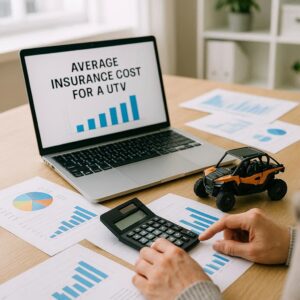
What is the Average UTV Insurance Cost?
Let’s get straight to the numbers. Because “average” can mean different things depending on where you live and what you drive, we need to look at a realistic range.
For a standard, recreational UTV policy with full coverage (which includes liability, comprehensive, and collision), most owners in the United States pay between $300 and $800 per year.
However, if you are insuring a basic utility model used on your property and you only need minimum liability, you might pay as little as $150 to $250 annually. On the flip side, if you own a high-horsepower, turbocharged machine designed for racing, your premiums can easily climb past $1,200 to $2,000+ per year.
To give you a clearer picture, here is a breakdown based on common rider profiles:
| Rider Profile | Average Annual Premium | Typical Coverage Level |
|---|---|---|
| Occasional Trail Rider | $150 – $300 | State Minimum Liability / No Comp |
| Weekend Enthusiast | $350 – $600 | $100k Liability, Comp/Coll, $500 Deductible |
| Farm & Utility User | $250 – $450 | Property Damage Focus, Theft Coverage |
| Performance / Sport Owner | $700 – $1,500+ | High Limits, Accessory Coverage, Racing Coverage* |
| Youth / Starter Model | $200 – $400 | Moderate Limits, Safety Course Discounts |
*Note: Standard policies often exclude racing. You may need a specialty policy for competitive use.
As you can see, there is a wide spectrum. The average UTV insurance cost is rarely a flat number because the machine itself is so versatile. Let’s look at why your specific price might land on the higher or lower end of that scale.
5 Key Factors That Determine Your UTV Insurance Cost
Insurance companies are in the business of calculating risk. They want to know the likelihood that you will file a claim and how expensive that claim might be. Here are the main variables they look at when calculating your premium.
1. The Value and Type of Your UTV
This is the biggest factor. It costs more to replace a $25,000 Can-Am Maverick R than a $8,000 Honda Pioneer.
-
Make & Model: Sport models with high top speeds are statistically more likely to be involved in accidents than slower, utility-focused machines.
-
Engine Size: Larger engines generally mean higher risk (and higher fun, but also higher cost).
-
Age: A brand-new machine will cost more to insure than a 10-year-old workhorse because the potential payout is higher.
2. How You Use the Vehicle
“Pleasure use” is a broad term. Insurers want specifics.
-
Recreation Only: You ride on weekends on designated trails. This is moderate risk.
-
Farm/Property Use: You use it to haul hay or check fences. This is often lower risk, especially if it never goes on public roads.
-
Hunting: This can be moderate risk depending on the terrain, but theft coverage is crucial here.
-
Racing or Dunes: This is high risk. Aggressive driving and jumps lead to breakdowns and crashes.
3. Where You Live and Ride
Location, location, location. Your ZIP code matters.
-
Garaging Location: If you live in an area with high theft rates, your comprehensive premium (which covers theft) will be higher.
-
Riding Terrain: Living near the Glamis Dunes in California or the muddy trails of the Southeast might signal to insurers that your machine will be worked hard, increasing the risk of damage.
4. Your Driving Record (and History)
Yes, even if you never take it on the highway, your record matters.
-
Previous Claims: If you have filed claims on your UTV or other vehicles in the past, you are statistically more likely to do so again.
-
Tickets: DUIs are a massive red flag. Insuring a UTV for someone with an impaired driving charge is very expensive, if not impossible with standard carriers.
-
Experience: New riders generally pay more than those who have been riding for 10 years.
5. The Coverage You Choose (Deductibles & Limits)
This is the one factor you have 100% control over.
-
Deductible: Choosing a $1,000 deductible instead of a $250 deductible can significantly lower your premium. Just make sure you can afford the deductible if you have a crash.
-
Liability Limits: Buying higher limits (like $300,000 instead of the state minimum of $25,000) will cost more, but it protects your savings and future wages if you cause an accident.
“I always tell my clients, ‘Don’t look at the monthly payment alone. Look at the gap between what you owe on the UTV and what the insurance will pay if it’s totaled.’ The average UTV insurance cost is a bargain compared to the cost of replacing a $20,000 machine out of pocket.”
— Mike Thompson, Independent Insurance Agent
Types of UTV Insurance Coverage Explained
To understand the bill, you have to understand the “ingredients.” A standard UTV policy is usually a mix of several different coverage types. Knowing what each one does will help you customize your average UTV insurance cost to fit your actual needs.
Liability Coverage (Required in Most States)
This is the foundation of any policy. If you cause an accident that injures someone else or damages their property, liability coverage pays for it.
-
Bodily Injury: Pays for the other person’s medical bills.
-
Property Damage: Pays to fix the fence you hit or the other UTV you dented.
-
Why it matters: If you don’t have this and cause a serious injury, you could be personally sued for the costs.
Collision Coverage
This pays to repair your UTV if you hit a tree, roll it over, or crash into a rock. If you still have a loan on your machine, the bank will almost certainly require this.
Comprehensive Coverage
This covers “other stuff” that isn’t a crash. Think:
-
Theft
-
Fire
-
Vandalism
-
Falling trees or objects
-
Flood damage
-
Animal strikes (hitting a deer)
Accessories / Custom Parts Coverage
This is a big one. You put a $2,000 winch, a roof, and a custom stereo on your rig. If you total the UTV, a standard policy might only cover the base “book value” of the machine.
-
Tip: If you have invested heavily in modifications, you need this endorsement to protect that money. It usually adds a bit to the average UTV insurance cost, but it protects thousands in gear.
Uninsured/Underinsured Motorist
This protects you if you are hit by someone who either has no insurance or not enough insurance to cover your injuries or damage.
Medical Payments (MedPay)
This covers your medical bills (and your passenger’s) after an accident, regardless of who is at fault. It is a simple way to cover deductibles on your health insurance or immediate medical needs.
Does Insurance Cost More for a UTV than an ATV?
This is a common question. Generally, yes, UTVs cost more to insure than ATVs.
Here is the simple breakdown:
-
ATVs (4-wheelers): They are smaller, carry one person, and are generally less expensive to purchase. The average ATV insurance cost might run from $100 to $300 per year.
-
UTVs (Side-by-Sides): They are bigger, heavier, carry passengers, and cost significantly more to buy. Because the replacement cost is higher and the potential for passenger injury exists, the average UTV insurance cost is roughly double that of an ATV.
Think of it this way: insuring a UTV is closer to insuring a small car than it is to insuring a dirt bike. The sheer mass and complexity drive the price up.
Ways to Lower Your UTV Insurance Premium
Nobody wants to overpay. While you need adequate protection, there are completely legitimate ways to lower that annual bill without sacrificing coverage.
1. Take a Safety Course
Many insurers offer a discount if you complete a recognized ATV/UTV safety course. It shows the company you are a responsible rider who knows how to handle the machine.
2. Bundle Your Policies
This is usually the easiest way to save. If you insure your home, car, and boat with a company, adding your UTV can often get you a multi-policy discount of 10% to 20%.
3. Join a Riding Club or Association
Organizations like the American Motorcyclist Association (AMA) or local off-road clubs often have partnerships with insurance companies that provide exclusive member rates.
4. Increase Your Deductible
If you have some cash saved up, raising your comprehensive and collision deductible from $250 to $1,000 can drop your premium significantly. You are essentially self-insuring the smaller bumps and scrapes.
5. Pay Annually, Not Monthly
Insurance companies often charge installment fees for spreading payments out over the year. If you can afford to pay the full premium in one go, you can often save 3-5%.
6. Store It Securely
Keeping your UTV in a locked garage or shed, especially in a high-theft area, can lower your comprehensive premium. Thieves love easy targets left in the driveway.
Common Mistakes to Avoid When Buying UTV Insurance
As you shop around, be careful. Trying to save a few bucks can lead to major headaches later. Here are the pitfalls to avoid:
-
Assuming Your Homeowners Insurance Covers It:
This is the most common mistake. Your homeowners or renters policy might cover the UTV if it is stolen from your property, but it usually provides zero liability coverage if you drive it down the street. And if you crash into a neighbor’s car? You are on your own. Never rely on home insurance for a motor vehicle. -
Buying the State Minimum Only:
UTVs can cause a lot of damage. They are heavy and fast. If you cause a multi-vehicle accident and only have $25,000 in liability coverage, you could be responsible for the remaining $100,000+ out of your own pocket. -
Ignoring the “Gap”:
If you financed your UTV, look into Gap Insurance. If you total the machine in the first year or two, you might owe $18,000 on the loan, but the insurance company says it is only worth $14,000 due to depreciation. Gap coverage pays the difference. -
Not Listing Modifications:
If you don’t tell your insurer about the lift kit and big tires, and you total the UTV, they will only pay for the stock value. “Upgrades” are only covered if you specifically insure them.
Conclusion
Finding the right protection for your side-by-side is a balancing act. While the average UTV insurance cost hovers between $300 and $800 per year, your final price will depend entirely on your machine, your habits, and the coverage levels you choose. By understanding the factors that influence the rate—from the model you drive to how you store it—you can make smart decisions. Don’t just buy the cheapest policy you find; invest in one that will actually be there for you when you are miles down a trail and something goes wrong. Protect your ride, protect your savings, and enjoy the adventure with peace of mind.
Frequently Asked Questions (FAQ)
Q: Is UTV insurance required by law?
A: It depends on where you live. If you drive your UTV on public lands, streets, or roads, most states require liability insurance, similar to a car. If you only ride on your private property, it may not be legally required, but it is still highly recommended to protect against theft and accidents.
Q: Does my credit score affect my UTV insurance cost?
A: In many states, yes. Insurers often use credit-based insurance scores to predict the likelihood of claims. Maintaining good credit can help you secure a lower rate.
Q: Can I insure a UTV for off-road use only if I have a permit?
A: Absolutely. Many companies offer specific policies for vehicles that never touch public asphalt. These policies often focus on comprehensive (theft/fire) and liability for off-road incidents, which can be very affordable.
Q: How does UTV insurance handle a total loss?
A: If your UTV is totaled, the insurance company will typically pay you the Actual Cash Value (ACV) . This is the replacement cost minus depreciation. Some specialty insurers offer “Stated Value” or “Agreed Value” policies for custom or classic models, which pay a set amount agreed upon when you buy the policy.
Q: Will insurance cover me if I roll my UTV?
A: Yes, if you have Collision Coverage on your policy. A rollover is considered a collision with the ground, and the coverage would apply, minus your deductible.
Additional Resource
To ensure you are riding legally and responsibly, always check the specific regulations for your state. For a comprehensive list of state-by-state laws regarding UTV operation on public lands and roads, visit the Recreational Off-Highway Vehicle Association (ROHVA) website at www.rohva.org. They provide excellent, unbiased resources for riders of all levels.