As a pilot, your life is defined by precision, calculated risk, and a unique lifestyle that often involves time away from home. While you’re expertly managing the variables in the air, have you given the same consideration to protecting your belongings on the ground? Renters insurance is a critical, yet often overlooked, part of a pilot’s financial security. But one question consistently comes in for a landing: what does pilot renters insurance actually cost?
The short answer is that the average pilot can expect to pay between $150 and $350 per year for a robust renters insurance policy. However, that’s just the altimeter reading. The true cost is influenced by a unique flight plan of factors specific to your profession and lifestyle.
This comprehensive guide is your co-pilot to understanding renters insurance costs. We’ll navigate through the standard pricing components, uncover the unique factors that affect premiums for pilots, and provide you with the checklists and strategies to secure the best possible coverage without overspending. Our goal is to empower you with knowledge, so you can make an informed decision that protects your home base, no matter where your career takes you.
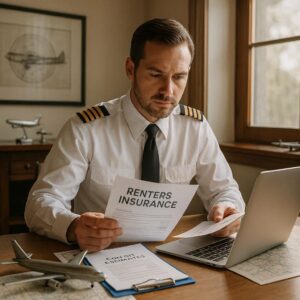
Pilot Renters Insurance Cost
Understanding the Fundamentals of Renters Insurance
Before we chart the specific costs, let’s establish what renters insurance is and what it does. In essence, it’s a safety net for your personal life on the ground.
Renters insurance is a policy that protects your personal property (like electronics, clothing, and furniture) from covered perils like theft, fire, or vandalism. It also provides liability coverage if someone is injured in your home and can help pay for additional living expenses if your rental becomes uninhabitable.
For a pilot, this isn’t just about replacing a stolen TV. It’s about safeguarding the high-value, often specialized equipment you may own, from noise-canceling headsets and iPads with aviation software to uniforms and luggage. More importantly, it’s about liability protection. A slip-and-fall incident in your apartment while you’re on a multi-day trip could lead to a costly lawsuit—coverage that is invaluable for a professional with a future earning potential to protect.
The Three Core Components of a Policy
-
Personal Property Coverage: Replaces your belongings if they are damaged or stolen.
-
Liability Coverage: Protects your assets if you are found legally responsible for injuring someone or damaging their property.
-
Loss of Use (Additional Living Expenses): Covers hotel bills, meals, and other costs if you cannot live in your rental due to a covered event.
Breaking Down the National Average Cost
To understand where pilot costs might deviate, we need to start with the baseline. According to industry data, the average annual cost of renters insurance in the United States is approximately $180 to $250. This is for a standard policy with around $30,000 in personal property coverage and $100,000 in liability coverage.
However, this is a nationwide average that includes all professions and life situations. It’s a useful reference point, but your specific premium will be calculated based on a personal risk profile.
Comparative Cost Table: Standard vs. Pilot Considerations
| Factor | Standard Policyholder Consideration | Pilot-Specific Impact on Cost |
|---|---|---|
| Occupation | Rarely a primary rating factor. | Can be a significant factor. Insurers may view pilots as responsible and lower-risk, potentially lowering cost. |
| Personal Property Value | Based on a typical tenant’s belongings. | Often higher. Aviation gear, frequent traveler electronics, and quality luggage can increase the needed coverage amount. |
| Lifestyle & Time Away | Not typically a major factor. | Major factor. Extended time away from home can be seen as a higher risk for theft or undetected damage (like a leak). |
| Location (State/City) | A primary cost driver based on local crime and weather risks. | Remains a primary driver, regardless of profession. |
| Credit-Based Insurance Score | Heavily weighted in most states. | Heavily weighted, but a pilot’s typically stable income can support a strong score. |
Key Factors That Determine Your Premium as a Pilot
Your insurance cost is not a random number. It’s a calculated assessment of risk. Here are the main variables insurers evaluate, with a focus on how they apply to pilots.
1. Location, Location, Location
Your apartment’s ZIP code is perhaps the biggest cost driver. Insurers assess local crime rates, weather-related risks (wildfire, hurricane, tornado zones), and even the frequency of insurance claims in your area.
Note for Pilots: If you’re based in a high-cost city (e.g., New York, San Francisco, Miami) or a state prone to natural disasters, your base premium will be higher. This is unavoidable but underscores the need for coverage.
2. Coverage Limits and Deductibles
This is the lever you control most directly.
-
Higher Coverage Limits = Higher Premium. Accurately valuing your belongings is key. Underinsuring to save $50 a year is a catastrophic financial risk.
-
Higher Deductible = Lower Premium. The deductible is what you pay out-of-pocket before insurance kicks in. Opting for a $1,000 deductible instead of a $500 deductible can lower your annual premium, but you must be prepared to cover that larger amount if you file a claim.
3. Your Unique Profession & Lifestyle
This is where your pilot status comes into clear focus.
-
The “Responsible Professional” Discount: Many insurers statistically view pilots, along with engineers, accountants, and scientists, as lower-risk policyholders due to their training, responsibility, and often stable financial standing. Always ask if your insurer offers a professional or occupational discount.
-
The “Frequent Traveler” Surcharge (Perceived Risk): Conversely, being away from home for days at a time can be seen as increasing the risk of burglary or undetected problems (e.g., a pipe leaking for days). You must disclose how often you are away. Mitigate this by discussing safety features like an alarm system or timed lights, which may qualify for other discounts.
4. The Value of Your Belongings (Especially Gear)
A standard policy might estimate $30,000 for personal property. A pilot’s inventory often requires a closer look:
-
Aviation headsets (Bose A20, etc.): $800 – $1,300
-
ForeFlight/iPad/EFB setup: $1,000 – $2,000
-
Professional uniforms & luggage: $1,000+
-
General electronics (laptop, camera, TV): Variable
We strongly recommend creating a home inventory. This ensures you purchase adequate coverage and simplifies the claims process.
5. Credit-Based Insurance Score
In most states, insurers use a credit-based insurance score to predict likelihood of filing a claim. It’s different from a standard FICO score but correlates strongly. Maintaining good credit is one of the most effective ways to keep insurance costs down.
6. Safety, Security, and Bundling
-
Security Systems: Having a centrally monitored alarm or smart home system can net a discount of 5-15%.
-
Fire/Smoke Detectors: Modern, interconnected systems may also qualify.
-
Policy Bundling: This is often the largest discount available. Bundling your renters insurance with your auto insurance (e.g., with providers like State Farm, Allstate, or GEICO) can save you 15-25% on both policies.
Realistic Cost Scenarios for Pilots
Let’s move from theory to practical numbers. These are estimated annual premiums for a policy with $40,000 in personal property coverage, $100,000 in liability, and a $500 deductible.
| Pilot Profile | Location Profile | Estimated Annual Premium | Key Cost Drivers |
|---|---|---|---|
| First Officer, Regional Airline | Medium-sized Midwest city (e.g., Indianapolis) | $170 – $220 | Lower location risk, occupational discount may apply, moderate personal property value. |
| Captain, Major Airline | Suburb of a major hub (e.g., Dallas-Fort Worth) | $220 – $300 | Higher personal property value, possible higher liability limit needs, still potential for occupational discount. |
| Corporate Pilot | High-cost coastal city (e.g., Los Angeles) | $300 – $450+ | High location risk, high personal property value for specialized gear, frequent travel profile. |
| CFI (Flight Instructor) | Smaller town near a flight school | $140 – $200 | Lower location risk and property value, but ensure liability limits are sufficient for your needs. |
Actionable Strategies to Manage Your Pilot Renters Insurance Cost
-
Shop Around and Compare: Get at least three quotes. Use independent insurance agents who can access multiple companies.
-
Ask Directly About Professional Discounts: Don’t assume the quote includes it. Say, “I’m a commercial airline pilot. Do you offer any occupational or professional discounts?”
-
Bundle Your Policies: The savings are too significant to ignore. Compare the bundled price to your current standalone policies.
-
Increase Your Deductible Wisely: If you have a healthy emergency fund, raising your deductible from $500 to $1,000 can offer meaningful premium savings.
-
Optimize Your Coverage: Don’t over-insure low-value items, but do add scheduled personal property endorsements for very high-value single items (e.g., a specialized watch or camera lens).
-
Improve Your Security: Install a monitored alarm system, smart locks, or water leak detectors. Submit proof to your insurer for discounts.
-
Maintain Excellent Credit: Pay bills on time and keep credit card balances low.
Critical Notes and Common Pitfalls to Avoid
Important Note: Your landlord’s insurance policy covers only the building itself. It provides zero coverage for your personal belongings or liability within your rented unit. Relying on it is a major financial risk.
-
Don’t Underestimate Liability Coverage: As a high-earning professional, you are a target for lawsuits. We recommend pilots carry a minimum of $300,000 to $500,000 in liability coverage. The cost to increase from $100k to $300k is usually minimal—often just $20-$40 more per year.
-
Understand “Actual Cash Value” vs. “Replacement Cost”:
-
Actual Cash Value (ACV): Pays the depreciated value of your item. A 5-year-old TV might be valued at $100.
-
Replacement Cost Value (RCV): Pays what it costs to buy that same or similar item new today. It costs more in premiums but is almost always worth it.
-
-
Document Everything: Use your phone to take a video walkthrough of your apartment, opening drawers and closets. Store this video and receipts in the cloud. This is invaluable after a major loss.
Conclusion
Securing the right renters insurance as a pilot is a straightforward yet crucial pre-flight check for your financial well-being. While the average cost typically ranges from $150 to $350 annually, your final premium is a personalized calculation based on your location, belongings, and the unique aspects of your aviation career. By shopping strategically, leveraging professional discounts, bundling policies, and prioritizing robust liability coverage, you can obtain comprehensive protection that safeguards your assets and provides peace of mind, wherever your journeys may lead.
Frequently Asked Questions (FAQ)
Q: Does my renters insurance cover my flight bag and gear when I’m traveling for work?
A: Typically, yes. Renters insurance generally provides “off-premises” coverage for your belongings anywhere in the world, usually up to 10% of your total personal property limit. So if you have $40,000 of coverage, about $4,000 would apply to items stolen from your hotel or car. Check your policy for specific exclusions.
Q: I have roommates who are also pilots. Do we need one policy or separate ones?
A: Separate policies are almost always recommended. A single policy would list all roommates as named insureds, which can complicate claims and liability. If one roommate causes a fire, it could impact the coverage for all. Individual policies protect each person’s property and liability independently.
Q: Are there any insurance providers that specialize in coverage for pilots?
A: While there are aviation-focused insurance agencies for life, disability, and aircraft insurance, renters insurance is generally obtained through standard residential insurers. Your best approach is to use a mainstream provider (like those you’d bundle with auto insurance) and ensure you disclose your profession to secure any available discounts.
Q: How does having a home security system actually lower my cost?
A: Insurers offer discounts for devices that reduce the risk of a theft or catastrophic loss claim. A centrally monitored alarm that alerts authorities to a break-in or fire can qualify you for a discount of 5% to 15%. Even non-monitored devices like water leak sensors may be recognized by some insurers.
Additional Resources
For further guidance on creating a home inventory and understanding insurance terminology, a valuable resource is the Insurance Information Institute’s website: III.org – Renters Insurance Guide. This non-profit organization provides clear, unbiased information to help consumers make informed decisions.