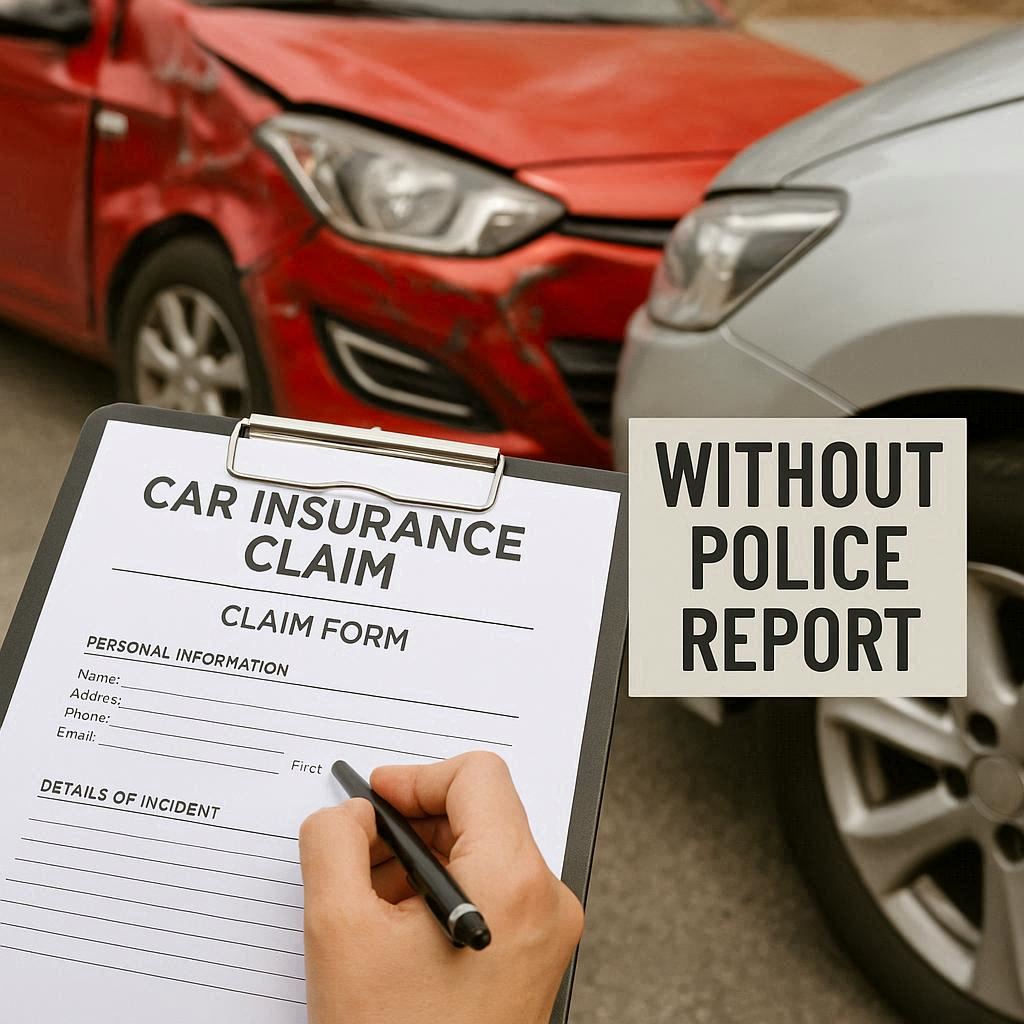
You just backed into a concrete pole in a parking garage. Or maybe a shopping cart hit your door, and the owner is long gone. Now you are asking yourself a very common question: Can I file a car insurance claim without a police report?
The short answer is yes, often you can. But the real answer is more detailed. Insurance companies care about facts, evidence, and truth. A police report is just one tool to prove what happened.
In this guide, we will walk through exactly when you can skip the police report, when you really should not, and how to handle your claim like a pro. No confusing legal talk. Just honest, practical advice.
Understanding the Role of a Police Report in Car Insuranc
Before we talk about claims without a report, let us understand why police reports matter so much to insurers.
A police report acts as an official third-party record of an incident. The officer who writes it has no financial stake in your claim. They do not care if your premium goes up. They simply document facts:
- The date, time, and location of the accident.
- Statements from both drivers.
- Witness contact information.
- Weather and road conditions.
- Any citations issued.
- A diagram of how the collision happened.
Insurance adjusters love police reports because they add credibility. When you file a claim with a report, the adjuster spends less time investigating. Without one, you have to work harder to prove your story.
But here is the truth. In many real-world situations, police will not even come to the scene.
When Police Will Not Respond to an Accident
In many cities, police only respond to accidents involving injuries, major damage, or blocked roadways. A minor fender bender in a grocery store parking lot? They will tell you to exchange information online or at a reporting center.
This means millions of drivers face the same situation every year. They have damage, but they have no police report. And that is okay, as long as you know what to do next.
Situations Where You Can File a Claim Without a Police Report
Let us look at common scenarios where insurers will accept a claim without a police report. Remember, every insurance company has slightly different rules, but these general principles apply almost everywhere.
1. Single-Vehicle Accidents on Private Property
You hit a low wall in your apartment parking garage. No other car involved. No injuries. You are the only driver.
In this case, a police report is rarely necessary. You simply damaged your own car. The insurance company will want photos, a description of what happened, and possibly a repair estimate. They will not demand an officer’s signature.
2. Hit-and-Run While Parked
You come out of the movie theater and find a new dent on your rear bumper. No note on the windshield. No cameras in sight.
This is frustrating, but it is also very common. Most insurers allow you to file a hit-and-run claim without a police report. However, some states require a report for uninsured motorist coverage to apply. Check your policy or call your agent.
3. Minor Collisions with No Injuries and No Disputes
You and another driver tap bumpers at a stop sign. You both pull over. You exchange information. You agree on what happened. Nobody is hurt. Damage looks minor.
If everyone agrees and leaves peacefully, police will not come. You can still file a claim. Just document everything yourself.
4. Damage from Road Hazards
A deep pothole bends your wheel. A piece of tire on the highway cracks your bumper. A fallen tree branch scratches your roof.
These are comprehensive claims, not collision claims. Police do not investigate road debris. File your claim, send photos, and move on.
5. Vandalism or Theft Attempts
Someone keyed your door. A thief broke your window but took nothing. Your tires are slashed.
Police may or may not come for vandalism. If they do not, you can still file an insurance claim. Insurance companies expect vandalism claims without a report, though a case number from a phone report helps.
When You Absolutely Should Get a Police Report
Now let us be very clear. In some situations, filing a claim without a police report is a bad idea. Here is when you should insist on a report, even if you have to wait an hour.
The Other Driver Disagrees with You
The light was green. You are sure of it. But the other driver says you ran a red. Right there at the scene, you already have a dispute.
Without a police report, it becomes your word against theirs. Insurance companies hate these cases. They may split fault 50/50, raising both your premiums. An officer’s opinion on who violated traffic law can change everything.
Anyone Is Injured
Even a minor complaint of neck pain changes the situation. Injuries mean medical payments, possible lawsuits, and much higher claim values.
You need an official record. Do not handle this yourself. Call 911 and get an officer to the scene.
The Damage Looks Major
Your car is not drivable. Airbags deployed. Fluids are leaking onto the street.
This is serious damage. Insurance companies will investigate thoroughly. A police report adds immediate credibility and speeds up your claim. Without it, you might face delays or even denial.
You Suspect Fraud
The other driver seems overly eager to leave. They do not want to exchange information. Or they insist on cash right now, no insurance involved.
These are red flags. Protect yourself. Get a police report to document the other driver’s behavior and identification.
Your State Legally Requires a Report
Some states, like New York, California, and Texas, require you to file a traffic accident report with the DMV if damage exceeds a certain amount, often $1,000. This is separate from calling police to the scene. But having an officer write a report at the scene makes your state filing much easier.
| State | Damage Threshold for Required Report | Must Police Come to Scene? |
|---|---|---|
| California | $1,000 | No, but you must file SR-1 form |
| Texas | $1,000 | No, but you must file CR-2 |
| New York | $1,000 | No, but you must file MV-104 |
| Florida | $500 | No, but you must file self-report |
| Illinois | $1,500 | No, but you must file SR-1 |
Check your local laws. These thresholds change.
Step-by-Step: How to File a Claim Without a Police Report
So you have decided to move forward without a report. Great. Here is your action plan. Follow these steps carefully.
Step 1: Secure the Scene and Check for Injuries
Safety first. Move your car if it is blocking traffic. Turn on hazard lights. Check yourself and any passengers for pain. If anyone is hurt, stop everything and call 911.
Step 2: Document Everything Yourself
This is the most important step. Your phone is now your best friend. Do not skip this.
- Take wide photos. Show the whole scene from different angles.
- Take close-up photos. Capture all damage, including scratches and dents.
- Take photos of license plates. Both your car and any other cars involved.
- Take photos of street signs, intersections, or parking spots. This helps prove location.
- Write down what happened immediately. Open a notes app. Write the time, date, weather, road conditions, and a sequence of events. Do this before you forget details.
Step 3: Exchange Information (If Another Driver Is Involved)
Get:
- Full name and contact number.
- Insurance company and policy number.
- Driver’s license number and state.
- Vehicle make, model, color, and license plate.
Take a photo of their driver’s license and insurance card. If they refuse, take a photo of their license plate and call the police.
Step 4: Find Witnesses
Look around. Did anyone see what happened? That person walking into the pharmacy. The security guard at the parking booth. The driver waiting behind you.
Ask politely: “Excuse me, did you see this? Would you be willing to give me your contact info for my insurance?”
Most people will help. Get their name and phone number. A witness statement can replace a police report in many cases.
Step 5: Write Your Own Statement
Before you call your insurance, write a clear, factual statement. Use this template:
“On [date] at [time], I was driving my [year, make, model] on [street name]. The weather was [sunny/rainy/clear]. Traffic was [light/heavy]. I was stopped at a red light when the other driver, [description], hit my rear bumper. I felt no injuries. We pulled into the gas station on the corner. I took photos. We exchanged information. No police came to the scene.”
Stick to facts. Do not guess. Do not say “I think” or “maybe.” Just describe.
Step 6: Call Your Insurance Company
Open your insurance app or call their claims number. Tell the representative: “I was in an accident. There is no police report, but I have photos, witness contact info, and a written statement.”
They will guide you through their process. Some insurers let you upload everything online. Others will email you a link. Be responsive. Send what they ask for quickly.
Step 7: Keep a Claim File
Create a folder on your phone or computer. Name it “Claim [date].” Save everything:
- All photos.
- Your written statement.
- Any texts or emails with the other driver.
- The claim number from your insurance.
- Names and dates of everyone you speak with.
This organization will save you headaches later.
How Insurance Companies Investigate Claims Without Police Reports
You might wonder: If there is no police report, how does the insurance company know I am telling the truth?
Great question. Adjusters have many tools.
Photo Analysis
Adjusters are trained to look at photos and spot inconsistencies. Does the damage pattern match your story? If you say you hit a pole while backing up, but the damage is on your front bumper, that raises questions. Your photos need to be clear and honest.
Scene Reconstruction
For larger claims, insurers may send someone to the actual location. They will measure skid marks, look at traffic light timing, and examine sightlines. This is rare for minor claims but common for disputed, serious accidents.
Witness Interviews
If you provided witness contacts, the adjuster will call them. A neutral witness who confirms your story carries almost as much weight as a police officer.
Digital Evidence
Insurance companies can request traffic camera footage, business security footage, or even data from your car’s event data recorder (black box) if your car is newer. They rarely do this for small claims, but for large or suspicious claims, they will.
Your Driving History
Adjusters look at your record. A driver with a clean history and no past claims gets more trust than a driver with three at-fault accidents in two years. Fair or not, that is reality.
Important Note: Insurance fraud is a serious crime. Never exaggerate damage or lie about what happened. Insurers have special investigation units (SIUs) that include former police officers and fraud experts. They will find inconsistencies. Honesty is always your best policy.
Types of Coverage and How They Apply Without a Police Report
Different parts of your auto policy have different rules. Let us break them down.
Collision Coverage
This pays for damage to your car from hitting another car or object, regardless of fault. You can absolutely file a collision claim without a police report. Your deductible applies. The insurer will still investigate, but a missing report is not a dealbreaker.
Comprehensive Coverage
This pays for theft, vandalism, weather damage, fire, and animal strikes. These events rarely have police reports. Comprehensive claims without a report are standard. Your insurer may still ask for photos and a description.
Liability Coverage
This pays for damage you cause to others. If you admit fault and the other driver agrees, you can file a liability claim without a police report. But if the other driver later changes their story, you will wish you had a report. Use caution.
Uninsured/Underinsured Motorist (UM/UIM)
This is where police reports become critical in many states. For UM claims, insurers often require proof that the other driver was truly uninsured and truly at fault. A police report is the gold standard. Without one, your claim may be denied, especially in states like New York and New Jersey.
UM/UIM Filing Requirements by State Attitude
| State Attitude | Police Report Typically Required? |
|---|---|
| Strict (NY, NJ, CA) | Yes, for hit-and-run UM claims |
| Moderate (TX, FL, IL) | Not always, but very helpful |
| Lenient (OH, IN, KY) | No, with good documentation |
Call your insurer to know your state’s rule.
Risks of Filing a Claim Without a Police Report
Let us be honest. There are real risks. Knowing them helps you decide wisely.
Risk 1: Claim Denial
Some policies require you to “promptly notify police” after an accident. If you did not and you cannot provide other strong evidence, the insurer may deny coverage. Read your policy’s “duties after an accident” section.
Risk 2: Delayed Processing
Without a police report, your claim goes into a slower review queue. Adjusters need to verify your story themselves. This can turn a three-day claim into a three-week claim.
Risk 3: Lower Settlement Offers
If fault is disputed, the other driver’s insurance may refuse to pay. Your own insurer may assign partial fault to you, reducing your settlement. A police report often settles fault questions quickly in your favor.
Risk 4: Rate Increases Even When Not at Fault
Here is something many drivers do not know. In some states, insurers can raise your rates after any claim, even a not-at-fault claim, if they cannot independently verify what happened. Without a police report, they may classify the accident as “undetermined fault” and raise your premium.
Risk 5: Difficulty With Subrogation
Subrogation is when your insurer pays you and then goes after the other driver’s insurer to recover the money. Without a police report, subrogation is harder. Your insurer may decide it is not worth the effort, and you could lose your deductible.
When to Pay Out of Pocket Instead of Filing a Claim
Just because you can file a claim does not mean you should. Sometimes, skipping insurance altogether is smarter.
Calculate Your Break-Even Point
Add your collision deductible (often $500 or $1,000) to the estimated premium increase over three years. Many drivers do not realize a single claim can raise rates by 20% to 40% for three years.
Example:
- Deductible: $500
- Premium increase: $300 per year for 3 years = $900
- Total cost to you: $1,400
If your damage costs $1,200 to repair, you will pay $1,400 through insurance. You are better off paying out of pocket.
Use This Simple Table
| Repair Estimate | Your Deductible | Estimated 3-Year Rate Hike | Better Choice |
|---|---|---|---|
| $400 | $500 | $0 (you don’t file) | Pay out of pocket |
| $900 | $500 | $600 | Pay out of pocket |
| $1,500 | $500 | $900 | File claim |
| $2,500 | $1,000 | $1,200 | File claim |
Note: Rate hikes vary dramatically by state, company, and driving record. This is an illustration, not a guarantee.
When to Always File
- The other driver is clearly at fault and has insurance.
- Damage exceeds $3,000.
- Anyone is injured.
- You have accident forgiveness on your policy.
How to Strengthen Your Claim Without a Police Report
You can make your claim almost as strong as one with a police report. Here is how.
Use Technology You Already Have
Smartphone cameras are powerful. Take a 360-degree video of the scene. Narrate as you film: “I am standing at the intersection of Main and 1st. The time is 3:15 PM. My car is the red sedan. The other car is the blue SUV. You can see my rear bumper damage here. The other driver’s front bumper is damaged here. There is a traffic camera on that pole.”
Dash cams are ideal. A $50 dash cam pays for itself the first time you prove you were not at fault. If you do not have one, consider buying one after reading this article.
GPS history from your phone or car can prove your location and speed at the time of the accident.
Get a Post-Accident Police Report
Even if police did not come to the scene, you can often file a report afterward. Go to the local police precinct or highway patrol office. Say: “I was in an accident on [date] at [location]. Officers did not respond. I would like to file a report for insurance purposes.”
Some departments will take a report over the phone. Others have online portals. This is not as good as a scene report, but it creates an official record.
Find Traffic and Business Cameras
Act fast. Many businesses overwrite their security footage every 7 to 30 days. Go back to the scene. Ask the store manager: “Could you please save your security footage from [date] at [time]? I was in an accident. My insurance may request it.”
Be polite. Bring a donut or two. Managers are more helpful when you are nice.
State-by-State Quirks You Should Know
Insurance laws vary. Here are a few notable state rules regarding police reports and claims.
California
You must file a traffic accident report (SR-1 form) with the DMV within 10 days if damage exceeds $1,000 or anyone is injured. Failure to file can suspend your license. You do not need a police report to file the SR-1, but you do need to submit your own statement.
Florida
Florida is a no-fault state. Your own insurance pays your medical bills regardless of fault, up to your PIP (Personal Injury Protection) limit. For property damage, police reports are not required for claims, but they are strongly recommended if you plan to sue the other driver.
Texas
Texas requires a written accident report (CR-2) for any accident causing injury, death, or $1,000+ damage. You can file this yourself. But for uninsured motorist claims, Texas insurers often demand a police report.
New York
New York is strict. For hit-and-run UM claims, you must file a police report within 24 hours or within a reasonable time. A late report can kill your claim.
No-Fault States (NY, FL, MI, NJ, PA, etc.)
In no-fault states, your own insurer pays your medical bills. Police reports are less critical for medical claims. But for property damage and lawsuits, they still matter.
Pro Tip: If you move to a new state, call your insurance agent and ask: “What are the police report requirements for claims here?” Do not assume the rules are the same as your old state.
Real-Life Examples: Claims With and Without Police Reports
Let us look at three real-world scenarios. Names changed, but situations are true.
Example 1: Without a Report – Success Story
Maria backed into a fire hydrant in her apartment complex. No other cars. No injuries. She took 15 photos from different angles. She wrote a statement. She filed a collision claim online. Her insurer approved the claim in 48 hours. The repair cost $2,300. She paid her $500 deductible. No police report needed.
Example 2: Without a Report – Denied Claim
David’s parked car was hit overnight. He found damage in the morning. No note. No witnesses. He filed a hit-and-run claim. His insurer asked for a police report. David called the police. They said they do not take reports for hit-and-run without suspect information. David’s insurer denied his UM claim because he could not provide a report. He paid $3,200 out of pocket.
What could David have done differently? Called the police immediately when he discovered the damage, not hours later. Some departments will file a report for insurance purposes even without a suspect.
Example 3: Without a Report – Disputed Fault
James and Sandra collided in a busy intersection. Both said the light was green for them. No witnesses stopped. No police came. James filed a claim with his insurer. Sandra filed with hers. Both companies investigated for three weeks. With no police report and no witnesses, both companies ruled 50/50 fault. Both drivers’ premiums increased. Neither was happy.
How could this have ended differently? If either driver had called the police immediately, an officer might have cited the at-fault driver. Or if either had a dash cam, the video would have settled it instantly.
Frequently Asked Questions (FAQ)
1. Can my insurance company deny my claim just because I have no police report?
Yes, they can if your policy requires you to “promptly notify law enforcement.” However, most standard policies do not require a report for minor, single-vehicle, or comprehensive claims. Read your policy’s “Duties After an Accident or Loss” section.
2. How long after an accident can I file a police report?
You can usually file a self-report within 24 to 72 hours at a local police station. Some departments allow up to 10 days. After that, they may refuse. Call the non-emergency number and ask.
3. Does a police report automatically prove I was not at fault?
No. A police report is evidence, but not a legal determination of fault. Insurance companies make their own fault decisions. However, officers rarely cite the wrong driver, so their opinion carries heavy weight.
4. Will my insurance rates go up if I file a claim without a police report?
Possibly. The rate increase depends on fault, claim size, your state, and your insurer’s policies. The lack of a police report itself does not cause a rate increase, but it can make it harder to prove you were not at fault, which impacts the final fault determination.
5. What if the other driver leaves the scene before I get their info?
This is a hit-and-run. Call the police immediately from the scene. Then call your insurance. For uninsured motorist coverage, many states require a police report. Do not delay.
6. Can I file a claim for a minor scratch or small dent?
You can. But should you? A small scratch might cost $200 to repair. Your deductible is likely higher. Even if you have no deductible, filing a claim tells your insurer you are accident-prone. Small claims often lead to higher premiums. Pay small repairs yourself.
7. Does a police report expire for insurance claims?
Most insurers expect you to file a claim within a reasonable time, usually 30 days to one year depending on your policy. A police report written two weeks after the accident is fine. A report written six months later raises questions.
8. What if I was partly at fault and have no police report?
Be honest. Tell your insurer exactly what happened. They will assign a fault percentage based on your statement, the other driver’s statement, and any evidence. Without a police report, the other driver’s insurance may argue you are more at fault. This is risky.
9. Can I add a police report after I already filed my claim?
Yes. If you filed a claim without a report and later obtain one, call your adjuster and send the report. This can only help you.
10. Should I call my insurance after every minor accident?
No. If damage is very minor and no one is injured, consider handling it privately with the other driver. Get a signed release form if you pay them cash. But never hide a serious accident. Honesty is always the best policy.
Additional Resources
For more detailed, state-specific information about accident reporting requirements, visit the Insurance Information Institute’s accident reporting guide:
https://www.iii.org/article/auto-insurance-what-to-do-after-an-accident
(Open in a new tab. The III is a trusted, nonprofit organization that provides unbiased insurance education.)
Conclusion
You can file a car insurance claim without a police report in many situations, especially single-vehicle accidents, minor collisions with agreement, vandalism, and road hazard damage. However, you must document everything yourself with photos, witness statements, and a detailed written account. When injuries, major damage, or fault disputes exist, always insist on a police report to protect yourself from claim denials, higher premiums, and legal trouble. Remember: a missing report does not automatically end your claim, but it puts the burden of proof squarely on your shoulders.