Let’s be honest for a second. Shopping for car insurance can feel like trying to solve a puzzle where the pieces keep changing shape. You see terms like “100/300” and your first thought might be, Is that a code? A math problem? It’s actually one of the most important numbers you will ever see on a car insurance policy.
So, what is the real 100/300 insurance cost? The short answer is that most drivers pay between $80 and $180 per month for this level of coverage. But that is like saying a meal costs between $10 and $50. It depends on where you eat, what you order, and who is cooking.
The longer answer—the one that will actually help you save money—is what we are going to explore together. This guide breaks down everything you need to know about 100/300 insurance costs. No confusing jargon. No hidden tricks. Just honest, practical information you can use today.
What Exactly is 100/300 Insurance? (A Simple Explanation)
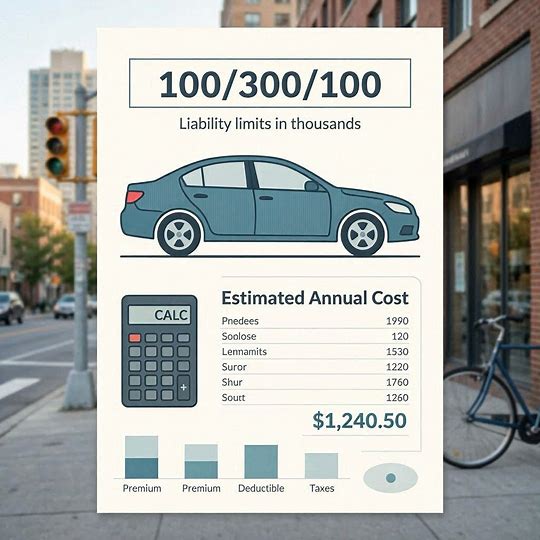
Before we talk about cost, let us make sure we understand what 100/300 actually means. You will often see this written as 100/300/100 or similar. The numbers refer to your liability coverage limits in thousands of dollars.
- 100 stands for $100,000 of bodily injury liability coverage per person. If you cause an accident, your insurance pays up to $100,000 for one individual’s medical bills, lost wages, or pain and suffering.
- 300 stands for $300,000 of bodily injury liability coverage per accident. This is the total amount your insurance will pay for all injured people in a single accident, regardless of how many people are hurt.
- 100 (the third number, if present) stands for $100,000 of property damage liability per accident. This covers damage you cause to other people’s cars, fences, buildings, or anything else you hit.
Think of it this way. The 100/300 limits act like a safety net. A larger net catches more. But a larger net also costs more to build and maintain. That is the trade-off you are making when you choose 100/300 over lower limits like 25/50 or 50/100.
Important Note for Readers: State minimum limits are often dangerously low. For example, some states only require 15/30 or 25/50. If you cause a serious accident with those limits, you could be personally responsible for tens of thousands of dollars in remaining bills. 100/300 is widely considered the first “responsible” level of coverage.
Why Choose 100/300 Instead of Lower Limits?
This is a fair question. Many drivers look at the monthly price difference and wonder, Do I really need that much coverage?
Here is the reality. Medical costs are not what they were ten years ago. A single ambulance ride can cost $1,000 or more. An emergency room visit for a broken bone often exceeds $10,000. Back surgery? Easily $50,000 to $100,000. And if an accident leads to long-term rehabilitation or permanent disability, the bills can climb past $500,000 very quickly.
Choosing 100/300 means you are protecting your future earnings, your savings, your home, and everything you have worked for. Without adequate coverage, a single accident could wipe you out financially.
That said, 100/300 is not for everyone. If you have very few assets—no home, minimal savings, and a lower income—you might consider 50/100 as a starting point. But for most working adults who own a home or have a decent nest egg, 100/300 is the smart, responsible choice.
Realistic 100/300 Insurance Cost Ranges (By Driver Profile)
Now let us get to the numbers you actually came for. Keep in mind that insurance is highly personal. Your neighbor might pay $120 per month for 100/300 while you pay $160. That does not mean someone is lying. It means your risk profiles are different.
Below is a realistic breakdown of what different types of drivers typically pay for 100/300 coverage. These figures assume full coverage (liability + comprehensive + collision) with a $500 deductible and a standard insurance company like Geico, Progressive, State Farm, or Allstate.
| Driver Profile | Monthly Cost (Approx.) | Annual Cost (Approx.) | Notes |
|---|---|---|---|
| Clean record, 30+ years old, good credit | $80 – $120 | $960 – $1,440 | Best possible rates |
| Clean record, 25-29 years old, good credit | $100 – $150 | $1,200 – $1,800 | Slightly higher due to age |
| One at-fault accident (last 3 years) | $130 – $190 | $1,560 – $2,280 | Surcharge applies |
| One speeding ticket (15+ over limit) | $120 – $170 | $1,440 – $2,040 | Minor violation |
| Young driver (18-22), clean record | $160 – $250 | $1,920 – $3,000 | High risk category |
| Driver with poor credit (500-580) | $150 – $220 | $1,800 – $2,640 | Credit affects rates heavily |
| Driver with DUI (over 3 years ago) | $180 – $300 | $2,160 – $3,600 | Varies by state |
These numbers are averages based on national data. Some states are much cheaper. Others are painfully expensive. Let us look at why.
How Location Changes Your 100/300 Insurance Cost
Where you park your car at night matters just as much as how you drive it. Insurance companies look at accident rates, theft rates, population density, and even weather patterns in your zip code.
Cheapest states for 100/300 insurance:
- Maine
- Vermont
- Ohio
- Idaho
- Wisconsin
Drivers in these states often pay 20% to 40% less than the national average. Why? Lower population density, fewer uninsured drivers, less traffic congestion, and fewer extreme weather claims.
Most expensive states for 100/300 insurance:
- Florida
- Michigan
- Louisiana
- New York (especially NYC)
- California (especially LA and SF)
In these states, monthly costs can easily exceed $200 or even $300 for the same 100/300 coverage. Florida and Michigan have unique no-fault laws that drive up medical payments. Louisiana has high lawsuit rates. Large cities mean more accidents and more expensive claims.
Real Talk: If you live in a high-cost state, do not blame yourself. You are playing a different game. Focus on the factors you can control, like your driving record, credit score, and deductible choices.
Factors That Influence Your 100/300 Insurance Cost (Beyond Your Control)
Some cost factors are completely out of your hands. Understanding them helps you stop feeling frustrated and start making better decisions.
Your Age and Gender (Yes, It Still Matters)
Statistics do not lie. Young male drivers under 25 file more and costlier claims than any other group. That is why a 20-year-old man often pays twice as much as a 40-year-old woman for identical 100/300 coverage. After age 25, rates start to drop. After age 30, the gap between genders narrows significantly.
Your Vehicle
A 2024 Ford F-150 costs less to insure than a 2024 Dodge Charger SRT. Sports cars, luxury vehicles, and cars with high theft rates carry higher liability costs because they are involved in more severe accidents. Safe, boring cars get safe, boring insurance rates.
Your Credit Score (In Most States)
Unless you live in California, Hawaii, Massachusetts, or Michigan, your credit score directly affects your insurance premium. Drivers with excellent credit (750+) often pay 30% to 50% less than drivers with poor credit (under 580). This is controversial, but it is the reality of modern insurance pricing.
Your Annual Mileage
Driving 5,000 miles per year is safer than driving 20,000 miles per year. More miles on the road mean more chances for an accident. Insurance companies ask about your commute and annual mileage for a reason. Driving less saves you money.
How to Lower Your 100/300 Insurance Cost (Practical Steps)
You have more control than you think. These seven strategies can reduce your premium by 15% to 40% without lowering your coverage limits.
1. Bundle Your Policies
This is the lowest hanging fruit. Most major insurers give you a 10% to 25% discount for having both your car and home insurance with them. Renters insurance counts too. If you have a motorcycle, boat, or umbrella policy, bundle everything.
2. Raise Your Deductible
A deductible is what you pay out of pocket before insurance kicks in for comprehensive or collision claims. Raising your deductible from $500 to $1,000 can lower your premium by 10% to 20%. Just make sure you actually have $1,000 in savings. Do not set a deductible you cannot afford to pay tomorrow.
3. Ask About Every Discount
Insurance companies do not automatically give you every discount you qualify for. You have to ask. Common discounts include:
- Good driver discount (3+ years accident-free)
- Good student discount (B average or higher for drivers under 25)
- Defensive driving course discount (5% to 10%)
- Low mileage discount (under 10,000 miles per year)
- Paid-in-full discount (5% to 15% for paying annually)
- Paperless discount (small but free money)
- Affinity discount (alumni groups, professional organizations, employers)
4. Improve Your Credit Score
This takes time, but it works. Pay your bills on time. Reduce your credit card balances. Dispute errors on your credit report. Even a 50-point improvement can save you hundreds of dollars per year on insurance.
5. Drive Safely for Three Years
Most accidents and tickets fall off your record after three years. If you had a bad stretch, patience is your best friend. Drive carefully. Use a driving monitoring app if your insurer offers one (like Snapshot or Drivewise). Good habits pay off.
6. Compare Quotes Every Six Months
Loyalty does not pay in car insurance. Companies raise rates on existing customers gradually because they know many people will not switch. Set a calendar reminder for every six months. Spend 30 minutes getting new quotes. Switching can save you 20% or more instantly.
7. Consider Usage-Based Insurance (UBI)
Programs like Progressive Snapshot, Allstate Drivewise, or State Farm Drive Safe & Save track your actual driving behavior. If you drive smoothly, avoid hard braking, and stay off the road late at night, you can earn discounts of 10% to 30%. Just be aware that very aggressive driving could raise your rate.
100/300 vs. Other Coverage Levels: Cost Comparison
Seeing the price difference between coverage levels helps you make an informed decision. Below is a realistic comparison for a typical 35-year-old driver with a clean record and good credit.
| Coverage Level | Monthly Cost | Annual Cost | Savings vs. 100/300 |
|---|---|---|---|
| State Minimum (25/50 or similar) | $50 – $80 | $600 – $960 | Save $30–$70/month |
| 50/100 | $65 – $100 | $780 – $1,200 | Save $15–$50/month |
| 100/300 | $80 – $120 | $960 – $1,440 | Baseline |
| 250/500 | $110 – $170 | $1,320 – $2,040 | +$30–$50/month |
| 500/1,000 (with umbrella) | $140 – $220 | $1,680 – $2,640 | +$60–$100/month |
As you can see, moving from state minimum to 100/300 might cost an extra $30 to $50 per month. That is roughly one or two restaurant meals. For that small amount, you gain $275,000 in additional liability protection. That is an incredible value.
When 100/300 Might Not Be Enough
Here is an uncomfortable truth. Even 100/300 can fall short in a catastrophic accident.
Imagine this scenario. You are driving on the highway and accidentally rear-end a minivan at high speed. Four people are inside. One passenger suffers a severe spinal cord injury requiring surgery, rehabilitation, and lifelong care. Total medical bills: $450,000. Another passenger breaks both legs: $85,000. Two others have whiplash and minor injuries: $20,000 each.
Your 100/300 coverage pays $100,000 to the first passenger, $85,000 to the second, and $15,000 total to the last two. That exhausts your $300,000 per-accident limit. The remaining $350,000 is your personal responsibility.
This is where an umbrella insurance policy becomes essential.
An umbrella policy sits on top of your auto and home insurance. It typically costs $150 to $400 per year for $1 million in additional coverage. But here is the catch. To buy an umbrella, most insurers require you to carry at least 100/300 on your auto policy.
So think of 100/300 as the entry ticket to umbrella coverage. If you have significant assets or future income potential, adding a $1 million umbrella policy is one of the smartest financial moves you can make.
Important Note for Readers: An umbrella policy does not replace 100/300. It extends it. You must maintain your underlying 100/300 limits, and the umbrella pays only after those limits are exhausted.
Real Examples of 100/300 Insurance Cost by Company
Every insurance company uses its own secret formula. The company that gives your friend the best rate might be the worst option for you. That said, here are typical price ranges for 100/300 coverage across major national insurers. These assume a 35-year-old driver with a clean record and good credit in a mid-cost state like Ohio or North Carolina.
| Insurance Company | Typical Monthly Cost (100/300) | Customer Service Rating | Best For |
|---|---|---|---|
| Geico | $85 – $130 | ★★★★☆ | Tech-savvy drivers, low mileage |
| Progressive | $90 – $140 | ★★★★☆ | Drivers with accidents or tickets |
| State Farm | $95 – $150 | ★★★★★ | Bundling with home insurance |
| Allstate | $100 – $160 | ★★★☆☆ | Young drivers (good student discount) |
| USAA | $75 – $115 | ★★★★★ | Military members and families |
| Farmers | $105 – $170 | ★★★☆☆ | High-limit umbrella bundling |
| Nationwide | $90 – $145 | ★★★★☆ | Low mileage and telematics |
Do not take this table as gospel. Your actual rate could be 20% higher or lower depending on your zip code, vehicle, and personal history. The only way to know your true cost is to get personalized quotes.
How to Get an Accurate Quote for 100/300 Insurance
Getting an accurate quote is easier than you think. Follow these steps to avoid surprises.
Step 1: Gather your information.
You will need your driver’s license number, vehicle VIN numbers, current policy declarations page, and an estimate of your annual mileage.
Step 2: Use the same coverage limits everywhere.
When comparing quotes, always ask for 100/300/100 with a $500 comprehensive and collision deductible. If one quote uses a $1,000 deductible, it will look cheaper but it is not a fair comparison.
Step 3: Check at least three companies.
Do not stop at one quote. Try a mix of direct insurers (Geico, Progressive) and traditional agents (State Farm, Allstate, local mutual companies).
Step 4: Ask about all discounts before the quote.
Say this out loud: “Can you please make sure I am getting every discount I qualify for, including bundling, good driver, good student, low mileage, and defensive driving?”
Step 5: Review the quote carefully.
Make sure the liability limits are correct. Some shady agents will quote you lower limits to make the price look better. Confirm 100/300 in writing before you buy.
Common Mistakes That Inflate Your 100/300 Insurance Cost
Avoid these errors and you will pay less for the exact same coverage.
Mistake #1: Staying with the Same Company for Years
Loyalty discounts are real, but they rarely keep pace with new customer discounts. A person who switches every two years often pays 15% less than a person who stays with one company for ten years.
Mistake #2: Paying Monthly
Paying monthly adds service fees of $3 to $10 per month. That is $36 to $120 per year for nothing. If you can afford to pay your entire six-month or annual premium upfront, do it.
Mistake #3: Ignoring Your Credit Score
As mentioned earlier, poor credit can double your rate. If your credit has improved since you last checked, ask your insurer to re-evaluate. Some companies will lower your rate immediately.
Mistake #4: Overlooking the “Named Driver” Rule
If you live with someone who has a bad driving record but you never let them drive your car, ask your insurer about an excluded driver endorsement. This removes them from your policy entirely, which can lower your rate significantly. Just be very sure they never drive your car. If they do and cause an accident, you will have no coverage.
Frequently Asked Questions About 100/300 Insurance Cost
Is 100/300 worth the extra money?
Yes, for most drivers. The difference between state minimum and 100/300 is often $30 to $50 per month. That small investment protects you from financial ruin. If you own a home, have savings, or plan to earn a good income in the future, 100/300 is worth every penny.
Does 100/300 cover my own injuries?
No. Bodily injury liability (the 100/300 part) only covers people you hurt in an accident you caused. To cover your own injuries, you need:
- Personal Injury Protection (PIP) in no-fault states
- Medical Payments (MedPay)
- Health insurance
How much is 100/300 insurance for a new driver?
Young drivers pay significantly more. A 18-year-old with a clean record might pay $200 to $350 per month for 100/300. Adding them to a parent’s policy is almost always cheaper than buying a separate policy.
Can I get 100/300 with a DUI?
Yes, but it will be expensive. Most standard insurers will still offer 100/300 after a DUI, but your rate could double or triple. Expect to pay $200 to $400 per month for three to five years. After that, the DUI falls off your record and rates drop significantly.
What is the difference between 100/300 and 250/500?
250/500 provides $250,000 per person and $500,000 per accident. It typically costs $30 to $50 more per month than 100/300. Most people do not need 250/500 unless they have substantial assets (over $500,000) or a high-risk profession that makes them a lawsuit target.
Does 100/300 cover uninsured motorists?
No. Uninsured/underinsured motorist coverage (UM/UIM) is separate. In fact, you should carry UM/UIM limits that match your liability limits. If someone with no insurance hits you and causes $150,000 in medical bills, your UM coverage pays. Many experts recommend carrying 100/300 for UM/UIM as well.
How often should I shop for 100/300 insurance?
Every six months. Insurance rates change constantly. Set a reminder on your phone. Spend one hour getting quotes twice per year. The savings add up fast.
Additional Resource: Free Tools to Compare 100/300 Insurance
For an unbiased, side-by-side comparison of 100/300 rates across multiple insurers, use a trusted independent aggregator. These tools do not sell insurance themselves, but they show you real-time quotes from several companies at once.
Recommended resource: The National Association of Insurance Commissioners (NAIC) provides a free consumer guide to comparing auto insurance rates state by state. Visit NAIC.org and search for “auto insurance consumer guide” to find average rates in your specific zip code.
For personalized quotes without spammy sales calls, try a site like The Zebra or Insurance.com. Enter your information once and receive multiple quotes. Just use a temporary email address if you want to avoid follow-up marketing.
Conclusion: Your Next Step Toward Affordable 100/300 Coverage
The 100/300 insurance cost is more affordable than most people think. Most drivers pay between $80 and $120 per month for this responsible level of liability protection. That is a small price to pay for peace of mind and real financial security.
Your actual rate depends on factors you can control (driving record, credit, deductible) and factors you cannot (age, location, vehicle). Focus on what you can change. Shop every six months. Bundle your policies. Raise your deductible. Improve your credit. These small actions add up to real savings.
Remember: the cheapest insurance is not always the best insurance. Saving $30 per month on state minimum coverage is a terrible deal if an accident leaves you $200,000 in debt. 100/300 is the sweet spot for most drivers—affordable enough for a monthly budget but strong enough to protect everything you have worked for.
Get your quotes today. Compare three companies. Ask about every discount. And drive safely out there.
Disclaimer: This article provides general educational information about insurance costs and does not constitute professional financial or legal advice. Insurance rates, laws, and regulations vary significantly by state and change over time. Always consult a licensed insurance agent in your state for personalized advice based on your specific situation. The author and publisher are not responsible for any decisions you make based on this content.